Use natural units and conformal time . The conformal Hubble parameter is . For the barotropic equation of state , the Friedmann acceleration equation givesThe Friedmann equation gives . Hence the constant-equation-of-state conformal Riccati equation isFor , separation and integration of this Riccati equation yield, after choosing the origin of conformal time,The open positive-energy density branch uses the hyperbolic cotangent, rather than the cotangent. Integrating giveswhere the positive constants are fixed by the energy density normalization. These formulas apply on branches where the bases are positive. For , take the Big Bang at . The cosmic time is thenThe integrals also give the general answer after selecting a suitable reference time when a finite Big Bang endpoint does not exist. The exceptional coasting fluid has , so is constant: and . If , instead and . A flat fluid with is the constant-density de Sitter spacetime case, for which the flat time integral is logarithmic.
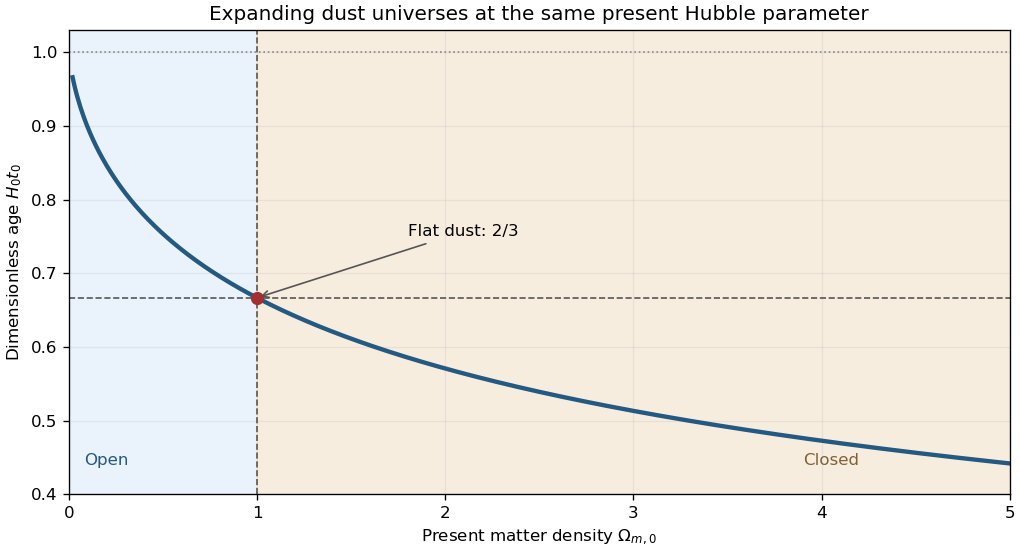
During matter domination, and . Absorbing numerical factors into separate positive constants gives the closed matter-dominated Friedmann solution, the flat Einstein-de Sitter universe and the open matter-dominated Friedmann solution:To compare the age of a dust universe without a cosmological constant, specify the normalization. At fixed present Hubble parameter , with and present matter cosmological density parameter , the Friedmann equation givesThe integrand decreases strictly with for . Therefore age ordering of dust universes at fixed Hubble parameter gives, on the expanding branches,The final bound is approached by the empty Milne universe. This compares models with the same ; fixing instead the present scale factor and energy density gives a different comparison.

The baryon asymmetry is an excess of net baryon number over zero, conveniently measured by . Ordinary matter contains abundant baryons, whereas no comparable primordial antibaryon population is observed. Large nearby domains of matter and antimatter would produce radiation through particle-antiparticle annihilation at their boundaries. Antiparticles produced in energetic collisions are not evidence for a cosmological antimatter domain. The small nonzero baryon-to-photon ratio inferred from Big Bang nucleosynthesis is independently tested by baryon-density consistency between nucleosynthesis and the microwave background.
Starting with zero net baryon number, the Sakharov conditions require baryon-number violation, C and CP violation, and departure from thermal equilibrium. Conservation of baryon number would keep the initial value zero. C symmetry or CP symmetry would pair baryon production with equal antibaryon production; CP rate cancellation in baryogenesis explains why C violation alone does not suffice. In thermal equilibrium with zero imposed charge chemical potentials, CPT symmetry forbids the required net baryon number. An asymmetric rate in one reaction must not be mistaken for net production after all reverse reactions are included.
A simple example is heavy-boson decay baryogenesis. Take equally many heavy bosons and their antiparticles, with decay channelsThe symbols in parentheses are branching fractions. The two channels carry baryon numbers and , so both cannot conserve one assigned baryon number for . Their mean baryon number is , while the mean for is . Consequently,where is the asymmetry per decaying particle. CP violation permits without violating the equality of total decay widths required by CPT symmetry. Microscopically a direct CP asymmetry requires interference between decay amplitudes with both relative weak phases and absorptive phases; specifying complex couplings alone would not establish unequal partial decay widths.
For radiation domination, a sufficient decay condition is . The heavy population can then survive as the equilibrium abundance drops, before decaying while inverse production is suppressed. Its actual abundance differs from its thermal equilibrium value. If subsequent baryon-number washout is negligible and cosmological entropy conservation holds, an initial total abundance producesHere is the entropy density. Residual baryon-number washout multiplies this expression by an efficiency factor below one. The example realizes all three Sakharov conditions; it illustrates a mechanism, rather than identifying the actual cosmological source of the baryon asymmetry.
At neutrino decoupling, the interaction rate is comparable with the Hubble parameter. Equating the supplied rates givesHere the Planck mass is the unreduced in natural units, , and the effective number of relativistic energy degrees of freedom is . The supplied rate gives an order-of-magnitude neutrino decoupling estimate; a precise neutron-proton conversion temperature uses its own weak-rate coefficients.
The chemical equilibrium condition for is . With negligible lepton chemical potentials, . The nonrelativistic Maxwell--Boltzmann number density therefore givesbecause and the small mass difference can be neglected in the prefactor. This is the neutron-proton chemical equilibrium relation.
For the deuterium equilibrium abundance, because photons have zero chemical potential. The sign convention in the paper is important: , while the positive nuclear binding energy is . Using spin multiplicities , givesWith , , and photon number density , this becomesHere is a number fraction; the fraction of baryons bound in deuterium is . The formula estimates the onset of the deuterium bottleneck opening while depletion of free neutrons and protons remains small. Because , stable deuterium becomes abundant only far below the positive nuclear binding energy, not simply at .
Let denote cosmological weak freeze-out of the neutron-to-proton ratio, , and let mark efficient nuclear burning. Free-neutron decay after freeze-out givesAlmost every surviving neutron enters helium-4, whose atomic nucleus contains two neutrons and four baryons. Thus neutron-limited helium synthesis givesA longer neutron half-life leaves more neutrons available, increasing the primordial helium mass fraction. If the longer lifetime reflects weaker weak interactions, the accompanying earlier cosmological weak freeze-out can reinforce that effect.
During radiation domination, whereas the weak conversion rate is proportional to . Hence . Increasing the effective number of relativistic energy degrees of freedom raises , increasing , and shortens the interval for free-neutron decay after freeze-out. Both increase the primordial helium mass fraction while nuclear burning remains efficient. The same reasoning gives the primordial helium response to a varying gravitational constant: larger over this interval produces more helium, with fixed microscopic rates and the approximate Friedmann equation unchanged. Smaller has the opposite effect. A particular varying- model must specify its background expansion and time history; the simple trend must not be extrapolated to changes so large that nuclear burning itself fails.
Cosmic inflation addresses the horizon problem by extending the causal past of the observed region, the flatness problem by damping the curvature contribution, and the cosmological monopole problem by diluting unwanted relics. A canonical inflaton can drive this expansion when its potential energy density exceeds twice its kinetic energy density.
Use the unreduced Planck mass , consistent with the coefficient in the Friedmann equation, and take , . Seek the exponential-potential power-law inflation solution and . The kinetic energy density is proportional to . The inflaton potential must have the same scaling, soSubstitution into the inflaton equation of motion givesThe Friedmann equation now reduces toConsequently the nontrivial positive-potential solution isA positive requires . Accelerating expansion occurs exactly for , givingThis is an exact solution, not a use of the slow-roll approximation. The first Hubble slow-roll parameter and equation-of-state parameter are constant:If the reduced Planck mass is used instead, the dimensionless exponential slope is and the exponent becomes ; these are the same solution.
For , the comoving Hubble radius decreases as . A region initially in causal contact can grow beyond that radius before the hot radiation-dominated universe begins. In the ideal power law extrapolated all the way to , the particle horizon integral diverges, so the solution has no finite past particle horizon. A finite, physically trustworthy inflationary interval instead requires a sufficiently large number of e-folds to enlarge an initially causal patch.
For a small curvature contribution, the Friedmann equation gives , solving the flatness problem. Conserved nonrelativistic magnetic monopoles have number density proportional to , while the inflaton energy density is proportional to ; their energy-density ratio therefore falls as . This gives the required dilution, provided later reheating does not recreate them. Inflationary shear damping similarly suppresses anisotropic expansion.
The main failure is no automatic graceful exit or reheating. The first Hubble slow-roll parameter never reaches one, and the exponential inflaton potential has no finite minimum about which the field can oscillate. Additional dynamics are needed for a graceful exit from inflation and transfer to a hot radiation-dominated universe. The ideal solution also retains a curvature singularity at ; solving the horizon problem does not itself explain the beginning of the universe. For , the constant inflaton potential instead permits constant-field de Sitter spacetime expansion; the logarithmic field solution is inapplicable.
Articles by others on the same topic
There are currently no matching articles.