Write for the material derivative and for the cross-helicity density, so . The ideal magnetohydrodynamic induction equation of ideal magnetohydrodynamics, with , givesThe dot product of the Euler momentum equation with the magnetic field has no Lorentz force contribution, because . Consequently,Here is the specific enthalpy, the temperature, and the specific entropy; is the internal energy per unit mass. The first law of thermodynamics in this convention is , so . Substitution, followed by , yields the cross-helicity conservation lawThe vector triple product identity puts this in the equivalent form
For the fixed volume, the divergence theorem gives the exact cross-helicity balanceThus cross-helicity is constant when the net source equals the outward flux. Simple sufficient hypotheses are throughout the volume and on its boundary. The first condition includes a homentropic flow; the second prevents both relevant boundary fluxes. Periodic boundary conditions, or sufficiently rapid decay at infinity, provide alternatives. These statements concern smooth ideal magnetohydrodynamics: material specific entropy conservation alone, , does not eliminate spatial specific entropy gradients along the magnetic field lines.
Let the constant mass density be and put , the Alfvén velocity. Since both the velocity and the magnetic field have zero divergence, the magnetic tension and magnetic pressure decomposition of the Lorentz force givesThe Newtonian gravitational potential remains in ; uniform mass density does not justify dropping a prescribed gravitational acceleration. Adding and subtracting the two equations proves the Elsässer variable equationsHere ; each Elsässer variable is transported by the other.
Define . Taking the dot product with gives the Elsässer energy invariant balanceThe divergence theorem proves whenever the net boundary flux vanishes. In particular, makes , so both fluxes vanish pointwise. Periodic boundary conditions or decay at infinity are also sufficient. These boundary conditions matter: fixed volume alone gives no conservation.
The kinetic energy plus magnetic energy isExpanding and using the cross-helicity definition yieldsBoth energy and cross-helicity therefore follow from the two Elsässer energy invariants. The quantity here is exactly the requested kinetic energy plus magnetic energy, without an additional gravitational term.
Use for the radial speed and distinguish the central mass from the Mach number . In each smooth nonzero-flow region, mass conservation, the adiabatic equation of state, and the Bernoulli equation giveHere is constant on a smooth isentropic flow branch, is the adiabatic sound speed, and is the Bernoulli function. Either sign of is possible. The positive-radius nondimensionalization in the question requires ; flows with do not have these positive and require another scaling.
Indeed, the supplied adiabatic process equations give , so is spatially constant along a steady nonzero radial fluid flow. The adiabatic sound speed is , and the specific enthalpy is . The radial Euler momentum equation, , integrates to because on this isentropic flow branch.
Put . Eliminating the mass density from the continuity equation givesWith , the Bernoulli equation becomesTherefore the physical constants of the spherical polytropic flow with adiabatic exponent three halves are
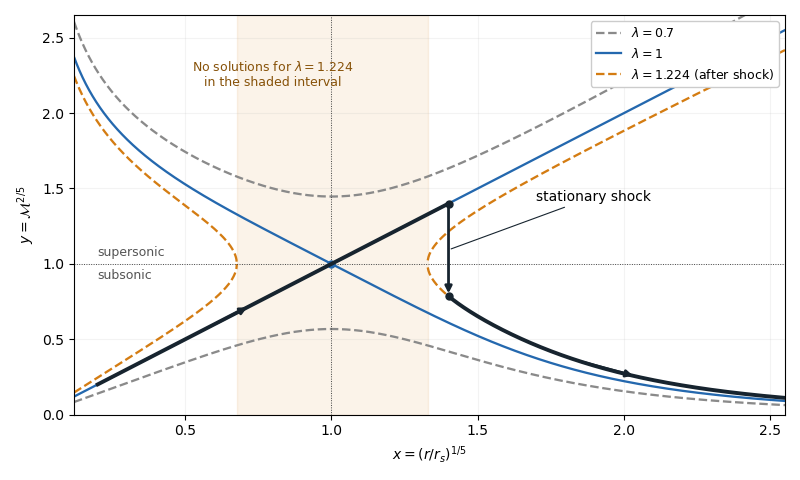
For , , so decreases from infinity to its unique minimum , then increases to infinity. This completely determines the algebraic curves. For , there are two disconnected branches at every , one subsonic flow with and one supersonic flow with . For , the line and a decreasing branch meet at . Their slopes are and , since the leading expansion is . For , solutions exist only where : if solve , there is a forbidden interval . At either endpoint the two branches turn at and have an infinite slope.
A smooth sonic point needs ; hence a regular sonic transition requires and . The critical speed of a polytropic flow is then , and the allowed mass flux is . Here the subscript on denotes evaluation at the sonic point, rather than the isothermal sound speed convention used in the next solution.
The simple transonic branch is . Direct substitution givesThus the radial velocity has constant magnitude, while the mass density and pressure scale as and . For an outward fluid flow, this is a subsonic flow becoming a supersonic flow as its adiabatic sound speed decreases.
On the other transonic branch, decreases as increases. At large , the terms and dominate, giving . At small , the terms and dominate, giving . The resulting asymptotic expansions areFor inward fluid flow, these are the nearly static reservoir at infinity and the inner free fall region of Bondi accretion. The specific enthalpy is smaller than in the inner limit, which explains free fall. Reversing the radial velocity gives a decelerating outflow with the same profiles. The formal small- limit describes the point-mass model: if the spherical gravitating body has a finite surface, the exterior solution stops there.
A stationary, nonradiative normal shock wave conserves the mass flux and the sum , while the Newtonian gravitational potential is continuous across its thin layer. Hence and are unchanged. The entropy production in a perfect-gas shock increases , soMore explicitly, the Rankine-Hugoniot condition for gives, with upstream ,Thus the shock wave jumps vertically, at the same , from the supersonic flow to a subsonic flow on a larger- curve. The figure illustrates an outward flow on with a shock wave at ; the downstream subsonic flow has and continues to larger . The shock wave radius is an additional boundary-data choice, rather than being determined by the smooth equations alone.

Write for the constant isothermal sound speed squared and for the constant Alfvén speed squared. The horizontal magnetic field has no vertical magnetic tension; magnetostatic equilibrium isConsequently the magnetized isothermal atmosphere hasThe sign of specifies the orientation of the magnetic field. The adiabatic sound speed is , also constant.
For the proposed normal mode, let , , and temporarily write for its constant complex amplitude. The divergence amplitude is . Using and , the Eulerian and Lagrangian fluid perturbations giveSince , the magnetohydrodynamic total pressure amplitude isThe vertical derivative of is . For the magnetic tension perturbation, the terms proportional to from and cancel, leavingThus the linearization really reduces to the constant-coefficient eigenvalue problem
For a static ideal magnetohydrodynamics equilibrium with conservative gravitational acceleration, the magnetohydrodynamic energy principle gives a Hermitian operator for the restoring force in the mass density weighted inner product, provided the surface terms vanish. The factor removes the exponential mass density weight. This can be checked directly, without assuming stability: set , , and . Then , whereThis is a Hermitian matrix for real and real positive . Therefore every squared frequency is real; negative values give exponential growth, rather than an oscillation with a complex squared frequency. In an infinite atmosphere these are generalized plane waves, not finite-total-energy global modes.
At and , the equation, after cancelling its magnetic terms, gives . For nonzero magnetic field, the equation also gives . Substituting and then yieldsFor a nontrivial mode ; otherwise these equations and force every component to vanish. Substitution in the vertical equation givesFor example, the determinant provides an independent check:
To prove the claimed “if and only if”, rather than merely locating a zero eigenvalue, use the magnetic buoyancy energy criterionIf , every term is nonnegative, so all eigenvalues are nonnegative for every wavevector, including . If , choose , any fixed , and , , . The first two squares vanish; the remaining value iswhich is negative for sufficiently small nonzero . The Rayleigh quotient of this displacement is therefore negative, proving a negative eigenvalue and an unstable normal mode. This uses precisely the assumption that boundary conditions do not exclude the chosen wavelengths. Equality is a neutral threshold, not exponential growth.
Finally the plasma beta is . HenceThe magnetic field is assumed nonzero in the marginal-mode elimination and in the finite expression. The positive-sound-speed, nonmagnetic limit remains covered by the energy identity; for the usual it is stable. Parker instability occurs because magnetic pressure supports part of the atmosphere's weight while the gas can drain along gently bent magnetic field lines. The resulting buoyant displacement can release Newtonian gravitational potential energy; choosing long wavelengths along the magnetic field makes the stabilizing magnetic tension small. The completed-square calculation quantifies this competition, including the adiabatic process restoring force.
Let the free surface be at and take the Newtonian gravitational potential to vanish at infinity. Mass conservation fixes . The enclosed mass is , and hydrostatic equilibrium requires . With vacuum outside, , givingThe pressure is zero outside. A prescribed constant external pressure would simply add that constant to .
The bulk Eulerian and Lagrangian fluid perturbations obey because the mass density is uniform and the Lagrangian displacement has zero divergence. The linearized Euler momentum equation in the interior isTaking the curl gives . Thus every nonzero-frequency normal mode has an irrotational flow displacement; the simply connected space formed by the interior admits and incompressibility gives the Laplace equation . For a regular center, one spherical harmonic component is , with .
It is essential to retain the surface gravity perturbation of a uniform-density sphere. Although the bulk mass density perturbation is zero, the displaced density discontinuity givesThe Poisson equation implies that is continuous and its outward radial derivative has the jumpUsing regularity at the center and decay at infinity, writeThe derivative jump is , so .
Integrating the bulk Euler momentum equation gives for . At the free surface the Lagrangian pressure perturbation vanishes:Combining these relations yields the Kelvin stellar mode frequencyThe choices of are degenerate because of spherical symmetry. For , is a linear combination of coordinates in a Cartesian coordinate system, so is a constant displacement: the zero frequency is rigid translation of the whole isolated body. Such a translation has no restoring force. The constant potential generates no displacement; a radial breathing motion is excluded by incompressibility and a regular center.
The printed irrotational assertion needs the nonzero-frequency qualification, or restriction to the potential incompressible stellar surface modes. It is false for all neutral displacements: has zero divergence, zero normal displacement at the surface, and , so it is a zero-frequency displacement, but . This does not change the Kelvin stellar mode spectrum just derived.
The separation of the two bodies is , as is fixed by the supplied Kepler third law . The phrase “orbit of radius ” cannot denote the first body's distance from the center of mass in that formula.
Expand the companion's Newtonian potential of a point mass about the first body's center. The constant term produces no force; the linear term produces the uniform acceleration of the center and disappears in the translating frame. The leading differential acceleration therefore comes from the quadrupolar tidal forcingwhere points toward the companion. It is a degree-two solid spherical harmonic. For a circular nonrotating-frame orbit, its time-dependent components have and frequency , because the squared direction cosines repeat twice per orbit. There is also a static component. The real part of one complex harmonic represents the pair of time-dependent components; its normalization and orientation are absorbed into the order-one coefficient . This gives and . The expansion is the leading term for small; spin is being neglected.
For a forced potential flow with the same temporal frequency, the Euler momentum equation becomesUse . The surface gravity perturbation of a uniform-density sphere is unchanged, as is the vanishing Lagrangian pressure perturbation boundary condition. Integrating the equation and applying that condition givesSince , the real surface displacement isIndeed , so the normalization is consistent. This is a particular forced response away from the resonance; arbitrary free normal modes can be added.
Put and . The tidal resonance of a stellar oscillation condition is , henceThe resonance gives for finite nonnegative , with actual forcing requiring . At exact resonance the undamped linearization has no bounded response at the forcing frequency: the time-domain particular solution grows proportionally to times a sinusoid. Thus the frequency-response formula has a pole, rather than describing a finite resonant displacement. Away from that pole, linearization requires the displayed surface displacement to be small compared with ; the leading quadrupolar tidal forcing approximation separately requires small.
Articles by others on the same topic
There are currently no matching articles.