Work in an inertial frame centred on the centre of mass, and follow a fixed material mass, with no stellar wind or accretion through its boundary. Assume nonrelativistic motion, Newtonian self-gravity, no external gravitational field, and sufficiently regular integrable fields. DefineHere is the scalar second mass moment, rather than a moment of inertia about one axis. The kinetic energy measures resolved internal motions relative to the centre of mass; random microscopic motion contributes to pressure and internal energy, and must not be counted again in .
The paper's symmetric compressive tensor is minus the tensile stress tensor, so its force per unit volume is . Differentiating the material integral twice and substituting the equation of motion givesIntegration by parts and the divergence theorem turn the stress contribution intoFor the requested scalar stellar virial theorem, assume isotropic pressure, , with uniform surface pressure . Then and the surface integral is . No spherical shape is needed for this step.
Finally, symmetrizing the pair integral for the Newtonian gravitational potential givesThereforeAnisotropic magnetic or viscous stresses retain their full trace and boundary terms; a changing integration mass adds transport terms.
For an ideal gas with constant specific-heat ratio , the specific internal energy is and . HenceThe stellar virial theorem consequently reads . For a static nonrotating star with negligible surface pressure, , so .
Fully ionized nonrelativistic ions and electrons form a monatomic ideal gas, with , provided electron degeneracy pressure and radiation pressure are negligible. ThusBeing steady alone does not eliminate rotation or other macroscopic kinetic energy; those are additional assumptions needed for this relation.
Consider a spherical stellar polytrope with , constant , , zero surface pressure and finite radius . Its specific enthalpy, measured from zero density, is . Hydrostatic equilibrium gives . Integrating over mass therefore yieldsThe static stellar virial theorem gives , and eliminating the pressure integral proves the gravitational energy of a stellar polytrope:For an ideal gas with constant specific-heat ratio, the accompanying internal energy isTo express both energies using alone one additionally identifies the model as an adiabatic stellar polytrope, so . ThenFor these become and . A general polytropic index need not be determined by the thermodynamic specific-heat ratio; without the adiabatic identification both and remain.
In the thin radiative envelope, take enclosed mass , luminosity , and constant mean molecular weight . Combining radiative diffusion in a star with the hydrostatic pressure support equation givesThe ideal gas relation is , where , so the opacity law impliesHere is the radiation constant, distinct from the exponent . Since , separation gives . With photospheric , the power-law opacity radiative envelope therefore hasThis expression assumes and a positive bracket on the physical branch. If , replace by ; if , the integrated relation is , with the same logarithmic limit when .
At the photosphere, use the stated boundary pressure and the effective temperature relation . The radiation constant obeys by the Stefan–Boltzmann law. Substitution into the radiative temperature gradient givesThis uses the approximate stellar surface boundary condition at optical depth ; it is not a universal photospheric gradient for arbitrary atmospheres.
For negative hydrogen ion opacity, and , so the exponents of the power-law opacity radiative envelope are and . Dividing the integrated pressure relation by givesSince and ,It starts below the monatomic adiabatic temperature gradient and rises as the temperature increases inward.
For a monatomic ideal gas of fixed composition, the adiabatic temperature gradient is . The Schwarzschild criterion places the onset of convection atThus . The integrated power-law opacity radiative envelope also gives there: the radiative layer spans only a small pressure range below the photosphere. Its geometrical depth is of order , with a representative pressure scale height, and is small compared with the stellar radius in the assumed thin envelope.
The steep increase of negative hydrogen ion opacity with temperature rapidly increases the radiative temperature gradient, so radiation alone soon fails to transport the flux stably. Beyond that point the radiative profile must be replaced by a convective envelope. Partial ionization can lower the actual adiabatic temperature gradient and shift onset; the numerical ratio here uses the fixed- monatomic approximation.
The outward radiative flux is . A photon of energy carries momentum , so the momentum transferred per unit volume and time to matter is , when is the appropriate transport opacity. Momentum conservation makes the radiation stress decrease outward by this amount. In the thin atmosphere, where the radiation stress is treated by its scalar radiation pressure,This is the first moment of the radiative transfer equation. The grey atmosphere approximation uses a frequency-independent transport opacity; in an optically thick diffusion regime it becomes the Rosseland mean opacity. Near the surface the plane-parallel atmosphere approximation removes geometric stress-divergence corrections.
Measure optical depth inward, so and at the exterior boundary. The printed integral is shorthand with inconsistent integration labels; this differential definition fixes its meaning. In a plane-parallel atmosphere in radiative equilibrium, is constant and .
For the Eddington surface boundary condition, approximate the outgoing frequency-integrated intensity by a constant over the outward hemisphere, with no incoming radiation. The angular moments at the surface areIntegrating the moment equation then gives . The Eddington closure approximation, with local thermodynamic equilibrium and radiative equilibrium, identifies the radiation energy density with and sets . Using givesThe photosphere is represented by , where ; the exterior boundary instead has . The closure and angular boundary condition are approximations, rather than exact isotropy of radiation at the surface.
Take the gas pressure to vanish at the exterior boundary and the atmosphere to be thin enough that surface gravity of a star is constant. With constant electron-scattering opacity, negligible radiative acceleration, and hydrostatic equilibrium in optical depth,If the radiative force is retained, for gas pressure, and the same result holds with the constant positive effective gravity . A nonzero exterior gas pressure instead gives . Total gas-plus-radiation pressure has the nonzero radiative surface term from part (ii), so the advertised exact formula presumes gas pressure with zero exterior gas pressure.
The stellar adiabatic exponent is defined at fixed specific entropy and composition byCombining parts (iii) and (iv), the radiative temperature gradient of the constant-opacity grey atmosphere isFor , the adiabatic temperature gradient is strictly below , and the Schwarzschild criterion is eventually violated. If is constant, solving for the crossing givesAt the radiative gradient approaches marginality from below, so there is no finite crossing in this model. If varies, the conclusion requires its subcritical value to persist in the deep layers. Uniform composition is needed for this use of the Schwarzschild criterion; a composition gradient requires the Ledoux criterion.
Assume an isolated star of initial mass five solar masses of approximately solar stellar metallicity. Rotation, convective overshooting and mass loss change numerical ages and the extent of a blue loop, so the ages below are estimates. Take zero age at the zero-age main sequence; the pre-main-sequence star phase adds a much shorter contraction time.
The original schematic Hertzsprung-Russell diagram marks the stages discussed below. The strip denotes the approximate Cepheid instability strip; the track is illustrative, rather than a computed stellar model.
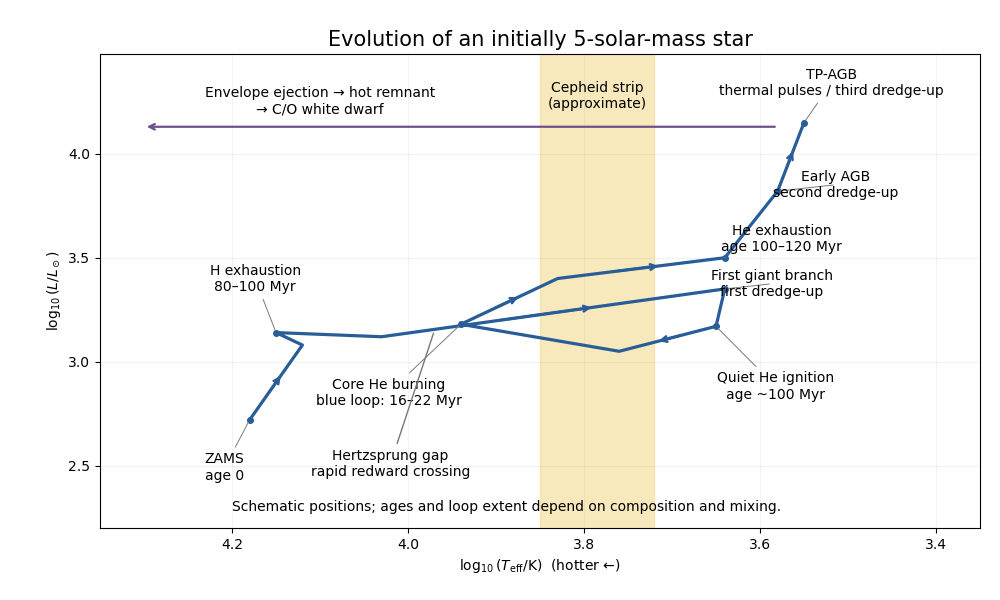

The main sequence lasts roughly – years. CNO cycle hydrogen burning is concentrated in a mixed convective core. Its declining hydrogen mass fraction and rising helium mass fraction are nearly uniform there, while the retreating core leaves a composition gradient. The unprocessed envelope remains hydrogen rich. At the terminal-age main sequence, core hydrogen is exhausted and a hydrogen-burning shell takes over.
The inert helium core grows through shell burning. The Schönberg-Chandrasekhar limit is approximatelyBeyond this limit an isothermal nondegenerate core cannot remain in thermal equilibrium with its envelope. Core contraction and envelope expansion carry the star across the Hertzsprung gap. An initial slower shell-burning interval can precede the rapid crossing; the crossing itself is governed by Kelvin-Helmholtz contraction, with a representative – years. First dredge-up then mixes hydrogen-processed material into the convective envelope, lowering its hydrogen mass fraction and increasing helium and nitrogen, while leaving a composition discontinuity where the envelope later retreats.
At an age still of order years, core helium burning begins quietly: the core is nondegenerate, so there is no helium flash. The Triple-alpha process and subsequent alpha capture build a carbon-oxygen core. Core helium burning lasts roughly – years in representative solar-composition models. Pols's stellar-evolution notes illustrate the substantial dependence of these lifetimes on convective overshooting.
During a blue loop the envelope contracts and effective temperature increases, before the star returns redward. The loop depends on core and envelope structure and the hydrogen discontinuity left by first dredge-up. A loop reaching the Cepheid instability strip produces two further crossings, blueward and redward, in addition to the earlier rapid crossing of the Hertzsprung gap. Cepheid variables pulsate through the opacity mechanism, involving helium ionization. Neither loop extent nor all three strip crossings are guaranteed for every composition or mixing prescription. The hydrogen-burning shell continues moving outward in enclosed mass while central helium is depleted. Lattanzio's five-solar-mass tutorial shows these composition changes.
After helium exhaustion, at an age roughly – years, the star ascends the Asymptotic giant branch. An inert carbon-oxygen core is surrounded by helium-rich material and a hydrogen-rich envelope. Second dredge-up mixes helium and hydrogen burning products into the envelope and reduces the hydrogen-exhausted core mass. Subsequently a helium-burning shell and hydrogen-burning shell alternate in importance. A thermal pulse of an asymptotic-giant-branch star causes intershell convection, expansion and temporary quenching of hydrogen burning; third dredge-up can carry carbon and slow neutron-capture process products outward. Between pulses hydrogen burning rebuilds the helium layer. These mechanisms are illustrated in Lattanzio's AGB tutorial.
The following original stellar composition profile sketches distinguish hydrogen exhaustion from helium exhaustion; their mass boundaries are illustrative.
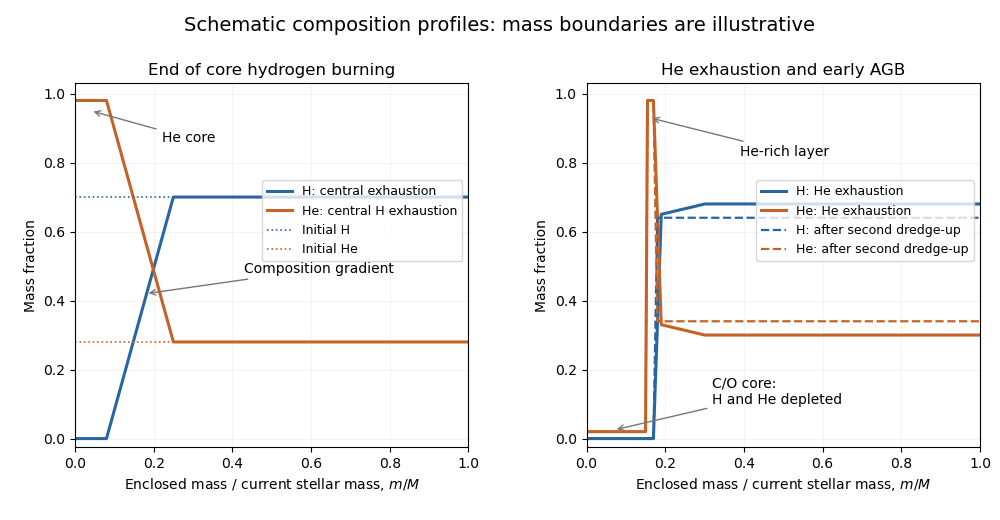
Schematic internal composition profiles during stellar evolution
. Details. 
The final giant phases add at most a few million years at this level of accuracy. Strong stellar winds remove the envelope; the hot remnant can illuminate a planetary nebula and then cool as a carbon-oxygen white dwarf. A typical remnant is of order one solar mass. The ordinary isolated case does not reach sustained carbon burning and core collapse. Thus the usual endpoint is a carbon-oxygen white dwarf, at a total age of order years, with its subsequent cooling age added separately.
Articles by others on the same topic
There are currently no matching articles.