A synthetic fluid membrane is a thin, laterally fluid sheet whose components can rearrange in its plane while the sheet resists changes of area and curvature. Synthetic amphiphiles can assemble into two opposed layers with solvent-compatible groups facing outward. Their fluid in-plane response gives no equilibrium static shear modulus, but does not imply zero membrane bending rigidity or zero area-compression modulus. A thin membrane can therefore bend easily while remaining difficult to stretch. These notes cover generic synthetic interfaces.
A convenient continuum description is the Helfrich energy, augmented by spontaneous curvature and the Gaussian term:Here and are mean curvature and Gaussian curvature, is preferred curvature, and have energy units, and is membrane tension with units . Leaflet asymmetry can favor nonzero . At fixed topology the integrated Gaussian term is constant for a closed surface by the Gauss-Bonnet theorem. A symmetric tensionless spherical sheet has mean-curvature bending energy , independent of its radius in this ideal model. Edge energy can favor closure, while fixed area and enclosed volume constrain the resulting shapes.
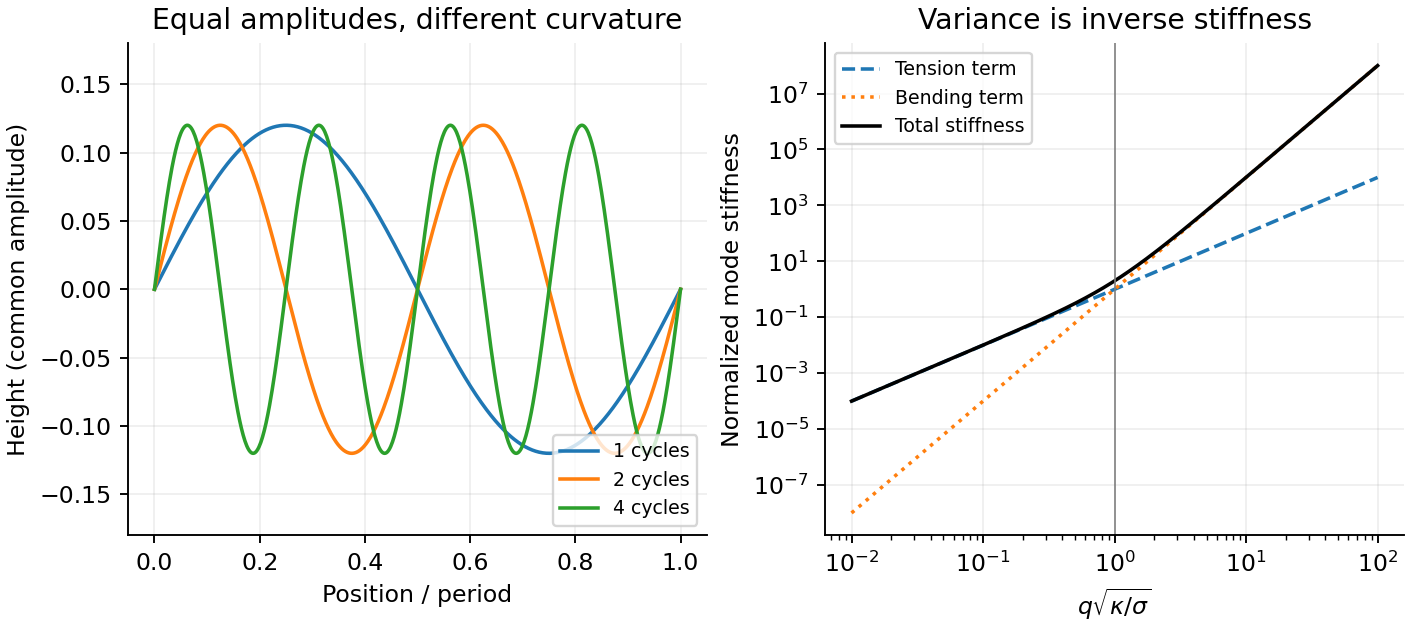
For a nearly flat sheet, its small-slope elastic membrane energy becomesWith , the equipartition theorem gives the membrane fluctuation spectrum under tension:Bending suppresses short wavelengths, whereas positive tension suppresses the longest undulations. Their crossover is . Measuring the spectrum can separate these two contributions, provided finite image resolution, projected versus true area, and external confinement are accounted for. The drawn modes below are synthetic calculations, not an image of a sample.
For a clean liquid interface at fixed temperature and composition, surface tension is the reversible free-energy cost per added area, , so . Its units are both and . Molecules at an interface have a different environment from those in the bulk; creating more interface changes their interactions and entropy. For constant , the interfacial free energy is up to a reference constant. This is not generally identical to the internal surface energy: the interfacial entropy density is , giving internal-energy density .
A line of length in one interface transmits a tangential force , perpendicular to the line. A soap film has two interfaces, giving force on a sliding rim. Quasistatic extension by creates total area , recovering that force from . Uniform positive surface tension favors minimum area at fixed volume, hence an isolated spherical droplet when gravity is negligible. curvature gives the Young–Laplace equation, with outward normal chosen consistently:A spherical liquid drop has ; a thin soap bubble with two similar interfaces has approximately . The capillary length compares gravity with capillarity. surface tension also restores capillary waves, rather than providing a bulk static shear modulus.
Interfacial contamination and added surfactants can change substantially; a nonuniform value produces tangential Marangoni stress. A rim-force measurement should therefore control temperature, cleanliness and the number of interfaces. Capillary-rise methods additionally need the contact angle, because the vertical component is proportional to . An independent frame-force measurement can distinguish a contact-angle change from a true change of surface tension.
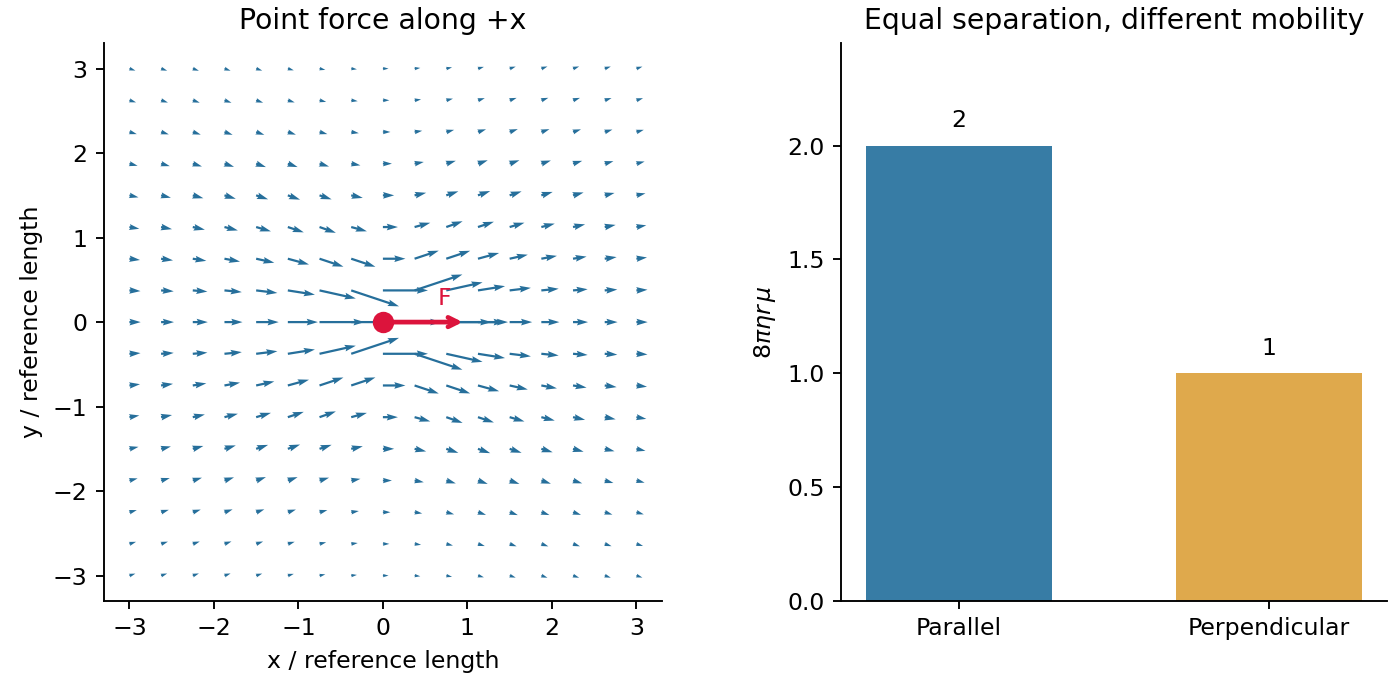
A moving or externally forced colloid disturbs the surrounding fluid, changing the velocity of other colloids even without direct contact. These hydrodynamic interactions are long-ranged at small Reynolds number. In an unbounded incompressible Newtonian liquid, the Stokes flow response to a point force is the Stokeslet:Its Oseen tensor isThis is a mobility tensor, with units velocity per force, rather than a stress tensor. At separation the response parallel to the line of centres is ; the perpendicular response is . Flow is not isotropic even though the solvent is. The disturbance decays as , so treating all drag forces as independent can miss correlated motion.
For well-separated equal spheres of radius , the leading hydrodynamic mobility matrix givesThe first term is the isolated-sphere self mobility; the remaining terms couple distinct particles. At thermal equilibrium the fluctuation-dissipation theorem also predicts correlated short-time increments, with the configuration locally fixed. Thus correlated Brownian displacements can reveal hydrodynamic coupling without an applied force.
The point-force approximation requires and negligible inertia. It diverges at the origin and cannot replace the finite self mobility. Near-contact lubrication, walls, many-body corrections, and a viscoelastic solvent require more complete mobility laws. A force-free particle can instead have a faster-decaying leading disturbance, so the claim specifically concerns a net-force-driven object.


Articles by others on the same topic
There are currently no matching articles.