Fermion occupation and ordinary metallic heat capacity. The Fermi-Dirac distribution for a single-particle state isAt low temperature it changes appreciably only in an energy window of width of order about . If the full density of states is smooth and nonzero there, only about states change population. Each excited particle or hole carries energy of order relative to the Fermi surface, so is of order . Differentiation therefore gives .
More precisely, the fixed-number Sommerfeld expansion givesHere includes all counted internal species. This argument requires and a density of states varying slowly across the thermal window; a band edge or vanishing density of states can change the power law.
Two-dimensional linear dispersion at zero chemical potential. Let count identical positive-energy branches, keeping the state-counting convention explicit. The number of wavevector states in a ring of radius is . With , this givesAt , the thermal energy of this branch isThe dimensionless integral is . Differentiating givesThis is the heat capacity for a two-dimensional linear fermion dispersion. A physical neutral particle–hole-symmetric Dirac cone also has electron holes in its filled negative-energy band. Their excitation energy gives an equal contribution, doubling for the same cone count. The scaling is unchanged. For a positive-energy-only gas, holding allows its mean particle number to vary; a neutral two-band surface instead maintains zero net excess charge as Electron–hole pairs are thermally excited. These conventions should not be conflated when specifying an exact coefficient.
Nonzero chemical potential. The ordinary metallic regime isThe thermal window then lies far from the cone tip. Since , its fractional change across that window is only of order . Treating it as locally constant restores the Sommerfeld result . When is comparable to or larger than , the window probes the vanishing density of states near the tip and crosses toward the neutral behavior, provided the linear dispersion remains valid.
Bulk phonons and the surface-to-bulk comparison. For the topological insulator model, assume bulk electronic excitations are frozen out while the conducting surface remains active. In three dimensions, acoustic phonons have a density of modes proportional to . Normalize the Debye spectrum to modes:The thermal part of the energy isAt , extending the upper integration limit to infinity introduces an exponentially small error. With and ,Temperature-independent zero-point energy makes no contribution to this heat capacity. The requested ratio consequently scales asFor a fixed shape and composition, and , so the ratio grows as . Smaller samples and lower temperatures favor the surface contribution. It dominates if the dimensionless right-hand side, including its state-counting prefactor, exceeds unity. This is the surface-electron and bulk-phonon heat-capacity crossover.
The continuum electronic law also requires a thermal energy larger than the surface finite-size level spacing, of order . The phonon continuum has its own finite-size cutoff. Therefore dominance obtained by formally taking cannot always be inferred from the two continuum power laws alone.
There is a numerical-normalization qualification in the paper. Combining the explicit one-positive-branch result above with the conventional -mode Debye normalization gives ratio prefactor ; including electron holes doubles it. For , this is approximately before that doubling, rather than the supplied . The problem specifies neither a cone/spin multiplicity that equates these nor another mode normalization. Its supplied prefactor is therefore used as the stipulated approximation for the requested numerical estimate, rather than claimed as an exact consequence of the single-branch count.
Numerical estimate. A cubic sample of volume has side . Counting the conducting surface on all six faces givesFor one atom per cubic cell of side ,Use and . Inserting the stated , and into the paper's supplied prefactor givesThus bulk phonons dominate at this temperature in this estimate. If only one face contributes, the ratio is ; if there are chemical atoms per unit cell, divide the corresponding estimate by . These geometrical and crystallographic factors are not supplied explicitly.
With the same prefactor and geometry, extrapolating would suggest equality near . However, the surface finite-size scale is already of order for this specimen. That extrapolated crossover lies outside the continuum electronic regime, so it is not a reliable prediction of the sample's ultimate lowest-temperature heat capacity.
Classical translational statistics. Write the number density as and the thermal de Broglie wavelength as . Quantum exchange is negligible when wave packets rarely overlap:The equivalent state-counting statement is that the mean occupation of each thermally relevant one-particle state is much smaller than one. The equations in this question count one internal species; with equally populated spin states the relevant density per species is .
Let be the dimensionless quantum gas fugacity, with the lowest one-particle energy chosen as zero. Both quantum distributions can be writtenIf , then for all , recovering Maxwell–Boltzmann statistics. Conversely, low occupation even at the spectrum's bottom requires for bosons or for fermions; either condition impliesA single high-energy state can be sparsely occupied even in a degenerate gas, so the condition must hold across the relevant spectrum, not just for one arbitrarily chosen energy. Also, classical translational statistics does not imply that all internal excitation energies or other quantum effects can be ignored.
Grand partition function, density and pressure. Noninteracting particles have independent occupations of each one-particle state. Put . Summing the allowed occupations givesThereforeThe grand potential is for this homogeneous gas. Replacing the sum by and using givesThe mean number is , givingFor bosons, the grand sum requires when the ground energy is zero. A macroscopic condensate at the limiting must be separated from the continuum integral in the condensed phase. The following small- calculation is in the normal, nondegenerate regime, so that complication does not enter.
Density expansion and inversion. Expand the occupation as a geometric series:The Gaussian wavevector integral for its th term isIt follows thatFor the inverse series, put and try . Substitution gives , henceThe leading equality directly connects the density and occupancy criteria for classical behavior.
Pressure and its first quantum correction. Expanding the logarithm in the pressure expression gives one extra factor compared with the density series:Insert the inverse series. To second order in ,ThusThe first quantum correction at fixed density and temperature isIt is negative for bosons and positive for fermions, and vanishes in the classical density limit.
Virial coefficient. Define the number-density virial expansion byThe coefficient has units in this convention. Comparing terms givesThis is the exchange contribution to the second virial coefficient. It arises without a pair-interaction potential; the underlying gas is noninteracting. A molar-density convention would multiply this by the Avogadro constant. For equally populated internal species, exchange occurs within each species and the coefficient in terms of total density is smaller by a factor .
Why the two signs differ. Bosonic exchange symmetry enhances the probability of nearby identical bosons, whereas fermionic exchange symmetry suppresses nearby identical fermions in the same internal state. In the dilute regime, the normalized equal-time pair detection correlation isThe exchange part follows by squaring the Gaussian one-particle coherence factor . At zero separation this gives for bosons and for one-component fermions. Integrating the exchange pair weight provides a direct coefficient check:Bunching therefore acts like an effective statistical attraction in the dilute equation of state, lowering the pressure needed at fixed density. Exclusion acts like an effective statistical repulsion, raising it. Neither description asserts an actual interparticle force. Different internal fermion species do not exclude each other from a common spatial location in the same way, explaining the importance of the species convention.
Order parameter and the free-energy landscape. In Landau theory, take a scalar magnetization component at fixed volume and composition. It is an order parameter: its nonzero spontaneous value distinguishes an ordered phase with ferromagnetism from the symmetric high-temperature phase. One first constructs a constrained order-parameter free energy at specified magnetization by summing over microscopic states compatible with it. An external magnetic field is an independent control, so it can also appear in that constrained function. For a total magnetic moment the conjugate term is ; if is a magnetization density, the total-energy term is , or in free-energy density. Minimizing over then yields the equilibrium thermodynamic potential as a function of the imposed field.
Thus treating both and as arguments of a Landau function does not treat them as independent natural variables of the already-minimized equilibrium free energy. The first is the fluctuating or constrained order parameter, and the second its conjugate field.
At zero field, reversal symmetry requires , excluding odd powers. Near a continuous transition, assume the homogeneous constrained free energy is analytic for small , that the quadratic coefficient crosses zero linearly, and that the quartic coefficient is positive. ThenThe temperature is where the zero-field quadratic coefficient vanishes and spontaneous ordering begins in this approximation. Higher powers are negligible sufficiently close to it; spatial fluctuations are neglected in this mean-field treatment.
Stationarity gives . Above , the only minimum is at zero. Below it, zero becomes a maximum and two minima appear:The two signs describe spontaneous symmetry breaking: they are the average magnetizations in the symmetry-broken pure phases. A strictly finite system at exactly zero field samples the two wells symmetrically and has ensemble average . A spontaneous pure-phase value is defined by selecting a phase, for example taking the thermodynamic limit before removing a small field. This qualification distinguishes a minimum's location from the average over a symmetric two-well distribution.
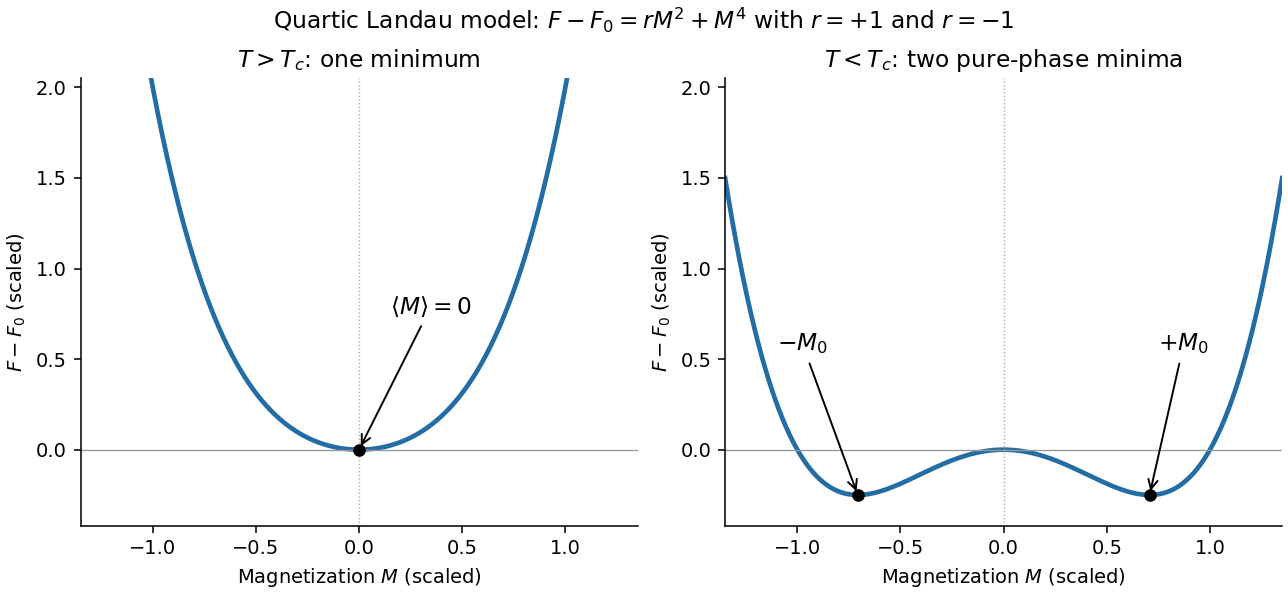
Quartic Landau free energy above and below the transition, showing the disordered and symmetry-broken minima
. Details. 
Minimum free energy and the heat-capacity jump. At a nonzero minimum, . Substituting this value givesHencewhile above the transition. Take the temperature derivatives only after minimizing, so the equilibrium order parameter is allowed to change with temperature. With ,ThereforeThis is the heat-capacity jump in quartic Landau theory. The entropy is continuous at , so there is no latent heat. If denotes free-energy density rather than total free energy, these expressions denote heat capacity per unit volume with the same normalization.
Stabilizing a tricritical expansion. At a tricritical point, the quartic coefficient is tuned to zero at the same point where the quadratic coefficient changes sign. Reversal symmetry still excludes odd powers. The next available stabilizing term is thereforeA negative or vanishing leading sextic coefficient would not stabilize this truncation for large ; a higher positive term would then be needed and the present tricritical form would be insufficient. The ordinary quartic theory has a continuous transition for , while a stabilized theory with can have a first-order transition. Their meeting at zero field is what makes the simultaneous tuning tricritical.
The tricritical minimum. At zero field and , stationarity givesThe nonzero solutions are minima: their curvature is . Put . Since at stationarity,ThusThe order parameter now vanishes as rather than the quartic theory's square root.
Heat-capacity singularity. Define , so the ordered-side singular free energy is . Its derivatives areConsequentlyThis is the tricritical heat-capacity amplitude in a sextic Landau expansion. It is positive on the ordered side and diverges as , rather than remaining a finite jump. This value of the heat-capacity critical exponent is the mean-field result along the path keeping the quartic term zero; a detuning to ultimately restores ordinary quartic behavior. Fluctuation corrections to the mean-field theory are not included in the stipulated polynomial minimization.
Articles by others on the same topic
There are currently no matching articles.