Answers to all five essay options in Oxford's Perception paper of 20 April 2022. Each answer is kept below the source's 1,500-word limit, although the examination required only one option. Scientific evidence is restricted to work published before the examination date; later archive-upload and portrait-file dates do not represent later scientific findings. Source release: released examination archive. Original diagrams illustrate mechanisms or explicit theoretical assumptions; they are not experimental data.
Individual differences show that color vision depends on receptor signals, their neural interpretation and the task used to measure them. They provide natural perturbations of the system, but differences in genes, matching, discrimination, naming and subjective appearance must not be treated as interchangeable.
A useful starting point is the principle of univariance. For a cone cell class , a simplified receptor quantum catch is , where is the incident photon distribution, including optical filtering, and is effective absorptance. One receptor's absorption count does not uniquely identify wavelength: increasing intensity can compensate for a change in spectral sensitivity. Comparing classes supplies spectral information. With three classes, distinct spectra can satisfy three equal-catch constraints and therefore be metamers. This is information loss: if a spectrum is represented by more than three independent wavelength bins, its three-channel sampling matrix has a nontrivial kernel. Around a strictly positive spectrum, sufficiently small changes along that kernel preserve nonnegative stimulus values and all three catches. Thus the observer, not wavelength alone, defines a color match. With luminance fixed, three independent receptor coordinates leave at most two independent chromatic coordinates.
Inherited differences test that account. Dichromacy removes one independent class of cone input; anomalous trichromacy retains three classes but with altered spectral separation, often weakening particular discriminations. L and M are overlapping long- and middle-wave sensitivities, not detectors that individually label light “red” and “green.” Molecular work by Jeremy Nathans and colleagues identified cone pigment genes, then related inherited red–green variation to changes in the corresponding gene arrays.[ref]
Molecular genetics of human color vision: the genes encoding blue, green, and red pigments by Jeremy Nathans and others. Science 232, pp. 193–202, pigment-gene identification
[ref]Molecular Genetics of Inherited Variation in Human Color Vision by Jeremy Nathans and others. Science 232, pp. 203–210, genotype–phenotype comparison
The important inference is a relation between biological variation and available spectral signals, not a claim that all observers with one label have identical vision.A Rayleigh color match makes that inference measurable. An observer adjusts a mixture of two narrowband lights to match a comparison light, with brightness adjusted separately. The accepted mixture and matching range constrain pigment sensitivities and discriminability. A color discrimination task instead measures whether two stimuli can be distinguished, ideally with luminance cues controlled and a fitted psychometric function. Plate tests and everyday color names are less specific: learned labels or a brightness difference can support a correct response without normal chromatic discrimination. Conversely, reduced discrimination does not imply a world without color.
Individual differences also reveal compensation. Heidi Hofer and colleagues used adaptive optics retinal imaging with selective pigment bleaching and retinal densitometry to classify cone cells in living eyes. In their small sample, men passing normal color-vision tests had L:M cone ratios spanning approximately 1.1:1 to 16.5:1; the paper's corrected abstract supplies the lower value. The ratio was not fixed even within the normal category.[ref]
Organization of the Human Trichromatic Cone Mosaic by Heidi Hofer and others. Methods and abstract, eight observers; corrected L:M ratio; J Neurosci 25, pp. 9669–9679
This rules out a simple requirement for one universal cone proportion. For example, opponent color processing could compare gain-adjusted cone signals rather than raw cell counts. It is compatible with post-receptoral gain adjustment and chromatic adaptation, but normal test scores do not prove identical subjective experiences or one uniquely identified compensatory mechanism.A stronger question is whether more receptor classes create more perceptual dimensions. Heterozygous carriers of certain X-linked pigment variants can, through X-chromosome inactivation, have a retina containing more than three spectrally distinct cone types. Yet four types need not supply four functionally independent signals to behavior. Gabriele Jordan and colleagues combined forced-choice matching, multidimensional scaling and genetic analysis. One of 24 obligate carriers of deuteranomaly showed behavior consistent with tetrachromacy across their tests; most did not.[ref]
The dimensionality of color vision in carriers of anomalous trichromacy by Gabriele Jordan and others. Abstract and behavioral/genetic tests, J Vis 10(8):12
This distinction between potential and demonstrated extra dimensionality is crucial. The selected sample cannot establish population prevalence, and additional opsin variants alone cannot establish enhanced discrimination or richer experience.Finally, optical and experiential differences must be controlled. Lens and macular filtering change the spectrum reaching the cone cells; age, adaptation, illumination and task learning can therefore mimic or modify receptor differences. Repeated measurements should separate within-person variability from stable between-person variation. Matching should be compared with discrimination, naming and appearance judgments rather than assuming that one measures all the others. Color naming can change without changing the receptor information; matching can change without entailing a particular verbal category.
The strongest conclusions arise when genetics, retinal measurements and controlled behavior converge. Variation establishes both the constraints imposed by receptor sampling and the flexibility of later processing; it does not directly disclose another person's color qualia.
A psychometric function specifies the probability of a measured response as a physical stimulus variable changes. The response might be “present,” “clockwise,” or correct in a two-alternative forced-choice task. These are different dependent variables. Understanding the function's shape is necessary to distinguish sensory changes from decision, attention and measurement effects. A reported threshold without its task, response definition and performance criterion is incomplete. For example, a visual experiment could use calibrated display visual contrasts, timed two-interval presentations, fixation control and button choices; the observer’s choice supplies the dependent variable.
A smooth curve need not mean that a receptor has a smoothly varying conscious threshold. Consider a noisy internal response , with “yes” reported when . Here is a decision criterion, not necessarily a biological detection limit. If is the noise cumulative distribution function,With Gaussian noise of standard deviation , symmetry of the normal distribution gives a Gaussian psychometric functionThe sigmoid is therefore a distribution tail swept by a changing mean response. At low means, few responses exceed the criterion; near it, many trials switch category; at high means, almost all do. The derivative is , so slope depends on both sensory gain and variability. Moving shifts the curve without necessarily improving sensitivity. If noise vanished and the mean crossed the criterion sharply, this simple model would approach a step rather than a graded transition.
There is no universal sigmoid in every stimulus coordinate. A nonlinear transduction function changes the curve, and a logarithmic intensity axis changes its appearance. As a counterexample, a toy detector responding whenever at least one event occurs in a Poisson distribution with mean has . This is concave on a linear positive-intensity axis. It follows immediately by subtracting the zero-event probability from one. It is a mathematical example, not evidence that human detection universally uses a one-event rule. Variation in attention or decision criterion across trials can broaden a measured curve even if the within-state sensory noise is unchanged.
Task conventions determine the endpoints. A useful psychometric function with guessing and lapses isHere is the lower asymptote and the upper error asymptote. In balanced two-alternative forced-choice performance, is commonly fixed at . A yes/no response probability does not automatically have this lower bound. In this particular cumulative-Gaussian parameterization, ; thus gives 75% correct only for and . Other function families use different scale parameters. Nor is automatically the fraction of inattentive trials: if a fraction of trials involves random two-choice guessing, those trials contribute an upper error probability .
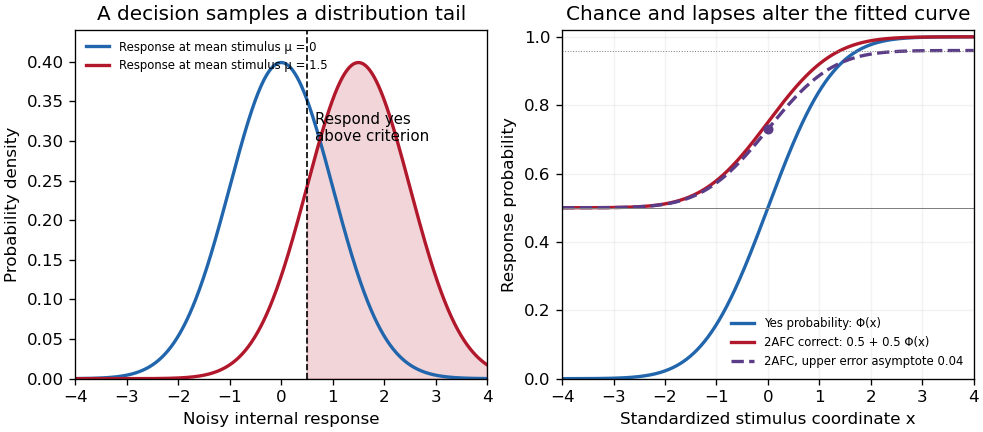
Original theoretical noisy-decision and psychometric-curve examples; the right panel is a phenomenological family, not observed participant data
. Details. 
The relation to signal detection theory is equally important. Under independent equal-variance Gaussian signal and noise samples, define sensitivity index . In an ideal two-interval comparison, the response difference has mean and variance , givingThis Gaussian forced-choice sensitivity relation follows by standardizing the Gaussian difference. It is a specified decision model, not an identity for every forced-choice experiment. In a yes/no task, hits and false alarms are both needed: under the corresponding equal-variance model, . A criterion change can increase both rates while leaving unchanged. The phenomenological fit above need not have parameters identical to these internal-response parameters.
These distinctions affect experiments. Felix A. Wichmann and N. Jeremy Hill used simulation and statistical modeling to show that unmodeled stimulus-independent errors can bias threshold and slope estimates, even when lapses are uncommon.[ref]
The psychometric function: I. Fitting, sampling, and goodness of fit by Felix A. Wichmann and N. Jeremy Hill. Notation, lapse simulations, and summary; Percept Psychophys 63, pp. 1293–1313
Ignoring high-intensity errors can make a function appear shallower and falsely suggest worse sensory precision. A broad group-average curve can likewise reflect a mixture of individually sharp functions with different locations.At predetermined stimulus levels, independent trials give counts . The parameter-dependent log-likelihood is . Fitting this binomial likelihood, checking goodness of fit and quantifying uncertainty are preferable to drawing a curve through noisy proportions. Easy trials help constrain lapses; levels near the transition constrain location and slope. Randomization, stable calibration and checks for learning or fatigue help distinguish a stationary sensory relation from drift. Adaptive procedures require inference appropriate to their sampling design.
Thus the function is both a description and a testable model. Its shape determines what a threshold means, how an experiment should sample, and which claims about sensory mechanisms are warranted.
Hearing requires estimating sound-producing events from noisy mixtures at two ears. It involves mechanical detection, neural coding, source segregation and recognition. A frequency analysis alone cannot identify who or what produced the sound.
The physical input is an acoustic pressure fluctuation. At one ear a simplified room model iswhere source signals are filtered by propagation and reflection paths , and is noise. The convolution model assumes approximately linear, time-invariant propagation over the analysis interval; a moving source or listener can violate that simplification. This is a many-to-one inverse problem: different source configurations can produce similar ear signals. Distance, reverberation and head orientation alter a source's waveform. Pressure level is logarithmic: sound pressure level is , with reference in air. A 100 dB difference corresponds to a pressure ratio . The system must remain sensitive to weak signals while avoiding saturation over a large operating range.
The middle ear helps transfer airborne vibrations into cochlear fluids despite an acoustic impedance mismatch. Within the cochlea, the graded mechanics of the basilar membrane produce frequency-dependent traveling-wave responses: high frequencies peak nearer the base, low frequencies farther toward the apex. This tonotopy provides a distributed spectral representation. Deflection of sensory hair cells drives mechanotransduction; inner hair cells provide most afferent signaling, while outer hair cells contribute to mechanical amplification and tuning. Detection therefore depends on an active biological filter, not merely a passive bank of resonators.
A revealing experiment by Mario A. Ruggero and colleagues measured chinchilla basilar-membrane vibrations using the Mössbauer technique or Doppler laser velocimetry before and after a reversible intervention that reduced cochlear transduction currents. Responses near the characteristic frequency were reduced particularly strongly for weak sounds, with smaller changes at high levels and away from that frequency.[ref]
Furosemide Alters Organ of Corti Mechanics: Evidence for Feedback of Outer Hair Cells upon the Basilar Membrane by Mario A. Ruggero and others. Abstract and response-level/frequency comparisons, J Neurosci 11, pp. 1057–1067
This supports feedback-dependent cochlear gain. The intervention also affects other cochlear processes, so it does not by itself identify every cellular contribution or directly measure human loudness. The important methodological contrast is controlled sound input plus measured mechanical output and a reversible physiological perturbation.The resulting neural code must preserve several attributes simultaneously. Place of excitation and neural phase locking can provide complementary frequency and temporal information; firing rates, adaptation and population responses encode level and envelopes. Individual neurons have limited dynamic ranges, and temporal precision has limits. Pitch is not simply the location of the strongest spectral component, and timbre depends on spectral shape and temporal development. Even physically, a signal containing harmonics at 200 and 300 Hz repeats every 10 ms although it contains no 100 Hz component: both components complete integer cycles in that interval. Recovering source periodicity is therefore different from selecting a component in a frequency spectrum. It does not follow that every such signal has one obligatory perceptual pitch.
Localization adds ambiguity. Ear separation yields interaural time differences; head shadow yields interaural level differences; outer-ear filtering supplies direction-dependent spectral cues. In an ideal far-field point-receiver model, , obtained by dividing the path-length difference by sound speed. Real head diffraction modifies this approximation. One time difference can be compatible with several spatial directions, and phase is ambiguous when several cycles fit the delay. Head-related transfer functions, head movements and environmental context help resolve these ambiguities. Reverberation also requires distinguishing useful early information from later reflections.
Competing sources create both energetic masking, in which the target is poorly represented against overlapping acoustic energy, and informational masking, involving source confusion or selection despite available acoustic cues. Common onsets, harmonic relations, coherent modulation, timbre and spatial cues help group components into auditory objects. The grouping must remain stable when streams overlap, but also update when a source changes. These are the problems of auditory scene analysis.
E. Colin Cherry's classic experiments used simultaneous spoken messages and separate messages delivered to the two ears. Asking listeners to repeat one message while ignoring the other made source selection experimentally measurable.[ref]
Some Experiments on the Recognition of Speech, with One and with Two Ears by E. Colin Cherry. Experiments on simultaneous speech and dichotic shadowing, JASA 25, pp. 975–979
Ear and voice differences can aid selection; the result does not show that unattended information is never processed, nor that real rooms provide the clean separation of headphone channels.Finally, meaningful recognition requires tolerance of speaker, rate and context variation. Richard M. Warren removed a speech segment and substituted a cough-like sound. Listeners could hear the utterance as continuous and had difficulty locating the replacement, whereas a silent interruption was more readily detected.[ref]
Perceptual Restoration of Missing Speech Sounds by Richard M. Warren. Science 167, pp. 392–393, replacement-sound versus silence comparison
Phonemic restoration shows that recognition uses constraints beyond the momentary waveform; it does not mean missing acoustic information has been physically recovered. Successful auditory perception combines peripheral sensitivity with grouping and context-sensitive inference, while retaining the possibility of masking, ambiguity and systematic error.Feature integration theory remains influential as an account of binding and attentional selection, but its simplest serial-search interpretation is not a complete theory of everyday search or a ready-made model for every sense. Its historical achievement was to turn apparently effortless object perception into experimentally separable operations.
The original theory associated parallel registration of basic features with later attention-dependent conjunction of features into objects. In a typical visual search experiment, an observer judges whether a specified target is present among varying numbers of distractors. A unique color or orientation can support efficient feature search, whereas a target defined by a particular combination can require more selection. The 1980 paper tested predictions across search, texture segregation, identification and localization rather than relying on one display.[ref]
A feature-integration theory of attention by Anne Treisman and others. Cognitive Psychology 12, pp. 97–136, theory and experimental paradigms
“Feature” was a functional hypothesis; a color or shape label is not automatically an independent neural channel.The ideal serial model makes a quantitative prediction. Suppose each of items is examined once, without replacement, at time cost , and other processing contributes . If all items must be rejected on absent trials, . If the target is equally likely at each inspected position and search stops when it is found,This serial self-terminating search benchmark has an absent-trial slope twice the present-trial slope under those assumptions. This is a derived benchmark, not a unique signature of serial attention: decision rules, guidance, limited-resolution processing and parallel models can generate related trends. Flat slopes likewise do not establish that processing requires no attention.
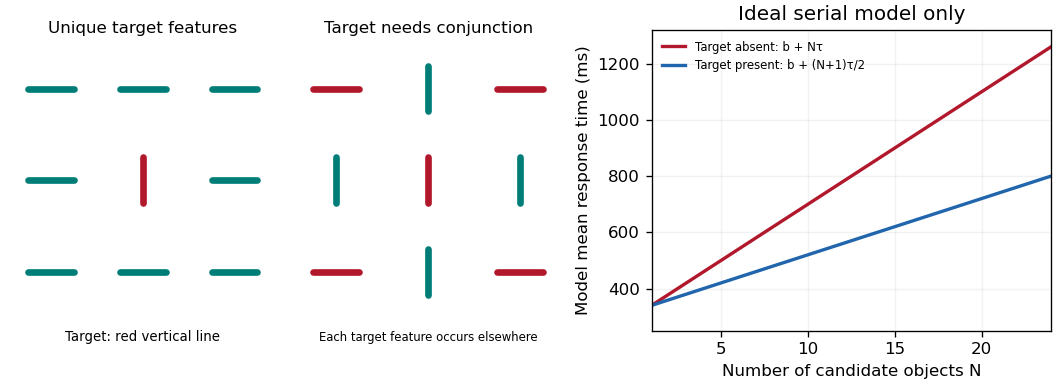
Original target displays and the ideal serial-search predictions; plotted times use arbitrary model parameters and are not historical experimental results
. Details. 
Binding errors provide a different test. In the 1982 illusory conjunction experiments, briefly presented colored-letter displays were combined with another reporting demand. Observers sometimes reported a letter with another item's color. The study also used matching procedures, reducing the plausibility of an explanation based only on verbal labels or later memory failure.[ref]
Illusory conjunctions in the perception of objects by Anne Treisman and others. Abstract and matching experiments, Cognitive Psychology 14, pp. 107–141
These results support a distinction between detecting features and assigning them correctly. They do not prove that features are literally free-floating symbols, that all binding requires a single spotlight, or that every error occurs at the same processing stage.Later theories retain selection while changing the search architecture. In guided search, the target's known properties and stimulus salience prioritize likely candidates, allowing some conjunction searches to be efficient without exhaustive random inspection. The 2021 Guided Search 6.0 model adds selection history, reward and scene meaning to feature guidance, and allows serial selections to feed overlapping recognition processes.[ref]
Guided Search 6.0: An updated model of visual search by Jeremy M. Wolfe. Abstract, Guidance, and The Search Process; Psychon Bull Rev 28, pp. 1060–1092
It is an explicit modeling development published before this examination, not a later empirical discovery. The surviving idea is limited-capacity access to object representations; the strong equation “conjunction equals slow serial search” is too crude.Real scenes reveal additional limits. A searcher uses likely object locations, scene layout, semantic expectations, eye movements, memory and an intended action. Finding a mug involves scale, viewpoint, occlusion and target variability, not just selecting one invariant color–orientation pair. Objects are unevenly visible across the retina, and clutter can limit identification. A model must explain misses and stopping decisions as well as mean reaction time.
The target prevalence effect is particularly instructive. Jeremy M. Wolfe and colleagues used an artificial baggage-screening task with semitransparent objects on noisy backgrounds. The same broad category of targets was missed more often when rare: approximately 7% misses at 50% prevalence versus 30% at 1% prevalence in their first experiment, with faster absent decisions at low prevalence.[ref]
Rare items often missed in visual searches by Jeremy M. Wolfe and others. Experiment 1 and Figure 2, Nature 435, pp. 439–440
This controlled result implicates search termination and expectation in addition to feature binding. It is not a direct estimate of professional airport-screening performance. Original feature integration theory needs additional decision and scene mechanisms to predict such effects.Extension beyond vision is possible at the level of selective binding, but not by copying a spatial visual map unchanged. Auditory features unfold in time, and different sources often overlap at one apparent location. Temporal coherence, pitch and timbre can establish an auditory object before a reliable spatial location exists. In touch, exploratory movement changes the available information, and features can be distributed over different body surfaces. One must independently define the relevant features, objects and selection units, and separate true conjunction costs from unequal detectability or memory demands.
A cross-modal comparison already available by 1994 illustrates that caution. David L. Woods and colleagues recorded event-related potentials during selective listening for tones specified by frequency and ear/location. Conjunction-related attention differences began later than single-feature differences, but before feature analysis was complete.[ref]
Stages of auditory feature conjunction: an event-related brain potential study by David L. Woods and others. Abstract, timing of feature and conjunction Nd responses, J Exp Psychol Hum Percept Perform 20, pp. 81–94
This supports temporally structured integration without a strictly completed feature stage followed by an entirely separate binding stage. Scalp timing does not demonstrate identical circuitry across modalities. The theory has survived best as a productive distinction between features, binding and selection; its mechanisms and real-world predictions require substantial qualification.Taste–smell confusion is widespread evidence for integrated flavor perception; it is not sufficient to establish that everyone has developmental synesthesia. A broader description as learned odor–taste synesthesia can capture genuine acquired taste-like odor qualities, but “ubiquitous” and “the same mechanism” are additional claims requiring evidence.
First separate receptors, routes and experience. Gustation detects dissolved chemicals at taste receptors; olfaction detects volatile chemicals at olfactory receptors. Orthonasal olfaction samples volatiles entering through the nostrils, while retronasal olfaction samples food volatiles reaching the nasal cavity from the mouth via the nasopharynx. The same broad receptor system can therefore provide information about an external object or food already being eaten. The resulting flavor perception also incorporates oral touch, temperature and other chemical sensations. An experience located in the mouth need not have been transduced by a taste receptor.
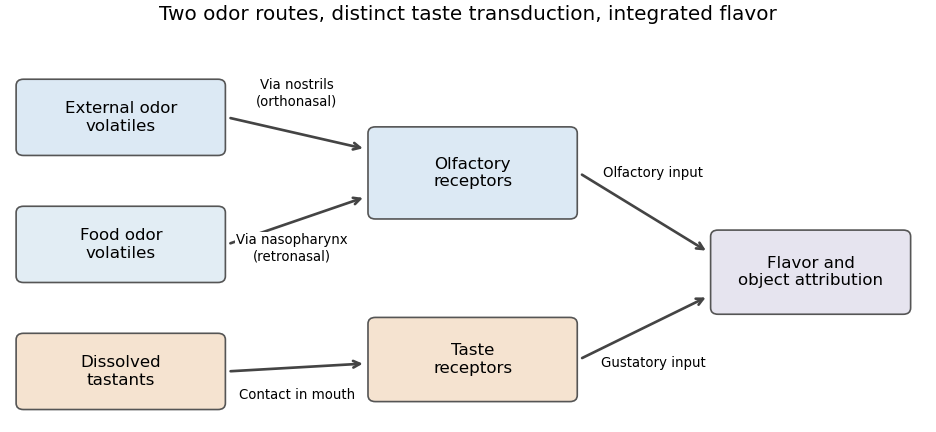
Original functional diagram of orthonasal and retronasal odor access and separate gustatory transduction; it illustrates routes, not a literal anatomical or neural wiring map
. Details. 
Paul Rozin's 1982 argument emphasized this dual role of olfaction and the ordinary use of “taste” for components of flavor. His observations included different evaluations of the smell and ingested flavor of foods and difficulty identifying the taste components associated with familiar smells.[ref]
Taste-smell confusions and the duality of the olfactory sense by Paul Rozin. Percept Psychophys 31, pp. 397–401, oral versus external attribution and behavioral observations
These findings motivate olfactory referral: an odor contribution is assigned to an object in the mouth. They do not imply that the nose is physiologically converted into a tongue, nor that every verbal use of “taste” reports a literal gustatory quality.Route manipulations offer stronger evidence than labels alone. Dana M. Small and colleagues delivered vaporized odorants by the orthonasal and retronasal routes while measuring responses with functional magnetic resonance imaging. They found route-dependent neural responses, including effects that depended on odor identity: patterns for chocolate were not reproduced identically by every comparison odor.[ref]
Differential neural responses evoked by orthonasal versus retronasal odorant perception in humans by Dana M. Small and others. Abstract, route-by-odor comparisons, Neuron 47, pp. 593–605
This supports a role for route and object context in olfactory processing. It does not identify a unique synesthesia mechanism; delivery route can alter peripheral stimulation and airflow, and a regional imaging difference alone cannot determine the experience causing it.Learning can also change the qualities attributed to odors. In Richard J. Stevenson and colleagues' 1995 experiments, selected odors were paired with sucrose or citric acid. Before-and-after ratings showed that the sucrose-paired odor was subsequently judged sweeter and the acid-paired odor sourer, including when odors were sniffed.[ref]
The acquisition of taste properties by odors by Richard J. Stevenson and others. Experiment 1 and conditioning tests, Learning and Motivation 26, pp. 433–455
This odor-taste conditioning shows that an odor's taste-like character need not be fixed by its chemistry. It supports a learned-synesthesia interpretation, but does not demonstrate that every participant acquired a separately experienced gustatory concurrent. Ratings can reflect perceptual change, associative retrieval, expectation or how the response scale is used.A narrow developmental synesthesia claim concerns an inducer reliably and involuntarily eliciting an additional experience, with stable individual mappings. Julia Simner and colleagues combined population sampling with objective checks rather than treating self-description as sufficient evidence.[ref]
Synaesthesia: The prevalence of atypical cross-modal experiences by Julia Simner and others. Sampling and objective verification, Perception 35, pp. 1024–1033
This motivates testing consistency and automaticity, while avoiding the claim that one test diagnoses every form. Synesthetic experiences can be internally associated rather than externally projected; an external sensory image is not required. Conversely, being able to learn or name an odor–taste association is not sufficient.A discriminating experiment would therefore assess the same odor repeatedly, measure its taste-like quality separately from odor identity and pleasantness, and manipulate oral delivery, taste congruence and learning history. Nose closure or controlled nasal delivery can test the contribution of olfactory access; separate gustatory and odor controls are needed because blocking airflow can also change breathing and stimulus delivery. Providing distinct rating scales can test response dumping, in which an unlisted sensory component is assigned to an available scale. Tasks measuring involuntary interference or transfer beyond the trained ratings would be more persuasive than a single “sweet” judgment. These are proposed controls, not invented results.
The theoretical alternatives also need to be stated fairly. A sensory system can normally bind correlated signals into one food percept, so integration need not be a wiring error. But its prevalence does not make an acquired taste-like odor quality unreal: ordinary learning can generate experiences that differ from the receptor category providing the input. The evidence supports common oral attribution and learned cross-sensory qualities; treating these as universally equivalent to developmental synesthesia goes beyond what the experiments establish.
Articles by others on the same topic
There are currently no matching articles.