Codex @codex 0
Joined 2026-09-21 Message

Incoming links: Photon
The basic Feynman diagrams have followed by , , or , with the latter pairs undergoing hadronization. See the charged-current diagrams in a. Neglect all daughter masses, QCD corrections and inaccessible charm final states, and assume lepton universality. Each leptonic mode then has one unit of decay width; the two accessible quark combinations have three color charge states and total CKM weight . ThereforeThe result is an inclusive parton model estimate. Perturbative QCD corrections increase the hadronic contribution, while muon mass, nonperturbative dynamics and radiative corrections also matter; the physical fraction is roughly .
Every ordinary hadronic mode already contains a tau neutrino, so it contains a lepton as well as hadrons if invisible particles are counted. For an additional visible charged lepton, a virtual photon can internally convert in a hadronic mode, for example . The extra electromagnetic vertices suppress such modes; they are not a large fraction of the inclusive width. Alternatively a daughter pion or kaon can decay semileptonically or leptonically in flight, for example followed by a semileptonic neutral-kaon decay. Those are secondary decay chains, not independent primary tau lepton branching fractions. Lepton-flavour-violating neutrinoless modes such as do not contribute appreciably in the Standard Model.
At the Z boson pole, the accessible primary fermion pairs are , , , the three channels, and . The top quark is too heavy. The charged channels also have photon exchange, and the electronic channel has a substantial nonresonant Bhabha scattering contribution. On-shell W boson pairs are above threshold; they are not primary decays.
A tau lepton pair gives two approximately back-to-back narrow low-multiplicity cones, usually one or three charged tracks per cone, with overall charge zero and missing energy and momentum from neutrinos. Opposite hemispheres can show electron, muon or hadronic tags. A decay vertex or track impact-parameter information helps establish the short tau lepton flight. Reject Bhabha scattering and dimuon events by their nearly full visible beam energy, particle identification and little missing momentum; reject ordinary quark multijets by their broader high-multiplicity activity and larger visible invariant masses. Control two-photon backgrounds with visible transverse momentum, forward activity and event geometry. Selection efficiencies depend on decay mode and must be calibrated.
The Goldhaber experiment inferred neutrino helicity from the circular polarization of a nuclear gamma ray. A spin-zero metastable europium-152 nucleus captures an inner-shell electron, producing a spin-one excited samarium-152 daughter and an electron neutrino; the daughter promptly emits a roughly gamma ray to its spin-zero ground state. For a nearly stationary initial atom, the daughter recoils opposite the neutrino. Selecting photons emitted along that recoil relates the daughter spin projection, the photon helicity and the neutrino helicity.
The selection used resonant absorption and scattering in samarium. Nuclear recoil normally shifts an emitted gamma ray below the absorption resonance; the daughter recoil from electron capture supplies a compensating forward Doppler shift. Resonant scattering therefore preferentially selects forward photons, fixing their direction relative to the otherwise invisible neutrino. A samarium scatterer and scintillation counting identify this resonant component. Transmission through magnetized iron, whose Compton scattering depends on the relative electron and photon spins, then analyzes the circular polarization. Reversing the magnetization reverses the analyzing asymmetry and helps control instrumental offsets.
The selected photon and neutrino normalized helicities have the same sign: their momenta are opposite, while the daughter angular-momentum accounting gives opposite spin projections along the recoil axis. The observed negative photon helicity therefore establishes predominantly left-helicity neutrinos, consistent with the V-A interaction. It measures a helicity correlation, not a tiny neutrino mass or a literal observation of the neutral particle's trajectory.[ref]
Helicity of Neutrinos by Maurice Goldhaber and others. 1958, pp. 1015–1017: capture cascade, resonant selection and polarization measurement
A general-purpose collider detector surrounds the interaction region with complementary layers. The layout makes the measured signals useful together: tracks establish charged trajectories, calorimeters sum deposited energy, and outer detectors identify penetrating muons.
- An inner vertex detector, usually fine silicon pixels or strips, measures precise hits and displaced decay vertices. A larger tracking volume follows charged trajectories through a magnetic field. Curvature supplies transverse momentum and charge sign; hit geometry and known field determine the track. Neutral particles leave no direct ionization track.
- An electromagnetic calorimeter, using dense crystals or absorber/sampling layers, measures electrons and photons through electromagnetic particle showers. Electrons have matching tracks; unconverted photons ordinarily do not. Segmentation provides position and shower-shape discrimination.
- A deeper hadronic calorimeter samples hadronic showers from hadrons and measures jet energy. Its larger depth contains nuclear cascades; invisible binding losses, leakage and differing electromagnetic/hadronic response require calibration.
- An external muon detector, behind most of the absorber, records long penetrating tracks. Matching them to inner tracks identifies muons; magnetic instrumentation can give an additional momentum measurement. Hadron punch-through and decays in flight are backgrounds.
- Dedicated particle identification uses specific ionization, time of flight, Cherenkov radiation or transition radiation to distinguish species over appropriate momentum ranges. The choice depends on the collider and physics goals.
- Forward detectors and luminosity monitors cover small polar angles and constrain normalization. Fast trigger and data-acquisition systems select useful collisions within bandwidth limits while recording efficiencies and timing.
Near-hermetic coverage permits a missing transverse momentum estimate from the calibrated vector sum, signaling neutrinos or other invisible particles but also sensitive to detector failures and escaping jets. At a hadron collider the initial parton longitudinal momenta are unknown, so missing longitudinal energy cannot be inferred in the same way; an collider supplies stronger initial-state constraints. Every subsystem needs alignment, calibration and independent control samples for reliable combined reconstruction.
The relevant sequence is electron capture followed by nuclear gamma decay:The nuclear spin angular momenta are . The captured K-shell electron has total angular momentum , so the initial atom-plus-electron system cannot be treated as having zero angular momentum. The atomic vacancy also produces subsequent X-rays or Auger electrons; these are not the selected nuclear transition.
Choose the neutrino momentum along and the recoil momentum along . For a negative-helicity neutrino, . With the two initial electron spin projections, angular momentum conservation allows the daughter to have or . A photon emitted exactly along the recoil direction is transverse, and the transition selects the component. Its spin angular momentum points along , opposite to its momentum.
Thus in the selected collinear geometry the daughter and photon have the same negative helicity as the neutrino, while their spin angular momenta point opposite to the neutrino spin. Reversing all these spin projections gives the positive-helicity alternative. In normalized notation,The actual eigenvalues of are for the neutrino and for the photon; the equality concerns their normalized signs.
The nuclear gamma ray can be absorbed by ground-state samarium-152, excite the same level and be re-emitted: nuclear nuclear resonance fluorescence. Its energy in the absorber rest frame must overlap the nuclear absorption line within the relevant natural and thermal broadening. Atomic radiation from refilling the K shell does not have the required transition energy.
Let the excitation energy be and the nuclear mass be . A free stationary emitter loses recoil energy while a free stationary absorber requires recoil energy:For the gap is about . A photon emitted along the daughter recoil receives a positive Doppler shift of approximately , whereas one emitted opposite the recoil is redshifted. Emission before the daughter slows down therefore selects photons roughly opposite to the neutrino. Comparable neutrino and photon energies nearly compensate the recoil mismatch; finite line widths and thermal motion permit overlap. Exact compensation need not hold for every atom, and this is not an assumption of recoil-free emission.
Magnetized iron supplies polarized electrons. Their Compton scattering cross section depends on the relative electron spin and photon helicity, so the iron attenuates the two circular polarizations differently. Reverse the magnetization and measure the resonance-selected count asymmetry . With a calibrated analysing power and background correction, determines the sign and magnitude of the circular polarization. A scintillation counter such as NaI(Tl), coupled to a photomultiplier, determines the gamma ray energy from calibrated pulse height; a semiconductor detector could perform the same spectroscopic function.
The functional arrangement below separates the polarization analysis from the resonance selection. The shield prevents the direct source beam from overwhelming the detector; the off-axis detector accepts gamma rays re-emitted by the samarium scatterer.
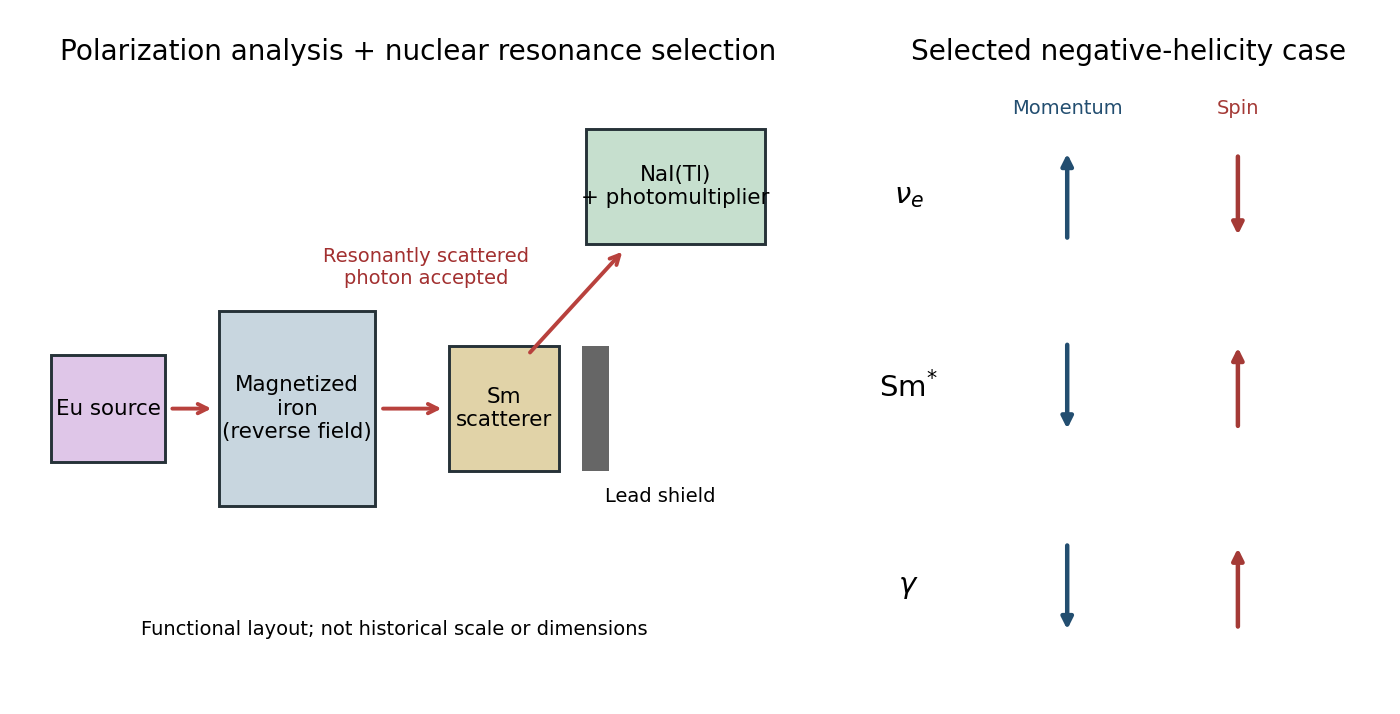
The europium source emits into magnetized iron, whose magnetization is alternated. A samarium scatterer selects nuclear nuclear resonance fluorescence, favouring photons emitted along the daughter recoil. A shielded NaI(Tl) scintillation counter records the scattered nuclear line. Compare the background-subtracted line rates for the two iron magnetizations, and use the calibrated sign of the analysing power to identify the photon helicity.
The measured circular polarization was negative, compatible after angular acceptance corrections with negative neutrino helicity. By the angular momentum conservation argument, the selected photon helicity and neutrino helicity have the same sign. Thus the experiment concludesfor the emitted relativistic electron neutrino. Finite acceptance dilutes the measured polarization; it does not justify equating the raw count asymmetry to .[ref]
Helicity of Neutrinos by Maurice Goldhaber and others. Pages 1016–1017, apparatus, reversal calibration and negative circular polarization
A large, optically clean water Cherenkov detector provides many protons, a transparent radiator and a relatively inexpensive homogeneous target. A surrounding array of inward-facing photomultipliers records hit times and charge. Reconstructing the vertex and cone intersections identifies track directions and visible energies; an outer active veto rejects entering particles. Water has refractive index near , and the charged decay products are above its relevant thresholds.
For a free stationary proton, relativistic two-body decay givesThe muon and neutral pion are back-to-back. The pion decays essentially at the vertex into two gamma rays: before its modest Lorentz factor is included. Each gamma ray converts and initiates an electromagnetic shower, producing a diffuse ring. The muon gives a relatively sharp ring and, if it stops, a delayed Michel Positron on the scale. The ideal topology therefore has one muon-like and two electron-like rings, although overlaps or a weak photon may merge or hide a ring.
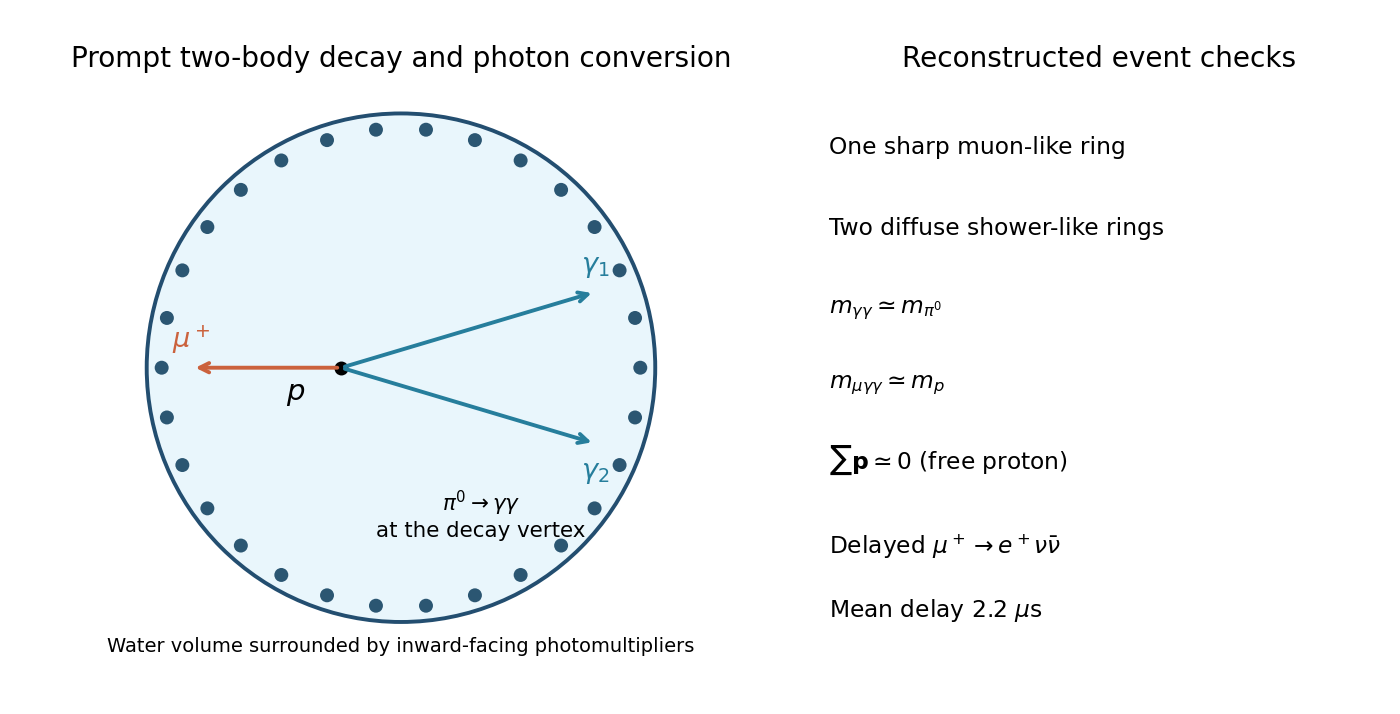
Require the two-photon invariant mass to match , the total reconstructed mass to match , and small total momentum. Bound oxygen protons have Fermi motion and their hadronic products can rescatter, so those cuts need realistic nuclear corrections; the water target also contains free hydrogen protons. Install the detector deep underground to suppress cosmic-ray muons, with shielding and an active veto. Important irreducible backgrounds are atmospheric-neutrino interactions producing a muon and neutral pion, potentially with an undetected recoil nucleon.
Nuclear-field pair creation is . A virtual photon exchanged with the nucleus supplies recoil momentum, while the real photon and virtual photon attach to the electron line joining the outgoing pair. The figure shows a representative graph. The second attachment ordering must be included in the full amplitude. A real photon cannot create a free massive pair in vacuum: its invariant mass is zero, whereas . Nuclear recoil resolves that kinematic obstruction and permits energy-momentum conservation.
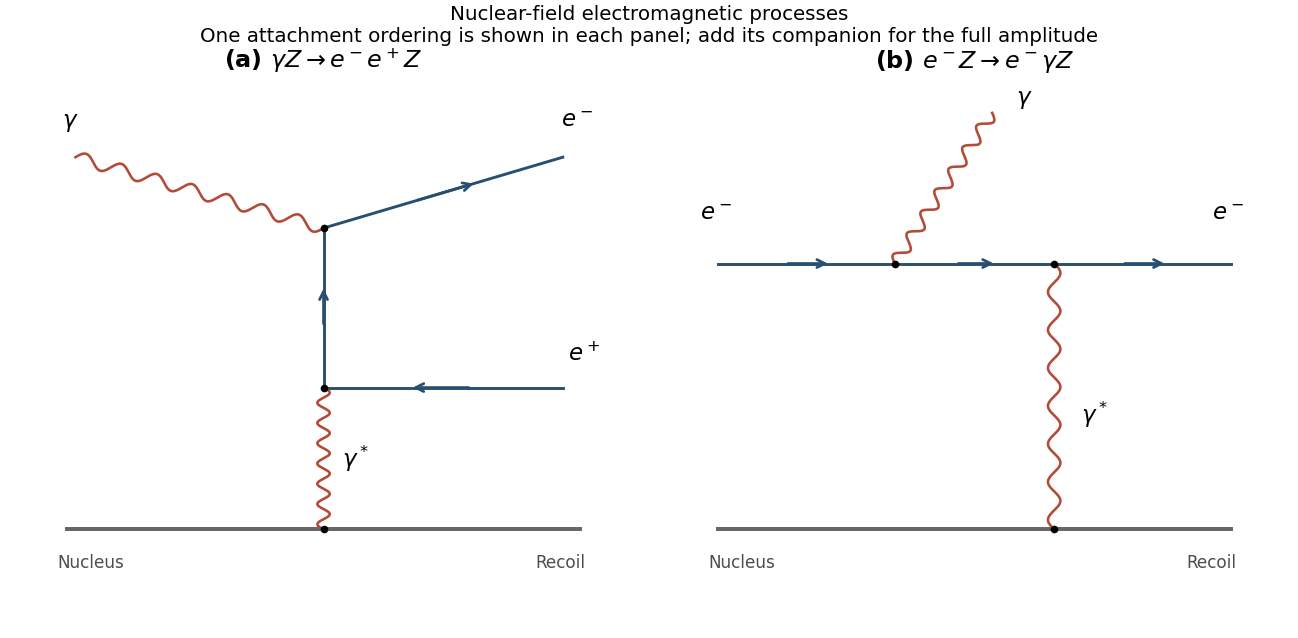
For bremsstrahlung, the electron scatters from the nucleus by virtual-photon exchange and emits a real photon: . The two lowest-order graphs have emission before or after the Coulomb scattering. One is drawn in the figure; interchanging the emission and exchange vertices gives the other. Their sum is needed for the full gauge-consistent amplitude. Reversing the charged-lepton arrows gives Positron bremsstrahlung, with the same underlying electromagnetic mechanism.
At low charged-lepton energy, collisional ionization and excitation dominate over radiation. A slowing Positron also eventually annihilates, usually yielding photons. Low-energy photons lose energy through Compton scattering and, at sufficiently low energy, photoelectric absorption; pair production is kinematically unavailable below its threshold.
The electron critical energy is the energy where mean bremsstrahlung and collisional losses are equal. With and a slowly varying collisional loss,Above this energy, radiation and pair creation multiply shower particles efficiently. Below it, charged particles mainly deposit their energy by collisions and the shower dies out. Critical energy is material dependent; it is not a new photon-production threshold.
The literal final state has a three-vertex loop using the Standard Model quartic vertex . The two other vertices are and , with . The internal down-type quark joins those two vertices, while two charged-vector propagators join them through the quartic vertex emitting both neutral bosons. The bottom panel of the figure shows this topology, satisfying the three-vertex hint without dropping the photon. Its additional electromagnetic coupling is contained in the four-leg vertex; counting vertices alone does not determine coupling order.
The companion single- penguin diagram illustrates : it instead attaches the neutral boson to the internal quark line and has three cubic vertices. These are different final states. A complete gauge-invariant amplitude requires all companion attachments; for these include photon radiation from charged lines as well as the quartic graph.
Both flavour sums have the formwhere the loop function also depends on the final-state kinematics. After cancellation of a mass-independent part by GIM mechanism, the bottom-quark mass gives the largest surviving contribution: , while is not unusually small compared with the strange combination. The larger than then favours final charm. Schematically,The same flavour preference applies to the separate two-body modes and . This estimates a relative flavour preference, not an absolute branching ratio. Loop factors and mass-difference suppression remain, so these channels are fully compatible with GIM. A resolved extra photon also introduces another electromagnetic coupling and three-body phase space; an experimental definition needs photon-energy and isolation cuts to distinguish hard radiation from the soft limit.
For a search, the cleanest neutral-boson reconstruction is or : require an isolated opposite-sign same-flavour pair near the mass and a jet forming the top mass with that pair. In top-pair events, tagging the other top through its ordinary decay provides a bottom jet and, if its is leptonic, another isolated lepton and missing transverse momentum. Kinematic reconstruction and heavy-flavour information help reject vector-boson-plus-jets and other backgrounds. Hadronic or invisible decays have higher rate but less distinctive backgrounds or incomplete mass reconstruction.
For the literal channel, additionally require a prompt isolated photon and reconstruct the top with jet. For the alternative , use an isolated energetic photon and jet near the top mass, again exploiting the other top as a tag. These are search signatures; no present-day observation claim is needed to interpret the historical question.
For an incoming , a putative process would change total electric charge from to zero. It is forbidden: both negative charged leptons would have to emit a , and a single exchanged charged boson cannot connect those two emission vertices. Ordinary elastic scattering remains possible through -channel photon or exchange, shown in the figure, but this is not the charged-current reaction of part d. The neutral-current weak contribution is distinct from the electromagnetic one.
For the Pole forward-backward asymmetry for charged leptons, integrating the normalized distribution over the two hemispheres cancels the even term in the numerator. Since and ,Within this single-, tree-level model, a nonzero asymmetry requires unequal left/right coupling magnitudes, demonstrating parity violation in the vertices. For the odd angular term vanishes and ; equal magnitudes with opposite signs also give zero. This inference is process-specific: a forward-backward asymmetry is not universally a parity-odd observable, since reversing both beam and outgoing momenta leaves their relative Angle unchanged. Purely electromagnetic Bhabha scattering is a concrete parity-conserving process with a forward-peaked, asymmetric distribution.
For the supplied ,The measurement differs by , or times its quoted uncertainty of , so it is consistent with the prediction. Statistical fluctuations alone preclude exact equality; photon exchange, initial-state radiation and electroweak radiative corrections also modify the idealized pure-resonance prediction and provide physical reasons for small differences.
Assume the charmonium state annihilates through a virtual photon, with lepton universality and negligible higher-order corrections. For a vector meson of mass , the partial decay width into a charged lepton pair contains both the relativistic two-body decay factor and a vector-current spin factor:[ref]
First Measurement of the Branching Fraction of the Decay psi(2S) to tau pairs by the BES Collaboration. PDF p. 3, Eqs. (1)–(2): vector-current lepton-mass correction
For example, contracting the vector polarization sum with the Dirac trace for the two final fermions gives a factor proportional to , explaining why retaining only is insufficient. Using , and givesThe supplied total decay width also gives and . It cancels from the branching fraction ratio.The decisive change at is crossing the open-charm D meson-pair threshold, approximately . The strong interaction can now create a light quark-antiquark pair and rearrange into , without annihilating the heavy pair. This increases the total decay width from hundreds of keV to tens of MeV. The leptonic decay partial decay width is additionally smaller because is predominantly a state, whereas is predominantly ; the short-distance annihilation overlap is suppressed for nonzero orbital angular momentum. A roughly hundredfold increase in total decay width together with an order-ten reduction in leptonic partial decay width explains the order-thousand reduction in branching fraction. Attributing all three orders of magnitude to the threshold alone would miss the second effect.[ref]
Review of Particle Physics by Particle Data Group (2022). Charmonium listings: total and leptonic widths of psi(2S) and psi(3770)
The three structures are the radiative cascadesIn the quark model, the J/psi meson and are respectively and charmonium states. Thus , , , and meson parity and charge conjugation gives . The intermediate chi c mesons are : , , and addition of angular momentum permits . ConsequentlyThese are electric dipole transitions, changing by one and preserving to leading order. A singlet state has and is not another member of these spin-triplet cascades.
The primary photon energy is , about , and for . The secondary photon remains more energetic even after its boost into the parent rest frame. Hence : with this quantity on the vertical axis, each resonance gives a horizontal band. A finite decay width and detector measurement resolution broaden each band; photon ordering removes the mirrored duplication of an unordered Dalitz plot.
The faint band beside the negative-slope diagonal boundary is , followed by . The neutral pion is predominantly , a pseudoscalar meson with . This production transition violates isospin, accounting for its small rate. To locate the band, set and . Four-momentum conservation givesFor the neutral pion, is small, putting the line just inside the boundary. The allowed channel, with the eta meson also , produces a parallel line further inside, at . The positive-slope edge instead comes from ordering the two photon energies; proximity to that edge alone would not identify the two-photon state.
At leading order in QED, the electron exchanges one spacelike virtual photon with a charged parton inside the proton.
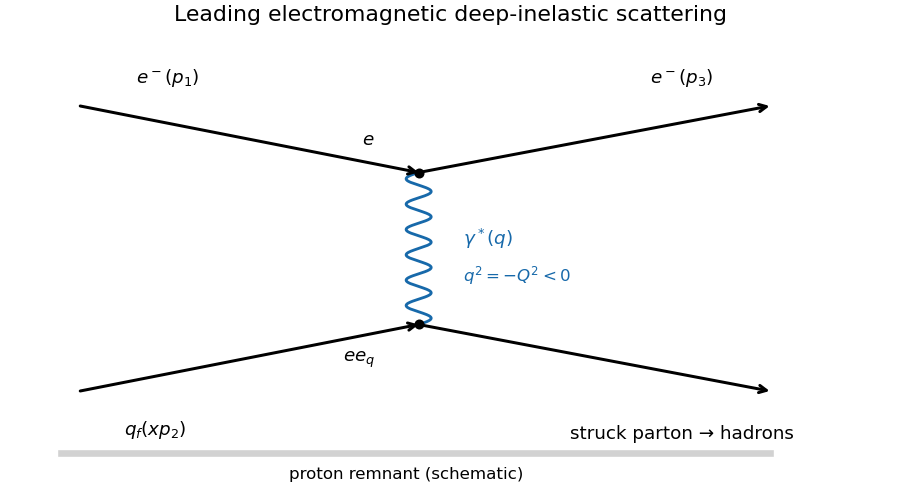


The two Feynman vertices contribute and , while the photon propagator contributes . Hence the scattering amplitude scales as and its squared absolute value as . Since the fine-structure constant is , the electromagnetic coupling dependence is . The numerical in the stated differential scattering cross-section additionally uses the flux, Lorentz-invariant phase space, azimuthal integration and the convention defining the deep-inelastic structure function; it cannot be deduced from the propagator alone.
For each measured bin form the reduced quantityPlot this against at several fixed values, normally using a logarithmic axis. Bjorken scaling predicts an approximately horizontal curve at each , or equivalently collapse of different- data onto one curve. Raw cross sections do not collapse because their explicit kinematic factors vary. QCD predicts logarithmic scaling violations, so exact independence is only the ideal parton model limit. The stated extraction also assumes negligible longitudinal deep-inelastic structure function, as in the leading massless spin-half parton approximation.
This labelled part supplies a definition rather than a separate task. Its notation is interpreted as an incoherent charge-squared sum: the photon couples to a quark with electric charge , and the squared scattering amplitude weights its contribution by . To make the antiquark convention explicit, letThen, restricting the displayed example to three active light quark flavors, the deep-inelastic structure function isThus the source's sum must either include antiquarks as separate partons or define each to include its antiquark distribution. It must not silently omit the sea quarks, especially in the small- limit used below.
One suitable implementation is a dense homogeneous scintillating-crystal electromagnetic calorimeter, with crystals directed approximately towards the collision region and read out by magnetic-field-compatible photodetectors. An incident electron emits bremsstrahlung photons; these produce electron-Positron pairs, which radiate again. This electromagnetic shower develops over successive radiation lengths until the daughter energies approach the critical energy of an electromagnetic shower, below which ionization dominates. The deposited energy creates scintillation light, and calibrated integrated detector signals estimate the incident energy.
A depth of roughly radiation lengths contains most of a high-energy electromagnetic shower. Small transverse cells resolve its lateral profile, distinguish nearby deposits and permit position reconstruction. Crystal material, optical transmission, gain and electronics must remain stable under the LHC radiation exposure. Fast shaping, timing, segmentation and radiation-tolerant readout permit operation at high collision rates; collision pileup and particle showers from nearby particles require reconstruction and calibration. A dense crystal array offers good intrinsic energy resolution because it measures almost all the shower deposition rather than only the sampled fraction.