A bare gauge boson mass would spoil the electroweak gauge structure. In the Standard Model a complex Higgs doublet instead has a symmetry-breaking potential. Choose the convention
The Higgs mechanism rearranges three scalar components into the longitudinal polarizations of the massive W bosons and Z bosons; the unbroken electromagnetic gauge symmetry leaves the photon massless. One physical scalar excitation, the Higgs boson , remains.[ref] Using tree-level Feynman diagrams,
These equations use natural units. Yukawa interactions generate charged-fermion masses and Higgs couplings proportional to those masses; the minimal model does not account for observed neutrino masses. The gauge kinetic term supplies Higgs couplings to W and Z pairs. The physical Higgs exchange also cancels the otherwise excessive high-energy growth of longitudinal vector-boson scattering. The mechanism does not fix the Yukawa couplings or the Higgs self-coupling, and most proton mass arises from strong-interaction dynamics rather than directly from the light-quark Higgs masses.
The mass-generation mechanism is a statement about the field and its vacuum expectation value; the observable boson is the excitation about that vacuum.
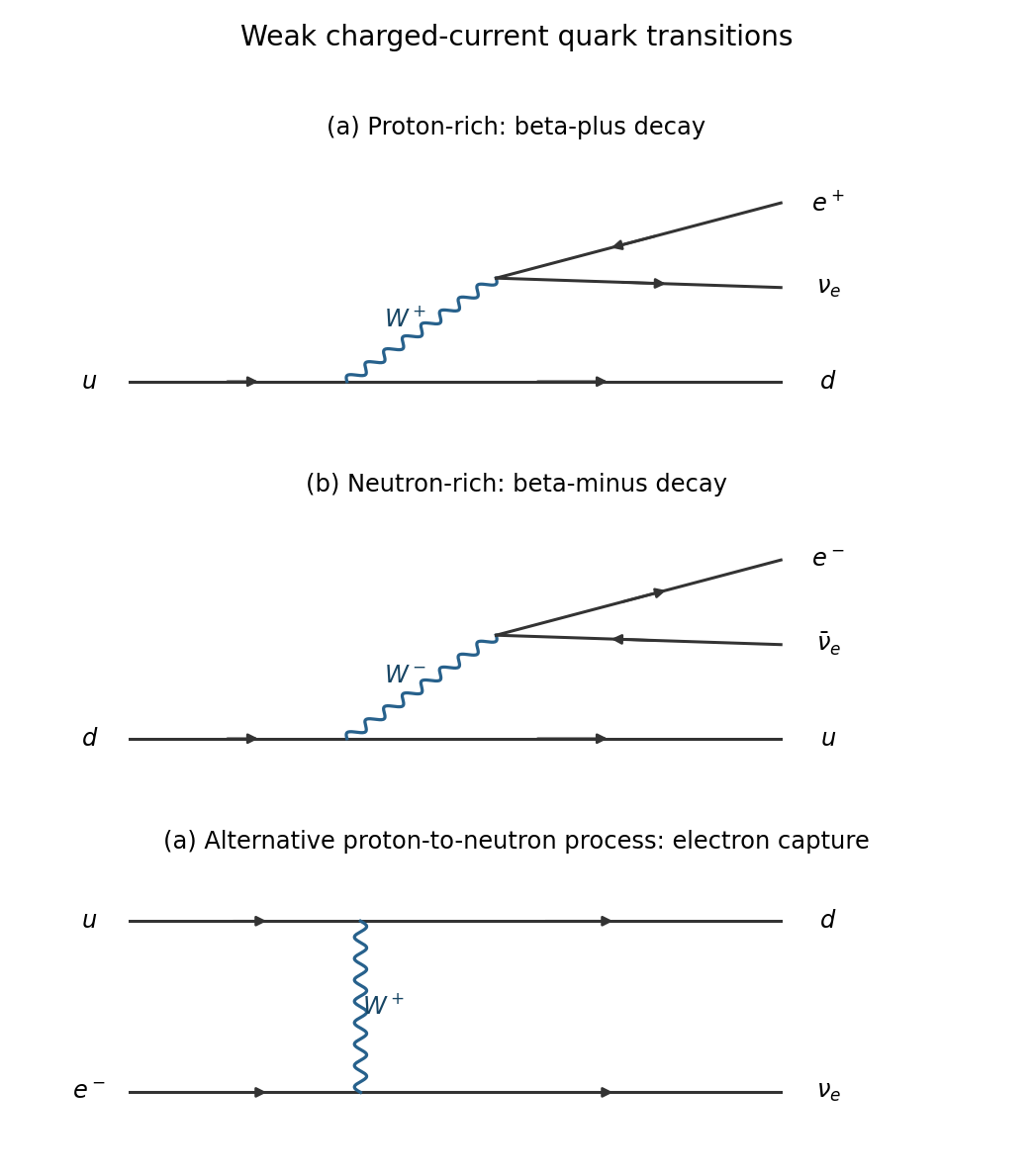
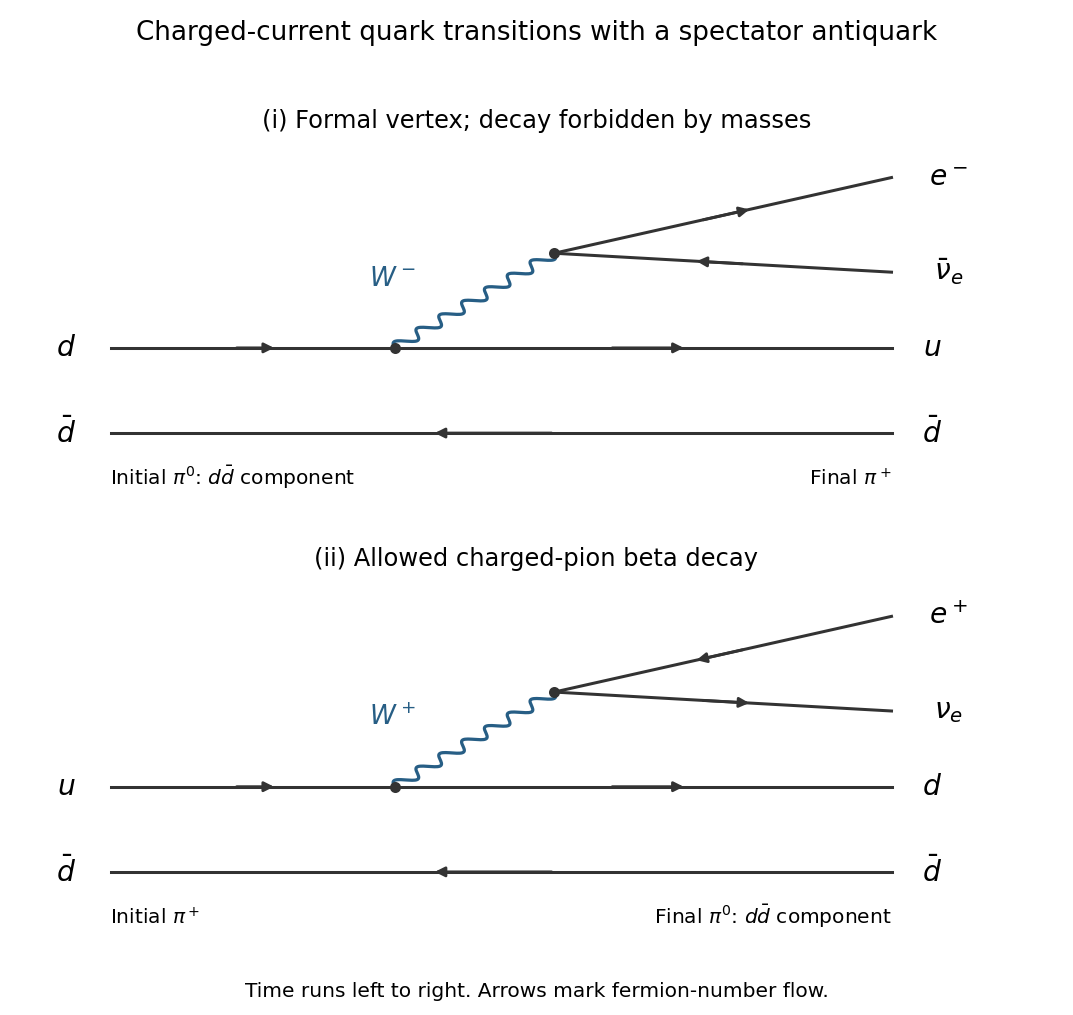
This is a weak charged-current decay. Panel (ii) has one vertex. The outgoing Positron and electron neutrino have total charge and cancelling lepton numbers. The W boson is on shell here; a second virtual boson is unnecessary.
Production and identification. At a hadron collider, initial partons carry fractions of the proton momenta; observable production rates combine parton-level amplitudes with parton distribution functions.
Why the three masses form a test. At tree level, electroweak symmetry breaking gives and . The Higgs mechanism relates masses to the vacuum field, but it does not by itself predict the top Yukawa coupling or the Higgs self-coupling, so the three masses are not fixed independently of measured parameters.
The stronger test comes from radiative corrections. With accurately measured , and , the electroweak precision test with the W, top and Higgs masses uses
The top-bottom loop contributes approximately , while the Higgs contribution has a characteristic logarithmic mass dependence. Hence direct measurements of and turn the precision calculation into a prediction for . Comparing that prediction with the direct W-mass measurement overconstrains the Standard Model; disagreement beyond experimental and theoretical uncertainties could indicate additional particles or interactions in the loops. The test concerns the relation among independently measured quantities, rather than merely the existence of the three particles.
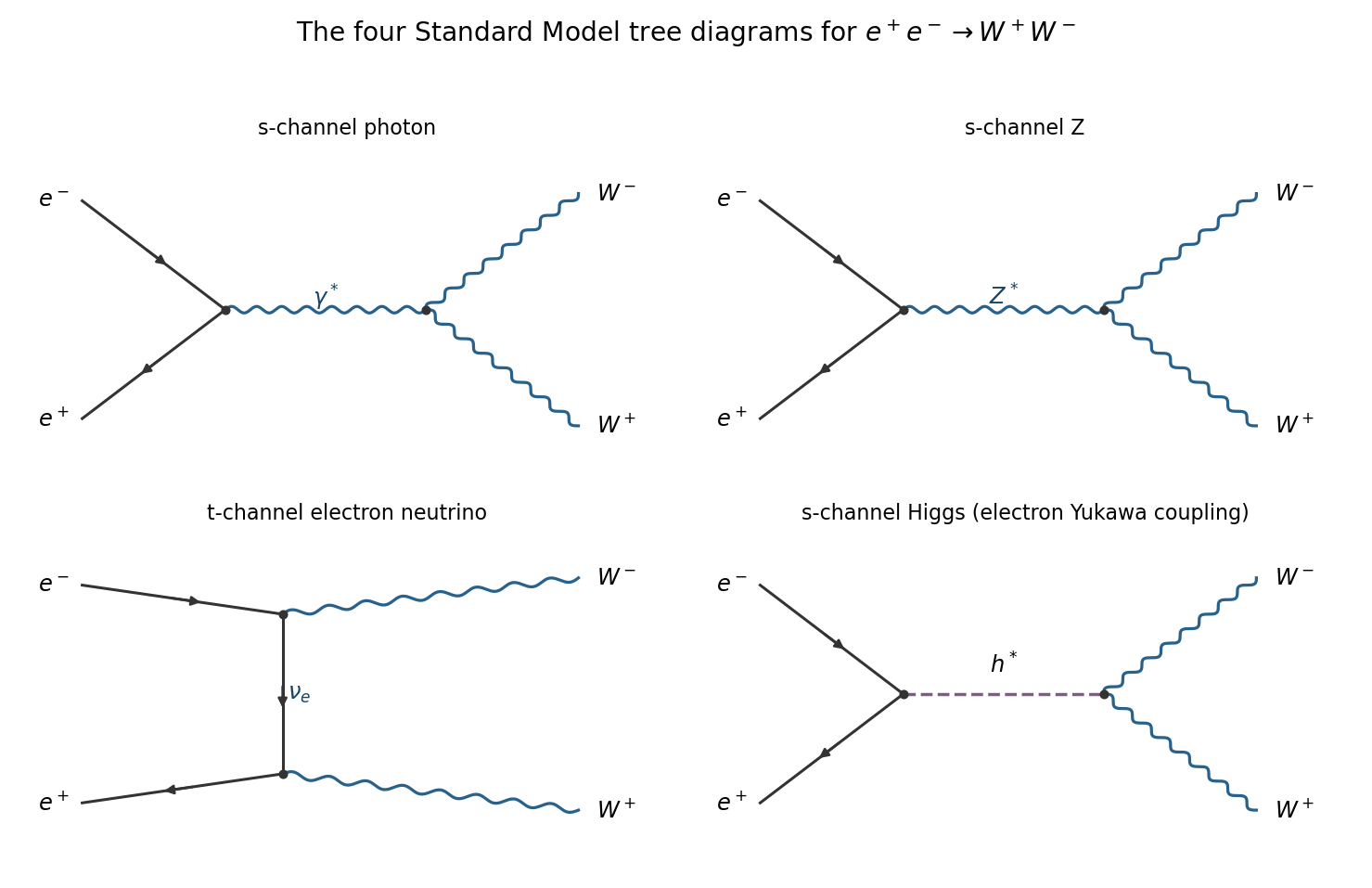
The four tree-level diagrams for electron-positron annihilation into W-boson pairs are
The first two diagrams contain the electromagnetic interaction and weak interaction neutral electron currents and the gauge boson self-interaction vertices and . The third has two weak charged current vertices joined by an electron neutrino propagator. In the fourth, the incoming electron-Positron pair couples to the Higgs boson, which then couples to .
The small factor is at the initial Higgs-electron vertex. With the usual electroweak vacuum value , electron Yukawa suppression of Higgs production gives
These are tiny compared with ordinary electroweak interaction gauge couplings. The decay amplitude for the Higgs boson diagram carries this small coefficient, and its separate squared contribution carries its square. Thus the Higgs diagram is negligible because the electron Yukawa coupling is proportional to the electron mass. It vanishes in the massless-electron approximation, even though the Higgs boson-W boson coupling itself is not small. The remaining three gauge diagrams must be added coherently, including their interference.
The nuclear determination of . A beta decay transition has no nuclear parity change and can proceed with zero lepton orbital angular momentum. The allowed scalar operator gives a Fermi transition; the rank-one Gamow-Teller transition operator cannot connect total nuclear spins zero to zero. The strong isobaric-analog transitions used for precision measurements are superallowed beta decays. A generic assignment alone would not guarantee superallowed strength if the states were nonanalog.
At the quark level the weak charged current converts and carries in the amplitude. The nuclear Fermi operator is an isospin ladder operator, giving
Here denotes the known phase space dependence, with the dimensional factors included in the proportionality constant. In the isospin-symmetric limit, between analog states is fixed by isospin algebra, for example for the usual analog transitions. A measured partial half-life and the computed phase space factor give the comparative half-life; after radiative corrections and isospin breaking corrections, its inverse determines . The decay rate measures a magnitude squared, not the complex phase of .
Ds decay diagrams and CKM comparisons. The original PDF has , with . The local TeX drops that overbar; using instead would give a different flavour channel. Use the PDF's neutral antikaon throughout.
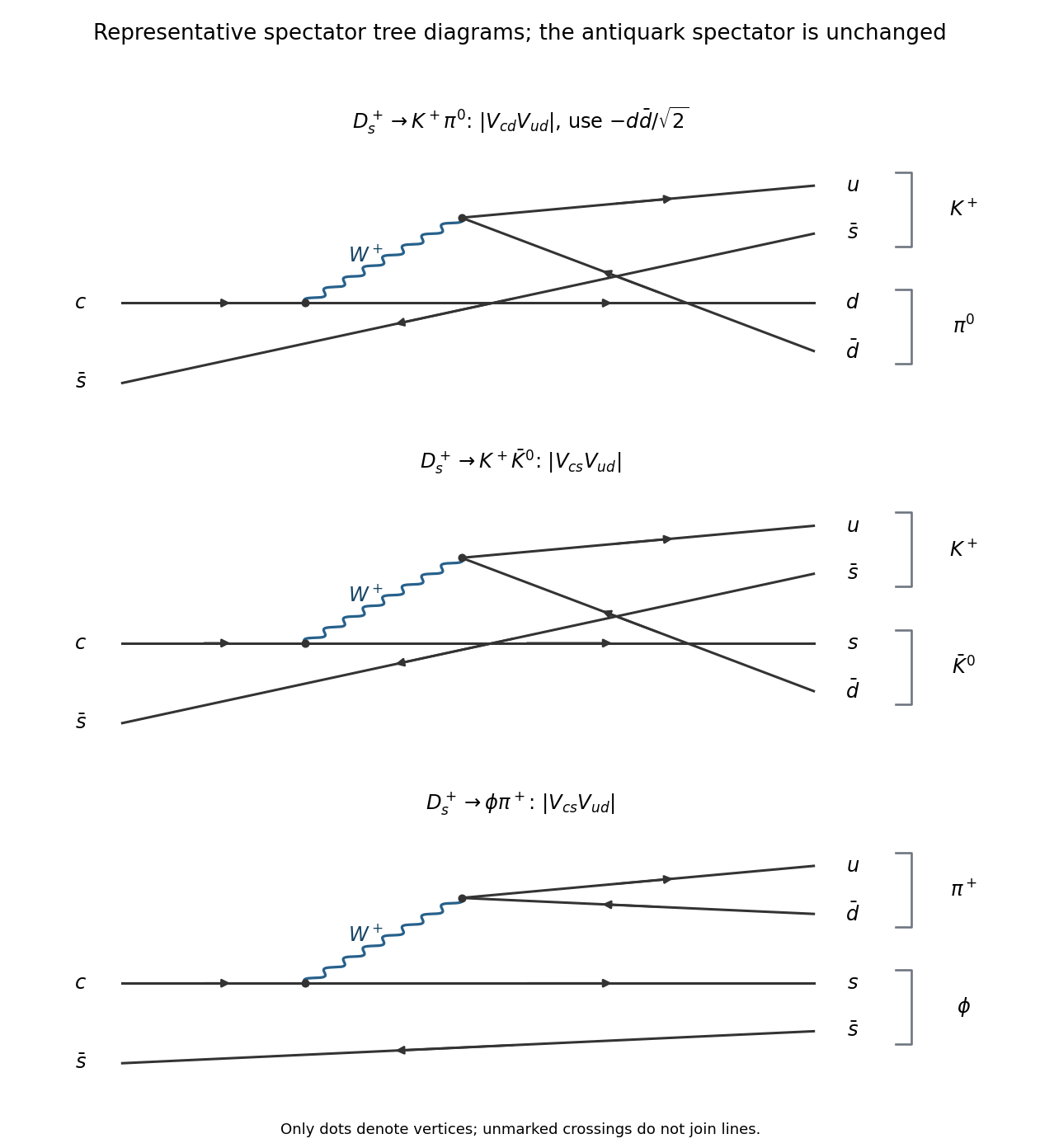
In the representative Ds nonleptonic tree amplitudes, the Ds meson spectator is . The elementary weak transitions are
Figure 1.
The three Ds spectator tree diagrams, using the neutral-antikaon channel in the original PDF
. Details.
In the first two channels, the produced joins the spectator to form ; the other quark joins . For the first channel this uses the component of the neutral pion. In the third, forms the phi meson and forms . The two possible final pairings have different colour contractions and hadronic matrix elements even when their weak CKM factors coincide.
The purely CKM rate suppression of relative to is
Thus is singly Cabibbo suppressed, while and are Cabibbo-favored at this level. If reduced hadronic strengths and phase space effects were equal, including the neutral-pion component would give
The supplied branching fractions instead give
The first observed ratio is times the neutral-pion-corrected simple estimate, requiring only an order-one remaining hadronic and phase space factor. Relative to , that remaining factor is . The two Cabibbo-favored channels differ by a factor despite equal CKM magnitudes. The CKM hierarchy therefore explains why one channel is much rarer, but it does not calculate the three exclusive branching fractions; spin, phase space, color charge and strong interaction final-state effects also matter.
What spin and parity establish. In either pseudoscalar-pseudoscalar final state, the total intrinsic spin is zero. Conservation of angular momentum for a spin-zero parent forces , so the final parity is
opposite to the parent Ds meson. Consequently
For a vector meson plus a pion, the intrinsic final spin is one. Coupling to total requires , giving , equal to the parent parity. Thus spin and parity alone permit a parity-conserving transition. That is the limited sense in which it is not necessarily weak from this information alone. In reality it is also weak: the initial charm flavour disappears, which the strong interaction and electromagnetic interaction conserve.
W branching fractions. In the massless-daughter, tree-level estimate, each leptonic channel contributes one common unit of decay width. Each accessible quark pair contributes because of the three final colours. The charged-current W branching-fraction counting denominator is
Only and are accessible up-type quarks; the large is irrelevant because a W boson cannot decay into the heavier top quark. Hence
A final bottom quark arises in or , so
This counts the primary decay channels; finite daughter masses and QCD corrections refine the approximation.
The requested top-lifetime estimate and its limitation. Under the instructed equal-coefficient Sargent's rule scaling, and the mean lifetime is inversely proportional to that fifth power. Converting both masses to GeV gives
This is the requested order-of-magnitude estimate, assuming the same effective coefficient for the two total decay rates. It corresponds to and is longer than the hadronization time, roughly a few . Taken literally, it would allow top-flavored hadrons to form; it does not establish the physical statement that the top decays before hadronizing.
The extrapolation fails because Sargent's rule uses a low-energy Fermi interaction approximation, whereas permits with an on-shell W boson. The physical leading decay width instead scales as
Using , the Fermi constant and gives about at the supplied top mass. Then , with , gives . This corrected regime explains top-quark decay before hadronization.[ref]
Count strangeness before drawing a weak interaction diagram. An Omega baryon has , a Lambda baryon has , a negatively charged kaon has , and a pion has . Thus the two nonleptonic baryon decays require
The strong interaction cannot supply either net change of strangeness.
Figure 1.
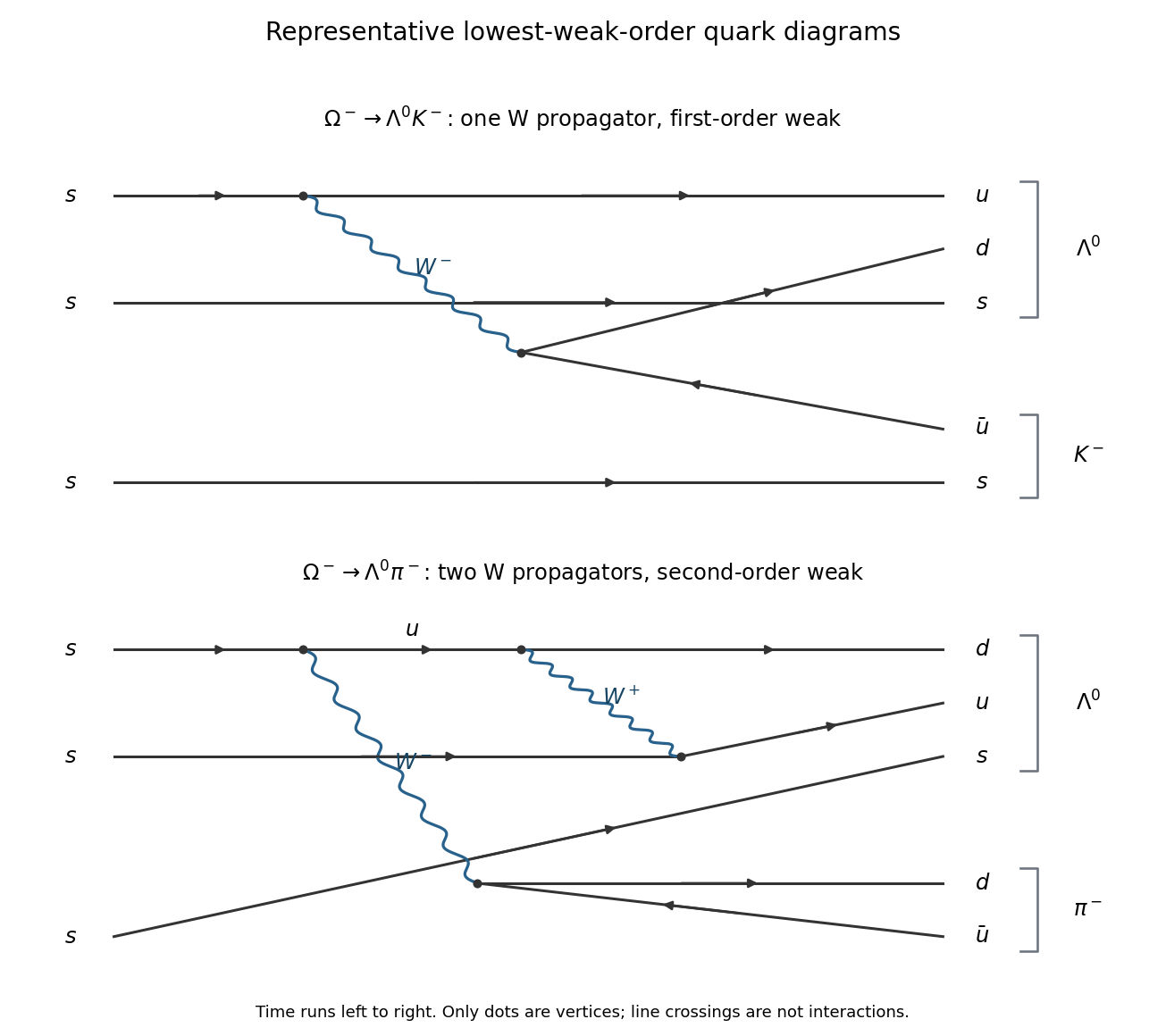
One-W and two-W quark diagrams for the two Omega decay channels
. Details.
In the upper Feynman diagram, one initial strange quark undergoes the weak charged current transition
The remaining two strange quarks are spectator quarks. Combine the outgoing and one spectator into the Lambda baryon, and the remaining with into the kaon. This uses one W boson propagator and two weak interaction vertices. Its Cabibbo-Kobayashi-Maskawa matrix factor has magnitude .
For the lower Feynman diagram, let the upper initial first emit a and become a virtual , then emit a and become a . The is absorbed by a second initial , turning it into a ; the third initial remains a spectator quark. The emitted produces . The complete quark flavour flow is therefore
The final form the Lambda baryon and the other form the pion. Electric charge conservation holds at every vertex. Internal lines are virtual; this is a contribution to one decay amplitude, not a sequence of freely propagating on-shell constituent-quark decays.
This is a possible lowest-weak-order diagram for a second-order strangeness-changing weak decay: it has two W boson propagators and four weak interaction vertices. Its Cabibbo-Kobayashi-Maskawa matrix factor has magnitude in the displayed light-quark topology. Other contributions can exist, but a single charged-current insertion cannot turn two net strange quarks into nonstrange ones. No extra loop Feynman diagram is compulsory: the displayed two-W tree already realizes the required quark flavour change.
At low energies, one-W exchange produces one power of the Fermi constant in an effective decay amplitude; the second process requires an additional weak insertion. Hadronic matrix elements and propagators supply the accompanying dimensions, so a numerical ratio cannot be obtained by simply squaring a dimensionful constant. The robust comparison is
The dominant reason is the extra weak order, with additional Cabibbo suppression in this representative topology. It is not a comparison between a strong decay and a weak decay.
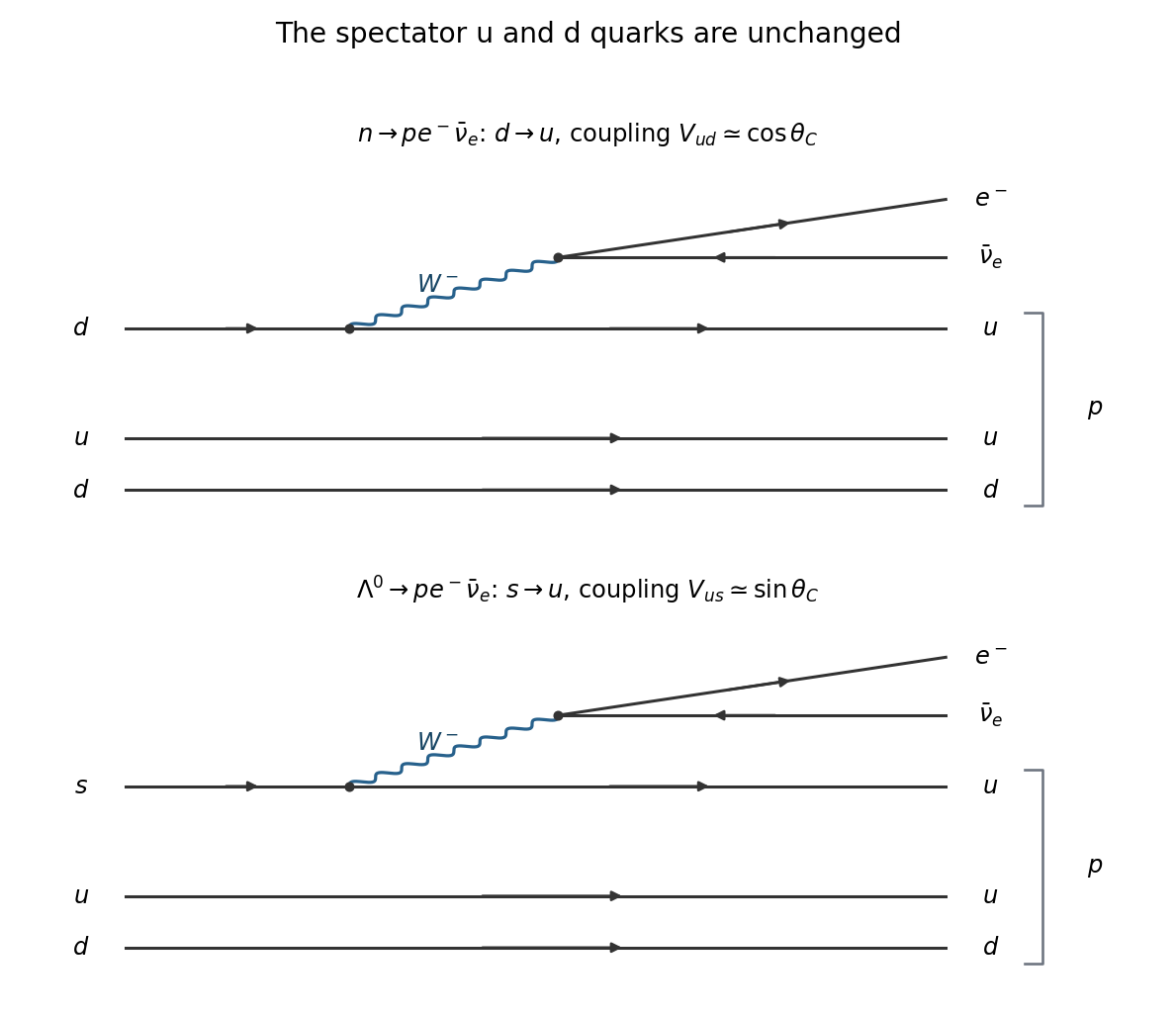
In both semileptonic decays, an active quark emits a virtual W boson, which produces an electron and an electron antineutrino:
The unchanged spectator quarks combine with the produced into the final proton. The relevant Cabibbo-Kobayashi-Maskawa matrix elements are and .
Figure 1.
Neutron and Lambda semileptonic decay diagrams and their Cabibbo factors
. Details.
Use the quoted masses in energy units, equivalently natural units , and define the energy releases before subtracting the electron rest energy as
The prescribed density of states ansatz uses precisely these differences to the fifth power. A Cabibbo-angle extraction from semileptonic decay rates also needs a common reduced hadronic strength. In that approximation the partial decay rates, measured in , are
The supplied mean lifetimes describe all decays, so multiply their inverses by the relevant branching fractions:
Taking their ratio cancels and gives
Choose the conventional first-quadrant Cabibbo angle:
The Lambda baryon partial rate is much larger despite its smaller weak flavour coupling because the fifth-power phase space factor is enormous.
There is an assumption beyond the stated density of states ansatz: the neutron and Lambda reduced hadronic strengths have been set equal. If their ratio is , the same data instead imply . Without specifying , the angle is not uniquely determined. Unequal hadronic form factors, finite electron mass and recoil make the displayed common-strength result an exercise-level estimate, rather than a precision measurement.
The original chart has vertically and horizontally. Thus its region (a) is proton-rich relative to the beta-stable band, whereas (b) is neutron-rich.
Electron capture, , is the other proton-to-neutron weak process; it remains possible for some neutral atoms whose beta-plus decay lacks the atomic-mass threshold.
  • In the heavy region (e), alpha decay moves the parent down and left:
The emitted alpha particle contains two protons and two neutrons. Very heavy nuclei can also compete through nuclear fission; the chart alone does not determine each nuclide's branching fractions.
Figure 1.
Quark-level beta-plus, beta-minus, and electron-capture processes
. Details.
The quark transitions are followed by in (a), and followed by in (b). The additional panel shows electron capture as through W boson exchange. The remaining quarks in each nucleon are spectators.
Regions (c) and (d) lie beyond the proton and neutron binding limits, respectively. In (c), unbound protons can be emitted, ; in (d), unbound neutrons can be emitted, . These are the proton drip line and neutron drip line limits, with one- or several-nucleon emission possible according to the nuclear separation energies. They are not merely more distant points on a beta-decay trajectory.
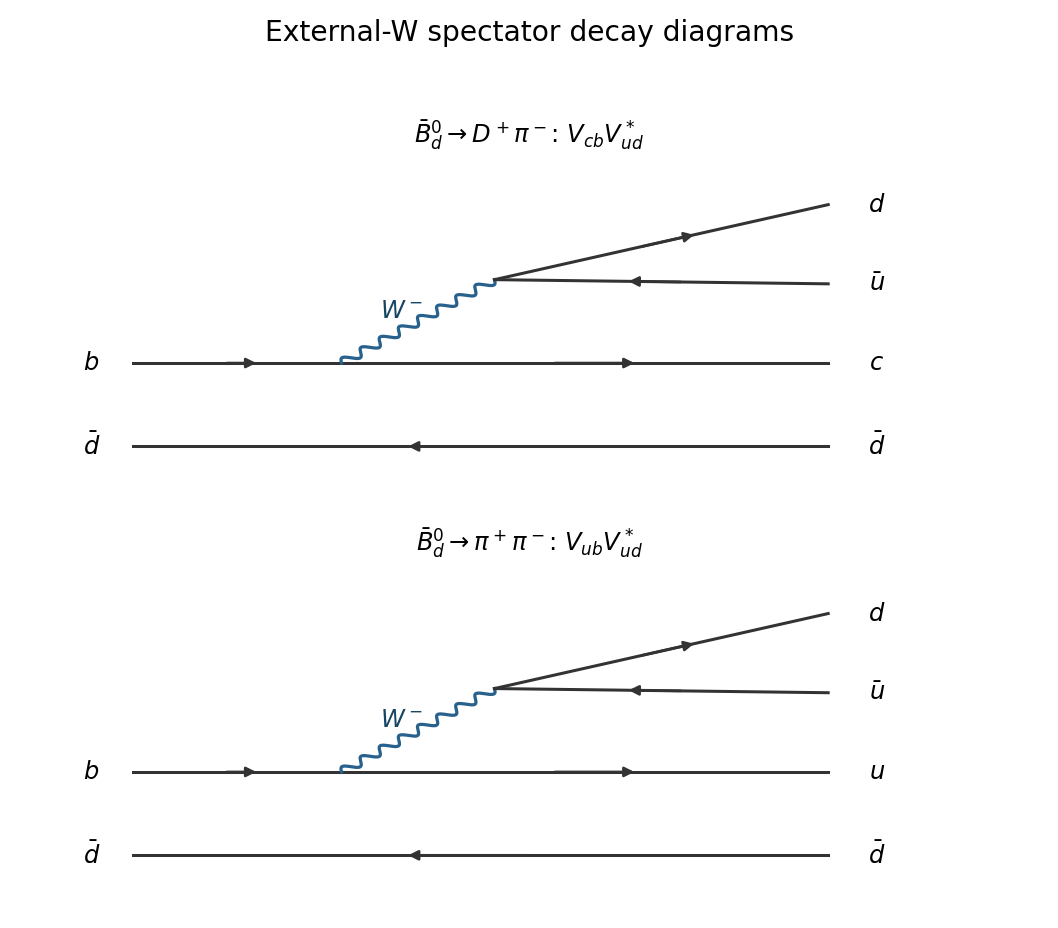
The antiquark in the specified is a spectator. For the charmed final state the leading external-W boson tree is
with and . For the charmless final state replace the active transition by , giving and the same . Their weak amplitudes have factors and , respectively, up to an irrelevant overall conjugation convention.
Figure 1.
Leading spectator diagrams for the charmed and charmless neutral-B decays
. Details.
The diagrams determine the leading weak flavour factors. Strong-interaction matrix elements and, particularly for the charmless channel, additional loop diagrams can also contribute to physical branching fractions.
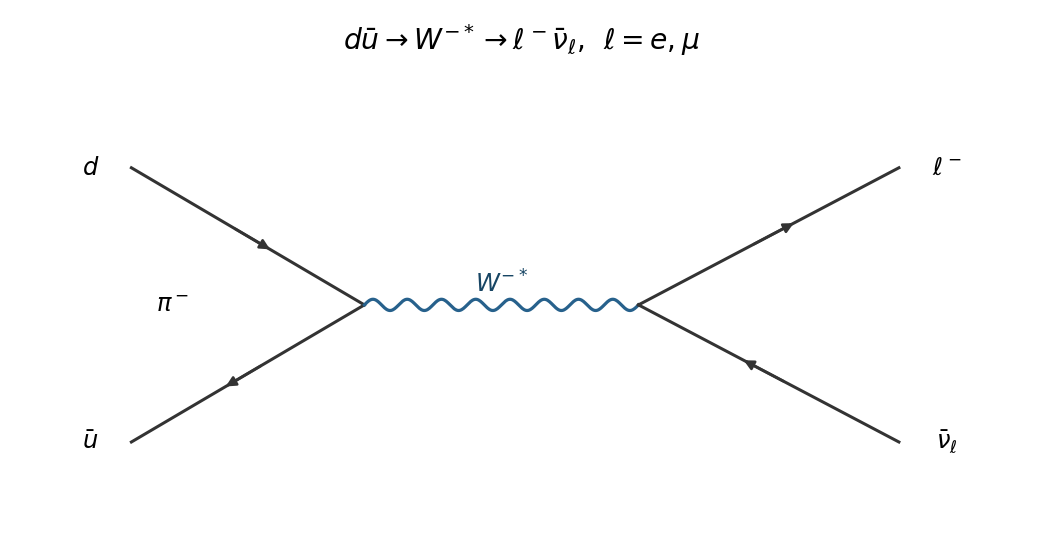
The charged pion has valence content . Its constituents annihilate into a virtual W boson, followed by the lepton pair:
Figure 1.
The leading quark-level charged-pion leptonic decay diagram
. Details.
The quark vertex carries the -- Cabibbo-Kobayashi-Maskawa matrix element, and the leptonic vertex is the weak charged current. The pion's nonperturbative spatial structure is encoded in the pion decay constant when evaluating the decay amplitude.
Use the usual Feynman rule convention in which the diagonal quadratic terms of the free Lagrangian, including the physical W boson and Z boson masses, are incorporated into their propagators. Then there are
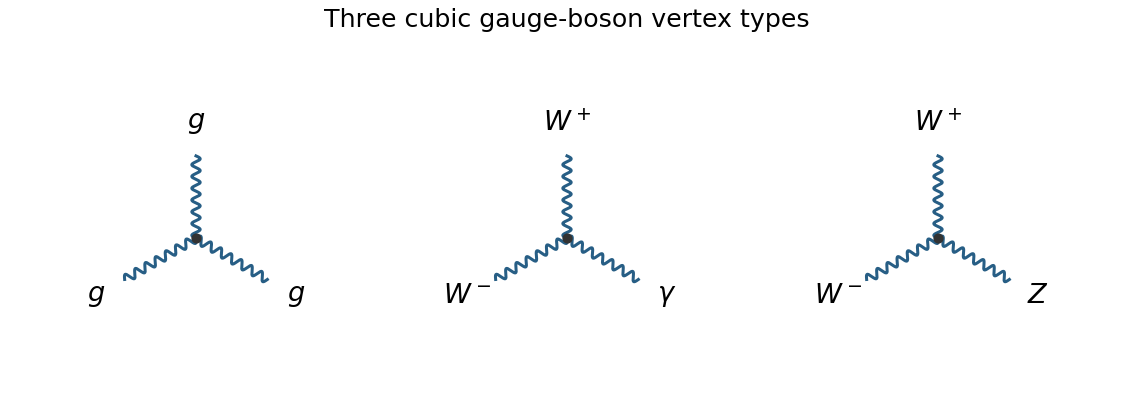
A line joining two ends is a propagator, not an interaction vertex. Gauge boson self-interactions begin with cubic terms in the Yang-Mills theory Lagrangian. The question's name four families: they include eight gluon colour components and the two charged W bosons .
There is a convention to distinguish here: if a calculation expands around massless free fields, quadratic and terms may be drawn as two-leg mass insertions. Those two insertion types belong to that bookkeeping convention. Similarly, two-point self-energy corrections occur in loop diagrams. Neither is an additional fundamental interaction in the standard physical-mass, tree-level rules used for the count above.
There are three vertex types, with all legs labeled in the following original drawings:
Figure 1.
The three fundamental cubic gauge-boson vertex types
. Details.
The gluon cubic interaction vertex follows from the non-Abelian gauge field strength of quantum chromodynamics. The electroweak Yang-Mills theory Lagrangian, after expressing the fields in the physical charged and neutral basis, produces the two charged-W boson vertices. In particular there are no fundamental , , , or vertices, and the separate colour and electroweak gauge factors do not generate a mixed or vertex. The count is by the boson labels requested, not by separate assignments of gluon colour indices.
Both formal processes use one weak charged current transition, with a virtual W boson producing the lepton pair. Two representative lowest-order quark-line diagrams are shown below. They use the component of ; attachment to the antiquark line in the component gives the other contribution to the same hadronic current.
Figure 1.
Representative quark-line diagrams for the two formal pion beta transitions
. Details.
In the first diagram, and , with a spectator quark. In the second, and , again with a spectator . The diagram for the first process describes the coupling but cannot make an energetically forbidden on-shell decay occur.
From the original tables,
Therefore the first process has Q value
and is forbidden for an isolated pion. The second has
The table therefore lists only the second, pion beta decay, with
Its tiny branching fraction combines a weak interaction with an exceptionally small available energy. An allowed semileptonic transition has a decay width scaling approximately as , where , with electron-threshold and recoil corrections. The fifth power makes the few-MeV gap especially restrictive. Unlike direct , this semileptonic channel is not forced to have an amplitude proportional to ; its primary extra suppression is the small phase space. Its approximately Cabibbo-favoured current does not supply a further large flavour suppression. The observed branching fraction corresponds to a partial decay rate of about , competing with the much faster dominant muonic decay.
Use the parton model, neglect antiquarks, binding and target mass corrections, quark masses, muon mass, QCD scaling violation and the W boson propagator correction. The struck quark is effectively free during the short interaction and carries parton momentum fraction , giving . The charged current reaction is . Its helicity amplitude has the same factor as in a. Define the effective parton distribution function by , summing only kinematically accessible final quarks; for valence-only protons and accessible this is approximately . It is not the unweighted sum .
Here is the inclusive deep inelastic scattering variable, and in the scaling limit. Integrating gives , hence
The moment measures the momentum fraction in the active quarks. Approximate linearity is evidence for scattering from pointlike spin-one-half constituents with approximately scale-independent parton distribution functions, rather than coherent scattering from an extended proton. It is an intermediate-energy prediction: thresholds, experimental deep inelastic scattering cuts, QCD scaling violation and eventually the finite W boson propagator modify it.
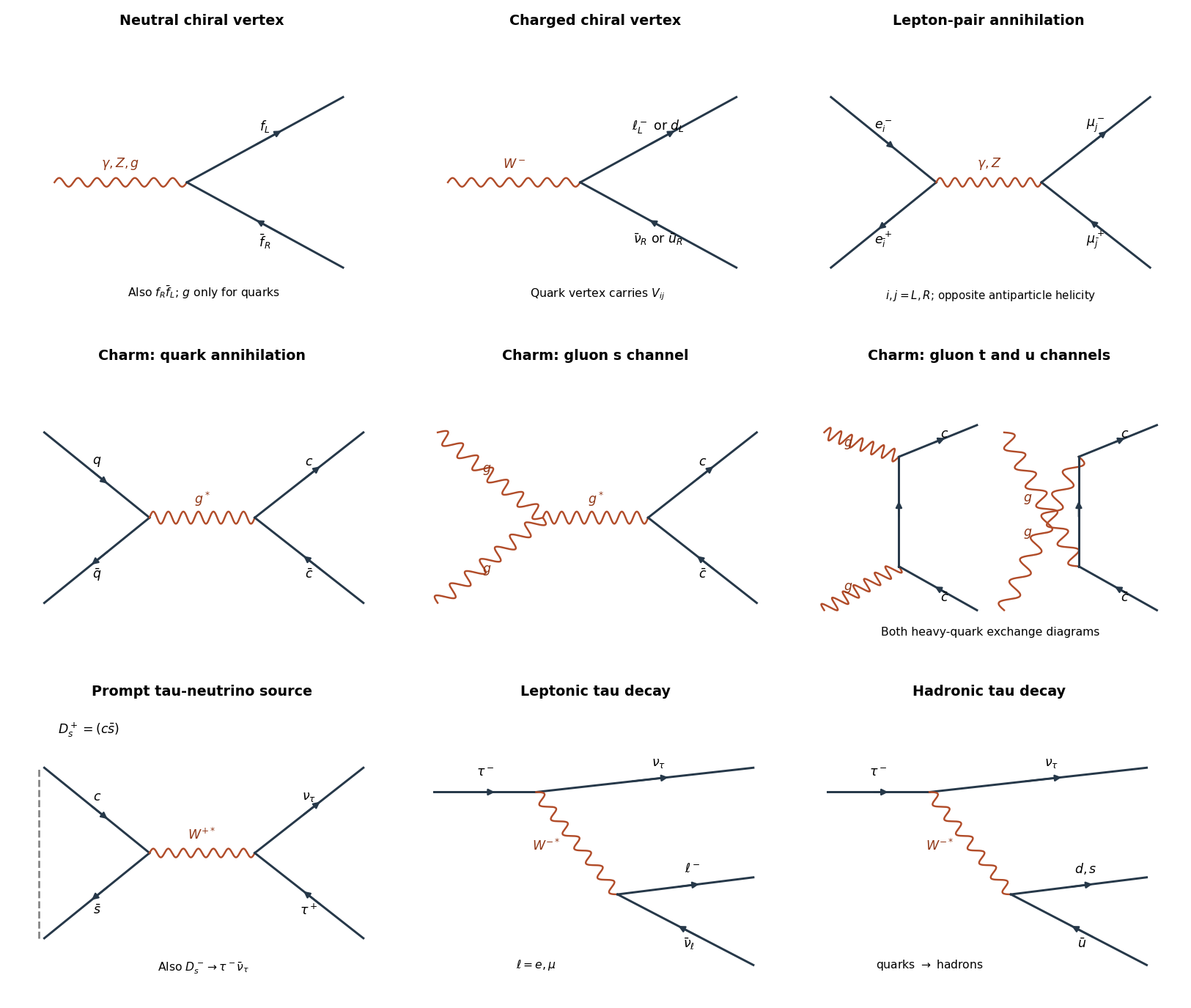
At energies large compared with fermion masses, the gauge interactions preserve chirality on each fermion line. A photon couples to charged fermions with equal left and right coefficients . A gluon couples to either quark chirality with coefficient . A Z boson couples to both, with coefficients on left-chiral fields and on right-chiral fields. A W boson couples only to left-chiral fermions and the associated right-helicity antifermions: or , and the charge-conjugate channels. For quarks the coefficient includes the CKM matrix. There is no Standard Model right-chiral neutrino gauge vertex.
For outgoing pairs at a neutral vertex, the allowed helicities are and ; the latter labels helicity, not the chirality of the corresponding antifield. Only the -channel photon and Z boson diagrams contribute to at tree level among these gauge exchanges. A W boson changes charged leptons into neutrinos, and gluons do not couple to leptons.
Figure 1.
Feynman diagrams for chiral gauge vertices, annihilation, charm production and tau decay
. Original diagrams. Fermion arrows denote fermion-number flow; dashed binding brackets indicate a meson projection, not a perturbative vertex. Neutral vertices allow the two opposite-helicity outgoing pairs listed in the solution. Details.
At the Z boson pole, the accessible primary fermion pairs are , , , the three channels, and . The top quark is too heavy. The charged channels also have photon exchange, and the electronic channel has a substantial nonresonant Bhabha scattering contribution. On-shell W boson pairs are above threshold; they are not primary decays.
A tau lepton pair gives two approximately back-to-back narrow low-multiplicity cones, usually one or three charged tracks per cone, with overall charge zero and missing energy and momentum from neutrinos. Opposite hemispheres can show electron, muon or hadronic tags. A decay vertex or track impact-parameter information helps establish the short tau lepton flight. Reject Bhabha scattering and dimuon events by their nearly full visible beam energy, particle identification and little missing momentum; reject ordinary quark multijets by their broader high-multiplicity activity and larger visible invariant masses. Control two-photon backgrounds with visible transverse momentum, forward activity and event geometry. Selection efficiencies depend on decay mode and must be calibrated.
The CKM matrix appears in the charged current of b. For a tree semileptonic transition, a schematic extraction is . Measure an absolute rate or differential spectrum, calculate or independently determine the hadronic factor, and solve for the modulus. The process is not a direct count of quark flavours in a detector: form factors, decay constants, nuclear structure and radiation can limit the result.
  • : superallowed nuclear beta decay, with neutron and pion beta decay cross-checks; correct for nuclear and radiative effects.
  • : spectra with the form factor; compare and using decay constants.
  • and : exclusive and , or inclusive charmless/charmed semileptonic spectra; separate the rare charmless component and control the hadronic calculation.
  • and : charm semileptonic or leptonic decays with form factors or decay constants, and charm production by neutrinos; charm-tagged W boson decays give a complementary constraint.
  • : single-top quark production and the ratio of to all decays, under stated assumptions about allowed interactions.
  • and : neutral B-meson mixing frequencies and rare loop-induced decays, with loop dynamics and hadronic inputs. Mixing-frequency ratios cancel some common uncertainties.
Rate moduli alone do not determine the complex phase. CP-asymmetric decay distributions and interference in neutral-meson systems, or tree-level interference, constrain the phase and the CKM unitarity triangle. Unitarity supplies consistency checks and indirect determinations, but a fit that imposes it must be distinguished from a direct measurement of an element.
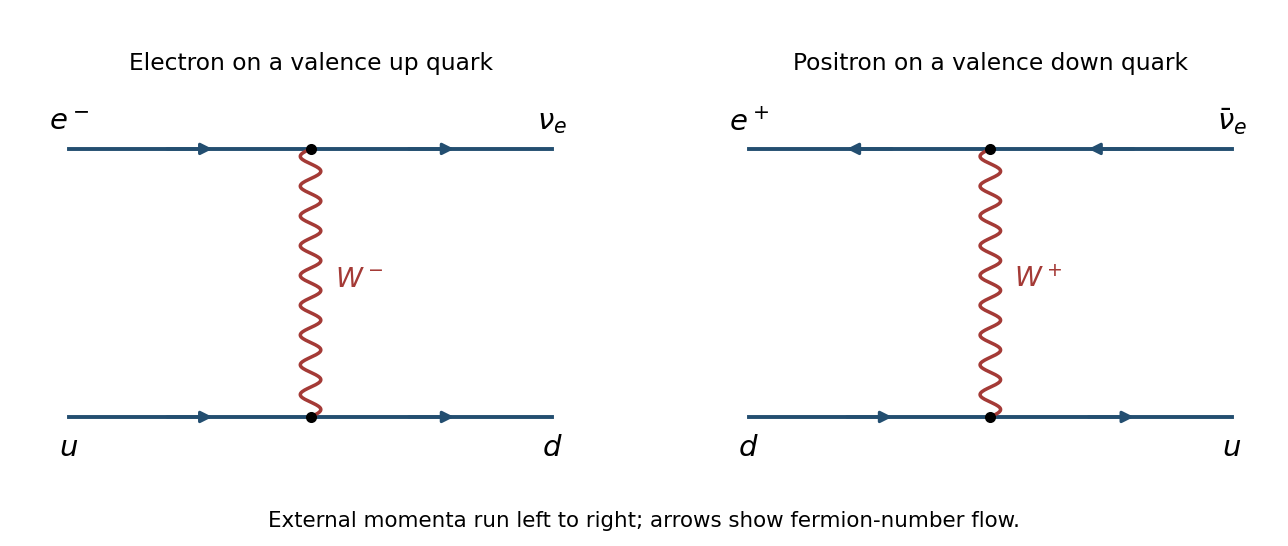
At the parton level, the dominant valence reactions are through W boson exchange and through W boson exchange. The first also acts on , while the second acts on with the appropriate Cabibbo-Kobayashi-Maskawa matrix factors; crossing supplies the antiquark reactions. The lines in the figure show fermion number flow; the Positron and antineutrino arrows point opposite to their momenta.
For unpolarized beams, the leading charged current cross sections, suppressing Cabibbo-Kobayashi-Maskawa matrix factors, have the form
Here each parton distribution function is evaluated at . The proton has two valence up quarks and one valence down quark; moreover, its valence contribution in the Positron reaction carries the chiral angular factor . Both effects favour . Increasing at fixed collider energy enforces , progressively suppressing the sea relative to the valence quarks; large further suppresses the Positron valence term. There is no universal factor of two valid at every .
The escaping neutrino prevents direct reconstruction from a scattered charged lepton. Instead use the Jacquet-Blondel reconstruction. With the axis along the proton beam, measure the complete hadronic final state and form
These relations follow from four-momentum conservation, with the unobserved neutrino transverse momentum opposite to the measured hadronic sum. A nearly hermetic hadronic calorimeter, supplemented by tracking detectors, must measure jets, their energies and their directions. Forward losses, initial-state radiation and small cause significant reconstruction uncertainties.
The photon propagator gives approximately , whereas a massive W boson gives . Up to different coupling constant values, parton distribution functions and angular factors,
Consequently the low- charged current suppression disappears as approaches . The source graph shows comparable cross sections at of order , so the relevant mass scale is of order .
A more quantitative, still rough reading uses the ratio near and near , where denotes , not . If varies slowly over this interval, set . Then
The reading is compatible with roughly –; it is not a precision mass determination. In particular, Z boson exchange contributes to the neutral current at high , and the parton distribution functions do not cancel exactly. Equality of two inclusive cross sections alone does not define .
The local Fermi interaction gives a three-body leptonic decay width of the form
at tree level with negligible neutrino masses and universal weak coupling constant values. The fifth power follows from the dimension of and the three-body phase space; results from integrating the V-A interaction matrix element over the reduced phase space when the charged daughter has nonzero mass. It is more than a purely geometric volume correction because the spin-dependent matrix element is included.
As , ; increasing daughter mass reduces the available energy and suppresses the rate. The largest ratio is , so the correction is visibly below one. The electron is extremely light relative to either parent. Using the lepton masses gives
These reproduce the supplied factors to their stated accuracy. Radiative and finite-W boson corrections are separate small corrections when a precision lepton universality test is performed.