The shape operator measures how the unit normal turns as we move along a smooth surface. A plane has a constant unit normal, whereas the outward unit normal of a sphere turns in every direction in the tangent plane. Keeping the direction of this change, rather than just its magnitude, lets one recover the principal curvatures and their principal directions.
Choose an orientation of a surface , with Gauss map . The shape operator at is the linear mapHere is the differential of the Gauss map. Its output belongs to , identified with because both are the vector plane perpendicular to . The minus sign is our convention throughout this branch. [ref]
https://ghomi.math.gatech.edu/Classes/Math497C/LectureNotes9.pdf. Ghomi, Lecture Notes 9, §2.2: Gauss map and shape operator
The shape operator packages the second fundamental form as an operator using the inner product supplied by the first fundamental form:The symmetry of the second fundamental form makes the shape operator a self-adjoint operator for this inner product. Thus an orthonormal basis of principal directions diagonalizes it. In a coordinate basis of a parametric surface, writeThe matrix need not be a symmetric matrix in this coordinate basis: its self-adjointness means . Using the eigenvalues of alone gives the principal curvatures only when is the identity matrix. [ref]
For a worked example, parametrize the lateral surface of an outward-oriented circular cylinder of radius using circumferential arc length and axial coordinate :The coordinate tangent vectors are an orthonormal basis. Since and , the shape operator satisfiesChanging to angular coordinate gives and ; still has eigenvalues . This is why the first fundamental form must participate in the calculation.
For a sphere of radius centered at the origin, the outward unit normal is . Hence , so both principal curvatures are . For a plane, and the shape operator vanishes. Reversing the unit normal negates the shape operator and both principal curvatures; the Gaussian curvature remains unchanged while the mean curvature changes sign, as in orientation reversal of surface curvature.
For a normal vector , this identity defines the corresponding shape operator using the vector-valued second fundamental form. It is self-adjoint because of the symmetry of the second fundamental form. Differentiating shows that . In higher codimension there is a different operator for each normal direction.
The Weingarten formula decomposes the ambient derivative of a normal field into a tangential shape operator term and the normal connection. The minus sign corresponds to . For the outward unit normal of a unit sphere, with this convention.
At a point of a smooth surface, a normal section of a surface can bend by different amounts depending on its tangent vector. The principal curvatures are the largest and smallest signed normal curvatures among unit tangent vectors. Equivalently they are the two eigenvalues of the shape operator, with an orthonormal basis of corresponding principal directions. Here the labels follow the selected directions, without requiring . [ref]
https://ghomi.math.gatech.edu/Classes/Math497C/LectureNotes10.pdf. Ghomi, Lecture Notes 10, §2.3.3: normal curvature and principal curvatures
For a unit tangent vector making angle with , Euler formula for normal curvature givesThe normal curvature is a weighted average of the principal curvatures; the extremes occur in the principal directions. If the principal curvatures coincide, every direction in the tangent plane is a principal direction: this is an umbilical point. The Gaussian curvature and mean curvature summarize the pair by
For an outward-oriented sphere of radius , both principal curvatures are , so the normal curvature is in every direction. For an outward-oriented circular cylinder, choose around the circumference and along the axis. The principal curvatures are , giving ; halfway between the principal directions, .
At the origin of the upward-oriented hyperbolic paraboloid , the principal directions are the coordinate axes and the principal curvatures are in the chosen length unit. Thus , with zero normal curvature at . Zero normal curvature in these directions coexists with Gaussian curvature : the shape operator is not zero. The mean curvature is zero at this point; this does not say that the whole hyperbolic paraboloid is a minimal surface.
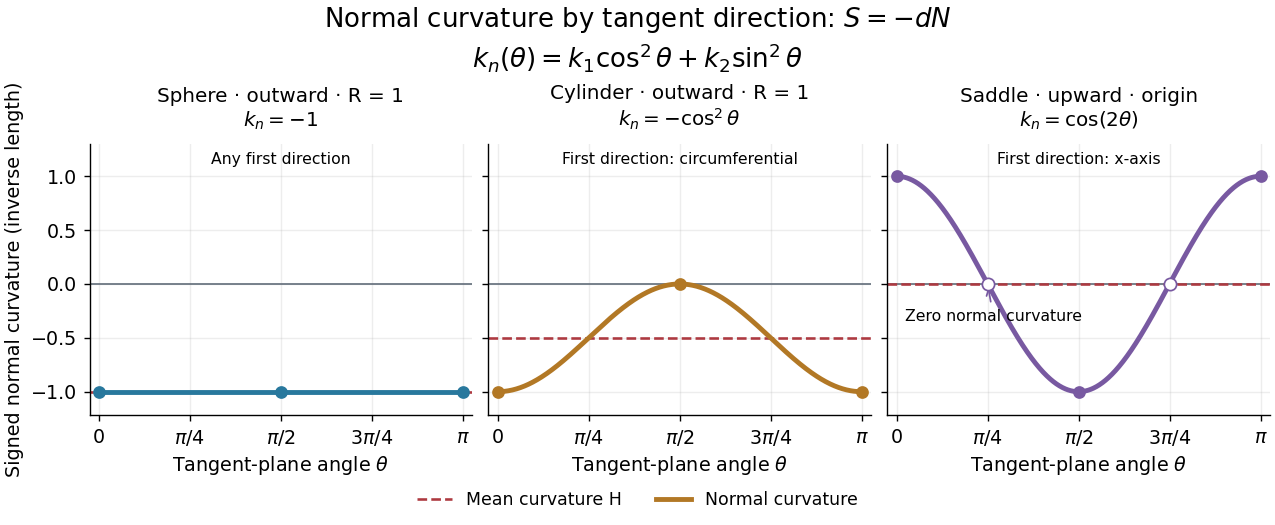

Each graph uses angle in the tangent plane, measured from the indicated first principal direction. The sphere and circular cylinder have ; the saddle graph refers only to the origin. Reversing the unit normal reflects each normal curvature graph through zero, negates both principal curvatures and the mean curvature, and preserves their product, the Gaussian curvature.
A principal direction is an eigenvector of the shape operator. The normal curvature in a unit principal direction is the corresponding principal curvature.
An umbilical point of a surface is a point where the two principal curvatures are equal, equivalently where the shape operator is a scalar multiple of the identity.
For a proper Euclidean motion of Euclidean three-space , transport the unit normal by . The corresponding shape operators are orthogonally conjugate:Their determinant and trace, hence Gaussian curvature and mean curvature, are unchanged.
Articles by others on the same topic
There are currently no matching articles.