Topics (384k) Articles (398k) Users (410) Discussions (242) Comments (383) Files (13k) New article

Small-amplitude oscillatory shear probes linear viscoelastic response by imposing and resolving the stress into components in phase with strain and strain rate.
A parallel-plate rheometer shears a sample in a thin gap between coaxial disks. Rotation at angular speed gives local shear rate , so differentiating the measured torque with respect to rim shear rate can recover a generalized-Newtonian viscosity.
A Lehmann representation inserts complete energy eigenstates into a correlation function, expressing its frequency dependence through transitions and operator matrix elements. For a Hermitian bosonic operator in a thermal retarded correlation function, the spectral weights contain at energy differences .
Here . A Wightman correlation function instead has the appropriate single occupation weight rather than the same difference, and fermionic ordering changes the thermal combination. The chosen correlation function therefore matters. This representation connects spectral features to allowed transitions and provides the basis for analytic continuation between imaginary- and real-frequency functions. A transition continuum produces a continuous spectral contribution rather than only isolated poles.
An infinite residually finite group is not a simple group. For a nonidentity element, residual finiteness supplies a map to a finite group in which it survives. Its kernel is proper and cannot be trivial, since an infinite group cannot inject into a finite group.
A kernel method represents data through a positive-semidefinite kernel, allowing algorithms to use inner products in an implicit feature map.
The reproducing property is ; it turns point evaluation into an inner product with a kernel section.
A renormalization-group flow tracks how a theory's effective couplings change as the observation scale changes. A coarse-graining step averages short-distance degrees of freedom and rescales the remaining variables, producing a new description for longer-distance measurements.
For dimensionless couplings and a logarithmic length scale , write . A renormalization-group fixed point has all beta functions zero. Near it, some perturbations grow and others shrink, giving relevant operators and irrelevant operators. This explains how distinct microscopic models can approach the same long-distance behavior. The sign convention matters: a beta function defined using increasing energy has the opposite scale direction from one defined using increasing length.
The engineering dimension of a field, parameter or operator is its dimension under the rescaling that leaves the quadratic theory invariant. Interactions can change it into a full scaling dimension.
The momentum-shell renormalization group splits a field into slow modes below and fast modes in , integrates out the fast modes, then rescales momenta and fields to restore the cutoff and kinetic normalization.
Wave-function renormalization rescales a field so that its kinetic term or propagator residue has the chosen normalization. Its scale dependence gives the field's anomalous dimension.
Variational regularization reconstructs an unknown by balancing data fit with a penalty expressing desired structure. A standard model isThe linear operator predicts data, denotes observations, and the extended-real functional can impose smoothness, sparsity or hard constraints. This construction includes nonlinear reconstruction maps even when itself is linear.[ref]
Modern Regularization Methods for Inverse Problems by Martin Benning and Martin Burger. §5, Definition5.1, equation(47), printed pp19–20
For , the model is quadratic Tikhonov regularization. For , the penalty controls the total variation seminorm on a domain and can retain jumps without demanding a square-integrable classical gradient. Adding the indicator functional of a constraint set enforces constraints such as nonnegativity.
Existence, uniqueness and stability are separate conclusions. A direct method in the calculus of variations requires suitable compactness of bounded-energy sets and lower semicontinuity; convexity alone does not supply compactness. A unique minimizer at fixed also does not prove convergence to the true object as noise vanishes: the regularization parameter choice must balance bias and noise.
For a bounded linear operator between Hilbert spaces and , Tikhonov regularization minimizesThe quadratic norm penalty makes this functional a strictly convex, coercive function, yielding the unique minimizer displayed in the title. Here is the adjoint operator and the identity operator. Our regularization parameter multiplies the squared norm directly. Hansen's notes instead write : the same reconstruction requires , not .[ref]
https://www.imm.dtu.dk/~pcha/Regutools/RTv4manual.pdf. Per Christian Hansen, Regularization Tools, §§2.4 and 2.7.1
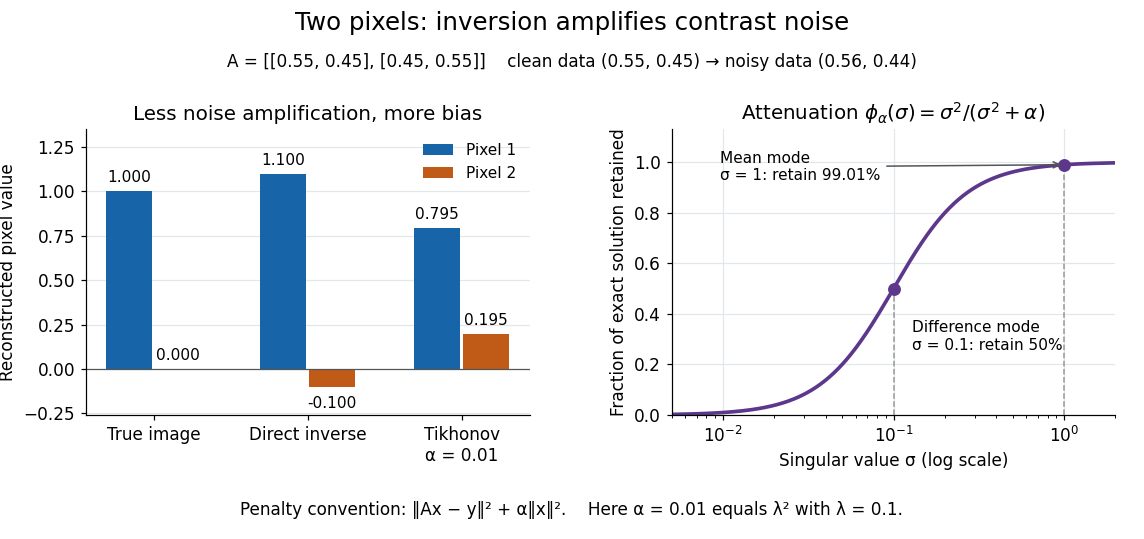
For a real matrix with singular value decomposition , the exact reconstruction isThe singular-system Tikhonov filter is the data-to-solution gain; is the fraction of an exact solution mode retained. If , a positive singular value mode has errorThe first term is approximation bias; the second is transmitted measurement noise. Suppressing a weak mode suppresses its true signal too.
For the two-pixel matrix in the inverse problem example and (), the mean and difference attenuation factors are and . Since , the reconstruction isIts noise contribution is , half the direct inverse's, but its exact-data reconstruction is . Consequently its total error Euclidean norm, about , exceeds the direct inverse's : this parameter sacrifices too much contrast. Taking instead gives and error about . Regularization parameter choice matters; attenuation alone does not guarantee accuracy.
Phi cubed theory has interaction , giving a cubic vertex . In four spacetime dimensions the scalar field has mass dimension one and has mass dimension one.
Hamming distortion is zero for a correctly reconstructed symbol and one for a mismatch. Its expected distortion is the symbol-error probability:For strings of length , separable distortion divides their Hamming distance by . Thus reconstructed as has Hamming distance one and average Hamming distortion . Counting only whether the whole string is correct would give a different criterion.
Complete randomization chooses uniformly among all treatment assignments having prespecified treatment-arm sizes.
A Hilbert-space-valued random variable is a measurable map into a Hilbert space, equipped with its Borel sigma-algebra. For a separable real Hilbert space, finite defines its mean by the Bochner integral; finite also defines a covariance operator. A random square-integrable function on , viewed as an element of L2 space, is an example. Its values are whole equivalence classes of functions, so point evaluation is not automatically meaningful. In a nonseparable space, strong measurability or an appropriate separable-valued hypothesis must be checked before using the same integral construction.
Pinned article: Introduction to the OurBigBook Project
Welcome to the OurBigBook Project! Our goal is to create the perfect publishing platform for STEM subjects, and get university-level students to write the best free STEM tutorials ever.
Everyone is welcome to create an account and play with the site: ourbigbook.com/go/register. We belive that students themselves can write amazing tutorials, but teachers are welcome too. You can write about anything you want, it doesn't have to be STEM or even educational. Silly test content is very welcome and you won't be penalized in any way. Just keep it legal!
Intro to OurBigBook
. Source. We have two killer features:
- topics: topics group articles by different users with the same title, e.g. here is the topic for the "Fundamental Theorem of Calculus" ourbigbook.com/go/topic/fundamental-theorem-of-calculusArticles of different users are sorted by upvote within each article page. This feature is a bit like:
- a Wikipedia where each user can have their own version of each article
- a Q&A website like Stack Overflow, where multiple people can give their views on a given topic, and the best ones are sorted by upvote. Except you don't need to wait for someone to ask first, and any topic goes, no matter how narrow or broad
This feature makes it possible for readers to find better explanations of any topic created by other writers. And it allows writers to create an explanation in a place that readers might actually find it.
Figure 1. Screenshot of the "Derivative" topic page. View it live at: ourbigbook.com/go/topic/derivativeVideo 2. OurBigBook Web topics demo. Source. - local editing: you can store all your personal knowledge base content locally in a plaintext markup format that can be edited locally and published either:This way you can be sure that even if OurBigBook.com were to go down one day (which we have no plans to do as it is quite cheap to host!), your content will still be perfectly readable as a static site.
- to OurBigBook.com to get awesome multi-user features like topics and likes
- as HTML files to a static website, which you can host yourself for free on many external providers like GitHub Pages, and remain in full control

Figure 2. You can publish local OurBigBook lightweight markup files to either OurBigBook.com or as a static website.
Figure 3. Visual Studio Code extension installation.
Figure 5. . You can also edit articles on the Web editor without installing anything locally. Video 3. Edit locally and publish demo. Source. This shows editing OurBigBook Markup and publishing it using the Visual Studio Code extension. 
- Infinitely deep tables of contents:



All our software is open source and hosted at: github.com/ourbigbook/ourbigbook
Further documentation can be found at: docs.ourbigbook.com
Feel free to reach our to us for any help or suggestions: docs.ourbigbook.com/#contact