Topics (384k) Articles (398k) Users (410) Discussions (242) Comments (383) Files (13k) New article

Number-phase conjugacy is the canonical relation between a conserved charge and the phase of its order parameter. A state of sharp number cannot also have a sharply selected broken-symmetry phase.
The superspin Casimir classifies massive supermultiplets analogously to the Pauli-Lubanski Casimir for Poincare representations. One construction contracts the tensor , where is the supersymmetric correction of the Pauli-Lubanski pseudovector.
Under standard assumptions on a nontrivial analytic relativistic S-matrix, the Coleman–Mandula theorem says that every continuous bosonic symmetry algebra is a direct sum of the Poincare algebra and an internal symmetry algebra.
For proper convex functions under a standard relative-interior qualification,In particular, if is differentiable at , then .
A Regge trajectory is an approximately linear relation between angular momentum and squared mass. A classical rotating open string obeys , with quantum effects adding an intercept.
A microswimmer is a microscopic body that propels itself through a fluid. At small Reynolds number its motion is governed by Stokes flow, and self-propulsion must respect the force-free and torque-free conditions.
A counting process records accumulated events. It is a nonnegative integer-valued Stochastic process , usually adapted and càdlàg, with and nondecreasing sample paths. Nonexplosion means at every finite time. In a simple counting process, every jump is one; broader counting conventions also allow several events at the same instant.
A rate- Poisson process has independent stationary increments, mean and variance . A one-event process , with , instead records whether its single event has occurred. It is a counting process without the Poisson process's unrestricted repeated arrivals.
The path is the observed count. A counting-process intensity describes its conditional event rate, and a compensator accumulates that predictable rate or, more generally, a predictable event measure. These objects are not the same: the count has integer jumps, whereas a continuous compensator can increase between observed events. In Survival analysis, the one-event convention naturally combines a Hazard function with an at-risk process.
Two stochastic processes are indistinguishable whenThis is stronger than equality almost surely at each fixed time, though the two notions agree for continuous processes after checking equality on a countable dense set.
If has continuous paths and is a finite continuous increasing family of random times, then also has continuous paths. A strictly increasing continuous clock that tends to infinity has a continuous inverse.
A Càdlàg process has sample paths that are càdlàg functions: they are right-continuous and have a finite left limit at every positive time.
The Infinitesimal generator describes the instantaneous action of a Markov transition semigroup on functions of the state. For a strongly continuous semigroup on a specified Banach space of functions, its generator isThe domain and the limit topology are part of the definition; different function spaces can give different operator domains. Pointwise generator formulas are often computed first on smooth test functions.
For a continuous-time Markov chain with rates ,For Brownian diffusion with variance , on smooth compactly supported functions. For a deterministic flow , the chain rule instead gives . These examples turn transition rules or local motion into an operator.
For suitable and integrability conditions, Dynkin's formula makes a martingale. Taking expectations yields evolution equations; stopping at a boundary gives equations such as for hitting probabilities and for mean first-passage times. The generator is useful because local drift, diffusion or jump rates encode global transition and boundary questions.
Chordal Schramm–Loewner evolution in the complex upper half-plane from to is the random Loewner chain driven by , where is standard Brownian motion and .
For times , the corresponding finite-dimensional distribution of a stochastic process is the joint probability distribution of the random vector . The collection of these distributions records every finite set of coordinates of the process.
Knowing only the one-time marginal distributions is insufficient. Let be independent standard normal random variables, and let for every , where is one standard normal random variable. Every and has the same standard normal distribution. Nevertheless, for , the difference has a normal distribution with variance two, whereas . The joint probability distribution of is concentrated on the diagonal; that of is spread across the plane. A model for tomorrow's value therefore needs the relation between observations as well as their separate distributions.
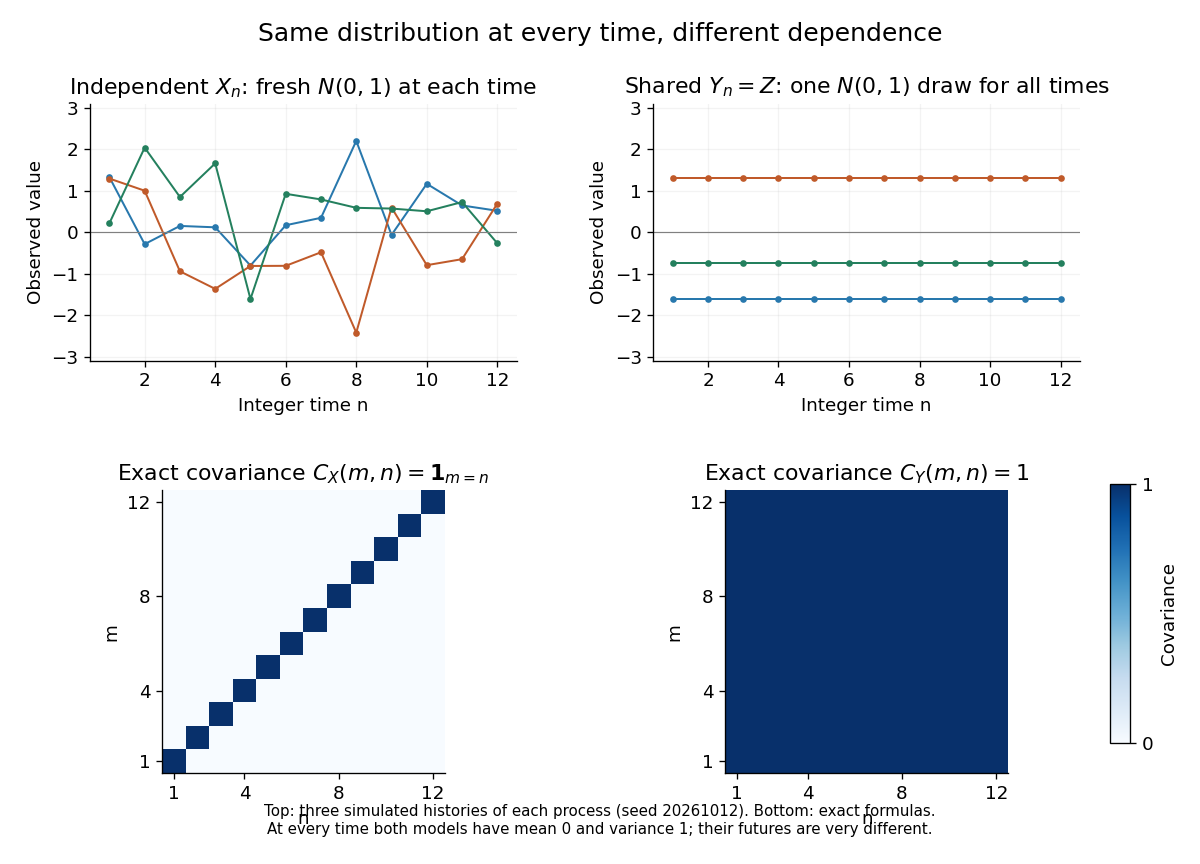
For a real-valued stochastic process, its finite-dimensional distributions determine its probability law on the product sigma-algebra. With an uncountable index set, a path property such as continuity need not be measurable in that sigma-algebra; specifying a suitable space of sample paths and a regular modification of a stochastic process is a separate step. This distinction is explained in MIT, The basics of stochastic processes, section 1.1.
A stochastic process has independent increments when, for every , the random variables are independent. Adjacent intervals are allowed: each increment represents the change after its left endpoint up to its right endpoint. A Poisson process, Brownian motion, and a random walk with independent steps have this property. Their values at different times need not be independent: for a fair simple random walk on the integer line, because both positions contain the same first increments. Independent increments need not be stationary increments; summing independent steps with time-dependent variances gives a counterexample.
A stochastic process has Stationary increments when the probability distribution of depends only on the duration , whenever both times belong to the index set. The clock origin then does not change the increment law. For Brownian motion, that law is ; for a rate- Poisson process, it is a Poisson distribution with expected value . Neither process itself is a stationary process: their variances grow with . Stationary increments and a stationary process describe different properties.
The effective temperature is the temperature of a blackbody with the same radiative flux as a star: .
For a nonmagnetic self-gravitating fluid star, let denote the bulk fluid kinetic energy, the Newtonian gravitational potential energy, a uniform surface pressure, and . The scalar virial theorem isThe pressure integral already accounts for microscopic thermal motion; it must not be counted again in the bulk . A static hydrostatic equilibrium has and . If surface pressure is negligible, it obeys . For a monatomic ideal gas with internal energy , this becomes . The negative gravitational binding term therefore balances positive thermal support. Magnetic stresses, rotation through bulk motion and nonnegligible surface terms must be retained when present.
Pinned article: Introduction to the OurBigBook Project
Welcome to the OurBigBook Project! Our goal is to create the perfect publishing platform for STEM subjects, and get university-level students to write the best free STEM tutorials ever.
Everyone is welcome to create an account and play with the site: ourbigbook.com/go/register. We belive that students themselves can write amazing tutorials, but teachers are welcome too. You can write about anything you want, it doesn't have to be STEM or even educational. Silly test content is very welcome and you won't be penalized in any way. Just keep it legal!
Intro to OurBigBook
. Source. We have two killer features:
- topics: topics group articles by different users with the same title, e.g. here is the topic for the "Fundamental Theorem of Calculus" ourbigbook.com/go/topic/fundamental-theorem-of-calculusArticles of different users are sorted by upvote within each article page. This feature is a bit like:
- a Wikipedia where each user can have their own version of each article
- a Q&A website like Stack Overflow, where multiple people can give their views on a given topic, and the best ones are sorted by upvote. Except you don't need to wait for someone to ask first, and any topic goes, no matter how narrow or broad
This feature makes it possible for readers to find better explanations of any topic created by other writers. And it allows writers to create an explanation in a place that readers might actually find it.
Figure 1. Screenshot of the "Derivative" topic page. View it live at: ourbigbook.com/go/topic/derivativeVideo 2. OurBigBook Web topics demo. Source. - local editing: you can store all your personal knowledge base content locally in a plaintext markup format that can be edited locally and published either:This way you can be sure that even if OurBigBook.com were to go down one day (which we have no plans to do as it is quite cheap to host!), your content will still be perfectly readable as a static site.
- to OurBigBook.com to get awesome multi-user features like topics and likes
- as HTML files to a static website, which you can host yourself for free on many external providers like GitHub Pages, and remain in full control

Figure 2. You can publish local OurBigBook lightweight markup files to either OurBigBook.com or as a static website.
Figure 3. Visual Studio Code extension installation.
Figure 5. . You can also edit articles on the Web editor without installing anything locally. Video 3. Edit locally and publish demo. Source. This shows editing OurBigBook Markup and publishing it using the Visual Studio Code extension. 
- Infinitely deep tables of contents:



All our software is open source and hosted at: github.com/ourbigbook/ourbigbook
Further documentation can be found at: docs.ourbigbook.com
Feel free to reach our to us for any help or suggestions: docs.ourbigbook.com/#contact