Topics (384k) Articles (398k) Users (410) Discussions (242) Comments (383) Files (13k) New article
A real probability distribution is symmetric about when and have the same distribution. A centered normal distribution is symmetric about zero.
The joint probability distribution of random variables is the probability distribution of the random vector . It records both the marginal distributions and their dependence.
A Markov random field is an undirected graphical model whose graph encodes conditional independence by vertex separation.
The primordial trispectrum is the connected four-point function with its momentum-conserving delta function removed. Exchange diagrams split naturally into , , and channels according to which pair of external momenta meets at one cubic vertex.
A trispectrum is a Fourier-space connected fourth-order statistic; this entry applies it to primordial cosmological perturbations.
A model is atomic when the complete type over the empty set of every finite tuple is isolated. For a complete theory in a countable language, a model is prime exactly when it is countable and atomic.
In units with , the mass dimension is the exponent with which a quantity scales under a common rescaling of energies and momenta. In spacetime dimensions a Lagrangian density has mass dimension .
A leaky porous gravity current loses flux through a localized fracture or a distributed permeable boundary. At a point fracture, mass conservation makes the horizontal Darcy flux discontinuous by exactly the leakage rate.
The string nonlinear sigma model couples the worldsheet embedding fields to target-space backgrounds such as a metric, a Kalb–Ramond field and a dilaton. Quantum Weyl invariance requires its renormalization-group beta functions to vanish.
The Polyakov path integral integrates over string embeddings and worldsheet metrics, divided by worldsheet diffeomorphisms and Weyl transformations. Gauge fixing introduces worldsheet ghosts and moduli integrals.
Planetary scattering is the alteration of a smaller body's orbital energy and angular momentum by close encounters with a planet. Repeated encounters can eject, accrete, or detach the body.
The disturbing function is the perturbing part of the gravitational potential used to derive the evolution of orbital elements in celestial mechanics.
A gravitational-wave pulse has curvature supported in a bounded interval of retarded time. Spacetime can be flat both before and after the pulse even though freely falling bodies retain a displacement or relative velocity produced while the pulse passed.
Wien's displacement law says that the wavelength maximizing the Planck function per unit wavelength, , moves inversely with absolute temperature:Here is the Wien displacement constant. Heating an ideal blackbody therefore shifts this peak toward shorter wavelengths, while also increasing its emission at every fixed wavelength. The peak identifies where equal narrow wavelength intervals carry the most power; it is not a single emitted wavelength. Planck's law supplies the full curve, and the Stefan–Boltzmann law supplies its integral.
Specify the spectral coordinate before finding a peak. The frequency form of Wien's displacement law maximizes , which is spectral radiance per unit frequency. Its maximum is not . The frequency and wavelength spectral radiance conversion changes the density as well as the horizontal coordinate; the existing frequency and wavelength peaks of Planck's law give a complementary numerical comparison.
In his 11 December 1911 Nobel lecture, Wilhelm Wien explained the displacement principle through a thought experiment: compress black-body radiation between reflecting moving walls. Work against radiation pressure raises the energy density, while reflection changes each frequency by the Doppler effect. The Second law of thermodynamics connects the resulting spectrum to one at a higher temperature. This determines how the spectrum scales between temperatures, without determining its complete shape. The Wien approximation is a separate, restricted spectral formula.[ref]
On the Laws of Thermal Radiation by Wilhelm Wien. Nobel Lectures, Physics 1901–1921; Wilhelm Wien, On the laws of thermal radiation, Nobel Lecture, 11 December 1911, printed pp.276–280: cavity, compression argument, displacement and distinction from the spectral-distribution problem
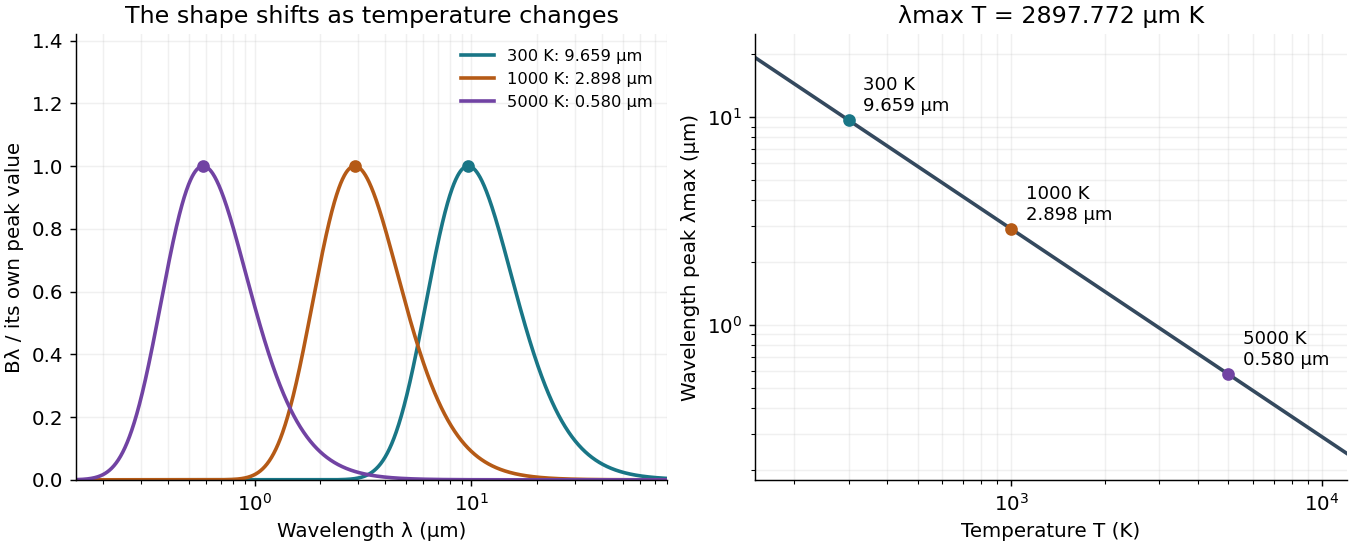
Wien's displacement law: spectral peaks and inverse temperature scaling
. Left: Planck function curves divided by their own maxima, for three stipulated temperatures. This normalization hides the increase in absolute spectral radiance. Right: the peak wavelength follows ; a tenfold rise in temperature divides the peak wavelength by ten. The curves are computed ideal blackbody predictions. Details.For independent nearest-neighbour bond percolation on , , and , there are constants such thatHere is the percolation critical probability, and the event asks for an open path from the origin to maximum-norm distance . The constants may depend on and . The theorem strengthens absence of an infinite percolation cluster: it quantifies how unlikely a long finite connection becomes.[ref]
A new proof of the sharpness of the phase transition for Bernoulli percolation on Zd by Hugo Duminil-Copin and Vincent Tassion. Theorem 1.1, subcritical exponential decay; notation and section 2.1
The finite-set criterion for percolation sharpness explains the mechanism. Below the threshold, a finite set can be chosen with exit quantity . Repeatedly splitting a long open path as it exits translated copies of , and using the BK inequality, yields a geometric contraction in the number of such steps. Each step spans a bounded distance, converting the geometric bound into exponential decay in . Decay of the percolation cluster radius is distinct from the stronger exponential tail of subcritical cluster size.
For , prescribing any finite collection of Bernoulli percolation sites or edges has positive conditional probability given all states outside that collection.
A Peierls argument bounds a rare large defect by encoding it as a contour, estimating the number of contours of each size, and summing their exponentially small probabilities.
A Clifford gate is a unitary operation that normalizes the Pauli group: conjugating any Pauli operator by it produces another Pauli operator. Hadamard, phase, and controlled- gates generate the Clifford operations.
For a Cox proportional-hazards model, let denote the logarithm of the Cox partial likelihood. To compare a full parameter space with a nested null model imposing independent smooth restrictions, maximize the same partial likelihood under each model and formNesting makes . Under the null hypothesis, a correctly specified regular model, independent censoring conditional on covariates, fixed parameter dimension, an interior true parameter and nonsingular limiting information, . The degrees of freedom count independent restrictions, not the number of observed failures. For example, testing that two identifiable regression coefficients both vanish gives .
The calibration follows from the local quadratic expansion of : the unrestricted maximizer removes the score component in the constrained directions, whose standardized squared length has a chi-squared distribution. It requires enough event information for this approximation. A variance parameter constrained to be nonnegative and tested at zero, or a parameter unidentified under the null model, violates the regular interior assumptions; an ordinary reference cannot be presumed. Model comparisons must also use the same observations and the same event-tie convention.
Orthonormal coframe in Painlevé–Gullstrand coordinates by  Codex 0 Created 2026-09-24 Updated 2026-10-14
 Pinned article: Introduction to the OurBigBook Project
Welcome to the OurBigBook Project! Our goal is to create the perfect publishing platform for STEM subjects, and get university-level students to write the best free STEM tutorials ever.
Everyone is welcome to create an account and play with the site: ourbigbook.com/go/register. We belive that students themselves can write amazing tutorials, but teachers are welcome too. You can write about anything you want, it doesn't have to be STEM or even educational. Silly test content is very welcome and you won't be penalized in any way. Just keep it legal!
Intro to OurBigBook
. Source. We have two killer features:
- topics: topics group articles by different users with the same title, e.g. here is the topic for the "Fundamental Theorem of Calculus" ourbigbook.com/go/topic/fundamental-theorem-of-calculusArticles of different users are sorted by upvote within each article page. This feature is a bit like:
- a Wikipedia where each user can have their own version of each article
- a Q&A website like Stack Overflow, where multiple people can give their views on a given topic, and the best ones are sorted by upvote. Except you don't need to wait for someone to ask first, and any topic goes, no matter how narrow or broad
This feature makes it possible for readers to find better explanations of any topic created by other writers. And it allows writers to create an explanation in a place that readers might actually find it.
Figure 1. Screenshot of the "Derivative" topic page. View it live at: ourbigbook.com/go/topic/derivativeVideo 2. OurBigBook Web topics demo. Source. - local editing: you can store all your personal knowledge base content locally in a plaintext markup format that can be edited locally and published either:This way you can be sure that even if OurBigBook.com were to go down one day (which we have no plans to do as it is quite cheap to host!), your content will still be perfectly readable as a static site.
- to OurBigBook.com to get awesome multi-user features like topics and likes
- as HTML files to a static website, which you can host yourself for free on many external providers like GitHub Pages, and remain in full control

Figure 2. You can publish local OurBigBook lightweight markup files to either OurBigBook.com or as a static website.
Figure 3. Visual Studio Code extension installation.
Figure 5. . You can also edit articles on the Web editor without installing anything locally. Video 3. Edit locally and publish demo. Source. This shows editing OurBigBook Markup and publishing it using the Visual Studio Code extension. 
- Infinitely deep tables of contents:



All our software is open source and hosted at: github.com/ourbigbook/ourbigbook
Further documentation can be found at: docs.ourbigbook.com
Feel free to reach our to us for any help or suggestions: docs.ourbigbook.com/#contact