Topics (384k) Articles (398k) Users (410) Discussions (242) Comments (383) Files (13k) New article

Response inhibition is the suppression or cancellation of an action that would otherwise be made. It is one aspect of inhibitory control. For example, in a stop-signal task a person prepares a button press in response to a go cue, but occasionally receives a later signal to stop. Successful stopping requires a change to an already prepared response.
The delay between go and stop signals matters: a very late stop signal leaves less opportunity for cancellation. Models use performance across delays to estimate stop-signal reaction time, rather than directly timing an invisible mental event. Brain lesion studies can test whether damage to a region is associated with impaired stopping, while interpretation still depends on task demands and the measurement model.[ref]
Stop-signal inhibition disrupted by damage to right inferior frontal gyrus in humans by Adam R. Aron and others. 2003, lesion study of stop-signal inhibition, Nature Neuroscience 6, 115–116
The hard-core model on a finite graph assigns probability to independent sets according to an activity :An occupied vertex excludes occupation of every neighbor, which is the hard constraint. At , all independent sets are equally likely, not all vertex subsets.
For one edge with vertices , the allowed sets are , giving and occupation probability for each vertex. The set has probability zero. Increasing activity favors larger allowed sets while retaining the exclusion rule.
Quantity-specific identifiability asks whether a chosen function of a model's parameters is determined by the observable probability distribution, even when the complete parameter vector is not. For model and target , the criterion isEquivalently, the target must be constant on each class of observationally equivalent parameters. This separates identification of a scientifically meaningful quantity from reconstruction of every internal parameter. Thomas J. Rothenberg's primary treatment explicitly distinguishes identification of individual parameter components from that of a full system.[ref]
Identification in Parametric Models by Thomas J. Rothenberg. §5, printed p.586, individual-parameter discussion and Theorem8
For an original example, let observations have a Poisson distribution with mean , where . Parameter pairs and give exactly the same observable law. The sum is identifiable, but is not: its values are and . With independent observations, the sample mean estimates the sum with variance . More observations can improve that estimate without distinguishing the two allocations.
Identifiability from linear observations gives a useful exact criterion. Suppose the observation law identifies and contains no additional information about . A linear target is identifiable exactly when belongs to the row space of . To prove this, observationally equivalent parameter differences lie in the kernel of a linear map . The target is unchanged for every such difference precisely when is orthogonal to that kernel, which is equivalent to membership in the row space. If , the target can be recovered as .
A deterministic geometric analogue appears in additional measurements and anatomical identifiability: measured perimeter can determine the surface area of the stipulated cuboid family even when exchanging its two horizontal side labels remains invisible. The target and the allowed model class must be stated.
Nonregular identification at a flat mean map occurs when different parameter values give different probability distributions, yet the first derivative of the observable mean vanishes at a parameter of interest. Identifiability is a property of the entire parameter-to-distribution map; a first-order sensitivity calculation can miss it.
Consider an original statistical model with independent observationsThe cubic mean map is a strictly increasing function, so equality of the normal distributions implies equality of . The model is globally identifiable, including at . Nevertheless, the single-observation score function and Fisher information areThus does not imply nonidentifiability. The rank is zero at the origin and one at every nonzero nearby point. This is precisely why a regular-point assumption matters: Rothenberg's local identification criterion assumes constant information-matrix rank in a neighborhood.[ref]
Maximum likelihood estimation gives , using the real cube root. At the true value zero, write with a standard normal random variable . ThenThis is an exact sampling distribution identity for every , not merely a convergence in distribution statement. The estimation error has scale and a nonnormal shape. At a fixed nonzero , the usual delta method instead gives asymptotic variance ; that approximation cannot be extended uniformly through zero.
An exact confidence interval through a cubic mean map follows by applying the strictly increasing function to both endpoints of the ordinary known-variance confidence interval for the mean:Here is the quantile function of the standard normal distribution. The transformed interval has exact coverage for every . When and the observed sample mean is zero, the 95% interval is approximately . Multiplying by 64 halves its width at that observed mean. A first-order interval based on dividing by the zero mean-map derivative would fail instead.
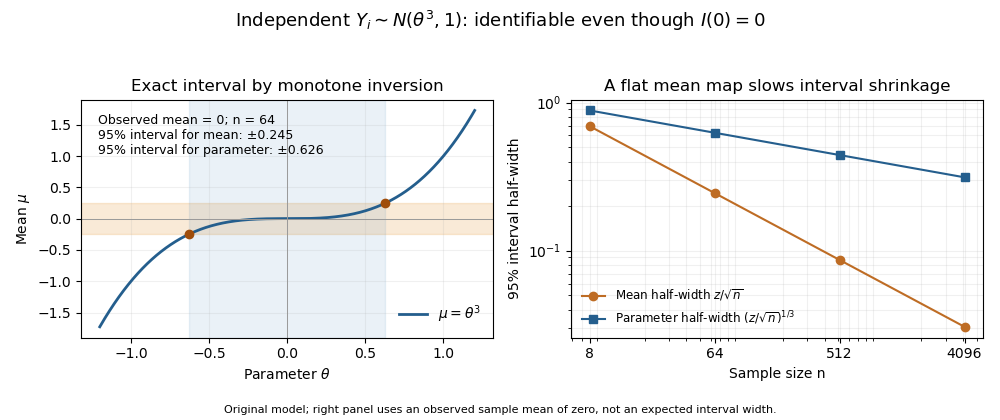
Cubic mean map and exact confidence-interval scaling at an observed sample mean of zero; original normal-observation model
. Details. The ideal boundary of hyperbolic space records directions in which geodesics escape to infinity. Its points can be represented by geodesic rays, identifying rays that stay a bounded distance apart. With the usual boundary topology it is a sphere .
In the unit-ball model it is the surrounding unit sphere; in the upper-half-space model it is . For this is the Riemann sphere. These are ideal endpoints, not points at finite hyperbolic distance. For instance, the vertical metric element makes the distance from height one to height equal to , which diverges as .
A complete hyperbolic geodesic has two distinct ideal endpoints. Hyperbolic isometries act on the ideal boundary, translating geometric questions about geodesics into questions about their endpoint pairs. The boundary topology and the hyperbolic metric play different roles: the closed-ball compactification adds ideal points without assigning them finite distance.
The humidity ratio is the mass of water vapor divided by the mass of dry air in a sample:It is commonly expressed as kilograms of water vapor per kilogram of dry air, or grams per kilogram. The denominator excludes the water vapor itself; the related specific humidity is a mass fraction of the entire moist sample.[ref]
Psychrometrics in the 2017 ASHRAE Handbook Fundamentals. Section5, Eqs7–9: humidity ratio and specific humidity
Using the ideal gas law for both components giveswhere are molar masses, is the water-vapor partial pressure, and is total pressure. At and , this yields , or about of dry air.[ref]
Psychrometrics in the 2017 ASHRAE Handbook Fundamentals. Sections1and5: ideal-gas mixture and molecular-mass ratio
Unlike relative humidity, the humidity ratio does not compare vapor pressure with saturation vapor pressure. Warming air without adding or removing water vapor can change its relative humidity while leaving unchanged. This distinction matters when comparing incoming and outgoing air in measurements of evaporation or biological heat loss.
Specific humidity is the mass fraction of water vapor in moist air. For vapor mass and dry air mass ,where is the humidity ratio. Both are dimensionless, but uses the total moist mass as its denominator.[ref]
Psychrometrics in the 2017 ASHRAE Handbook Fundamentals. Chapter1, Section5, Eqs7–9
For an ideal gas mixture, substitute to obtainwhere is the vapor partial pressure, is total pressure and are molar masses. At and , the result is , or of moist air. These are illustrative inputs, not a measured weather observation.
Heating the same closed sample without adding, removing or condensing water leaves unchanged while relative humidity can change. This helps distinguish a change in atmospheric moisture content from a change in temperature when interpreting evaporation and thermoregulation.
HTTP heuristic freshness estimates an HTTP freshness lifetime when a stored HTTP response lacks explicit expiration information and is otherwise eligible for that treatment. It allows constrained reuse when the origin has not supplied a lifetime, without pretending that the origin explicitly guaranteed one.[ref]
Eligibility comes first. The RFC permits heuristics for otherwise allowed responses that are heuristically cacheable by status or explicitly marked cacheable, when explicit freshness information is absent. A cache must not replace an explicit expiration time with its own heuristic. The ordinary storage constraints still apply.[ref]
HTTP Caching. §4.2.2, permitted responses and prohibition when explicit expiration is present; §3, storage constraints
For an own example, assume a successful response satisfies those conditions and has no restrictive directives. Its
Date corresponds to time seconds and Last-Modified to seconds. Choose a cache policy that fixes its lifetime at one tenth of the interval between those timestamps:At HTTP current age seconds, and fifteen seconds remain until the freshness boundary. At age , the strict comparison fails.The fraction and exact timestamp policy are stated assumptions of this example. The RFC encourages a fraction of the interval since modification and mentions ten percent as a typical setting, but does not prescribe a universal heuristic algorithm or require that fraction.[ref]
A long time since modification is evidence useful to an estimate; it is not proof that the origin will remain unchanged for the chosen lifetime. HTTP cache validation can later check whether a stored representation remains suitable. Different permitted heuristics can also produce different lifetimes from the same metadata.
An HTTP private cache and an HTTP shared cache must each respect the applicable caching constraints; being private or shared does not authorize arbitrary estimation. When an origin needs explicit freshness behavior, an explicit control such as
max-age avoids relying on the cache to infer that lifetime.[ref]HTTP apparent age estimates the age of an HTTP response at receipt by comparing its
Date value with the receiving cache's clock. With receipt time and date value expressed in compatible seconds,The nonnegative clamp prevents a negative age when the date appears to lie in the receiver's future. The RFC describes this estimation route as relying on reasonable clock synchronization.[ref]For example, receipt time and date value give an apparent age of six seconds. With receipt time and date value , the result is insteadThis zero does not establish that the representation was generated at the instant of receipt. A disagreement between clocks can conceal age in this comparison.
Another estimation route uses the received
Age value and HTTP response delay. Suppose a request starts at , its response arrives at , the date value is and the received age is ten seconds. The apparent age is zero, while the delay-corrected value is . The RFC's conservative maximum-based initial estimate therefore gives fourteen seconds rather than zero.[ref]After six more seconds in this cache, that initial estimate gives HTTP current age . Apparent age itself is the receipt-time estimate; adding local residence belongs to the later current-age calculation. Keeping those stages distinct avoids adding the wrong interval or treating the original estimate as a permanently current value.
The result feeds HTTP freshness rather than replacing the full reuse decision. A small apparent age does not override cache controls, validate the current origin state or make every stored response eligible for reuse. It is useful precisely as one defined estimate with explicit inputs and assumptions.
In the HTTP current age calculation, HTTP response delay is the interval between the cache's request time and the time it receives the corresponding HTTP response:The interval corrects the age information carried in the response for time spent obtaining it. It is one input to cache-age estimation.[ref]
For an own example, a cache initiates a request at local time seconds and receives the response at . Its response delay is seconds. If the response carries
Age: 12, the RFC's delay-corrected value isAfter another four seconds of local residence, using that corrected initial age would give seconds of current age.[ref]This interval does not isolate server computation. Transport, waiting and response handling can all contribute; a single elapsed interval does not reveal their separate amounts. Likewise, the received
Date value comes from response metadata rather than defining either local endpoint of this subtraction.The RFC permits the corrected age value as the corrected initial age. It also gives a conservative alternative that takes the maximum of that value and HTTP apparent age, particularly for paths involving old caches that might not supply appropriate
Age information. The example uses the delay-corrected route explicitly instead of silently assuming both routes always agree.[ref]A correct elapsed-time calculation matters because HTTP freshness compares the resulting age with an HTTP freshness lifetime. Treating a received response as age zero simply because it has just reached the local cache would discard both the received age estimate and the acquisition interval.
HTTP proactive negotiation is HTTP content negotiation in which the server selects an HTTP representation using information in the client's request. Explicit preferences can describe acceptable media types, languages or content encodings; the server can also use implicit request characteristics. The specification also calls this server-driven negotiation.[ref]
Suppose
/report offers both JSON and HTML. A client sends Accept: application/json, text/html;q=0.5. The omitted quality weight for JSON defaults to one, so the request expresses a stronger preference for JSON than for HTML. If the server honors this ranking and both forms are available, it returns the JSON form with Content-Type: application/json.[ref]This can deliver the preferred representation in the first response. The client does not first need to retrieve a menu of alternatives and then make another choice. In contrast, HTTP reactive negotiation leaves selection to the client after an initial response identifies alternatives. Either approach still requires the application to decide what the available representations mean.
A server selecting on
Accept can send Vary: Accept. That field identifies an additional request dimension that might affect the response, beyond the method and target identifier. A stored response chosen for one Accept value is consequently not automatically the appropriate selection for another; caching must account for the relevant variation.[ref]The server's information is incomplete. A supported format need not be the best format for the user's intended task, and describing capabilities in every request can increase message size and disclose information about the client. The specification also permits servers to disregard negotiation preferences rather than return
406 when honoring them would leave no acceptable choice. The example's ranking policy is therefore a stated application assumption, not an unconditional protocol guarantee.[ref] Pinned article: Introduction to the OurBigBook Project
Welcome to the OurBigBook Project! Our goal is to create the perfect publishing platform for STEM subjects, and get university-level students to write the best free STEM tutorials ever.
Everyone is welcome to create an account and play with the site: ourbigbook.com/go/register. We belive that students themselves can write amazing tutorials, but teachers are welcome too. You can write about anything you want, it doesn't have to be STEM or even educational. Silly test content is very welcome and you won't be penalized in any way. Just keep it legal!
Intro to OurBigBook
. Source. We have two killer features:
- topics: topics group articles by different users with the same title, e.g. here is the topic for the "Fundamental Theorem of Calculus" ourbigbook.com/go/topic/fundamental-theorem-of-calculusArticles of different users are sorted by upvote within each article page. This feature is a bit like:
- a Wikipedia where each user can have their own version of each article
- a Q&A website like Stack Overflow, where multiple people can give their views on a given topic, and the best ones are sorted by upvote. Except you don't need to wait for someone to ask first, and any topic goes, no matter how narrow or broad
This feature makes it possible for readers to find better explanations of any topic created by other writers. And it allows writers to create an explanation in a place that readers might actually find it.
Figure 1. Screenshot of the "Derivative" topic page. View it live at: ourbigbook.com/go/topic/derivativeVideo 2. OurBigBook Web topics demo. Source. - local editing: you can store all your personal knowledge base content locally in a plaintext markup format that can be edited locally and published either:This way you can be sure that even if OurBigBook.com were to go down one day (which we have no plans to do as it is quite cheap to host!), your content will still be perfectly readable as a static site.
- to OurBigBook.com to get awesome multi-user features like topics and likes
- as HTML files to a static website, which you can host yourself for free on many external providers like GitHub Pages, and remain in full control

Figure 2. You can publish local OurBigBook lightweight markup files to either OurBigBook.com or as a static website.
Figure 3. Visual Studio Code extension installation.
Figure 5. . You can also edit articles on the Web editor without installing anything locally. Video 3. Edit locally and publish demo. Source. This shows editing OurBigBook Markup and publishing it using the Visual Studio Code extension. 
- Infinitely deep tables of contents:



All our software is open source and hosted at: github.com/ourbigbook/ourbigbook
Further documentation can be found at: docs.ourbigbook.com
Feel free to reach our to us for any help or suggestions: docs.ourbigbook.com/#contact