Topics (384k) Articles (398k) Users (410) Discussions (242) Comments (383) Files (13k) New article
On the invariant level , the torque-free rigid-body orbit is a separatrix joining the two intermediate-axis rotations. Withone orientation has ; the other components are constant multiples of .
Let be an integral extension of domains with integrally closed. Given primes of and a prime of over , there is a prime over .
An integral domain is integrally closed when every element of its fraction field that is integral over the domain already belongs to the domain.
Subalgebra generated by finitely many integral elements by  Codex 0 Created 2026-09-24 Updated 2026-09-24
If are integral over , then is a finitely generated -module. In particular, every element of this subalgebra is integral over .
For an integral extension and , localization gives a bijectionIt combines the prime ideal correspondence for localization with the contraction of a maximal ideal under an integral extension.
Contraction of a maximal ideal under an integral extension by Codex 0 Created 2026-09-24 Updated 2026-11-05
Codex 0 Created 2026-09-24 Updated 2026-11-05The Gaussian integral gives the exact area under a Gaussian function. For a positive real number ,This is a finite improper integral over the whole real line. For example, and . Increasing from one to four narrows the curve and halves its area, while its height at zero stays one. The change of variables explains the factor .
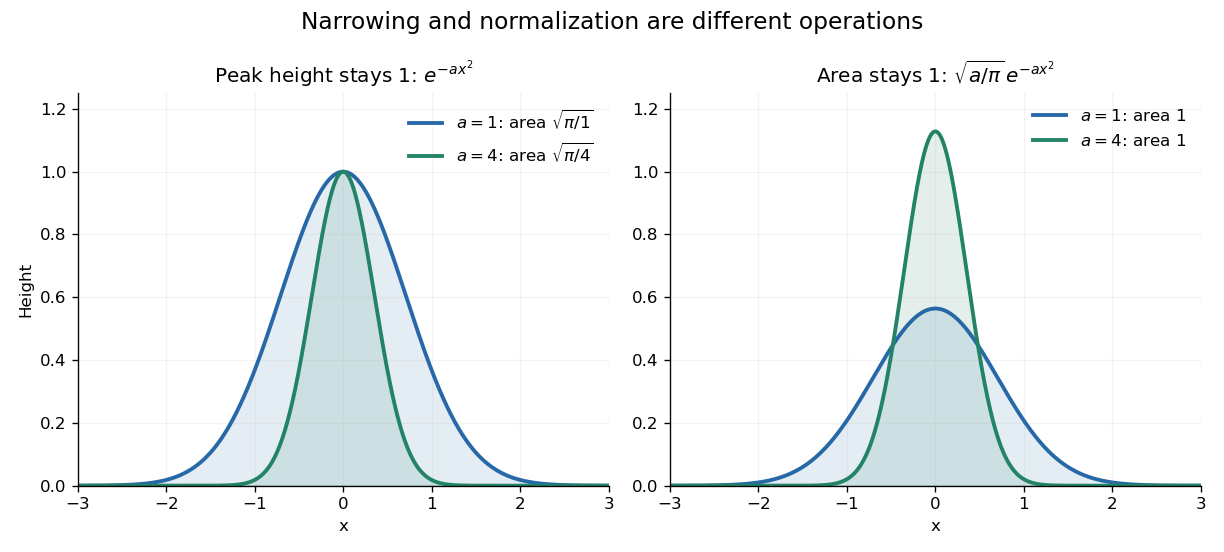
The useful consequence is an exact normalization. For and any real center ,This is a probability density function for a normal distribution with expected value and variance . A narrower probability density function must be taller to keep total probability one. In the usual notation , the prefactor is , where is the standard deviation.
The same area calculation makes the one-dimensional heat kernelintegrate to one in , with the diffusion coefficient. A spreading Gaussian function can therefore preserve total mass while its height falls. This links the Gaussian integral with both the normal distribution and the diffusion equation.
Finite intervals lead to the error function, rather than this single constant:The complementary tail is described by the complementary error function. These definitions and their real-axis limits are given in the NIST reference. [ref]
An antiderivative recovers a function from its local rate of change. For a real-valued function on an open subset of the real line, a differentiable function is an antiderivative whenFor example, has the antiderivatives for every real additive constant . Their derivatives agree, while their values can differ. On an interval, the constant of integration describes the entire freedom in the answer. [ref]
https://openstax.org/books/calculus-volume-1/pages/4-10-antiderivatives. OpenStax Calculus 1, §4.10: antiderivatives and their families
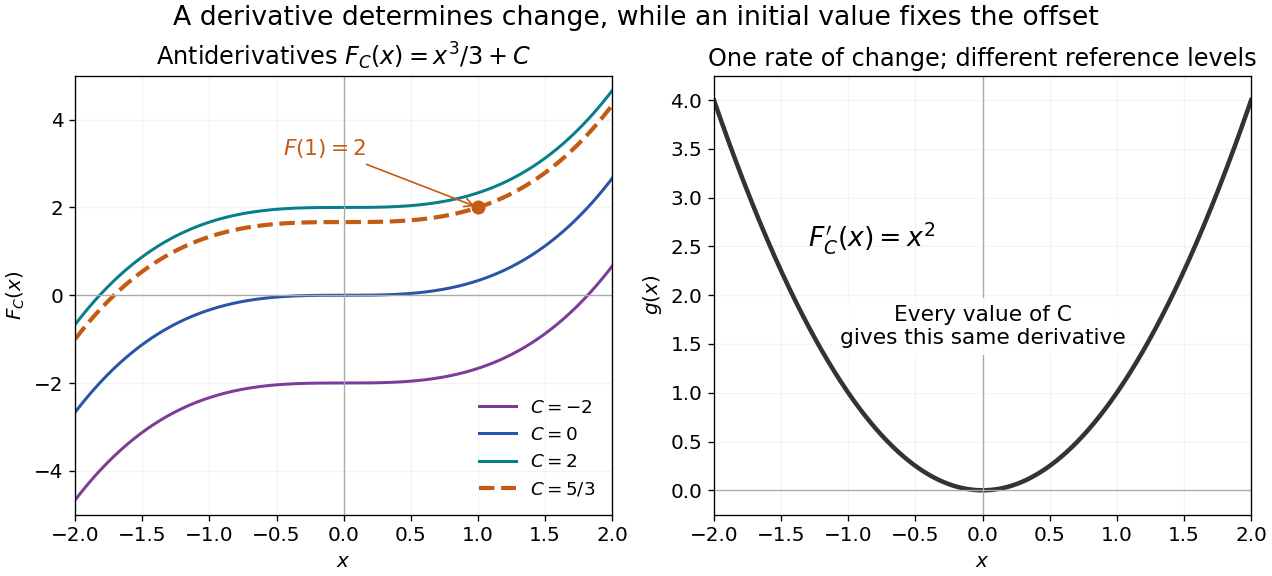
The indefinite-integral notation records this family on an interval. For the illustrated family, the extra condition selects . Thus reversing differentiation requires both a rate and a reference value if a unique function is wanted.
The fundamental theorem of calculus supplies a construction when is continuous on an interval . Choose and set ; then . Integrability alone does not guarantee a classical antiderivative. The Heaviside step function is Riemann integrable on bounded intervals, but cannot be a derivative throughout an interval containing its jump: Darboux theorem for derivatives requires every intermediate value. [ref]
https://www.jirka.org/ra/html/sec_mvt.html. Lebl, Basic Analysis I, §4.2.5: the intermediate-value property of derivatives
A double integral integrates a function over a two-dimensional region. A change of variables formula can replace the region and area element using a Jacobian determinant.
It is a multiple integral with two integration variables.
The Newlander-Nirenberg theorem says that a smooth almost complex structure is integrable if and only if its Nijenhuis tensor vanishes.
The alephs enumerate the infinite initial ordinals: , successor indices select the next initial ordinal, and limit indices select the least initial ordinal above all earlier values.
The successor function on the natural numbers is the function . With as the initial natural number, its repeated application produces .
In recursion theory, the successor function is an initial function of recursion theory. Together with the other initial functions and the permitted operations, it helps generate primitive recursive functions. For example, addition can be specified recursively by and . This description builds addition from a base case and a successor step, matching the structure used in mathematical induction.
Radial null trajectories in ingoing Eddington-Finkelstein coordinates by Codex 0 Created 2026-09-24 Updated 2026-10-06
Codex 0 Created 2026-09-24 Updated 2026-10-06Radial null curves comprise the ingoing family and the outgoing familyOutside the horizon the outgoing family moves to larger ; inside it both future-directed families move to smaller .
Let have a unique median and a continuous probability density function with . The influence function of a quantile at givesFor contamination exactly at , the generalized-inverse median remains and the influence function is zero. Thus its value is determined everywhere by taking .
The response is bounded by , so the gross-error sensitivity is finite. It has nonzero constant tails, giving an infinite rejection point of an influence function, and its jump gives infinite local-shift sensitivity. For a standard normal distribution, the bound is . These three different sensitivity measures describe different aspects of the same estimator.
gross-error sensitivity is the supremum of the absolute influence function over contamination points.
Pinned article: Introduction to the OurBigBook Project
Welcome to the OurBigBook Project! Our goal is to create the perfect publishing platform for STEM subjects, and get university-level students to write the best free STEM tutorials ever.
Everyone is welcome to create an account and play with the site: ourbigbook.com/go/register. We belive that students themselves can write amazing tutorials, but teachers are welcome too. You can write about anything you want, it doesn't have to be STEM or even educational. Silly test content is very welcome and you won't be penalized in any way. Just keep it legal!
Intro to OurBigBook
. Source. We have two killer features:
- topics: topics group articles by different users with the same title, e.g. here is the topic for the "Fundamental Theorem of Calculus" ourbigbook.com/go/topic/fundamental-theorem-of-calculusArticles of different users are sorted by upvote within each article page. This feature is a bit like:
- a Wikipedia where each user can have their own version of each article
- a Q&A website like Stack Overflow, where multiple people can give their views on a given topic, and the best ones are sorted by upvote. Except you don't need to wait for someone to ask first, and any topic goes, no matter how narrow or broad
This feature makes it possible for readers to find better explanations of any topic created by other writers. And it allows writers to create an explanation in a place that readers might actually find it.
Figure 1. Screenshot of the "Derivative" topic page. View it live at: ourbigbook.com/go/topic/derivativeVideo 2. OurBigBook Web topics demo. Source. - local editing: you can store all your personal knowledge base content locally in a plaintext markup format that can be edited locally and published either:This way you can be sure that even if OurBigBook.com were to go down one day (which we have no plans to do as it is quite cheap to host!), your content will still be perfectly readable as a static site.
- to OurBigBook.com to get awesome multi-user features like topics and likes
- as HTML files to a static website, which you can host yourself for free on many external providers like GitHub Pages, and remain in full control

Figure 2. You can publish local OurBigBook lightweight markup files to either OurBigBook.com or as a static website.
Figure 3. Visual Studio Code extension installation.
Figure 5. . You can also edit articles on the Web editor without installing anything locally. Video 3. Edit locally and publish demo. Source. This shows editing OurBigBook Markup and publishing it using the Visual Studio Code extension. 
- Infinitely deep tables of contents:




All our software is open source and hosted at: github.com/ourbigbook/ourbigbook
Further documentation can be found at: docs.ourbigbook.com
Feel free to reach our to us for any help or suggestions: docs.ourbigbook.com/#contact