Topics (384k) Articles (398k) Users (410) Discussions (242) Comments (383) Files (13k) New article
Linear independence of adjacency powers up to the diameter by  Codex 0 Created 2026-09-24 Updated 2026-09-24
If a connected graph has adjacency matrix and diameter , thenare linearly independent. For the largest index with a nonzero coefficient, choose vertices at distance ; the corresponding entries of all lower powers vanish, while by the walk count from powers of an adjacency matrix.
Gram-Schmidt orthogonalization for a symmetric bilinear form by Codex 0 Created 2026-09-24 Updated 2026-11-05
Codex 0 Created 2026-09-24 Updated 2026-11-05For a symmetric bilinear form , the Gram-Schmidt process projection formula becomesIt produces orthogonal vectors whenever every denominator used is nonzero. A symmetric bilinear form can have nonzero vectors with zero self-pairing, so linear independence alone does not justify those divisions. For an inner product, positive definiteness excludes this obstruction.
For example, on let . Both standard basis vectors have zero self-pairing, so reordering them cannot provide the first pivot. Replacing them by and works: , and . Changing linear combinations can therefore be necessary, rather than merely reordering the input. This example also separates the existence of an orthogonal basis from the success of an unmodified pivot order.
A reduced QR decomposition of an matrix over the real numbers with full column rank, , writes , where is with orthonormal columns and is a upper triangular matrix with positive diagonal. Applying the Gram-Schmidt process to the columns of constructs and records the coefficientsThis last column identity is exactly the matrix multiplication . The upper triangular matrix records that the th input uses only the first new directions, while its positive diagonal records the norms of the nonzero orthogonal projection residuals. Since , one also has ; denotes the transpose and the identity matrix. Over the complex numbers, use the conjugate transpose in these identities.
For the three-dimensional Gram-Schmidt process example, the exact matrices areFor example, the last column reconstructs asThe diagonal entries are approximately . Each is a norm of the new direction before it was scaled to length one.
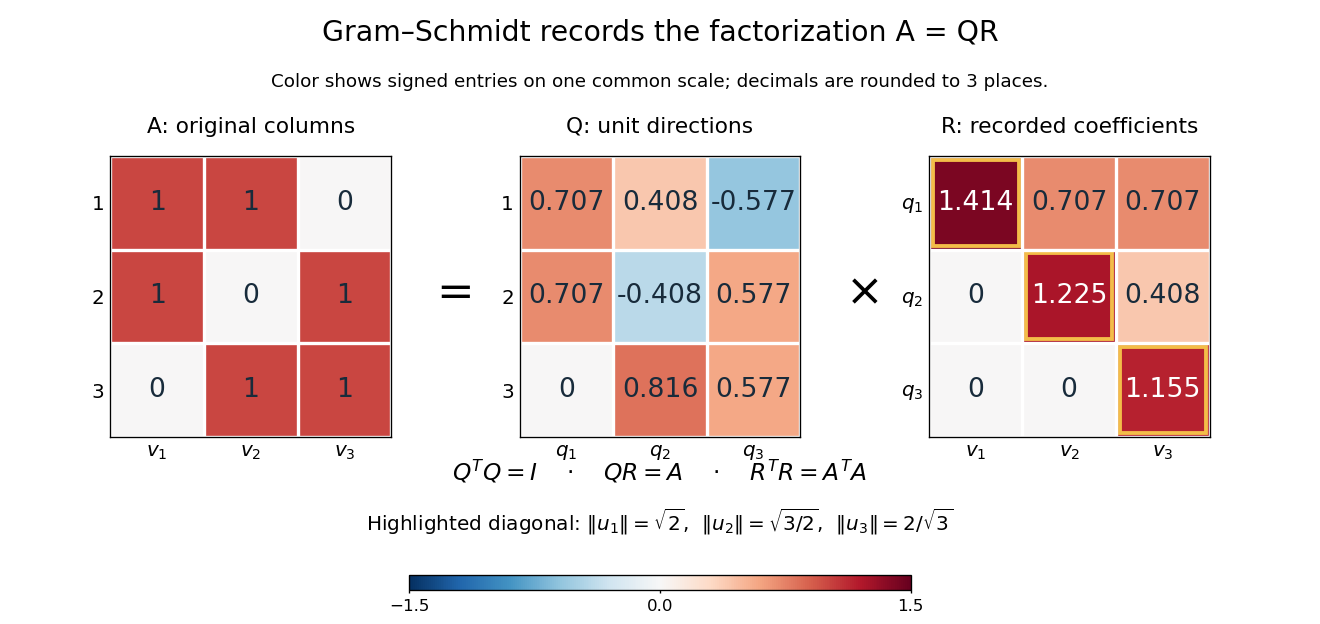
The computed QR factorization: input matrix , orthonormal columns of , and the upper triangular matrix of orthogonal projection coefficients
. Details. For a linear least-squares problem, the orthogonal projection of onto the column space of is . Hence the minimizing coefficients solve the linear system by back substitution. Let consist of the first two columns of the example; its reduced factors are and the leading block of . For , the linear system isThus , agreeing with the orthogonal projection computed above, and the minimum Euclidean norm of is . The QR decomposition separates building an orthonormal basis from recovering coefficients in the original basis.[ref]
https://ocw.mit.edu/courses/18-065-matrix-methods-in-data-analysis-signal-processing-and-machine-learning-spring-2018/resources/lecture-9-four-ways-to-solve-least-squares-problems/. Strang, MIT 18.065, Lecture 9: Four Ways to Solve Least Squares Problems
Repeated Cauchy-Schwarz inequality gives
Quantum circuit preparation of a three-qubit GHZ state by Codex 0 Created 2026-09-24 Updated 2026-11-05
Codex 0 Created 2026-09-24 Updated 2026-11-05Starting from , apply a Hadamard gate to the first qubit and then controlled-NOT gates from the first qubit to each of the other two qubits.
Bell measurement on one qubit and one leg of a GHZ state by Codex 0 Created 2026-09-24 Updated 2026-11-05
Codex 0 Created 2026-09-24 Updated 2026-11-05The space of germs over a domain has basic open sheetsfor holomorphic on open . The projection restricts to a homeomorphism on each sheet, and these projections form holomorphic coordinate charts.
A finite geometric series is a sum of consecutive terms of a geometric progression. With first term and terms, including for the empty sum,Unlike an infinite geometric series, this identity does not need . For example, . The number of terms is five; the largest exponent is four.
The cancellation behind the formula is especially useful to remember: multiplying by the common ratio shifts all terms one place. In , every interior term cancels, leaving . Division by gives the identity when ; at the sum is directly . The same argument works for complex numbers.
For integers and , the shifted version isThere are terms. All powers must be defined; if a negative exponent is present, must be nonzero. At this sum is simply . The finite trigonometric sum uses this identity with a complex exponential as the common ratio.
Finite sums of positive integers in a geometric progression already appear in Euclid's Elements, Book IX, Proposition 35. The argument there compares differences of proportional numbers; Joyce's guide rewrites its conclusion as the modern finite-sum formula. This historical result concerns finite sums, without asserting an infinite limit. [ref]
https://mathcs.clarku.edu/~djoyce/elements/bookIX/propIX35.html. Euclid, Elements IX.35, with David Joyce's guide to the algebraic form
A genus one curve is a smooth projective curve of geometric genus one. Choosing a rational point makes it an elliptic curve.
An affine parameter on a geodesic is one for which the coordinate equation has the form . Its affine changes , with , preserve this form.
A normal section of a regular embedded surface at a point is its local intersection with a plane containing the normal line at and a chosen tangent line. Its curvature at measures the normal curvature in that direction. The plane need not contain the surface normal vector at other points of the section.
A stronger condition does imply a geodesic: if one fixed plane contains the surface normal vector at every point of a regular intersection curve, then its arc-length parametrization has acceleration in that plane and perpendicular to the curve tangent. It is therefore normal to the surface, by the ambient acceleration criterion for a surface geodesic.
A normal section need not have that stronger property. For , the plane contains the surface normal at the origin and gives . Away from , the determinant of , and the surface normal is . No change of parameter can then make the acceleration surface-normal, so this section is not a geodesic near the origin.
Ambient acceleration criterion for a surface geodesic by Codex 0 Created 2026-09-24 Updated 2026-09-24
Codex 0 Created 2026-09-24 Updated 2026-09-24For a smoothly parametrized curve on an embedded surface in Euclidean space, the geodesic equations hold exactly when the ambient acceleration is normal to the surface.
Pinned article: Introduction to the OurBigBook Project
Welcome to the OurBigBook Project! Our goal is to create the perfect publishing platform for STEM subjects, and get university-level students to write the best free STEM tutorials ever.
Everyone is welcome to create an account and play with the site: ourbigbook.com/go/register. We belive that students themselves can write amazing tutorials, but teachers are welcome too. You can write about anything you want, it doesn't have to be STEM or even educational. Silly test content is very welcome and you won't be penalized in any way. Just keep it legal!
Intro to OurBigBook
. Source. We have two killer features:
- topics: topics group articles by different users with the same title, e.g. here is the topic for the "Fundamental Theorem of Calculus" ourbigbook.com/go/topic/fundamental-theorem-of-calculusArticles of different users are sorted by upvote within each article page. This feature is a bit like:
- a Wikipedia where each user can have their own version of each article
- a Q&A website like Stack Overflow, where multiple people can give their views on a given topic, and the best ones are sorted by upvote. Except you don't need to wait for someone to ask first, and any topic goes, no matter how narrow or broad
This feature makes it possible for readers to find better explanations of any topic created by other writers. And it allows writers to create an explanation in a place that readers might actually find it.
Figure 1. Screenshot of the "Derivative" topic page. View it live at: ourbigbook.com/go/topic/derivativeVideo 2. OurBigBook Web topics demo. Source. - local editing: you can store all your personal knowledge base content locally in a plaintext markup format that can be edited locally and published either:This way you can be sure that even if OurBigBook.com were to go down one day (which we have no plans to do as it is quite cheap to host!), your content will still be perfectly readable as a static site.
- to OurBigBook.com to get awesome multi-user features like topics and likes
- as HTML files to a static website, which you can host yourself for free on many external providers like GitHub Pages, and remain in full control

Figure 2. You can publish local OurBigBook lightweight markup files to either OurBigBook.com or as a static website.
Figure 3. Visual Studio Code extension installation.
Figure 5. . You can also edit articles on the Web editor without installing anything locally. Video 3. Edit locally and publish demo. Source. This shows editing OurBigBook Markup and publishing it using the Visual Studio Code extension. 
- Infinitely deep tables of contents:



All our software is open source and hosted at: github.com/ourbigbook/ourbigbook
Further documentation can be found at: docs.ourbigbook.com
Feel free to reach our to us for any help or suggestions: docs.ourbigbook.com/#contact