Topics (384k) Articles (398k) Users (410) Discussions (242) Comments (383) Files (13k) New article
Consider a small scalar field fluctuation on a prescribed FLRW metric, neglecting its feedback on the metric tensor. Linearizing the canonical field equation about homogeneous gives, in units ,Here is the comoving wavevector of the spatial Fourier transform. For constant Hubble parameter and a negligibly small effective mass term , this reduces toA nearly constant value of the inflaton potential alone does not justify dropping its second derivative; the mass assumption is separate. At large physical wavenumber , the mode oscillates, whereas at the massless equation admits a constant mode and a decaying mode. A full comoving curvature perturbation calculation also includes metric perturbations and specifies a coordinate condition such as Newtonian gauge.
For a nonempty set of words, the propertyis a nontrivial extensional property of unary partial computable functions: the nowhere-defined function fails it, while any total constant function with value in satisfies it. The Rice theorem therefore makes its index set undecidable.
Irreducible characters of the affine semidirect product of orders eleven and five by  Codex 0 Created 2026-09-24 Updated 2026-09-24
For with faithful action, the abelianization supplies five linear characters. The two orbits of size five on the nontrivial characters of induce two irreducible characters of degree five. Their squared degrees satisfyso these seven characters are all the irreducible characters of .
Quotient deterministic finite automaton by indistinguishable states by Codex 0 Created 2026-09-24 Updated 2026-09-24
Codex 0 Created 2026-09-24 Updated 2026-09-24Indistinguishability is a right-invariant equivalence relation. The quotient has states , transition , initial state , and accepting classes represented by accepting states. It accepts the original language and has no two distinct indistinguishable states.
Independent and identically distributed random variables by Codex 0 Created 2026-09-24 Updated 2026-10-25
Codex 0 Created 2026-09-24 Updated 2026-10-25An independent and identically distributed sequence combines two conditions: its members are independent random variables, and every member has the same probability distribution. For a finite sequence with common law , this means that for all measurable sets ,For an infinite sequence, require this condition for every finite collection of distinct indices. Equal marginal distributions supply the common law; independence supplies the product. Neither condition supplies the other. Grinstead and Snell call the combination an independent trials process.[ref]
Introduction to Probability by Charles M. Grinstead and J. Laurie Snell. §4.1, Definitions 4.4–4.5, printed pp. 143–144: mutual independence and a common distribution
Choose a Bernoulli distribution with success probability . Four independent draws produce all sixteen binary patterns with probability each. If instead for one fair Bernoulli random variable , every member still has that same Bernoulli distribution, but only patterns
0000 and 1111 occur. Conversely, independently drawn Bernoulli random variables with success probabilities have a product joint probability distribution but unequal marginal distributions.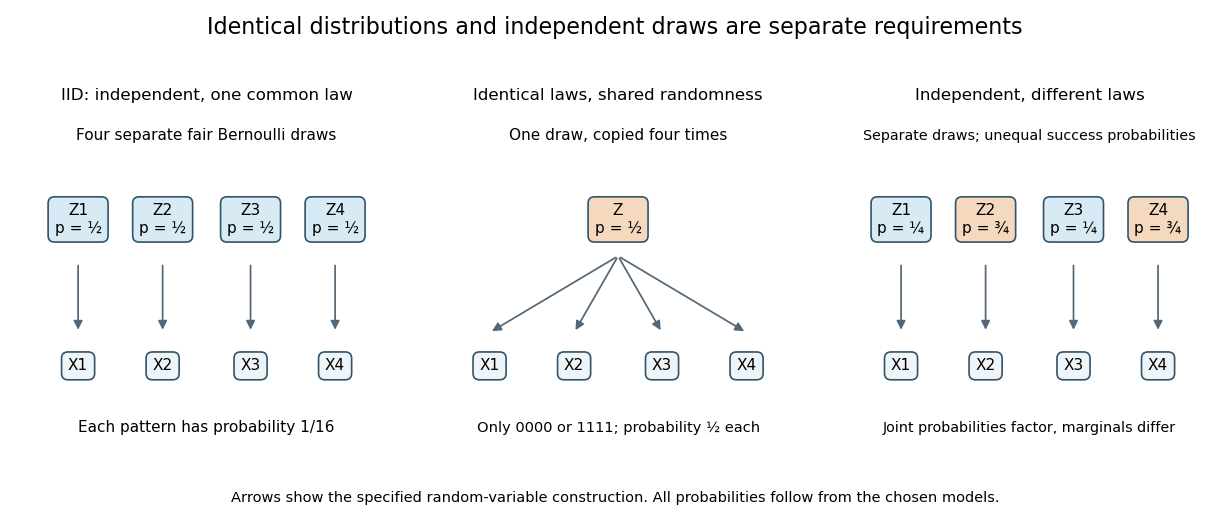
IID sampling combines a common distribution with separate independent draws
. Original constructions of four Bernoulli random variables. Separate arrows in the first and third panels represent explicitly independent source draws; the middle panel copies one shared draw. Dependence and marginal laws are specified by the chosen models. Details.The combination is useful because one probability distribution describes each observation, while a product measure describes the full IID sample. In particular, an IID sample of finite-variance, real-valued observations has a predictable sample mean: its expected value stays at the population expected value, while its variance of a sample mean decreases as . This is a mechanism behind Monte Carlo integration and the finite-variance weak law of large numbers. Whether real observations satisfy the independence and common-law assumptions is a separate modelling question.
Orthogonality of independent centered Hilbert-space random variables by Codex 0 Created 2026-09-24 Updated 2026-10-05
Codex 0 Created 2026-09-24 Updated 2026-10-05If are independent centered square-integrable random variables in a Hilbert space, then for , and hence
A nonzero ordinal is additively closed when for all . These are exactly the ordinals : sufficiency follows from Cantor normal form, while necessity follows by splitting any leading coefficient or nonzero tail below into two smaller summands.
As a quadrature rule, the trapezoidal rule replaces an integrand by the linear interpolation joining its two endpoint values:For nonnegative endpoint values, this is the area of a trapezoid; in general it is a signed area. The quadrature nodes are , each with quadrature weight . Unlike the midpoint quadrature rule, it uses endpoint samples, which can be reused between adjacent panels.
Every affine function agrees with its linear interpolation, so the trapezoidal rule integrates it exactly. On , gives . On , the polynomial instead gives , exceeding by . Its degree of precision of a quadrature rule is exactly one.
If , its signed approximation error satisfiesA convex function lies below its endpoint chord, so the trapezoidal rule overestimates its integral; a concave function gives the reverse inequality. The error formula assumes that the second derivative exists and is a continuous function throughout the closed interval.[ref]
3.5 Quadrature, subsection (i) Trapezoidal Rules. §3.5(i), equation 3.5.1 and its C² hypothesis; the source writes integral minus rule
A short derivation is the identityobtained by two integrations by parts. The nonnegative Peano kernel has integral , and the weighted mean value theorem for integrals gives the formula.The trapezoidal rule for an ordinary differential equation averages vector fields at the old and new states and is A-stable.
This time-stepping use applies the same trapezoidal rule to the integral of the derivative in an ordinary differential equation. That connection explains its place under implicit Runge-Kutta methods; its quadrature behavior and the nonlinear issue in trapezoidal rule fails B-stability concern different uses of the same endpoint averaging.
The Karoubi envelope freely splits idempotents. Its objects are pairs and a morphism is a map satisfying .
A steady axisymmetric magnetohydrodynamic wind follows nested magnetic-flux surfaces and has conserved mass loading, field-line angular velocity, angular momentum, entropy, and Bernoulli quantities along each surface.
A magnetohydrodynamic shock is a discontinuity satisfying conservation of mass, momentum, energy, normal magnetic field, and tangential electric field.
An ideal of a graded ring is homogeneous when it is generated by homogeneous elements of a graded ring, meaning elements that belong to individual graded components. Equivalently, whenever an element of the ideal is written as a finite sum of homogeneous components, every one of those components belongs to the ideal.
For the usual total-degree grading on , the ideal is homogeneous because its generator has degree one. In , the ideal is not homogeneous: it contains but does not contain its constant component one. The definition concerns arbitrary graded rings; it does not require that homogeneous elements be polynomials.
Let be a Dedekind domain, let be distinct nonzero prime ideals, and choose nonnegative integers . There is a nonzero withChoose . The prime ideals are maximal, so their powers are pairwise comaximal. The Chinese remainder theorem gives for every , which gives exactly the requested prime-ideal valuations in a Dedekind domain. No restrictions are imposed on primes outside the list.
For example, has valuation two at the prime two and valuation one at the prime three in . Prescribed negative valuations can likewise be realized in the fraction field: first clear them by a common nonzero denominator, apply the integral version, and divide back. The Dedekind-domain hypothesis supplies the valuations and the comaximality used in this argument.
Pinned article: Introduction to the OurBigBook Project
Welcome to the OurBigBook Project! Our goal is to create the perfect publishing platform for STEM subjects, and get university-level students to write the best free STEM tutorials ever.
Everyone is welcome to create an account and play with the site: ourbigbook.com/go/register. We belive that students themselves can write amazing tutorials, but teachers are welcome too. You can write about anything you want, it doesn't have to be STEM or even educational. Silly test content is very welcome and you won't be penalized in any way. Just keep it legal!
Intro to OurBigBook
. Source. We have two killer features:
- topics: topics group articles by different users with the same title, e.g. here is the topic for the "Fundamental Theorem of Calculus" ourbigbook.com/go/topic/fundamental-theorem-of-calculusArticles of different users are sorted by upvote within each article page. This feature is a bit like:
- a Wikipedia where each user can have their own version of each article
- a Q&A website like Stack Overflow, where multiple people can give their views on a given topic, and the best ones are sorted by upvote. Except you don't need to wait for someone to ask first, and any topic goes, no matter how narrow or broad
This feature makes it possible for readers to find better explanations of any topic created by other writers. And it allows writers to create an explanation in a place that readers might actually find it.
Figure 1. Screenshot of the "Derivative" topic page. View it live at: ourbigbook.com/go/topic/derivativeVideo 2. OurBigBook Web topics demo. Source. - local editing: you can store all your personal knowledge base content locally in a plaintext markup format that can be edited locally and published either:This way you can be sure that even if OurBigBook.com were to go down one day (which we have no plans to do as it is quite cheap to host!), your content will still be perfectly readable as a static site.
- to OurBigBook.com to get awesome multi-user features like topics and likes
- as HTML files to a static website, which you can host yourself for free on many external providers like GitHub Pages, and remain in full control

Figure 2. You can publish local OurBigBook lightweight markup files to either OurBigBook.com or as a static website.
Figure 3. Visual Studio Code extension installation.
Figure 5. . You can also edit articles on the Web editor without installing anything locally. Video 3. Edit locally and publish demo. Source. This shows editing OurBigBook Markup and publishing it using the Visual Studio Code extension. 
- Infinitely deep tables of contents:



All our software is open source and hosted at: github.com/ourbigbook/ourbigbook
Further documentation can be found at: docs.ourbigbook.com
Feel free to reach our to us for any help or suggestions: docs.ourbigbook.com/#contact