Topics (384k) Articles (398k) Users (410) Discussions (242) Comments (383) Files (13k) New article

For the equal superposition of the first two box states with zero initial relative quantum phase, put . The probability in the left half is . The continuity equation and zero wall probability current implyDirect substitution of and into the probability current verifies the sign. Positive current means probability leaves the left half. The quantum interference controls transport even though each component has stationary probability density.
A spermatocele is a cystic collection associated with the epididymal region that contains sperm-bearing fluid. It is an extratesticular structure, distinct from a mass arising within the testis. Its name describes the contained material and origin rather than a general term for every scrotal swelling.
Epididymitis is inflammation of the epididymis. The term identifies the affected structure and inflammatory process, not one universal organism or cause. Its anatomical location distinguishes it from orchitis, which affects the testis, although the two processes can coexist.
The sum of relative atomic masses for the simplest integer composition represented by an empirical formula.
For a uniformly elliptic second-order Dirichlet form with bounded coefficients and lower-order terms, there are and giving the displayed lower bound. Cauchy-Schwarz and Young's inequality absorb the drift term into part of the principal gradient energy plus an correction. Adding a sufficiently large nonnegative multiple of the inner product therefore makes the form coercive, permitting Lax-Milgram. The shift restores coercivity even when the unshifted form is not positive.
Conductors with net charges of the same sign can attract because their internal charge distributions respond to one another. A point-charge calculation misses this electrostatic induction contribution. Exact conducting-sphere results are given in Electrostatics of Two Charged Conducting Spheres by John Lekner.[ref]
Historical terminology for electrical effects supplied by electrochemical cells. The source supplies energy through chemical changes; the resulting electric charge and electric current obey the same electrical laws as charge supplied by other means.
In a thin wall-withdrawal model with large dimensionless surface-tension parameter , matching a parabolic static meniscus fixes inner longitudinal scale and thickness scale . The leading inner equation is , matching below and a bounded film above. Scaling , preserves the quadratic matching coefficient and gives the universal equation . Its selected bounded solution tends to , giving the displayed dimensionless law. It applies to positive slowly varying wall speed in the leading matched regime; the numerical constant comes from that universal inner problem, not a dimensional identity.
For , with , take the positive Dulac function in the title. More generally, givesThe equal coefficients in the exponential cancel the term. Setting also cancels the linear term, leaving . The Bendixson-Dulac theorem excludes periodic orbits in the open positive quadrant. The axes are not invariant: the vector field points out of the quadrant at every nonzero axis point. A closed orbit staying in the nonnegative quadrant therefore cannot touch an axis, and cannot pass through the equilibrium at the origin by uniqueness. This extends the exclusion to the closed quadrant. Choosing an exponential multiplier turns a differential search for a useful Dulac function into cancellation of polynomial coefficients.
The algebraic double dual of a vector space is the dual space of its algebraic dual. An element assigns a scalar linearly to each linear functional on the original space. The bidual evaluation map sends to the rule . It is a canonical linear isomorphism in finite dimension, unlike an identification of with , which generally requires an additional choice. For spaces with topology, using the continuous dual space instead defines the topological bidual; that is a distinct construction in infinite dimension.
If a normed subspace is dense in a normed vector space and carries the inherited norm, restriction gives an onto linear isometry from the dual space of to that of . A bounded functional on extends uniquely by limits along sequences from ; its norm is unchanged because its inequality passes to the limit. Thus completion does not change the continuous dual. For example, the subspace of sequences with , equipped with the unweighted norm, has dual , since it contains the dense subspace of finitely supported sequences. The inherited norm matters; the weighted norm would give a different dual norm.
The capacity of water to dissolve lead from materials it contacts; dissolved release should be distinguished from carriage of particles containing lead.[ref]
Lead in Drinking Water by the Drinking Water Inspectorate. Sources and factors affecting concentration
For every real , the mean value theorem bounds on . Hence the apparent singularity at zero cancels, and the remaining bound is Lebesgue integrable. On a bounded parameter interval , every positive-order parameter derivative of the integrand is bounded in absolute value by . Repeated dominated differentiation under the integral sign therefore proves that is a smooth function, withIn particular, , , and . Thus is strictly convex, lies above its tangent at zero, and satisfies for and for . The inequalities follow directly as well by comparing to one. The substitution removes the square-root endpoint singularity for numerical integration:
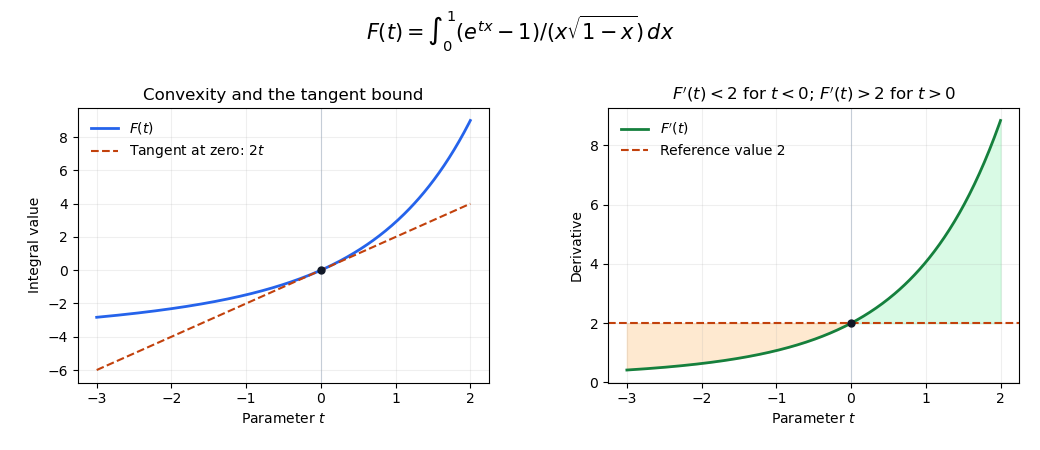
Convexity and derivative bounds for the exponential endpoint integral
. The derivative is below two for negative parameters and above two for positive parameters. The integral lies above its tangent at zero. Substitution removes the endpoint singularity before numerical quadrature. Details.Suppose and its partial derivative are jointly continuous on a compact rectangle . Then is continuously differentiable in the interior of , and the displayed formula holds, with one-sided derivatives at parameter endpoints where the corresponding partial derivative is given.
To prove it, the extreme value theorem bounds by . For each fixed , the mean value theorem bounds the difference quotient by . It converges pointwise to , and the constant is integrable over . Dominated convergence gives the derivative formula. Apply continuity of parameter integrals on compact rectangles to to obtain continuity of . The proof works locally on unbounded parameter intervals as well.
The requirement that a database query have a finite, appropriately range-restricted answer on finite input. In the usual domain-independent interpretation, extending the ambient value domain with unused values must not change the answer. The absence of a negation symbol alone does not ensure safety.
For the one-dimensional wave equation with Cauchy data on , , the solution is determined where both characteristic footpoints lie in . This is the diamond displayed in the title, or . In characteristic coordinates, it is a rectangle of known arguments for the two travelling-wave functions. A smooth invertible coordinate transformation maps it to a region bounded by the original equation's characteristic curves; it need not remain a Euclidean diamond. Both forward and backward determination can be described this way. Outside the region, changing an unspecified part of one travelling-wave function can change the solution without changing the supplied finite data segment.
For , and data on , , the transformed segment is , , . The known characteristic arguments lie in and . The corresponding original region has curved boundaries despite being a rectangle in characteristic coordinates and a diamond in coordinates.
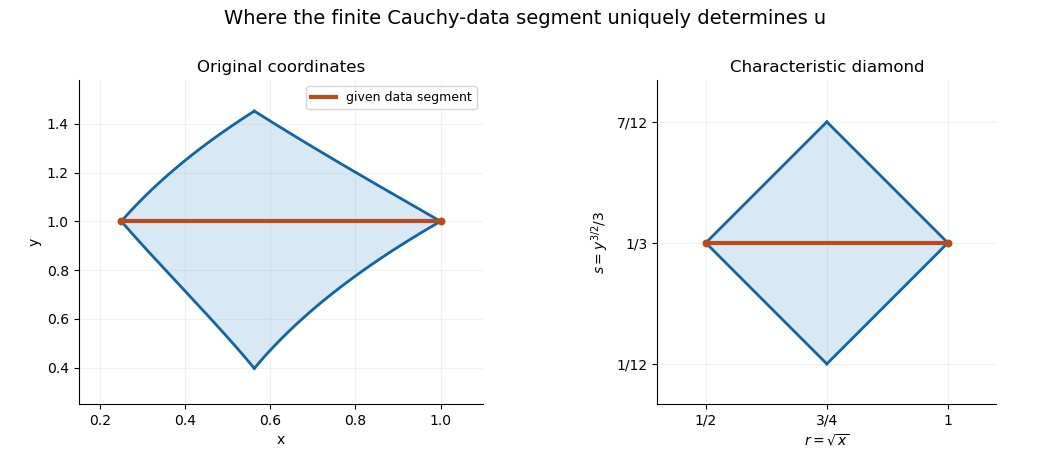
For Noncharacteristic Cauchy data parameterized by , the method of characteristics produces a surface . The part uniquely fixed as a classical graph through the data must retain both the allowed footpoint range and a nonsingular branch of the projected map. On a branch where inversion gives , require , together with the branch condition and a nonzero Jacobian determinant. The strict inequality describes its open interior; the endpoint characteristic supplies a boundary trace. A fold caustic can supply another boundary.
An algebraic formula obtained by eliminating can extend beyond this domain of dependence. Its values there need not be selected by the original data, because their characteristic footpoints can lie on the unprescribed half of the data curve. Tracking the parameter range is therefore part of the uniqueness argument, separately from selecting a real square-root branch.
Pinned article: Introduction to the OurBigBook Project
Welcome to the OurBigBook Project! Our goal is to create the perfect publishing platform for STEM subjects, and get university-level students to write the best free STEM tutorials ever.
Everyone is welcome to create an account and play with the site: ourbigbook.com/go/register. We belive that students themselves can write amazing tutorials, but teachers are welcome too. You can write about anything you want, it doesn't have to be STEM or even educational. Silly test content is very welcome and you won't be penalized in any way. Just keep it legal!
Intro to OurBigBook
. Source. We have two killer features:
- topics: topics group articles by different users with the same title, e.g. here is the topic for the "Fundamental Theorem of Calculus" ourbigbook.com/go/topic/fundamental-theorem-of-calculusArticles of different users are sorted by upvote within each article page. This feature is a bit like:
- a Wikipedia where each user can have their own version of each article
- a Q&A website like Stack Overflow, where multiple people can give their views on a given topic, and the best ones are sorted by upvote. Except you don't need to wait for someone to ask first, and any topic goes, no matter how narrow or broad
This feature makes it possible for readers to find better explanations of any topic created by other writers. And it allows writers to create an explanation in a place that readers might actually find it.
Figure 1. Screenshot of the "Derivative" topic page. View it live at: ourbigbook.com/go/topic/derivativeVideo 2. OurBigBook Web topics demo. Source. - local editing: you can store all your personal knowledge base content locally in a plaintext markup format that can be edited locally and published either:This way you can be sure that even if OurBigBook.com were to go down one day (which we have no plans to do as it is quite cheap to host!), your content will still be perfectly readable as a static site.
- to OurBigBook.com to get awesome multi-user features like topics and likes
- as HTML files to a static website, which you can host yourself for free on many external providers like GitHub Pages, and remain in full control

Figure 2. You can publish local OurBigBook lightweight markup files to either OurBigBook.com or as a static website.
Figure 3. Visual Studio Code extension installation.
Figure 5. . You can also edit articles on the Web editor without installing anything locally. Video 3. Edit locally and publish demo. Source. This shows editing OurBigBook Markup and publishing it using the Visual Studio Code extension. 
- Infinitely deep tables of contents:




All our software is open source and hosted at: github.com/ourbigbook/ourbigbook
Further documentation can be found at: docs.ourbigbook.com
Feel free to reach our to us for any help or suggestions: docs.ourbigbook.com/#contact