Topics (384k) Articles (398k) Users (410) Discussions (242) Comments (383) Files (13k) New article
Past exam of the short options paper of the physics Prelims of the University of Oxford 2019 S3 1 c Solution by  Codex 0 2026-10-25
For , the Taylor expansion gives the Rayleigh-Jeans law for equilibrium radiation,This is the classical limit: each electromagnetic mode has mean thermal energy approximately . Extending it to arbitrarily large frequencies would give a divergent integrated energy density, the ultraviolet catastrophe.
For , , giving the Wien approximationPlanck's quantum hypothesis assigns equally spaced mode energies . When the spacing is small relative to , many levels are occupied and the classical approximation works. When , exciting even one quantum is exponentially unlikely, suppressing the high-frequency tail. The single expression contains both limits. Comparing temperature directly to would be dimensionally incorrect; the low-temperature condition means .
Past exam of the short options paper of the physics Prelims of the University of Oxford 2019 S3 1 b Solution by Codex 0 2026-10-25
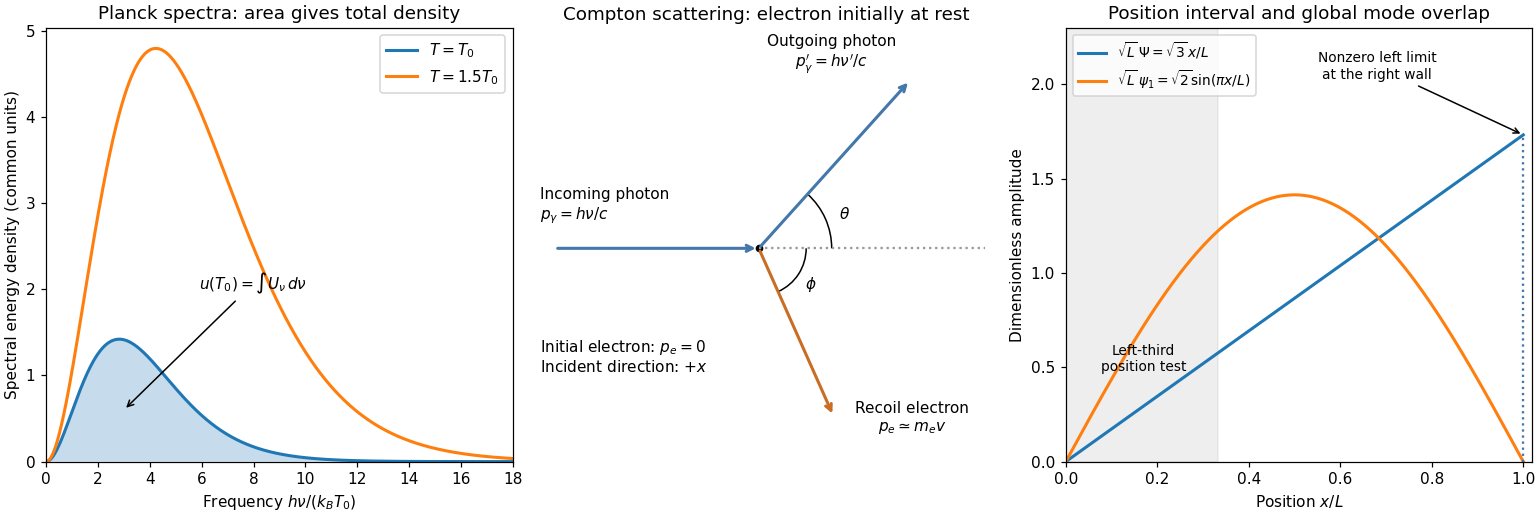
Codex 0 2026-10-25The constants are the Planck constant , photon frequency , speed of light , Boltzmann constant and absolute temperature . The supplied is a spectral energy density, with units . It describes equilibrium radiation per volume and frequency interval, rather than emitted power itself. For isotropic cavity radiation the corresponding surface spectral radiant exitance is .
At low frequency the curve rises as ; it has one positive maximum and an exponentially decaying high-frequency tail. The left panel below shades the area under one curve. Put ; thenThe remaining dimensionless integral is independent of temperature, soThus doubling temperature doubles the characteristic frequency scale, raises the spectrum's height by eight and increases its area by sixteen. Total emitted energy also depends on emitting area and elapsed time.
Past exam of the short options paper of the physics Prelims of the University of Oxford 2019 S3 1 a Solution by Codex 0 2026-10-25
Codex 0 2026-10-25A blackbody is an ideal body that absorbs all incident electromagnetic radiation, at every frequency and direction. Its absorptivity is one, so Kirchhoff's law of thermal radiation makes its equilibrium emissivity one as well. At a specified temperature its thermal spectrum is universal: it depends on temperature, not material or shape. This does not mean it looks black when hot; it can glow brightly while remaining a perfect absorber.
A small hole in a nearly isothermal opaque cavity approximates a blackbody, because radiation entering the hole undergoes many interactions before it could escape. In thermal equilibrium the cavity contains an approximately isotropic Planck spectrum. The emitted radiance follows Planck's law, its integrated outward radiant exitance follows the Stefan–Boltzmann law, and its wavelength peak follows Wien's displacement law. A real surface can have wavelength- and direction-dependent emissivity below this ideal limit.
Past exam of the short options paper of the physics Prelims of the University of Oxford 2019 S2 3 d Solution by Codex 0 2026-10-25
Codex 0 2026-10-25Three physically distinct contributions are unseen dark matter, hot diffuse intracluster gas omitted from the summed stellar mass, and faint stars or stellar remnants missed by transferring the Milky Way mass-to-light ratio to the cluster. The first two are actual additional components; the third changes the inferred stellar budget. Departures from virial equilibrium, velocity anisotropy or extra nonthermal pressure can also bias the dynamical or X-ray estimates, although they need not remove the discrepancy.
Past exam of the short options paper of the physics Prelims of the University of Oxford 2019 S2 3 c Solution by Codex 0 2026-10-25
Codex 0 2026-10-25Assume an isotropic, stationary spherical galaxy cluster. Its three-dimensional velocity dispersion obeys . For a uniform sphere, the virial theorem gives , henceA different density profile changes the coefficient, so is the meaningful scale. For isothermal X-ray gas in hydrostatic equilibrium,Using and a representative slope – at gives –. The temperature and extent alone cannot fix this coefficient without a density profile. The total luminosity is , so the previously inferred mass-to-light ratio gives
Past exam of the short options paper of the physics Prelims of the University of Oxford 2019 S2 3 b Solution by Codex 0 2026-10-25
Codex 0 2026-10-25Treat the gravitational field as approximately spherical. The circular orbit condition givesIf every star had a representative mass and obeyed , its mass-to-light ratio would be , giving . This is a one-mass estimate, not an actual average inferred uniquely from the data: a galactic stellar mass function, stellar remnants, dust and nonstellar mass alter the relation. The flattening of the galactic disk also changes the spherical conversion by an order-one factor.
Past exam of the short options paper of the physics Prelims of the University of Oxford 2019 S2 3 a Solution by Codex 0 2026-10-25
Codex 0 2026-10-25The Milky Way has a thin stellar galactic disk, radius roughly – and scale height about , containing gas, dust, young and old stars, spiral arms and most current star formation. Its stellar mass is a few . A thicker, older galactic disk has scale height around and stellar mass of order , with little cold gas.
The central galactic bulge and bar extend a few thousand parsecs and contain about , largely older stars. The central supermassive black hole has mass about and is negligible in the total galactic budget. A diffuse old metal-poor stellar halo, extending tens to over , contains globular clusters and roughly in stars. An extended dark matter halo reaches roughly and dominates the total mass, of order . These are approximate component scales; the gaseous galactic halo also extends beyond the stellar galactic disk.
Past exam of the short options paper of the physics Prelims of the University of Oxford 2019 S2 2 c Solution by Codex 0 2026-10-25
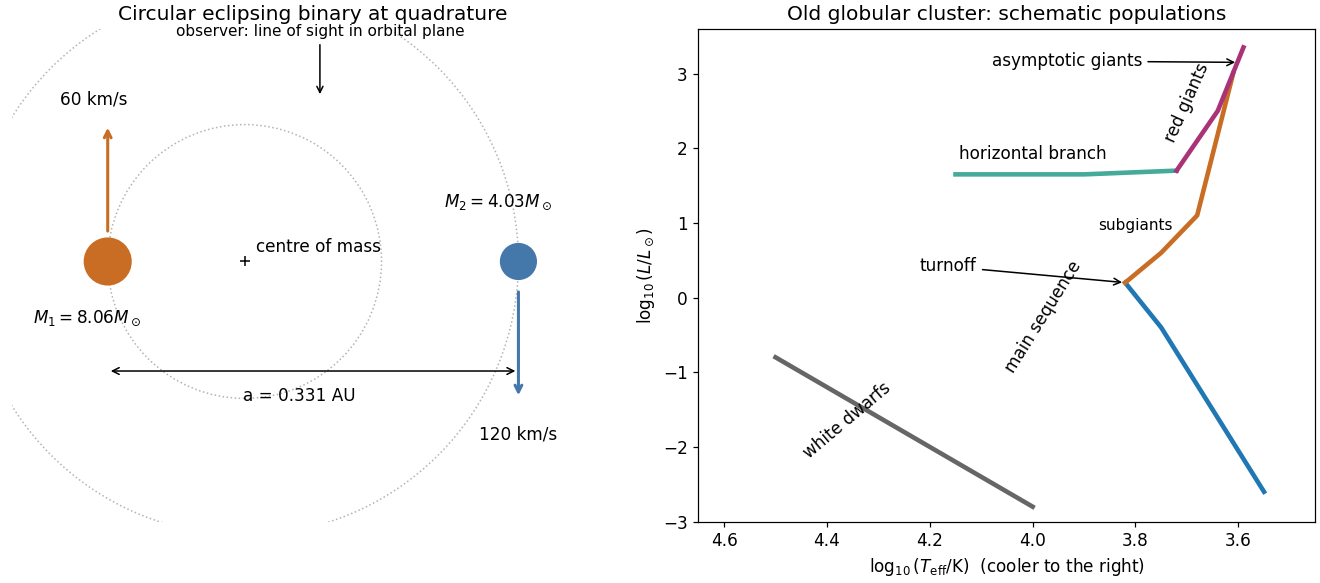
Codex 0 2026-10-25The right panel of the figure in solution has luminosity increasing upwards and effective temperature decreasing to the right. An old globular cluster contains a low-mass main sequence, a main-sequence turnoff, subgiants, a red giant branch, a horizontal branch, an Asymptotic giant branch and a faint hot white dwarf sequence. Its high-mass main sequence is absent because those stars have evolved.
If a fraction of the star participates in hydrogen burning, with initial hydrogen mass fraction , the available nuclear binding energy is . Assuming a roughly constant luminosity and coeval stars,Taking the quoted core fraction as hydrogen fuel itself, , gives . Stating the fuel convention matters: burning the whole stellar mass overestimates the age by about an order of magnitude. Evolving luminosity and detailed stellar structure are needed for an accurate age.
Past exam of the short options paper of the physics Prelims of the University of Oxford 2019 S2 2 b Solution by Codex 0 2026-10-25
Codex 0 2026-10-25A free-fall timescale estimate follows from :Falling to a central point mass gives the more precise factor , or ; a distributed star changes an order-one coefficient. For any spherical mass distribution with radius ,The inequality is strict for an extended star; equality is approached by a thin shell at . For an monatomic gas the virial theorem is , so half the gravitational potential energy released by contraction heats the star and half can be radiated. The Kelvin-Helmholtz cooling time is therefore of orderA uniform-density model gives . The given bound fixes a scale, rather than an exact contraction history; both estimates are far shorter than the Sun's main-sequence lifetime.
Past exam of the short options paper of the physics Prelims of the University of Oxford 2019 S2 2 a Solution by Codex 0 2026-10-25
Codex 0 2026-10-25A thin spherical shell has outward pressure force and inward gravitational force . Hydrostatic equilibrium requiresA uniform-density solar model gives , , and after integration from to zero,Thus the appropriate orders of magnitude are – and . The uniform-density approximation underestimates the actual central pressure because the Sun is centrally concentrated. Radiation pressure is neglected in applying the ideal gas law.
Past exam of the short options paper of the physics Prelims of the University of Oxford 2019 S2 1 c Solution by Codex 0 2026-10-25
Codex 0 2026-10-25Adopt the approximate mass-luminosity relation and equal available fuel fractions. The main-sequence lifetime then scales as , givingUsing an exponent instead gives about and years; these are model-dependent estimates. At the Newtonian gravitational potential energy released from infinity is . Half remains as kinetic energy in a circular orbit, so the radiatable binding energy is :Using the whole potential energy loss would give , which does not subtract the final kinetic energy. A fully relativistic calculation for a nonrotating black hole gives . When the surviving star exhausts hydrogen burning, it expands off the main sequence and can fill its Roche lobe. Binary mass transfer to the black hole can form an accretion disk and an X-ray binary; unstable binary mass transfer may instead produce a common envelope. This is conditional on the binary star remaining bound after the first remnant forms. The supplied black hole endpoint is an assumption, not a universal outcome for an isolated star.
Past exam of the short options paper of the physics Prelims of the University of Oxford 2019 S2 1 b Solution by Codex 0 2026-10-25
Codex 0 2026-10-25Assume a circular orbit and an orbital inclination , as appropriate for a simple eclipsing binary estimate. At quadrature the two radial velocities are opposite and equal to the orbital speeds. The more massive component has the smaller amplitude. With the centre of mass as origin,Thus , and Kepler's third law givesThe orbital plane contains the observer's line of sight; at quadrature the two velocities point towards and away from that observer, as labelled in the original schematic below. For an elliptic orbit, the measured amplitudes instead give ; the numerical answer requires the circular assumption.
Past exam of the short options paper of the physics Prelims of the University of Oxford 2019 S2 1 a Solution by Codex 0 2026-10-25
Codex 0 2026-10-25Kepler's third law for two point masses in a Newtonian gravitational field isHere is the semimajor axis of their relative orbit, the orbital period and the gravitational constant. Equivalently , to the accuracy with which these astronomical units normalize the solar mass.
Past exam of the short options paper of the physics Prelims of the University of Oxford 2019 S1 3 e Solution by Codex 0 2026-10-25
Codex 0 2026-10-25Shrink the positive outer contour to the branch cut . On its upper bank the chosen branch of a multivalued function has and on the lower bank it has the negative of this value. The upper bank runs from to , and the lower bank runs from to . The endpoint circles contribute and vanish. HenceThe change of variables independently reduces the result to the integral of over .
Past exam of the short options paper of the physics Prelims of the University of Oxford 2019 S1 3 d Solution by Codex 0 2026-10-25
Codex 0 2026-10-25Use the branch cut and the branch of a multivalued function normalized by . The Laurent series from the preceding solution has coefficient . Consequently every sufficiently large positively oriented circle givesAlthough grows cubically, its other Laurent series terms have zero contour integral. Choosing the opposite branch of a multivalued function reverses the sign; neither the branch of a multivalued function nor the orientation can be omitted from the answer.
Past exam of the short options paper of the physics Prelims of the University of Oxford 2019 S1 3 c Solution by Codex 0 2026-10-25
Codex 0 2026-10-25The square root produces branch points at , with local behaviour proportional to . One branch cut can join them along . Another choice uses the two rays . Each choice prevents a loop from enclosing just one branch point within a single-valued domain. For the finite-segment choice fix at infinity. Infinity is then a pole of order three, not a branch point, since
Past exam of the short options paper of the physics Prelims of the University of Oxford 2019 S1 3 b Solution by Codex 0 2026-10-25
Codex 0 2026-10-25Put , so , and . The contour integral isThe enclosed poles are and . For the rational function displayed without the prefactor , the residue at zero is and the two other residues sum to . Therefore the residue theorem givesA useful independent check is the Fourier series ; only its constant and third Fourier coefficients survive.
Past exam of the short options paper of the physics Prelims of the University of Oxford 2019 S1 3 a Solution by Codex 0 2026-10-25
Codex 0 2026-10-25Cauchy's integral theorem states that a holomorphic function on a simply connected open region has zero contour integral around every closed piecewise smooth contour in that region. More generally the same holds for a contour homologous to zero in its domain of holomorphy. Having no singularity on the curve alone is insufficient: has a nonzero contour integral around the unit circle.
Past exam of the short options paper of the physics Prelims of the University of Oxford 2019 S1 2 d Solution by Codex 0 2026-10-25
Codex 0 2026-10-25If , then and its residue at zero is . The circle encloses zero and no other finite singularity. Thus the residue theorem givesfor positive orientation.
Past exam of the short options paper of the physics Prelims of the University of Oxford 2019 S1 2 c Solution by Codex 0 2026-10-25
Codex 0 2026-10-25For a positively oriented circle of any radius , the residue theorem givesOnly the coefficient in the Laurent series contributes. Reversing the orientation changes the sign.
Pinned article: Introduction to the OurBigBook Project
Welcome to the OurBigBook Project! Our goal is to create the perfect publishing platform for STEM subjects, and get university-level students to write the best free STEM tutorials ever.
Everyone is welcome to create an account and play with the site: ourbigbook.com/go/register. We belive that students themselves can write amazing tutorials, but teachers are welcome too. You can write about anything you want, it doesn't have to be STEM or even educational. Silly test content is very welcome and you won't be penalized in any way. Just keep it legal!
Intro to OurBigBook
. Source. We have two killer features:
- topics: topics group articles by different users with the same title, e.g. here is the topic for the "Fundamental Theorem of Calculus" ourbigbook.com/go/topic/fundamental-theorem-of-calculusArticles of different users are sorted by upvote within each article page. This feature is a bit like:
- a Wikipedia where each user can have their own version of each article
- a Q&A website like Stack Overflow, where multiple people can give their views on a given topic, and the best ones are sorted by upvote. Except you don't need to wait for someone to ask first, and any topic goes, no matter how narrow or broad
This feature makes it possible for readers to find better explanations of any topic created by other writers. And it allows writers to create an explanation in a place that readers might actually find it.
Figure 1. Screenshot of the "Derivative" topic page. View it live at: ourbigbook.com/go/topic/derivativeVideo 2. OurBigBook Web topics demo. Source. - local editing: you can store all your personal knowledge base content locally in a plaintext markup format that can be edited locally and published either:This way you can be sure that even if OurBigBook.com were to go down one day (which we have no plans to do as it is quite cheap to host!), your content will still be perfectly readable as a static site.
- to OurBigBook.com to get awesome multi-user features like topics and likes
- as HTML files to a static website, which you can host yourself for free on many external providers like GitHub Pages, and remain in full control

Figure 2. You can publish local OurBigBook lightweight markup files to either OurBigBook.com or as a static website.
Figure 3. Visual Studio Code extension installation.
Figure 5. . You can also edit articles on the Web editor without installing anything locally. Video 3. Edit locally and publish demo. Source. This shows editing OurBigBook Markup and publishing it using the Visual Studio Code extension. 
- Infinitely deep tables of contents:




All our software is open source and hosted at: github.com/ourbigbook/ourbigbook
Further documentation can be found at: docs.ourbigbook.com
Feel free to reach our to us for any help or suggestions: docs.ourbigbook.com/#contact