Topics (384k) Articles (398k) Users (410) Discussions (242) Comments (383) Files (13k) New article

James A. Blackwell, Jr. coauthored NASA's 1972 study of rear-upper-surface modifications to a supercritical airfoil with Charles D. Harris. The report connects specified shape changes with measured aerodynamic loads.[ref]
The apparatus combined surface pressure orifices with a downstream rake for the fluid wake, in the Langley 8-foot transonic wind tunnel. Surface readings characterized the pressure coefficient distribution, while wake measurements supplied separate information for drag. These observations constrain different parts of the aerodynamic response.[ref]
Wind-tunnel Investigation of Effects of Rear Upper Surface Modification on an NASA Supercritical Airfoil by Charles D. Harris and James A. Blackwell, Jr.. Printed pp. 4–6, Apparatus and Techniques
An original pressure-load example illustrates that distinction. On normalized airfoil chord , stipulate two lower-minus-upper pressure coefficient distributions,Both integrate to one, giving the same chord-normal pressure force. Their first moments differ:At dynamic pressure and airfoil chord , both loads are . In this chord-normal-load model, nose-up-positive pressure moments about the quarter-chord are instead and per metre of span. Equal integrated force therefore does not establish equal load location or pitching moment. These profiles are invented, not reconstructed report data; a measured pressure distribution also does not by itself include the full viscous stress contribution to drag.
The orbicularis oris muscle is a complex of skeletal muscle fibres around the mouth that closes and shapes the lips. Its contraction can press the lips together or project them forward. Compare sealing the mouth while holding water with rounding the lips to whistle: both use the same muscular region to change the outlet's shape. The visible lip includes other tissues besides the muscle that moves it.[ref]
Anatomy and Physiology 2e by J. Gordon Betts and others. Section 11.3, Muscles That Create Facial Expression, figures 11.7–11.8
Video4Linux is the Linux kernel subsystem through which applications control supported video-related hardware and exchange data with it. Its version-two application programming interface is called V4L2. A device driver exposes the applicable device interfaces; applications use file descriptors and control operations rather than directly programming the hardware registers. The kernel specification describes video capture/output, radio and related device-node types.[ref]
A video device node such as
/dev/video0 is an entry point to an interface, not a promise about a camera's identity or its supported formats. Device numbering can depend on discovery order. After opening a device, an application queries its capabilities with VIDIOC_QUERYCAP; the available operations depend on the device.[ref]Opening devices and querying capabilities in the Linux Kernel video API documentation. §1.1.2, device naming notes; Querying Capabilities, §1.2
For an original frame-storage example, suppose a device supports NV12M at width 640 and height 480, with eight-bit samples, even dimensions and no padding. Full-resolution luma needs bytes. The two colour-difference components together need bytes, giving 460800 active bytes per frame. At a stipulated 30 frames per second, active sample data total . Allocation padding, other transport data and actual timing are separate quantities.
The V4L2 multi-planar API can describe those separately stored image memory planes; each V4L2 plane descriptor supplies that plane's extents. A negotiated pixel format and framebuffer stride tell an application how to interpret the received data. A successful device open alone establishes none of those layout choices.
Universal Dependencies is a framework for comparable grammatical annotation across languages. It combines part of speech labels, morphological features and typed syntactic dependencies, while allowing documented language-specific choices. The framework supplies a common representation rather than a claim that all languages express every distinction identically.[ref]
Universal Dependencies annotation guidelines. project introduction and Morphology: General Principles, representation layers
For
Birds fly, a compatible analysis identifies Birds as a noun with plural grammatical number, gives it the lemma bird, and links it to fly with the subject relation nsubj. These are distinct annotation decisions: changing a lexical convention need not require changing the sentence's dependency structure.Basic dependencies form a rooted tree, whereas an enhanced representation can contain additional relations and need not remain a tree.[ref]
Universal Dependencies annotation guidelines. Syntax: General Principles, basic versus enhanced representation
Keeping the layers explicit helps compare parser output and manually analyzed text corpus resources. A valid interchange file and an empirically justified grammatical analysis remain different achievements.CoNLL-U is a plain-text format for exchanging Universal Dependencies linguistic annotation. A word line has ten tab-separated fields: identifier, form, lemma, universal and optional local part of speech, features, basic head, basic relation, enhanced dependencies and miscellaneous information. Blank lines separate sentences; hash-prefixed comments can describe each sentence.[ref]
CoNLL-U Format in Universal Dependencies. opening format specification and ten-column field definitions
An original two-word example, with literal tab separators, is:The first word depends on word two as its subject; word two is attached to the notional root numbered zero. Underscores indicate unspecified values. A saved sentence ends with its blank separator, including at the end of a file.
# text = Birds fly
1	Birds	bird	NOUN	_	Number=Plur	2	nsubj	_	_
2	fly	fly	VERB	_	_	0	root	_	_
The specification also requires UTF-8 text with NFC Unicode normalization and LF line endings. Range identifiers represent multiword tokens and decimal identifiers represent empty nodes under additional rules. Consequently, counting ten columns is useful but insufficient for validating every CoNLL-U record.
An interlinear gloss aligns a linguistic example with an analysis of the meanings or grammatical properties of its words and morphemes. It commonly combines an original-language line, a segmented line, analytical labels and a freer translation. The aligned analysis provides information that the translation alone can conceal.
The Leipzig Glossing Rules by Bernard Comrie and others specify word alignment, matching hyphens at segmentable morpheme boundaries, and abbreviated grammatical labels.[ref]
Leipzig Glossing Rules by Bernard Comrie and others. Rules 1–3, alignment, morpheme correspondence and category labels
In the original English illustration walk-ed / walk-PST, PST identifies past grammatical tense; the matching hyphens connect the ending with its proposed contribution. The unsegmented surface form is walked.A matching number of boundaries does not prove the segmentation correct. The rules explicitly distinguish the gloss from the original data: different analyses can describe the same recorded form. An interlinear gloss therefore makes claims about linguistic morphology inspectable while preserving the need for independent evidence about those claims.
Word segmentation identifies the units treated as words in a particular linguistic analysis. Written spaces provide one possible cue, but an orthographic unit need not correspond to one syntactic unit. The boundary convention must therefore be stated before counting words or assigning syntactic dependencies.[ref]
Tokenization and Word Segmentation in Universal Dependencies. orthographic tokens versus syntactic words; documented contraction examples
The Universal Dependencies guidelines analyze the written item
au as corresponding to two syntactic words, à and le. Extending that example to au village, an orthographic count gives two units, while the syntactic analysis gives three. With no added boundary symbols, their word-bigram counts are respectively and .This is a change in representation, not evidence that the utterance became longer. Word segmentation affects n-gram counts, lemma assignment and linguistic annotation. A reproducible text corpus records how boundaries were chosen and how original written forms map to the analyzed units.
The Kubo formula expresses a linear response through an equilibrium correlation function. For a perturbation and observable , one convention gives , withThe step function enforces causality, and the commutator records the quantum response.
The sign depends on the declared perturbing-Hamiltonian convention. Applying the framework to currents or polarization relates transport coefficients to fluctuations in an unperturbed system, forming a foundation of linear response theory and the fluctuation-dissipation theorem.[ref]
Statistical-Mechanical Theory of Irreversible Processes. I by Ryogo Kubo. 1957 general response, relaxation and correlation framework
A lemma is a conventional citation form used to represent a lexical entry or a set of related grammatical forms. It differs from a lexeme, the abstract vocabulary item being represented, and from an arbitrary truncation of a word's spelling. The convention is language-specific.[ref]
Morphology: General Principles in Universal Dependencies. Lemmas, canonical dictionary form and language-particular conventions
In a simple English analysis,
walks, walked and walking can be assigned the lemma walk. The Universal Dependencies guidelines also distinguish inflection from derivational morphology: organizations has citation form organization, not organize or organ.Context can be needed before the citation form is chosen. The spelling
saw can name a tool or occur as a past form of see; a process that uses spelling alone cannot settle every such ambiguity. Recording the part of speech, intended word sense and the original occurrence makes a text corpus analysis more reproducible than retaining only the normalized label.A lexical database organizes information about the lexemes of a language. It can record forms, part of speech, definitions, word senses, examples and relationships among entries. A database representation makes these items separately identifiable and queryable rather than treating an entire entry as one unstructured string.[ref]
Lexical Database in the SIL Glossary of Linguistic Terms. Definition and Discussion, entry contents and sense-specific information
For a toy design, an entry for
bank can link to distinct word sense records for a financial institution and a river margin, each with an example sentence. A form record for banks can refer to the relevant entry without requiring duplicated definitions. Spelling is consequently an inadequate unique identifier: different lexical analyses can involve the same written form.A lexical database can also connect entries to attested uses in a text corpus, as in FieldWorks Language Explorer. The stored relations support searches and revision, but the linguistic annotation still represents an analysis whose evidence must be retained.
A word sense is a particular meaning distinguished for a word or lexical entry within an explicit analysis. The same spelling can support different interpretations, and a lexical database may represent those interpretations separately. A sense inventory is therefore a set of analytical distinctions, rather than a count of written forms.
For example,
bank can refer to a financial institution or a river margin. The context in the bank approved the loan favors a different interpretation from the boat reached the bank. WordNet organizes senses through synsets and semantic relationships; its documentation explicitly distinguishes relations between meanings from associations between word forms.[ref]In an original annotation task, suppose two readers agree on the sense labels for three of four uses. Their observed agreement is , but the result depends on which distinctions the inventory requires. Merging two fine distinctions can increase agreement without improving every downstream task. Word sense analysis consequently needs both context and documented granularity.
The left ventricular outflow tract, LVOT, is the passage within the left ventricle leading to the aortic valve. It links the ventricular cavity with the aortic root; the neighboring anterior mitral valve leaflet and ventricular septal structures help define this outflow region.[ref]
Anatomy and Physiology 2e by J. Gordon Betts and others. §19.1, Left Ventricle and internal heart anatomy
[ref]Surgical anatomy of the aortic valve and root—implications for valve repair by Ruggero De Paulis and Andrea Salica. General considerations; The VAJ and the VBR
Its measurement is useful in Doppler echocardiography. In a fixed-area model, a cross-sectional area and area-mean axial velocity give the forward transported volumewhere the velocity-time integral has dimensions of length. It is not a peak velocity or a volume by itself. The primary technical report uses paired diameter and Doppler measurements at a consistent outflow site.[ref]
Recommendations for Noninvasive Evaluation of Native Valvular Regurgitation by William A. Zoghbi and others. Section II.B.6.a, quantitative pulsed Doppler; Table 7, SV method
For a stipulated circular diameter cm and velocity-time integral 20 cm,If the measured diameter is instead 2.2 cm with the same integral, the estimated area and volume both increase by , or . A diameter change therefore does not produce only a volume change.
The approximation requires consistent geometry and velocity sampling. A noncircular outline, changing area, nonuniform flow or an angled ultrasound beam can alter the relation between a measured signal and area-mean velocity. The left ventricular outflow tract also names anatomy, while aortic stenosis names a pathological narrowing at the valve: a passage's location alone does not establish whether it is obstructed.
Left ventricular filling is the inflow of blood into the left ventricle, primarily through the mitral valve during diastole. It depends on the pressure difference between the left atrium and ventricle, valve-flow resistance and the ventricle's changing mechanical state. A volume increase is an integrated transport observation, not simply another name for one measured pressure.
With an ideal open mitral pathway of hydraulic resistance and no simultaneous outflow, an original reduced model isThis expression applies while the pressure difference favors filling; an ideal one-way valve would otherwise set . To isolate a passive filling timescale, assume constant atrial pressure and a linear ventricular relation , where represents ventricular compliance in a fixed mechanical state. ThenThe product has units of time. A longer available filling interval and a different mechanical or hydraulic timescale have distinct effects on the final volume.
For stipulated mL, initial volume mL and s, the modeled volumes at 0.5 and 1 s are approximately 91.5 and 110.6 mL. The added amounts are 31.5 and 50.6 mL. These are mathematical examples, not normal human reference values. Actual filling also involves active relaxation, atrial contraction, moving boundaries and changing flow conditions, all omitted from this constant-parameter model.
A primary experiment in six sheep reconstructed ventricular and mitral annulus markers using biplane fluoroscopy, then estimated how annular motion contributed to filling volume.[ref]
Contribution of mitral annular dynamics to LV diastolic filling with alteration in preload and inotropic state by C. Carlhäll and others. Abstract, marker reconstruction and tetrahedral volume estimates
Its apparatus makes moving geometry observable, complementing a pressure-flow model rather than treating the chamber boundary as fixed.A complete interpretation therefore identifies whether the observation is chamber volume, boundary motion, valve-flow speed or transported volume. Their relationship follows from the measurement geometry and conservation of mass, with any other inflow or outflow included in the balance.
Ventricular compliance describes how much a ventricle's volume changes for a small change of distending pressure, with the mechanical state and other relevant conditions specified. For a passive chamber relation , its local value isThe distinction between intracavity and transmural pressure matters when external pressure changes. A large local compliance means a relatively large volume increment for a small pressure increment; its reciprocal is the local chamber stiffness. It is a chamber property and need not equal a material property of the muscular wall.
For a linear model , the derivative is constant. The quotient generally is not that compliance, because it also contains the reference volume . Nor does a single pressure-volume point determine a slope. The end-diastolic pressure-volume relationship instead assembles measurements at a specified phase over different filling states.
An original nonlinear model makes this distinction visible. TakeDirect differentiation givesWith stipulated mmHg and , the local compliances at pressures 6 and 14 mmHg are 5 and 2.5 mL/mmHg. The second operating point is less compliant even though the model parameters are unchanged. These are explanatory values, not human reference ranges or a diagnosis.
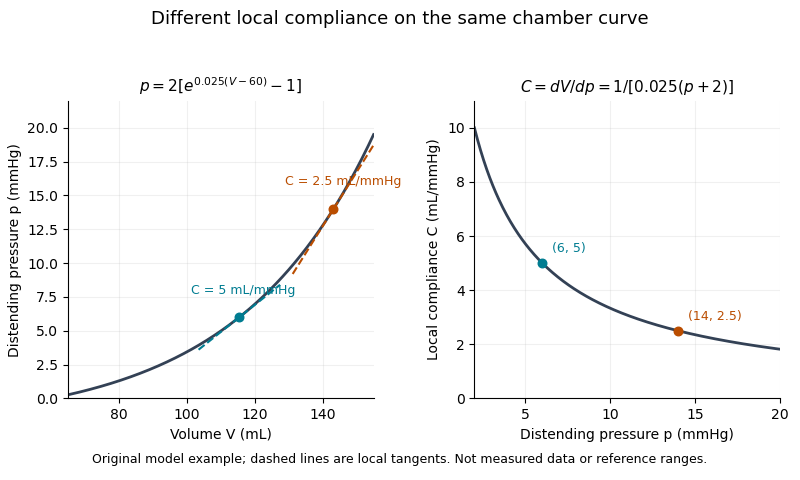
A primary experiment made the measurement problem concrete. Six excised dog hearts were perfused outside the body. An intraventricular balloon supplied a known volume, a micromanometer catheter recorded pressure, and echocardiography with automated boundary detection measured a mid-ventricular short-axis area. Repeated volume increments allowed pressure-area estimates to be compared with the balloon's pressure-volume reference. The reported agreement supported that experimental estimation method, while the authors explicitly left clinical validation open.[ref]
A pressure-volume trajectory during left ventricular filling also reflects time-dependent relaxation, valve flow and external constraints. Its instantaneous slope should not automatically be interpreted as the derivative of one fixed passive curve. Specifying the phase, pressure reference and conditions makes ventricular compliance a testable mechanical quantity rather than a synonym for filling volume.
Atrial reservoir function is the temporary storage of returning blood in an atrium during a phase when its inflow exceeds its outflow. For the left atrium, it is especially relevant while the mitral valve is closed during ventricular systole. It differs from passive onward passage, or atrial conduit function, and from the active late-filling contribution of atrial contraction.[ref]
A direct volume measure is the excursion over a specified cardiac cycle. Its denominator matters when it is converted into a ratio. An original example with volumes 70 and 40 mL gives mL, but and . These ratios describe different normalizations of the same excursion, not contradictory measurements.
The governing storage balance isA constant net inflow of 60 mL/s for 0.4 s stores 24 mL in this idealized interval. Neither the peak inflow rate nor a single chamber volume alone supplies the required integral. Over a repeating cycle with no net accumulation, total inflow and outflow must balance even though storage changes within the cycle.
The volume excursion also does not identify how long each parcel remains in the left atrium. A primary study reconstructed atrial flow using time-resolved computed tomography and computational fluid dynamics, then followed modeled particles to distinguish conduit, reservoir and longer-residence components.[ref]
Comprehensive left atrial flow component analysis reveals abnormal flow patterns in paroxysmal atrial fibrillation by Sophia Bäck and others. Abstract; Methods; Figure 7
Two atria can have similar maximum and minimum volumes while differing in which blood passes directly onward or remains through later phases. Storage volume and parcel residence are related questions, but they are different measurements.Atrial conduit function is the passive passage of returning blood through an atrium toward the ventricle, distinguished from temporary storage in atrial reservoir function and active pumping in atrial booster-pump function. For the left atrium, the pathway connects pulmonary vein inflow with mitral valve outflow during ventricular filling.[ref]
Two measurement descriptions need to be distinguished. A volumetric account compares chamber-volume changes with total ventricular filling. A parcel-based account asks when particular modeled blood enters and leaves the left atrium. A primary study defined conduit flow as entry and exit within the same ventricular diastolic phase and compared such components with volumetric indices.[ref]
Comprehensive left atrial flow component analysis reveals abnormal flow patterns in paroxysmal atrial fibrillation by Sophia Bäck and others. Abstract; flow-component definitions; Figure 7
The operational definition determines what is counted.An original bookkeeping model illustrates the volumetric approach. Suppose a periodic system has ventricular stroke volume , and suppose a reservoir release and direct onward passage form a complete, nonoverlapping partition of that delivered volume. ThenIf a further idealization identifies with the atrial excursion , values mL and an excursion of 30 mL give a conduit proxy of 50 mL. The arithmetic is exact for the stipulated partition; the correspondence between that partition and real trajectories is an additional assumption.
For example, simultaneous inflow and outflow can exchange blood while chamber volume remains constant. In the balance , equal 100 mL/s flows give zero volume change even though 20 mL passes in 0.2 s. Thus a flat volume trace does not demonstrate absent transport. Geometry, timing and modeled parcel histories supply information that volume extrema alone cannot provide.
Atrial booster-pump function is the active contribution of atrial contraction to ventricular filling. In the left atrium, contraction late in ventricular diastole helps drive blood through the open mitral valve. It supplements earlier filling associated with atrial conduit function, rather than accounting for all filling during the cardiac cycle.[ref]
Anatomy and Physiology 2e by J. Gordon Betts and others. §19.3, Cardiac Cycle, atrial systole and passive filling
A volumetric descriptor compares the chamber volume just before contraction, , with the subsequent minimum, . Their difference is the observed active-phase volume loss; the left atrial active emptying fraction usesFor constructed values 50 and 40 mL, the volume loss is 10 mL and this fraction is . Choosing the denominator is part of defining the descriptor.
That loss is not automatically all of the blood flow through the mitral valve during the interval. Integrating the left atrium's balance giveswhere is signed net pulmonary vein inflow over the same interval. If mL in the constructed example, 18 mL leaves through the mitral valve despite a chamber-volume decrease of only 10 mL.
A primary atrial flow component analysis reconstructed flow from time-resolved computed tomography and computational fluid dynamics, distinguishing modeled passage and residence histories.[ref]
Comprehensive left atrial flow component analysis reveals abnormal flow patterns in paroxysmal atrial fibrillation by Sophia Bäck and others. Abstract; Methods; Figure 7
This helps separate a phase-associated volume measurement from the route taken by each parcel. Likewise, an observed contraction-associated volume loss is not itself a controlled measurement of how much less ventricular filling would have occurred without contraction; pressure, timing and continuing inflow can also differ.Atrial flow component analysis classifies blood transport through an atrium by the entry, exit and retention histories of represented fluid parcels. It asks a different question from measuring only maximum and minimum left atrium volumes: which blood passed onward, remained within the chamber, or crossed a boundary in another direction?
A primary study used time-resolved computed tomography to reconstruct moving atrial anatomy, computational fluid dynamics to estimate the flow field, and modeled particle trajectories to classify six components. It distinguished atrial conduit flow component, atrial reservoir flow component, atrial delayed-ejection flow component, atrial retained-inflow component, atrial residual-volume component and pulmonary-vein backflow component.[ref]
Comprehensive left atrial flow component analysis reveals abnormal flow patterns in paroxysmal atrial fibrillation by Sophia Bäck and others. Abstract; Methods, flow-component definitions
These are model-derived transport categories, not six separate anatomical chambers.A typical trajectory calculation followswhere is the modeled fluid velocity. Boundary crossings and their timing within a defined cardiac cycle determine the category. For example, the study's conduit definition requires entry and exit within the same ventricular diastolic phase.[ref]
Comprehensive left atrial flow component analysis reveals abnormal flow patterns in paroxysmal atrial fibrillation by Sophia Bäck and others. Abstract and component definitions
Changing the time window or category definition changes what is counted.An original weighting example shows why counting markers alone can be misleading. Suppose three modeled markers represent 1, 1 and 8 mL, with the first two assigned to one component. That component contains 2 of 10 mL, or , although it contains two-thirds of the markers. The relevant fraction iswith the represented volumes for the chosen analysis. The denominator must be stated; an analysis that includes entering flow is not automatically a partition of one instantaneous chamber volume.
The results depend on reconstructed boundaries, flow assumptions, numerical tracking and phase definitions. Atrial reservoir function and atrial conduit function can be investigated with these categories, but a volumetric proxy and a parcel-based component need not be identical observations.
Pinned article: Introduction to the OurBigBook Project
Welcome to the OurBigBook Project! Our goal is to create the perfect publishing platform for STEM subjects, and get university-level students to write the best free STEM tutorials ever.
Everyone is welcome to create an account and play with the site: ourbigbook.com/go/register. We belive that students themselves can write amazing tutorials, but teachers are welcome too. You can write about anything you want, it doesn't have to be STEM or even educational. Silly test content is very welcome and you won't be penalized in any way. Just keep it legal!
Intro to OurBigBook
. Source. We have two killer features:
- topics: topics group articles by different users with the same title, e.g. here is the topic for the "Fundamental Theorem of Calculus" ourbigbook.com/go/topic/fundamental-theorem-of-calculusArticles of different users are sorted by upvote within each article page. This feature is a bit like:
- a Wikipedia where each user can have their own version of each article
- a Q&A website like Stack Overflow, where multiple people can give their views on a given topic, and the best ones are sorted by upvote. Except you don't need to wait for someone to ask first, and any topic goes, no matter how narrow or broad
This feature makes it possible for readers to find better explanations of any topic created by other writers. And it allows writers to create an explanation in a place that readers might actually find it.
Figure 1. Screenshot of the "Derivative" topic page. View it live at: ourbigbook.com/go/topic/derivativeVideo 2. OurBigBook Web topics demo. Source. - local editing: you can store all your personal knowledge base content locally in a plaintext markup format that can be edited locally and published either:This way you can be sure that even if OurBigBook.com were to go down one day (which we have no plans to do as it is quite cheap to host!), your content will still be perfectly readable as a static site.
- to OurBigBook.com to get awesome multi-user features like topics and likes
- as HTML files to a static website, which you can host yourself for free on many external providers like GitHub Pages, and remain in full control

Figure 2. You can publish local OurBigBook lightweight markup files to either OurBigBook.com or as a static website.
Figure 3. Visual Studio Code extension installation.
Figure 5. . You can also edit articles on the Web editor without installing anything locally. Video 3. Edit locally and publish demo. Source. This shows editing OurBigBook Markup and publishing it using the Visual Studio Code extension. 
- Infinitely deep tables of contents:



All our software is open source and hosted at: github.com/ourbigbook/ourbigbook
Further documentation can be found at: docs.ourbigbook.com
Feel free to reach our to us for any help or suggestions: docs.ourbigbook.com/#contact