Topics (384k) Articles (398k) Users (410) Discussions (242) Comments (383) Files (13k) New article

J. Stenflo coauthored the 1974 work identifying gamma-carboxyglutamic acid in prothrombin, connecting Vitamin K dependence with a specific chemical modification of a clotting protein. The study isolated a four-residue peptide from the calcium-binding amino-terminal region and found mobility that ordinary amino-acid composition did not explain.[ref]
Nuclear magnetic resonance and mass spectrometry identified two modified glutamic-acid residues in that peptide. The result supplied a chemical identity for the anomaly, rather than treating an altered migration pattern alone as a complete explanation.[ref]
Vitamin K dependent modifications of glutamic acid residues in prothrombin by J. Stenflo and others. Abstract: proton NMR, mass spectrometry and two gamma-carboxyglutamic-acid residues
An additional carboxyl group changes a side chain's chemical possibilities, including its interactions with ions. This makes post-synthesis chemistry biologically significant: two protein preparations with the same genetically specified sequence can differ in modifications and function. The finding helped connect a nutritional requirement, a measurable molecular difference and the behavior of a calcium-binding protein, while preserving the distinction between a chemical observation and a physiological inference.
M. Soriano-Garcia is the first-listed author of a structural study connecting calcium ion binding with organization of the Gla domain of prothrombin. The 1992 paper reports an X-ray crystallography structure of calcium-bound prothrombin fragment1 at resolution and lists a chemistry affiliation at Michigan State University.[ref]
The comparison was mechanistically informative. In crystals without bound calcium, much of the Gla domain was disordered; in the calcium-bound preparation, the domain was well resolved and bound seven calcium ions. Carboxylate groups of gamma-carboxyglutamate residues helped coordinate those ions. Thus calcium was associated with a particular folded arrangement, rather than simply being another ingredient in solution.[ref]
The Ca2+ ion and membrane binding structure of the Gla domain of Ca-prothrombin fragment 1 by M. Soriano-Garcia and others. Abstract: apo/calcium-bound comparison and coordination
The study illustrates a limit of structural interpretation. Failure to resolve a region in a crystal does not prove that the corresponding amino acids are absent. The same sequence can be present while adopting multiple arrangements that do not yield one sharply defined crystallographic position. Comparing binding states can therefore reveal organization without implying that a missing part of the image was missing from the protein.
Pedro Cuatrecasas was a biochemist who helped develop affinity chromatography and studied receptor biology. With collaborators including Meir Wilchek, he developed methods that used selective molecular binding to isolate particular proteins from complex mixtures.[ref]
His 1970 paper, Agarose Derivatives for Purification of Protein by Affinity Chromatography by Pedro Cuatrecasas, explained the organizing principle: attach a suitable ligand to an insoluble matrix, then exploit its reversible interaction with the desired macromolecule. The immobilized ligand supplies chemical selectivity, rather than requiring the target protein to be distinguished only by bulk size or charge.[ref]
Agarose Derivatives for Purification of Protein by Affinity Chromatography by Pedro Cuatrecasas. opening text, reversible recognition and covalently attached ligand
The method separates capture from recovery. Binding a target is useful only if the experiment can distinguish it from other retained material and recover it in a usable state. This makes protein purification a problem of controlled interactions as well as apparatus. Cuatrecasas also applied binding measurements and affinity methods to the insulin receptor, connecting recognition of a hormone to a physically isolable molecular component.[ref]
Emanuel Margoliash was a biochemist whose work on cytochrome c connected protein primary structure, molecular function and evolution. He isolated and sequenced the protein from different organisms and helped develop comparisons of amino acid sequences as evidence for phylogenetic trees.[ref]
His 1963 paper, Primary structure and evolution of cytochrome c by Emanuel Margoliash, made the structural comparison itself a source of evolutionary evidence. Subsequent collaborative work assembled a tree from twenty cytochrome-c sequences, combining published sequences with measurements from his laboratory.[ref]
A toy example shows the measurable idea. Align the five-residue strings
ACGKT and ACGRT: four positions agree and one differs, giving an observed mismatch fraction . These are invented strings, not Margoliash's data. An observed mismatch count is not automatically elapsed evolutionary time: repeated substitutions can hide earlier changes. The power of the approach is to make molecular resemblance explicit and test competing explanations, while retaining the distinction between sequence observations and an inferred history.Venizelos Papayannopoulos is a biomedical researcher whose work concerns neutrophils and extracellular antimicrobial responses. He was first author of a 2010 study connecting neutrophil elastase and myeloperoxidase to the formation of neutrophil extracellular traps.[ref]
That work connected localization to chemistry. Neutrophil elastase entered the cell nucleus and cleaved particular histones, while experiments with purified components tested how those changes affected chromatin decondensation. A mouse loss-of-function comparison supplied evidence about trap formation in an infection model.[ref]
Neutrophil elastase and myeloperoxidase regulate the formation of neutrophil extracellular traps by Venizelos Papayannopoulos and others. Abstract and Fig. 1, component assays and genetic comparison
The scientific value lies in combining tests of different claims. Imaging can locate a protein; an enzyme assay can identify activity; removing a component can test a requirement in a larger system. Agreement among those observations supports a mechanism, while none is an automatic substitute for the others. This makes the research an example of how protein biochemistry can explain a changing cellular structure.
Gennadiy Moiseyev is a researcher in retinoid biochemistry and the visual cycle. He was first author of a 2005 study demonstrating RPE65-dependent conversion of all-trans-retinyl esters into 11-cis-retinol in an expression system.[ref]
A subsequent study tested the enzyme's metal requirement. Chelation inhibited the measured activity, and supplying ferrous iron restored it; the tested ferric-iron additions did not. The study also examined recombinant RPE65 and measured iron associated with purified protein.[ref]
The contrast illustrates why the relevant variable is more specific than “some iron is present.” Oxidation state, accessible metal and assay conditions can affect whether an enzyme functions. Inhibition followed by chemically specific restoration provides a stronger mechanistic test than a correlation between protein abundance and product amount. Those biochemical experiments concern a defined reaction system; they do not by themselves establish a treatment or explain every physiological consequence of altered retinoid metabolism.
Meir Wilchek is a biochemist whose work helped establish affinity chromatography as a practical method of protein purification. His collaboration with Pedro Cuatrecasas used selective molecular recognition to retain a desired protein on a ligand-bearing support, connecting a biochemical interaction to a separation method.[ref]
Pedro Cuatrecasas by Alan R. Saltiel. p. 2, collaboration with Wilchek and development of affinity methods
The central idea differs from simply sorting proteins by size. An immobilized ligand supplies a binding partner for the target, while the experiment must still control unwanted retention and recover useful protein. The combination of specificity and reversibility makes a molecular interaction into an analytical tool.
For an illustrative comparison, two proteins of similar mass may behave differently on a column if only one recognizes the attached ligand. Conversely, a tightly retained protein is not automatically the intended target. Identity measurements and controls remain necessary. Wilchek's contribution is scientifically interesting because it makes biological selectivity useful for experimental isolation, rather than treating recognition only as a phenomenon to describe.[ref]
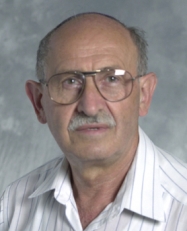
Portrait of Meir Wilchek
. Photograph explicitly identified as Wilchek Meir in the official departmental directory.C. E. Nerantzis is an author of anatomical research on coronary arteries and their distribution in the human heart. The 1996 primary paper Functional dominance of the right coronary artery: incidence in the human heart by C. E. Nerantzis and others lists the author with the Pathology Department, University of Athens. Its byline establishes the initials used here; it does not by itself establish a fuller personal name.[ref]
Functional dominance of the right coronary artery: incidence in the human heart by C. E. Nerantzis and others. Primary byline, affiliation and abstract
Nerantzis and colleagues studied 200 human hearts after injection of radiopaque material, combining direct observation with X-ray analysis. They classified 178 as right dominant because the right coronary artery gave rise to the posterior interventricular artery. Within those 178, they distinguished 19 specimens with both a large posterior branch and a large continuation beyond the crux. The mapped right coronary artery in this subgroup supplied the right ventricle and nearly half the left ventricle.[ref]
Functional dominance of the right coronary artery: incidence in the human heart by C. E. Nerantzis and others. Abstract, injected-heart methods and right-dominant subgroup
The nested counts show why a classification and a detailed territory map are different observations: of this collection met the usual right-dominance criterion, but the described extended subgroup was of those right-dominant hearts. These sample fractions do not automatically estimate every population. The work illustrates how coronary dominance summarizes a branch origin while leaving additional variation in arterial extent.
Radiopaque filling makes the vessel paths visible; it does not directly measure living blood flow under exercise or after an obstruction. The anatomical observation motivates questions about which myocardium a proximal lesion could affect, while physiological flow and clinical outcome require additional evidence.
William H. Mason, whose earlier course notes use the byline W. H. Mason, was an aerospace engineer and Virginia Tech professor whose work connected aerodynamic theory, computation and aircraft design. His university identifies both his academic work and his earlier industrial experience at Grumman in introducing the posthumous Lecture Notes on Configuration Aerodynamics by William H. Mason.[ref]
Lecture Notes on Configuration Aerodynamics by William H. Mason. Publisher landing page, author byline and scope; official departmental announcement linked in source card
The earlier Applied Computational Aerodynamics by W. H. Mason gives a particularly concrete example of this approach. Its geometry appendix turns an airfoil or wing planform into explicit equations suitable for calculation: a shape is not merely a sketch but a set of coordinates, chord distributions and area integrals. For a trapezoidal wing, specifying wingspan, root chord and wing taper ratio determines the projected wing area, which then enters the definition of lift coefficient.[ref]
Applied Computational Aerodynamics by W. H. Mason. Appendix A, Geometry for Aerodynamicists, pp. A-1 and A-27–A-29
This emphasis is useful in interpreting a simulation. A computed change in lift can come from a changed wing planform, a changed angle of attack, or a changed normalization by wing area; checking the geometry and reference quantities is part of checking the result. Mason's later lecture notes extend the design perspective across low-speed and high-speed configurations, with Pradeep Raj serving as editor of the published volume.[ref]
Pradeep Raj is an aerospace engineer whose work concerns computational fluid dynamics in aircraft design. His Virginia Tech profile records a 1976 doctorate in aerospace engineering and describes teaching in aircraft design and applied computational fluid dynamics. Its account emphasizes using calculated forces and torques as inputs to structural and control design, while recognizing credibility problems in strongly separated flows.[ref]
His account of simulation-driven design identifies an important distinction: a virtual prototype can be inexpensive to change, but it helps engineering only if its predictions correspond sufficiently well to the real system. Faster calculations alone do not establish model validation.[ref]
An original uncertainty calculation illustrates the issue. Suppose a stipulated aircraft model requires and a computation predicts drag . Its predicted lift-to-drag ratio is . A second design predicted to have appears better, with . If either actual drag can independently differ from its prediction by up to , their intervals overlap and either ordering is possible. The nominal 5% drag reduction is not by itself a verified improvement.
Experiments addressing the relevant Reynolds number, Mach number and flow separation can test that comparison. Computational fluid dynamics and wind tunnel measurements have different limitations; their agreement is informative only when geometry, operating conditions and measurement definitions are comparable. This is a reason to study predictive credibility alongside numerical efficiency.

Eastman N. Jacobs (1902–1987) was an aerodynamicist at the National Advisory Committee for Aeronautics' Langley laboratory. He joined in 1925 and led its variable-density wind tunnel section from 1928 to 1939. His work connected systematic NACA airfoil geometry with experimental measurements and later helped drive low-turbulence airfoil research.[ref]
The scientific problem was that a wind tunnel can influence the very phenomenon being studied. Higher air density raises the model's Reynolds number, making a small airfoil more representative of a larger one. But a large wind-tunnel turbulence intensity can alter boundary layer transition, preventing an otherwise appropriate Reynolds number match from reproducing flight behavior. NASA's account describes this difficulty as a motivation for Jacobs's low-turbulence tunnel program.[ref]
An original scale comparison makes the distinction concrete. At mean speed , an illustrative fluctuating velocity with root mean square has intensity . A second test with the same mean speed, density, dynamic viscosity and model dimensions but has intensity . Both have the same Reynolds number; their fluctuation levels differ twentyfold. These stipulated values are not historical tunnel measurements.
Jacobs's program thus illustrates why dimensional analysis and careful apparatus design complement one another. A laminar flow claim needs evidence about the flow environment as well as a smooth-looking airfoil. His collaborators Kenneth E. Ward and Robert M. Pinkerton supplied further experiments on related sections and their measured performance.

Kenneth E. Ward was a National Advisory Committee for Aeronautics researcher whose wind tunnel investigations examined interactions between aircraft components. He also coauthored the systematic related-airfoil investigation with Eastman N. Jacobs and Robert M. Pinkerton.[ref]
Interference Effects and Drag of Struts on a Monoplane Wing by Kenneth E. Ward. Byline, Introduction and Apparatus and Tests
[ref]In his 1931 strut experiment, a 5-by-30-inch Göttingen 387 airfoil was tested first alone and then with inclined struts attached in different upper- and lower-surface positions. The variable-density wind tunnel operated at 20 atmospheres and approximately . A repeated wing-alone test before and after the strut trials checked the comparison's repeatability. Separate strut measurements helped isolate aerodynamic interference.[ref]
Interference Effects and Drag of Struts on a Monoplane Wing by Kenneth E. Ward. Printed pp.2–5, Apparatus and Tests and Discussion of Results
The central question is whether component drag adds. Define an interaction residual at matched operating conditions byFor invented measurements of , and, respectively, . The assembly's drag increase is twice what the isolated struts contribute. Ward reported that interaction drag could be as large as the struts' own drag; the numerical forces here simply illustrate the subtraction.[ref]
Interference Effects and Drag of Struts on a Monoplane Wing by Kenneth E. Ward. Summary and Discussion of Results, interference compared with isolated strut drag
This aircraft component drag interaction is why a streamlined part cannot be assessed solely in isolation. Changing its location also changes neighboring pressure and fluid flow. Comparable Reynolds numbers, mounting corrections and repeat measurements are needed to distinguish that interaction from a changed test condition.
Robert M. Pinkerton investigated airfoil aerodynamics at the National Advisory Committee for Aeronautics. He coauthored the related-section study with Eastman N. Jacobs and Kenneth E. Ward and later compared measured surface pressure distributions with potential flow calculations.[ref]
The Characteristics of 78 Related Airfoil Sections from Tests in the Variable-Density Wind Tunnel by Eastman N. Jacobs and others. Report byline
[ref]His 1937 report describes a 5-by-30-inch NACA 4412 model in a variable-density wind tunnel, with 54 pressure orifices at the middle of the span. Seventeen angles of attack, from −20 to 30 degrees, were tested at a Reynolds number of approximately. These readings test the distribution of pressure, not merely whether the total lift happens to agree with a calculation.[ref]
Calculated and Measured Pressure Distributions over the Midspan Section of the NACA 4412 Airfoil by Robert M. Pinkerton. NTRS abstract, apparatus and conditions
An original simplified example explains the extra information. If a thin airfoil has a constant difference over its chord, its surface pressure integration for airfoil lift gives the normal-force approximationWith dynamic pressure and airfoil chord , the normal force per unit span is . A different distribution can give the same integral while producing a different pitching moment or boundary layer behavior. These are invented uniform data, not Pinkerton's measurements.
Finite pressure-tap spacing and pressure-tap position error can change the inferred integral. A measured distribution therefore offers both a stricter test of potential flow and a way to see where its assumptions cease to describe the actual fluid flow.
Richard T. Whitcomb was an aerospace engineer at the National Advisory Committee for Aeronautics and National Aeronautics and Space Administration's Langley laboratory. His research linked aerodynamic geometry with measurements of pressure, drag and flow changes near the speed of sound. NASA's official profile identifies his area rule, supercritical airfoil and winglet work.[ref]
Richard T. Whitcomb by NASA. Named biography and passages on the three aerodynamic contributions
His 1947 sweep investigation provides a concrete earlier example. A wing was tested with zero, forward and backward sweep in the Langley 8-foot high-speed wind tunnel. Pressure measurements and wake surveys supplied loading and drag information, showing that changes associated with shocks were delayed by sweep without following a universal cosine shift exactly.[ref]
For the area rule, the scientific question was whether the streamwise area distribution of the complete wing-body combination mattered more than judging each component separately. NASA describes testing his proposed distribution with a specially built wing-body model, then applying the result to a fighter configuration.[ref]
Richard T. Whitcomb by NASA. Area-rule passage, prioritized model test and subsequent configuration change
An original bookkeeping example illustrates the geometric idea without predicting wave drag. If a body contributes of cross-sectional area at one station and the added wing contributes another to the stipulated combined section, their sum is . Reducing the body's contribution to restores a total there. The relevant research concerns how that total varies along the vehicle; this one-station sum is not a drag law.
His later supercritical airfoil and winglet contributions addressed different flow mechanisms. NASA describes a shaped high-subsonic section and carefully tailored wing-tip devices, rather than treating every drag reduction as the same geometric correction.[ref]
Richard T. Whitcomb by NASA. Supercritical-wing and winglet passages
The common experimental method is to specify the geometry, identify the predicted flow change and measure the resulting aerodynamic response.Ira H. Abbott was an aerospace engineer whose Langley work connected airfoil geometry, wind tunnel measurements and corrections to aerodynamic data. NASA's institutional profile records his arrival at the Variable Density Tunnel in 1929, subsequent airfoil research and participation in tunnel design. The profile emphasizes that section data do not by themselves determine a complete three-dimensional aircraft wing's behavior.[ref]
Ira H. “S” Abbott by NASA. Technical-career paragraphs, Variable Density Tunnel and distinction between airfoil and wing design
A specific primary contribution is the 1939 report with Eastman N. Jacobs on support interference in the variable-density wind tunnel. Its abstract states that the support effect made earlier drag coefficients and their apparent increase with airfoil thickness too large; the report supplies corrected data and methods. The apparatus supporting a model can alter the flow being measured, so its effect is not established merely by an empty-tunnel zero.[ref]
For an original arithmetic illustration, stipulate measured drag coefficients of and for two sections, with separately established support corrections of and . The corrected values are and : the apparent difference falls from to . At dynamic pressure and a shared reference area of , these correspond to corrected drag values of and . This invented example illustrates the experimental question; it does not replace the report's geometry-dependent correction method with a universal subtraction.
Dan H. Neuhart is the first named author, with Catherine B. McGinley, of the 2004 Langley study of wind-tunnel turbulence intensity. The report's title page identifies the byline and Langley affiliation. Its scientific contribution is an experimental characterization of tunnel flow with a specified signal chain, rather than an assertion that a facility has one universal turbulence number.[ref]
Free-Stream Turbulence Intensity in the Langley 14- by 22-Foot Subsonic Tunnel by Dan H. Neuhart and Catherine B. McGinley. Title page, Summary and flow-quality survey
The study combined hot-wire anemometry, velocity calibration and spectral analysis. The reported dynamic-data procedure retained approximately to , sampled at and acquired simultaneous records. The distinction between sampling rate and retained bandwidth is essential: increasing the former does not establish which fluctuations were included in the reported intensity.[ref]
An original ideal spectral example makes that distinction quantitative. Suppose a one-sided power spectral density is constant at across a selected band and zero elsewhere. ThenKeeping only a subset of that flat band gives . The changed answer reflects a changed integration band, not a measured improvement in the underlying flow. Real spectra are not generally flat; the invented example isolates the reporting issue without attributing either value to Neuhart's experiment.
Catherine B. McGinley is identified as a Langley researcher and coauthor with Dan H. Neuhart of a 2004 experimental report on wind-tunnel turbulence intensity. The primary title page establishes this byline; the report connects the claimed flow quality to a documented measurement procedure.[ref]
Free-Stream Turbulence Intensity in the Langley 14- by 22-Foot Subsonic Tunnel by Dan H. Neuhart and Catherine B. McGinley. Title page and printed pp. 7–9, apparatus and data analysis
The experiment used calibrated hot-wire anemometry to convert electrical signals into mean and fluctuating velocity. Its comparisons included different positions and tunnel operating conditions. Calibration and retained frequency range belong to the interpretation of a turbulence result; the report's Figure 20 explicitly examines bandwidth sensitivity.[ref]
Free-Stream Turbulence Intensity in the Langley 14- by 22-Foot Subsonic Tunnel by Dan H. Neuhart and Catherine B. McGinley. Printed pp. 8–9, hot-wire calibration; Figure 20, integration-bandwidth comparison
An original calculation illustrates why a numerical turbulence intensity needs a scale. With , stipulate and mean speed . Then . If an independent additive measurement-noise component has RMS , the observed fluctuation RMS becomesgiving . Subtracting RMS values directly would give the wrong answer; independence permits subtraction of variances. These stipulated numbers are not measurements from the report. The example shows why a small recorded fluctuation cannot be interpreted without considering apparatus noise and the measurement model.
Earll Murman is an aerospace engineer and MIT professor emeritus whose institutional profile identifies aircraft systems engineering among his specializations. His authored lecture on aircraft performance connects aerodynamic forces, propulsion, energy and maneuvering constraints. The lecture title page credits him directly and is dated 18 September 2003; the host course is a separate Fall 2004 offering.[ref][ref]
Introduction to Aircraft Performance and Static Stability by Earll Murman. Title slide and Today's Topics

Earll Murman in the portrait provided by his official MIT AeroAstro faculty profile
. One useful connection in that lecture is aircraft energy height. For constant mass , gravitational acceleration , altitude and true airspeed in a still-air model, divide the sum of gravitational potential energy and kinetic energy by gravitational weight:If thrust acts along the motion, drag opposes it, and other energy exchanges are neglected, the specific excess power isThis expresses the possibility of using the available mechanical power for climbing, accelerating, or both.[ref]
Introduction to Aircraft Performance and Static Stability by Earll Murman. PDF pp. 21–24, Specific Energy and Excess Power and Summary of Power Characteristics
For an original stipulated example, take , , and . Then . At constant true airspeed, that is the model's climb rate. At constant altitude, the same instantaneous power gives . These are alternative allocations at the stipulated condition, not a claim that an actual engine maintains the same excess thrust throughout a maneuver.
The distinction illustrates why satisfying a lift or aerodynamic load factor requirement alone does not establish sustained performance. Measurements of speed change, altitude change, thrust and drag test different terms of the energy account. The lecture's force and energy models make those assumptions explicit; they do not replace configuration-specific experimental data.
Charles D. Harris is the first named author, with James A. Blackwell, Jr., of the 1972 NASA report testing rear-upper-surface changes on a supercritical airfoil. The experiment examined a local off-design velocity peak while also checking the consequences at the design condition. The published summary reports that the particular attempted change adversely affected design-condition drag.[ref]
Wind-tunnel Investigation of Effects of Rear Upper Surface Modification on an NASA Supercritical Airfoil by Charles D. Harris and James A. Blackwell, Jr.. Byline, Summary and Introduction, printed pp. 1–2
The tests covered Mach numbers from to in a transonic wind tunnel. The models differed in rear-upper-surface shape while retaining their trailing-edge thickness; pressure measurements and a wake rake connected the geometric change to aerodynamic observations.[ref]
An original comparison shows why an improvement needs its operating condition. Stipulate that a proposed modification changes drag coefficient by at one condition and at another. With the same reference dynamic pressure and area for this arithmetic example,gives and , respectively. The sign of the benefit reverses. These invented coefficients are not values reported by Harris; they isolate why suppressing one local feature cannot establish lower total drag throughout an operating range.
A useful experimental comparison therefore records the Mach number, Reynolds number, angle of attack, loading and surface condition with the measured pressure coefficient distribution and drag. Changes of boundary-layer transition or mounting effects can alter the result. The documented negative outcome is scientifically informative because it tests a specific geometric proposal rather than assuming that a locally smoother-looking flow must improve complete performance.
Pinned article: Introduction to the OurBigBook Project
Welcome to the OurBigBook Project! Our goal is to create the perfect publishing platform for STEM subjects, and get university-level students to write the best free STEM tutorials ever.
Everyone is welcome to create an account and play with the site: ourbigbook.com/go/register. We belive that students themselves can write amazing tutorials, but teachers are welcome too. You can write about anything you want, it doesn't have to be STEM or even educational. Silly test content is very welcome and you won't be penalized in any way. Just keep it legal!
Intro to OurBigBook
. Source. We have two killer features:
- topics: topics group articles by different users with the same title, e.g. here is the topic for the "Fundamental Theorem of Calculus" ourbigbook.com/go/topic/fundamental-theorem-of-calculusArticles of different users are sorted by upvote within each article page. This feature is a bit like:
- a Wikipedia where each user can have their own version of each article
- a Q&A website like Stack Overflow, where multiple people can give their views on a given topic, and the best ones are sorted by upvote. Except you don't need to wait for someone to ask first, and any topic goes, no matter how narrow or broad
This feature makes it possible for readers to find better explanations of any topic created by other writers. And it allows writers to create an explanation in a place that readers might actually find it.
Figure 1. Screenshot of the "Derivative" topic page. View it live at: ourbigbook.com/go/topic/derivativeVideo 2. OurBigBook Web topics demo. Source. - local editing: you can store all your personal knowledge base content locally in a plaintext markup format that can be edited locally and published either:This way you can be sure that even if OurBigBook.com were to go down one day (which we have no plans to do as it is quite cheap to host!), your content will still be perfectly readable as a static site.
- to OurBigBook.com to get awesome multi-user features like topics and likes
- as HTML files to a static website, which you can host yourself for free on many external providers like GitHub Pages, and remain in full control

Figure 2. You can publish local OurBigBook lightweight markup files to either OurBigBook.com or as a static website.
Figure 3. Visual Studio Code extension installation.
Figure 5. . You can also edit articles on the Web editor without installing anything locally. Video 3. Edit locally and publish demo. Source. This shows editing OurBigBook Markup and publishing it using the Visual Studio Code extension. 
- Infinitely deep tables of contents:



All our software is open source and hosted at: github.com/ourbigbook/ourbigbook
Further documentation can be found at: docs.ourbigbook.com
Feel free to reach our to us for any help or suggestions: docs.ourbigbook.com/#contact