Topics (384k) Articles (398k) Users (410) Discussions (242) Comments (383) Files (13k) New article

Module learning with errors is a structured version of learning with errors in which matrix entries and secret components are elements of a specified polynomial ring. A typical relation isHere is a public matrix of ring elements, while and have sampled small coefficients. Multiplication combines polynomial multiplication with reduction by the defining polynomial and coefficient modulus.
A ring element packs coefficients, giving structured linear operations without storing an arbitrary dense matrix of all scalar coefficients. This saves space and computation, while introducing an algebraic structure that the security assumption must cover. CRYSTALS-Kyber uses module-LWE, and ML-KEM standardizes a related encapsulation construction. This is a conditional hardness basis, not a proof that every choice of ring and parameters is secure.[ref]
Kyber documentation by CRYSTALS project. Scientific Background, polynomial rings and Module-LWE
The average power of a laser pulse train is its integrated radiant energy per observation time. If an interval contains complete pulses, with no uncounted edge contributions or continuous background,Thus the relevant pulse repetition frequency is the actual emitted-pulse rate in the interval. Historical calorimetric calibrations inferred average power and pulse energy from total received energy, injection time and pulse rate.[ref]
Calibration Service for Laser Power and Energy at 248 nm by Rodney W. Leonhardt. §6.2, Laser stability, printedp.23
An original counting example exposes a possible cancellation of errors. A nominal trigger produces 200 triggers in . Suppose only 180 complete optical pulses arrive, each carrying . Their total is , so the pulse contribution is , corresponding to an actual 90kHz pulse rate. Add a continuous optical background of , and a detector integrating everything reads .
Dividing that total by the nominal trigger rate would happen to give , despite both the missing pulses and the unremoved background. Removing the background but still using the nominal rate would instead infer , ten percent below the actual emitted-pulse energy. This missing-pulse bias in average-power inference cannot be diagnosed from the apparently reasonable quotient alone. A pulse-resolving monitor and a suitable background subtraction distinguish the two contributions.
For bursts or variable repetition, count the pulses in the same interval as the energy measurement. A slow integrating detector can establish their mean energy after these corrections but does not resolve pulse-to-pulse energy fluctuation or optical peak power. Laser pulse energy separates these observables.
The pulse energy shape factor is the dimensionless ratiowhere is laser pulse energy, is background-subtracted peak power and is a stated pulse duration. It belongs to the chosen profile and width convention. Here denotes the power full width at half maximum, the convention explicitly used by the primary source documentation.[ref]
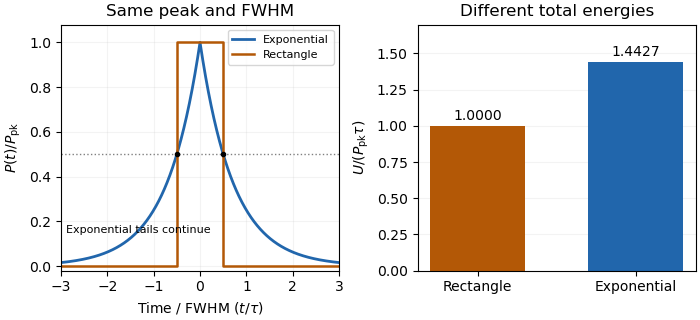
An original counterexample compares a rectangular pulse with a bilateral exponential pulse. Give both the same and power FWHM . The rectangle is nonzero over a width , so and . Forthe half-maximum points are again , but integration of the two tails gives and .
With and , the energies are and . The same measured peak and FWHM therefore leave a 44.3 percent difference in this example. This nonuniqueness of pulse energy at fixed peak power and FWHM is a profile ambiguity, not an instrument-unit conversion.
Pulse energy baseline correction subtracts the estimated non-pulse contribution before integrating a measurement trace. For a trace calibrated in power units over a gate ,The estimate must have the same units as the integrated trace. Optical background and a detector-electronics offset enter at different stages of a physical measurement; a voltage offset cannot be subtracted directly from optical power without a response calibration.
An original drift example takes a gate. Suppose pulse-free observations establish a baseline increasing linearly from to across that gate. Its integrated contribution isIf the measured trace integrates to , the corrected estimate is . Subtracting only the initial would yield , with a positive error. This is a baseline-drift bias in pulse-energy integration in a stipulated linear model.
Historical NIST measurements took baselines before and after each run and averaged them to correct background and thermal drift. The leakage-background configuration was specified separately from a pulse injection.[ref]
Calibration Service for Low-level Pulsed-Laser Radiometers at 1.06 µm: Pulse Energy and Peak Power by Rodney W. Leonhardt. §3.5, printedp.8; §7.2, Type B component4, Leakage Effect
Bracketing observations must genuinely represent the non-pulse signal; they cannot include an unrecognized pulse tail. Subtraction also cannot recover energy excluded by a detection time gate or repair a nonlinear detector. The Gaussian pulse time-gate energy fraction quantifies one profile-specific truncation effect.Pulse-to-pulse energy fluctuation is variation in the laser pulse energy of successive emitted pulses. For a stationary population with finite variance, its standard deviation is . A finite record supplies an estimate, whose convention should be stated rather than being confused with the uncertainty of the record's mean.
For an original four-pulse record, take measured energies . Their mean is . The sample standard deviation isIts coefficient of variation is 11.55 percent. The root-mean-square deviation of this particular list, using divisor four rather than three, is instead or 10 percent. The definition matters when comparing reported stability figures. The familiar estimate of uncertainty in a mean additionally assumes independent, identically distributed observations; an ordered record alone does not establish that assumption.
A historical NIST stability assessment compared an internal excimer-laser pulse monitor with a pyroelectric laser-energy meter. Its calorimeter integrated a pulse train, so averaging and individual-pulse variation entered different parts of the analysis.[ref]
Calibration Service for Laser Power and Energy at 248 nm by Rodney W. Leonhardt. §6.2, Laser stability, printedp.23
Observed variability also includes readout noise. Separating detector noise from pulse-energy variance requires an appropriate measurement model and independent information about that noise. Detector saturation, drift and correlated pulse errors are not removed merely by collecting a longer record. An average power of a laser pulse train measurement by itself does not resolve this sequence.
Laser light is radiation produced by a laser, in which stimulated emission and feedback select and amplify optical modes. It can have high directional concentration, a narrow spectrum and strong coherence compared with ordinary thermal sources.
These are properties to quantify, rather than guarantees of perfect monochromaticity or one universal intensity distribution. A pulsed laser has finite bandwidth, and a multimode laser can have several frequencies. The emission's temporal coherence, spatial mode and polarization determine which interference or focusing experiments it supports.
A ring laser is a laser whose optical cavity follows a closed circulating path through a laser gain medium. Mirrors can fold the path into a triangle or another polygon; guided structures can implement the same circulating feedback principle. A travelling optical wave can return to its starting position and direction after one full circuit. The laser threshold requires round-trip gain to balance the complete losses; a closed path alone is not enough to produce laser oscillation.[ref]
Fundamentals of Photonics and Quantum Electronics lecture notes by Franz X. Kärtner. Chapter7, printedpp.313–314, Figure7.19 and equations7.10–7.12
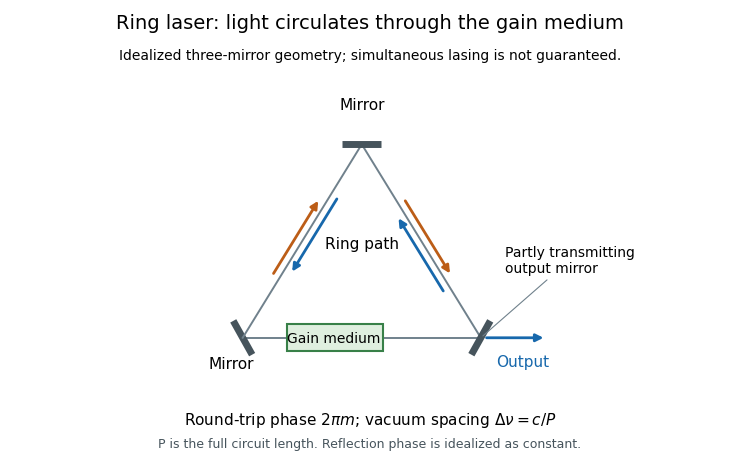
Original schematic of a three-mirror ring laser, a laser gain medium, two possible circulation directions and one output port
. Idealized optical-path diagram rather than a reconstruction of the McNamara experiment. The arrows indicate possible travelling waves; their simultaneous stable lasing is not assumed. Details.The phase condition explains the allowed normal modes. Neglect dispersion and take a constant round-trip reflection phase . If the circuit's optical path length is , resonance requiresSubtracting the equations for consecutive modes gives the free spectral rangeMore generally the spacing is approximately the inverse round-trip group delay. A vacuum circuit of full geometric perimeter has a round-trip time about and mode spacing about . There is no additional factor of two: already counts the whole returning route.[ref]
Fundamentals of Photonics and Quantum Electronics lecture notes by Franz X. Kärtner. Chapter7, equations7.10–7.12: inverse round-trip-time spacing and distinction between linear and ring cavities
Gain and phase impose different conditions. In an original startup model let the three mirror intensity reflectivities be , and , and let the intensity gain accumulated during one complete circuit be , with other losses neglected. The round-trip intensity multiplier isThe modeled field can grow from a seed. Reducing to gives , so it decays. These are intensity quantities, not amplitude reflectivities. Saturation and competition between normal modes must determine real steady operation.
A reciprocal ideal ring supports possible clockwise and counterclockwise waves. Their simultaneous stable emission is a dynamical question because both can interact with the same laser gain medium. A ring laser gyroscope uses rotation-dependent differences between the two circulation directions through the Sagnac effect; ring geometry by itself does not guarantee a useful rotation measurement.
A different motivating experiment used the directional dynamics as a nonlinear sensor. In 1988 Bruce McNamara, Kurt Wiesenfeld and Rajarshi Roy periodically modulated the asymmetry between counter-rotating lasing modes and added controlled external noise. Their measured signal-to-noise ratio improved for injected noise relative to no external noise, demonstrating stochastic resonance. This observation concerns a particular modulated dynamical response, not a claim that adding noise improves every optical measurement.[ref]
Observation of Stochastic Resonance in a Ring Laser by Bruce McNamara and others. Publisher abstract, Physical Review Letters60, pp.2626–2629, 1988
A carbon dioxide laser, or CO2 laser, uses excited carbon dioxide molecules as its laser gain medium. Its characteristic emission lies in the infrared, with important lines near . The emitting transitions change the molecule's vibrational and rotational states. This connects laser action with molecular vibration and molecular rotation, rather than with a requirement to break the molecule into its constituent atoms.
Energy supplied to the gas creates an appropriate excited-state distribution. Stimulated emission amplifies light on a selected transition; an optical cavity returns it through the medium, and a partly transmitting output element extracts useful radiant power. The laser threshold depends on complete round-trip gain and loss. The presence of carbon dioxide alone does not establish population inversion or select a unique oscillating line.
A primary experimental landmark is C. K. N. Patel's 1964 report from Bell Telephone Laboratories. It identified continuous-wave laser action on several rotational lines of two vibrational bands, with the strongest reported vacuum wavelength and continuous output around . The same transitions were observed under pulsed-discharge excitation, and time-dependent output was studied. These are properties of that reported experiment, not universal power or wavelength limits for every CO2 laser.[ref]
Continuous-Wave Laser Action on Vibrational-Rotational Transitions of CO2 by C. K. N. Patel. Publisher byline and abstract, Physical Review136 (1964), pp.A1187–A1193
The molecular line structure explains why a quoted wavelength is only part of the specification. Several allowed transitions can supply gain, while the optical cavity favours its own normal modes. A device need not emit every line of a rovibrational spectrum, nor is its line selected merely by saying that the medium contains carbon dioxide. A spectral measurement can test which transitions actually oscillate.
An original calculation connects the reported wavelength with the size of an energy quantum. Using the Planck constant and the speed of light ,For a stipulated monochromatic beam at that wavelength, the rate of emitted photons isThe individual photon energy is small even when the collective beam carries measurable power. This bookkeeping does not establish how efficiently the electrical input becomes output radiation; that comparison requires separate input and output measurements.
The film-activation apparatus in laser capture microdissection supplies a distinct application: a carbon dioxide laser pulse activates a thermoplastic film locally to collect selected tissue. Its use there depends on the material's response and the spatial delivery of energy, rather than the name of the laser alone.[ref]
Laser capture microdissection by Michael R. Emmert-Buck and others. Abstract: carbon-dioxide pulse and transparent-film capture
A cosmic void is a large region with lower matter or galaxy density than its surroundings in the large-scale structure of the universe. It is not an exactly empty volume; voids can contain galaxies, gas and dark matter.
Voids emerge as initially underdense regions evolve relative to denser filaments and walls. An observational void depends on the tracer population, survey selection and identification algorithm, so a galaxy-defined void need not coincide exactly with a matter-defined underdensity. Their shapes, abundance and dynamics can test cosmological structure-growth models.
A galaxy group is a gravitationally associated collection of galaxies, usually less massive and less richly populated than a galaxy cluster. Its physical system can include a shared dark matter halo and diffuse hot gas as well as its visible galaxies. A collection close together on the sky need not be a bound group: distance and velocity information are essential.
Spectroscopy measures line-of-sight velocities, imaging estimates projected separations, and diffuse X-ray emission can trace hot gas in the common gravitational potential. Under equilibrium assumptions, the scale relates a characteristic group size and velocity dispersion to total mass. For the illustrative values Mpc and km/s, this scale is about solar masses, before geometry-dependent factors. It is an inference model, not a direct mass measurement.
The ROSAT group catalogue combines optical group selection with extended X-ray measurements, illustrating why complementary observations distinguish a physical group from a projected association. Dynamically disturbed groups need not satisfy simple equilibrium mass estimates.[ref]
RASSCALS Galaxy Groups Catalog by NASA HEASARC. Catalogue description and X-ray luminosities of optically selected groups
The ribosomal exit tunnel is the passage through the large ribosomal subunit leading from the peptidyl transferase center toward the exterior of the ribosome. The growing polypeptide enters this passage during biological translation. Its walls contain ribosomal RNA together with contributions from ribosomal proteins; the tunnel is part of the molecular machine, rather than an opening through the cell membrane.[ref]
The structural basis of ribosome activity in peptide bond synthesis by Poul Nissen and others. Abstract, RNA and protein contributions to the polypeptide exit tunnel
The tunnel can also help distinguish particular nascent sequences. A 2002 experiment identified a SecM peptide motif that arrests elongation. Mutations in 23S ribosomal RNA or ribosomal protein L22 could bypass this arrest; the affected residues faced the tunnel's constriction. Changing tunnel components changed the response to the nascent product, supporting a functional interaction between the polypeptide and its surroundings.[ref]
Consider two chains containing the same number of amino acid residues in different orders. Equal length alone would not imply identical passage or stalling behaviour, because their side chains encounter different local environments. The SecM result makes that distinction experimentally meaningful: the ribosomal exit tunnel can participate in sequence-dependent regulation, while remaining the route followed by many unrelated polypeptides.
Labrador Sea Water is a water mass formed by deep winter mixing in the Labrador Sea, identifiable by its temperature, salinity, density and ventilation history. Surface heat loss increases density and can deepen convection, producing a relatively uniform water column that subsequently spreads into the surrounding North Atlantic.[ref]
2024 and 2025 Oceanographic Conditions in the Labrador Sea by Igor Yashayaev. Abstract and Introduction, formation and spreading
A motivating measurement combines shipboard profiles of temperature, salinity and dissolved oxygen with repeated profiling-float observations. A deep layer with weak vertical property gradients indicates mixing; oxygen and other tracers help reveal recent contact with the atmosphere. Comparing successive winters distinguishes renewed formation from the later movement of an older water mass. Surface freshening can preserve stable stratification even during substantial cooling, so heat loss alone does not determine the depth reached by convection.[ref]
2024 and 2025 Oceanographic Conditions in the Labrador Sea by Igor Yashayaev. Introduction and Winter Convection and Hydrographic Conditions in the Central Labrador Sea
The observational lesson is that a water mass is identified through a combination of properties and history. A cold reading at one depth is insufficient to establish its origin or to measure the whole ocean overturning circulation.
Pinned article: Introduction to the OurBigBook Project
Welcome to the OurBigBook Project! Our goal is to create the perfect publishing platform for STEM subjects, and get university-level students to write the best free STEM tutorials ever.
Everyone is welcome to create an account and play with the site: ourbigbook.com/go/register. We belive that students themselves can write amazing tutorials, but teachers are welcome too. You can write about anything you want, it doesn't have to be STEM or even educational. Silly test content is very welcome and you won't be penalized in any way. Just keep it legal!
Intro to OurBigBook
. Source. We have two killer features:
- topics: topics group articles by different users with the same title, e.g. here is the topic for the "Fundamental Theorem of Calculus" ourbigbook.com/go/topic/fundamental-theorem-of-calculusArticles of different users are sorted by upvote within each article page. This feature is a bit like:
- a Wikipedia where each user can have their own version of each article
- a Q&A website like Stack Overflow, where multiple people can give their views on a given topic, and the best ones are sorted by upvote. Except you don't need to wait for someone to ask first, and any topic goes, no matter how narrow or broad
This feature makes it possible for readers to find better explanations of any topic created by other writers. And it allows writers to create an explanation in a place that readers might actually find it.
Figure 1. Screenshot of the "Derivative" topic page. View it live at: ourbigbook.com/go/topic/derivativeVideo 2. OurBigBook Web topics demo. Source. - local editing: you can store all your personal knowledge base content locally in a plaintext markup format that can be edited locally and published either:This way you can be sure that even if OurBigBook.com were to go down one day (which we have no plans to do as it is quite cheap to host!), your content will still be perfectly readable as a static site.
- to OurBigBook.com to get awesome multi-user features like topics and likes
- as HTML files to a static website, which you can host yourself for free on many external providers like GitHub Pages, and remain in full control

Figure 2. You can publish local OurBigBook lightweight markup files to either OurBigBook.com or as a static website.
Figure 3. Visual Studio Code extension installation.
Figure 5. . You can also edit articles on the Web editor without installing anything locally. Video 3. Edit locally and publish demo. Source. This shows editing OurBigBook Markup and publishing it using the Visual Studio Code extension. 
- Infinitely deep tables of contents:




All our software is open source and hosted at: github.com/ourbigbook/ourbigbook
Further documentation can be found at: docs.ourbigbook.com
Feel free to reach our to us for any help or suggestions: docs.ourbigbook.com/#contact