Topics (384k) Articles (398k) Users (410) Discussions (242) Comments (383) Files (13k) New article
Past exam of the physics 1 paper of the University of Oxford 2013 resit 6 b Solution by  Codex 0 2026-10-25
Applying the same work-energy theorem at the higher pair of speeds givesThe identical increment now needs about two thousand times as much work. The growth follows from the rapidly increasing Lorentz factor near the speed of light.
Past exam of the physics 1 paper of the University of Oxford 2013 resit 6 a Solution by Codex 0 2026-10-25
Codex 0 2026-10-25The external work equals the change in relativistic kinetic energy, . With ,The rest energy cancels between endpoints. At these speeds, the nonrelativistic estimate is close but slightly smaller.
Past exam of the physics 1 paper of the University of Oxford 2013 resit 11 c Solution by Codex 0 2026-10-25
Codex 0 2026-10-25As , a gives . The upper ball then rises through height above the near-ground mutual encounter:The rise above its original release level is therefore in this idealization. Although its speed triples, the light ball's fraction of the total energy tends to zero, . This distinguishes maximum rebound height from the maximum energy-transfer fraction in b. With finite radii, is the leading approximation in drop height relative to the collision height.
Past exam of the physics 1 paper of the University of Oxford 2013 resit 11 b Solution by Codex 0 2026-10-25
Codex 0 2026-10-25Write . The upper ball's fraction of the available kinetic energy after the separated elastic collisions isThus the maximal possible fraction is unity, attained atThe identity proves the global bound without selecting a spurious stationary point. At the optimum the upper ball receives all the initial translational kinetic energy. Its subsequent rise is above the mutual-collision level. For arbitrary large mass ratios further ground encounters may occur; the unity bound is already attained in the stated two-impact sequence.
Past exam of the physics 1 paper of the University of Oxford 2013 resit 11 a Solution by Codex 0 2026-10-25
Codex 0 2026-10-25Let be the common drop height in the small-gap, small-ball approximation and put . Use upward positive velocity. Just before ground impact both balls have velocity . The massive fixed ground reverses the lower ball's velocity elastically, so immediately before the ball-ball encounterOne-dimensional conservation of momentum and reversal of relative velocity in an elastic collision giveThe sequence is shown for the optimal ratio in b. At that ratio the lower ball stops and the upper ball departs upward, so no immediate third encounter needs to be included. Finite gaps introduce unequal contact times and gravitational corrections; no gap or ball radii are supplied to calculate those corrections.
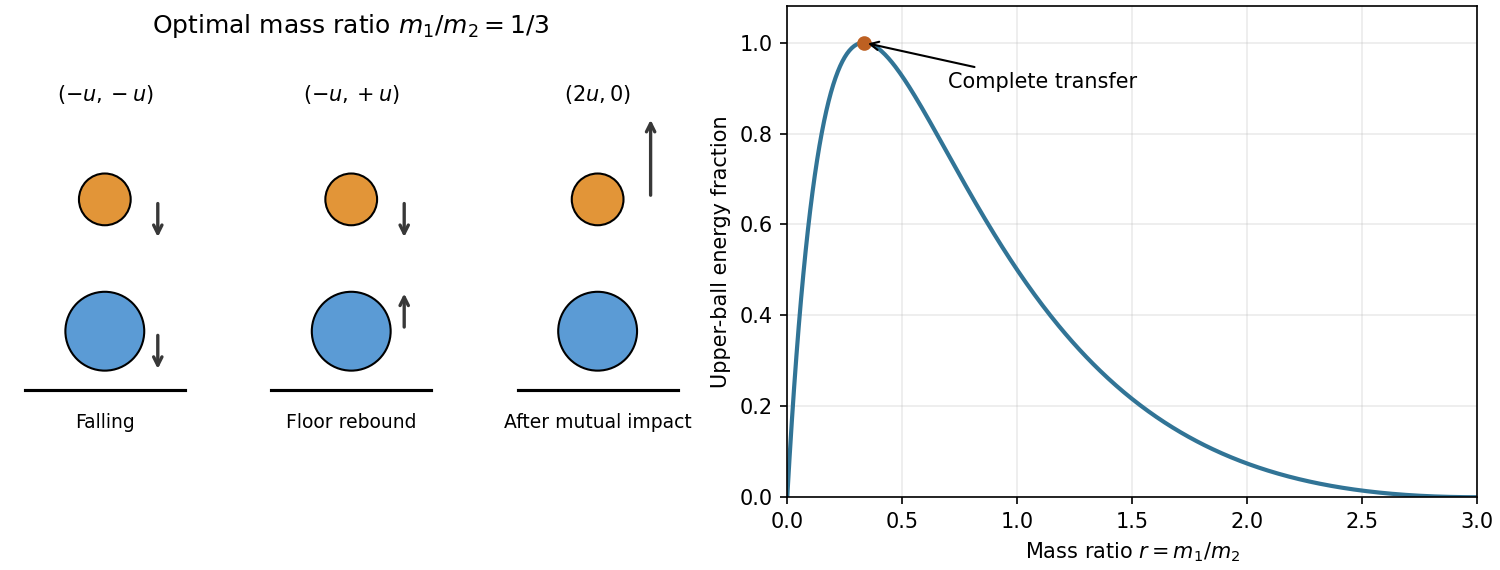
Separated elastic impacts and the energy transfer to the upper ball
. The arrows show the velocities immediately before ground impact, after the lower ball rebounds, and after the mutual collision for the optimal mass ratio. The neighbouring curve gives the upper ball's fraction of the total initial kinetic energy. Details. Past exam of the physics 1 paper of the University of Oxford 2013 resit 10 ii Solution by Codex 0 2026-10-25
Codex 0 2026-10-25At a fixed launch radius the escape threshold is zero total mechanical energy. It depends on the initial speed alone:A direction aimed into the planet can of course cause impact before escape. If the planet rotates, the ground-relative launch velocity must be added to to obtain the inertial velocity. The condition becomes : prograde launch needs less ground-relative speed than retrograde launch. For a spherical planet the threshold expressed as inertial speed at the same radius remains independent of direction.
Past exam of the physics 1 paper of the University of Oxford 2013 resit 10 i Solution by Codex 0 2026-10-25
Codex 0 2026-10-25About a chosen origin , a particle has angular momentum . A body has , or the corresponding integral for a continuous mass distribution. For a fixed origin in an inertial frame,Internal central pair forces cancel in the total torque. About a fixed origin, a central force conserves a particle's angular momentum; zero net force alone is insufficient if an external couple remains.
Past exam of the physics 1 paper of the University of Oxford 2013 resit 10 b Solution by Codex 0 2026-10-25
Codex 0 2026-10-25For a tangential launch, conserved specific angular momentum is . At the outer turning point the radial velocity vanishes but the tangential speed is . ThusUsing a eliminates the gravitational potential difference and givesThe expression printed in the source is the leading correction for , rather than an exact identity. Equivalently, , so the launch speed exceeds the circular value and the surface is the periapsis of the nonintersecting ideal orbit.
Past exam of the physics 1 paper of the University of Oxford 2013 resit 10 a Solution by Codex 0 2026-10-25
Codex 0 2026-10-25Put . At the turning point of a radial launch the speed vanishes, so conservation of energy givesThis result is exact within the exterior Newtonian gravitational potential. The condition means is just below the escape velocity: . Replacing gravity by a constant would be inappropriate in this regime.
Past exam of the philosophy of science supplementary subject of the University of Oxford 2021 4 b Solution by Codex 0 2026-10-25
Codex 0 2026-10-25Falsificationism is more plausible than a requirement of conclusive verification, but a fallible theory of testing should retain positive evidential support as well as criticism. The comparison changes if verificationism is weakened to mean empirical confirmability rather than proof.
First separate a methodological thesis from a thesis about meaning. Methodological verificationism says that scientific theories should be established by verifying observations. A stronger semantic version treats verifiability as a criterion of meaningful factual assertion. These positions are not identical. A theory might be meaningful and empirically significant even though no finite test can establish its unrestricted truth.
The central asymmetry is logical. For a universal claim , observing leaves unexamined cases open. A genuine counterinstance contradicts that universal claim. A finite sequence of favourable tests of an unrestricted physical law therefore differs from a conclusive deduction of it. This gives falsificationism a substantial advantage over strong verificationism: it makes scientific risk possible without demanding an unattainable final proof.
Karl Popper's methodological proposal is not to invent theories that are false, but to formulate conjectures with empirical content and subject them to severe tests. Surviving such tests amounts to corroboration, not conclusive verification.[ref]
Science: Conjectures and Refutations by Karl Popper. chapter 1, section I, numbered conclusions 1–7 on testability and corroborating evidence
A theory that prohibits nothing cannot gain comparable credit simply by retelling whatever happens.However, the logical asymmetry does not make scientific decisions automatic. The alleged counterinstance depends on identifying the object, measuring the relevant quantity and applying the theory in an appropriate domain. In , failure of refutes the conjunction, not uniquely . The Duhem problem therefore defeats a naive rule that every discrepant reading immediately falsifies the central theory. Independent tests of the auxiliary hypotheses can make rejection well justified, but that is additional evidential work.
Statistical models create another difficulty. For mutually independent trials, each governed by a Bernoulli distribution with success probability , a specified sequence with successes has probability . An unusual sequence is therefore not a logical counterexample to this model. An appropriate statistical hypothesis test instead asks how surprising a specified discrepancy would be under the model, allowing controlled but nonzero error. The decision depends on the test protocol, sample size and alternatives. Recasting such testing as literal contradiction would erase the distinction between impossible and improbable outcomes.
The universal-claim argument also has a converse. An existential claim can sometimes be established by one well-authenticated instance, although no finite failed search proves that there are no instances anywhere. Therefore the logical asymmetry concerns forms of claims; it is not a proof that every scientific statement must have exactly the same testing structure.
A defender of weak verificationism can accept all this and require only that observations can increase support. Bayesian confirmation, for example, compares a theory's likelihood with those of alternatives. That avoids treating favourable evidence as a proof. It does inherit questions about prior probabilities and the problem of induction, but criticism does not eliminate those questions either. Scientists still need reasons to use one surviving theory rather than another when planning further work.
Thus falsificationism wins against conclusive verificationism by recognizing the openness of empirical theory and the importance of possible failure. It does not win a monopoly on rational scientific reasoning. A stronger account combines demanding tests, scrutiny of auxiliary hypotheses, appropriate statistical treatment and defeasible positive support. The main achievement is disciplined error correction, rather than replacing one promise of certainty with another.
Past exam of the philosophy of science supplementary subject of the University of Oxford 2021 4 a Solution by Codex 0 2026-10-25
Codex 0 2026-10-25A plausible demarcation assesses how a practice makes and tests empirical claims, while allowing unsettled boundary cases. An exact sentence-level test is less defensible than an account of sustained accountability to evidence. Pseudoscience should also be distinguished from honest scientific error and from activities that make no scientific pretension.
Karl Popper's falsifiability criterion identifies something central: an empirical theory excludes possible observations. A proposed relation between a controllable input and an instrument reading is testable only if some readings would conflict with it under the stated conditions. Collecting agreeable anecdotes is weak when an account can be made compatible with every outcome. Risky predictions matter because passing a test should have been difficult for a mistaken account.[ref]
Science: Conjectures and Refutations by Karl Popper. chapter 1, section I, numbered conclusions concerning risky prediction, refutability and protective modifications
Yet falsifiability is not sufficient for good science. Someone could guess tomorrow's detector count and then advertise the guess as an established result. The numerical claim is falsifiable, but that does not supply calibration, a justified sampling model or a reliable research practice. Conversely, an investigation can be scientific even if the working model later proves false. The demarcation problem concerns the character of inquiry, not a guarantee of truth.
Nor does a failed prediction always justify immediate rejection of the principal theory. In a test represented by , the observation yields . The auxiliary hypotheses might include an initial condition, an instrument model or the composition of a sample. This Duhem problem is a logical limitation on what one unsuccessful test establishes.[ref]
The Aim and Structure of Physical Theory by Pierre Duhem. part II, chapter VI, section 2, testing a theoretical group rather than a hypothesis in isolation
There is nevertheless an evidential difference between a justified repair and an evasive one. If a suspected detector defect is measured independently, and correcting it yields further successful predictions, the change increases the theory's exposure to testing. If a new invisible influence is introduced after each failure with no independent consequences, the repair preserves agreement at the expense of accountability. An auxiliary hypothesis is not disreputable merely because it is auxiliary; its evidential role matters.
Imre Lakatos therefore shifts attention to sequences of theories and their capacity to generate corroborated new results. A programme that repeatedly anticipates discoveries differs from one that continually explains away known failures.[ref]
Science and Pseudoscience by Imre Lakatos. discussion contrasting progressive and degenerating research programmes
This improves on judging an isolated claim, but it does not provide a timetable stating exactly how long an initially unsuccessful programme deserves support. New research may need time, and a previously fruitful programme can stagnate.A workable standard consequently asks whether investigators specify discriminating predictions or comparisons, expose their methods and data to appropriate scrutiny, respond to contrary findings, and seek independent checks. These demands should fit the field. An astronomical claim can be tested by predicted observations and independent instruments even when the investigator cannot manipulate a star. A laboratory science can often use controlled interventions. Requiring all inquiry to copy one laboratory format would exclude legitimate evidence.
An objection is that these standards describe good scientific conduct rather than draw an exact boundary. That is partly right. But a usable demarcation need not be a mechanical classifier for every new idea. Persistent evasion of the standards while claiming scientific authority supports a judgement of pseudoscience; mixed or immature cases can remain unresolved. A single statistical mistake need not condemn an entire field, while a consistent refusal to acknowledge tests can.
The resulting distinction is plausible because it explains what the boundary is for: identifying practices that can correct error through public evidence. It permits criticism of established institutions as well as marginal claimants. Its price is contextual judgement, which is preferable to pretending that one syntactic feature settles every case.
Past exam of the philosophy of science supplementary subject of the University of Oxford 2021 2 b Solution by Codex 0 2026-10-25
Codex 0 2026-10-25Explicit reference to laws is not necessary for every good scientific explanation. Laws remain indispensable in many explanations, but their occurrence alone is not sufficient either. The issue turns partly on whether a law means a contingent regularity of nature, any supporting generalization, or even a mathematical necessity.
The deductive-nomological model offers a strong positive case. Laws and circumstances entail the phenomenon, and at least one law is essential to the derivation. For example, Newton's second law and an inverse-square gravitational force, with appropriate initial conditions, yield predictions for an idealized two-body orbit. A universal relation unifies cases that otherwise look like unrelated observations. Carl Hempel and Paul Oppenheim explicitly develop adequacy conditions for such deductive explanations; their 1948 paper should not be read as a finished treatment of every statistical explanation.[ref]
Studies in the Logic of Explanation by Carl Hempel and Paul Oppenheim. section 3, the deductive schema and conditions of adequacy
However, derivability does not always give the right explanatory direction. In a simplified geometrical optics model, a vertical pole of height on level ground casts a shadow of length at solar elevation . Given and , one derives ; given and , one derives . The same geometrical relations enter both derivations. Yet the shadow does not normally explain why the pole was built to that height. The reverse calculation is a way to measure its height. The difference concerns which features produce or constrain which others, rather than deductive validity alone.
Mechanistic explanation is another challenge to a compulsory law-based format. A clock stopped because debris blocked a particular wheel, thereby preventing the mechanism from advancing. Inspecting the obstruction, removing it and observing restored operation can answer the causal question with considerable precision. The explanation describes organization and a relevant difference-making event without stating a universal law. It is more informative about this failure than the observation that every component obeyed Newtonian mechanics.
A defender of the covering-law model can reply that the causal account relies implicitly on regularities: debris that offers no resistance would not stop the wheel. This is a fair warning against treating a bare chronology as an explanation. But it does not establish that explanatory understanding requires identifying exceptionless fundamental laws, or that replacing the account with a complete microscopic derivation would improve the answer. Stable, tested relations in the actual operating regime may be sufficient.
An explanation can also turn on a mathematical constraint. Suppose an engineer asks why a connected network with four odd-degree junctions cannot be inspected by a route using every segment exactly once. Represent junctions as vertices and segments as edges of an undirected graph. Every intermediate visit pairs an incoming and an outgoing edge, so only the two endpoints of an open trail can have odd vertex degree. Four such vertices therefore exclude an Eulerian trail. The impossibility persists if segment lengths, construction materials or walking speeds change while the connections remain fixed. This is the obstruction in the Seven Bridges of Königsberg.[ref]
Solutio problematis ad geometriam situs pertinentis by Leonhard Euler. sections 6, 9 and 20: connectivity data, the four-odd-region obstruction and the general rule
The physical application requires that the graph represent the allowed routes correctly. Once that is granted, the explanatory necessity comes from parity, rather than a contingent physical law. Calling every mathematical constraint a law would preserve the original claim only by greatly widening its meaning. A critic may restrict “scientific” to causal explanations, but that restriction needs justification when applied mathematics answers a concrete engineering question.
Thus laws are powerful explanatory resources, and good explanations normally support relevant what-if judgements. Those judgements can be grounded in laws, mechanisms or mathematical constraints. Requiring explicit reference to laws imposes an unnecessarily narrow format; requiring some disciplined account of dependence is much more defensible.
Past exam of the philosophy of science supplementary subject of the University of Oxford 2021 2 a Solution by Codex 0 2026-10-25
Codex 0 2026-10-25Old evidence challenges a simple account of confirmation as actual conditional updating, but does not refute every probabilistic treatment of the raven paradox. The strongest response distinguishes support from newly acquired information and makes the sampling procedure explicit.
Let say that every raven is black. Its contrapositive says that every nonblack thing is a nonraven. Since these statements are logically equivalent, evidence should support them equally. Combining this equivalence requirement with the unrestricted rule that every positive instance confirms a universal generalization appears to make discovering a white shoe support . The tension is between that result and the judgement that such a discovery is irrelevant.[ref]
Studies in the Logic of Confirmation I by Carl Hempel. section 5, the paradoxes generated by instance confirmation and equivalence
Bayesian confirmation replaces an automatic instance rule with a comparison of likelihoods. For background , positive prior probability for both and its alternative, and evidence of positive probability,The equivalence follows directly from Bayes' theorem. A statement's grammatical appearance as a positive instance does not determine either likelihood.
Consider an intentionally simple finite model. There are ravens and nonblack objects, with these counts fixed under both hypotheses. Under none of the nonblack objects is a raven; under the sole alternative , exactly one is. Selecting uniformly among the nonblack objects and discovering a nonraven has likelihoods and . Selecting uniformly among the ravens and discovering a black one has likelihoods and . With equal prior probabilities, the respective posterior probabilities of areIf , the first discovery supplies far less support. For and , the increases over are approximately and . This illustrates a possible resolution of the intuitive disparity, not a theorem that every nonblack nonraven always confirms . More complex alternatives can reverse the comparison, and examining something already known to be a shoe need supply no relevant new information.[ref]
How Bayesian Confirmation Theory Handles the Paradox of the Ravens by Branden Fitelson and James Hawthorne. Introduction and the analysis conditioning confirmation on background assumptions and sampling information
Now suppose is already in . Then , and ordinary conditioning givesThere is no further increase from learning the same fact again. Yet an already established observation can become an important reason to accept a subsequently developed theory. Clark Glymour's problem of old evidence exposes this mismatch between actual updating and scientific assessments of evidential support.[ref]
Why I Am Not a Bayesian by Clark Glymour. chapter 3 of Theory and Evidence, discussion of the old-evidence/new-theory problem
One response evaluates the observation relative to an earlier or counterfactual background that does not contain it. That can represent how strongly a theory accounts for the observation compared with alternatives. It must specify that background rather than pretend to remove knowledge uniquely from a person's present beliefs. Another response concerns learning that a theory successfully accounts for the observation. That discovery can be new even when the observation is old. Modelling it requires attention to limited reasoning and changing hypotheses; an ideal agent already knowing every logical consequence cannot simply learn an entailment it previously overlooked.
Neither manoeuvre licenses counting the same evidence twice, or ignoring that parameters were selected to fit it. Neither establishes a unique complete theory of confirmation. Nevertheless, the old-evidence objection concerns the interpretation and completeness of a probabilistic framework; it does not invalidate the likelihood calculation for genuinely new sampling information.
The preferable solution combines a background-sensitive account of support with rejection of unrestricted instance confirmation. It preserves logical equivalence while allowing a white shoe to provide tiny support, no support or contrary support under different justified models. This is more explanatory than assigning confirmation solely from logical form, although assessing old evidence requires additional work beyond routine conditioning.
Past exam of the philosophy of science supplementary subject of the University of Oxford 2021 1 b Solution by Codex 0 2026-10-25
Codex 0 2026-10-25A distinction between physical constitution and perceptual response is plausible and scientifically useful. A division into wholly objective primary qualities and wholly unreal secondary qualities is much harder to defend. These are different interpretations of the primary and secondary qualities distinction.
John Locke attributes extension, solidity, shape, number and motion to bodies as primary qualities. Secondary qualities are powers to produce sensations through the constitution of bodies: a body's power to produce a colour experience is distinct from the experience itself. This distinction need not make the power unreal. Nor should the further resemblance thesis, that ideas of primary qualities resemble their causes, be confused with the more modest claim that bodily constitution explains experience.[ref]
An Essay Concerning Human Understanding by John Locke. book II, chapter VIII, sections 8–15 and 23–26: qualities, powers and resemblance
A modern model of colour perception shows what can be retained. For a nonfluorescent surface in fixed viewing geometry, a simplified cone cell response isHere is the incident spectral irradiance, the spectral reflectance, and an effective sensitivity for one of three cone cell classes. Neural processing and adaptation also matter, so these responses are not a complete identification of perceived colour. Nevertheless, the model separates the surface, illumination and observer rather than assigning every experienced variation to a changing surface.
It follows that one surface can produce different responses under different illumination. Conversely, distinct spectral reflectance functions can produce the same three responses for a specified illuminant and observer, a case of metamerism. Three weighted integrals do not in general uniquely determine a whole function. Thus identifying experienced colour with one intrinsic surface property loses both the dependence on the observer and the many-to-one character of the response.
The scientific benefits are concrete. A comparison of paints should specify illumination and observer conditions. A measurement intended to characterize a material can instead estimate its spectral reflectance, preserving information that a single colour match discards. In both cases the distinction tells an investigator what to hold fixed and what to vary. It organizes experiments and explains disagreement without requiring that one observer be hallucinating.
However, perceptual variability alone does not distinguish primary qualities from secondary qualities. George Berkeley points out that apparent extension and shape also change with viewpoint and perceiver.[ref]
A Treatise Concerning the Principles of Human Knowledge by George Berkeley. part I, sections 9–15, particularly the variation of extension and figure
A circular disc yields different projected shapes at different viewing angles. The stable object is inferred through a model of that variation; it is not simply copied into experience. Primary qualities therefore have no automatic exemption from the interpretative work involved in perception.Nor is relationality equivalent to subjectivity. In special relativity, measured length depends on an inertial frame, but relations between such measurements are tightly constrained. Conversely, a disposition to affect a specified perceiver under specified conditions can be an objective physical fact. Classifying a property as relational does not settle whether it is real, measurable or explanatory.
The best distinction is consequently functional and revisable: distinguish the experience to be explained from physical properties and relations used to explain it. That retains the scientific benefits of separating constitution, environment and response. It does not establish an immutable list of primary qualities, a simple resemblance relation between experience and object, or a proof of scientific realism.
Past exam of the philosophy of science supplementary subject of the University of Oxford 2021 1 a Solution by Codex 0 2026-10-25
Codex 0 2026-10-25Scientists should take sceptical challenges seriously when they reveal unsupported assumptions or distinguishable sources of error. They need not obtain a proof against every conceivable deception before conducting an experiment. This position concedes the force of some philosophical scepticism while rejecting certainty as the normal standard of scientific warrant.
There are several importantly different challenges. Global philosophical scepticism questions whether an external world exists at all. The problem of induction questions the justification for extending observed regularities to unobserved cases. Local criticism questions a particular instrument, sample or inference. A response appropriate to the last challenge need not answer the first. Repeating a measurement with a second instrument can expose a faulty sensor; it does not prove that all experience is independent of a deceiving agency.
David Hume's challenge to inductive reasoning is especially relevant. A finite record does not deductively entail a universal generalization. Nor can the inference be justified simply by saying that past uses of inductive reasoning succeeded: that argument itself extends a past regularity beyond the observed cases. The possibility that an observed regularity fails tomorrow is not a contradiction. This identifies a real gap between deduction and empirical projection.[ref]
An Enquiry Concerning Human Understanding by David Hume. section IV, parts I–II, especially paragraphs 16–21 on the circular appeal to past experience
For example, suppose a metal's measured resistance agrees with throughout a tested temperature interval. Both that expression and a rival with an extra term zero throughout the interval fit those measurements exactly, yet can disagree outside it. Additional measurements can discriminate specified rivals, but no finite collection excludes every possible future deviation. The scientific lesson is to state the tested domain, physical assumptions and uncertainty. A linear electrical resistance model can be useful without being a universal law; a phase transition is an independently intelligible reason why extrapolation might fail.
One might reply that successful prediction and scientific replication justify confidence. They certainly distinguish a tested model from an arbitrary guess under the ordinary standards of inquiry. They do not supply the noncircular proof demanded by radical philosophical scepticism. A Bayesian inference similarly makes the dependence on prior probabilities and likelihoods explicit; it does not deduce the correctness of those commitments from no premises. Acknowledging this limit is preferable to claiming that a mathematical updating rule dissolves the problem of induction.
The sceptic nevertheless owes us an account of the practical consequence. If two global possibilities give exactly the same observable consequences under every available intervention, their difference does not identify which laboratory procedure to change. A scientist can suspend judgement about that difference while comparing models that make different predictions. This is a defence of proceeding under fallible standards, rather than a refutation of global philosophical scepticism.
By contrast, local criticism can reorganize an entire research programme. If an apparent signal might be instrument drift, useful responses include independent calibration, reversing a controllable input, measuring an appropriate control and conducting scientific replication. Those procedures make the proposed error account answerable to evidence. Merely imagining that every control could also be deceptive adds no further discriminating test.
The defensible policy is therefore fallibilism: confidence proportionate to the testing and domain, openness to identifiable error, and no claim to absolute foundations. Sceptical arguments matter most when they improve the questions asked of a model. Their inability to be conclusively defeated does not make every model equally warranted or make scientific work irrational.
Past exam of the philosophy of science supplementary subject of the University of Oxford 2019 7 b Solution by Codex 0 2026-10-25
Codex 0 2026-10-25A commitment to testing claims against experience is a defensible scientific norm. A strict account according to which every meaningful scientific statement must be conclusively verified, or translated into a fixed vocabulary of theory-free observations, is much harder to sustain. Logical empiricism should also be understood as a changing family of projects, not reduced without qualification to its strongest early formulations.
An unrestricted universal scientific law concerns cases beyond a finite observation record. No finite list of favourable cases deductively entails all of them. Requiring conclusive verification would therefore exclude much ordinary theoretical science. Replacing that demand with scientific confirmation retains a relation to evidence while accepting that support is fallible. This is a substantive revision, rather than proof that universal laws were conclusively verified after all.[ref]
Studies in the Logic of Confirmation I by Carl Hempel. sections 1–2: testability, confirmation and the limits of conclusive verification
A second difficulty concerns observations. A detector count relies on assumptions about sensitivity, background and the production of a signal. Theory-ladenness makes a sharp division between completely neutral observations and theoretical claims implausible. But dependence on some assumptions does not imply dependence on the truth of the target theory. A calibration can be supported independently, and agreement across instruments using different mechanisms can make a putative effect less vulnerable to one shared error.
Nor should unobservable vocabulary be dismissed merely because its referents cannot be seen directly. A theory of electrons and electromagnetic fields can organize measured currents, spectra and scattering through a common model. What matters scientifically is how the theoretical commitments constrain observations and survive attempts to discriminate them from alternatives. Insisting that each term independently translate into an observation report can miss the role of a whole theoretical structure.
An empiricist can accept much of this. Constructive empiricism permits literal theoretical discourse and commitment to using a theory while restricting belief to empirical adequacy. It separates withholding a stronger ontological belief from refusing to reason with theoretical models.[ref]
Constructive Empiricism Now by Bas van Fraassen. section III: theory acceptance and the distinction between acceptance and belief
Whether this restraint is preferable to selective scientific realism remains an argument about what successful testing warrants.The strongest sustainable empiricism is consequently methodological and fallible: demand explicit empirical consequences, scrutinize calibration and preserve the possibility of correction. The stricter verificationist reduction does not adequately describe how laws, theoretical terms and measurement actually work. Rejecting that reduction need not weaken the central demand that scientific claims remain accountable to evidence.
Past exam of the philosophy of science supplementary subject of the University of Oxford 2019 7 a Solution by Codex 0 2026-10-25
Codex 0 2026-10-25Scientific underdetermination limits what evidence alone establishes, but its practical consequences depend on the strength of the equivalence being claimed. Rival theories fitting present data need not agree on future observations. Rival formulations agreeing on every observable in a specified domain present a more persistent limitation within that domain.
With finitely many data points , suppose an interpolation polynomial fits all measurements. Thenalso fits them for every . This proves nonuniqueness for a deliberately broad model class. It does not prove that all these functions are equally plausible physical theories. Constraints from independently tested mechanisms, bounds on derivatives, symmetries and the measurement process can sharply restrict the class. A new observation at a different point can also distinguish the displayed alternatives.
The Duhem problem concerns an additional kind of latitude: a prediction tests a theory together with auxiliary hypotheses. A mismatch can be assigned to different components. This is a reason to vary apparatus, calibrate independently and use multiple kinds of evidence. It is not a demonstration that any preferred theory can be made equally well supported by arbitrary repairs.[ref]
The Aim and Structure of Physical Theory by Pierre Duhem. part II, chapter VI, section 2: an experimental test concerns a theoretical group
Exact empirical equivalence requires more. If two accounts supply identical probability distributions for all observations allowed by a stated setup, observations of that kind cannot favour one through their likelihoods. Bayesian inference makes the limitation explicit: posterior odds equal prior odds when the likelihood ratio is one. Declaring a prior preference does not transform it into new experimental discrimination.
Theories can nevertheless differ in explanatory organization, computational usefulness or how they connect with a larger domain. Those are legitimate questions, provided their role is stated. If a proposed new intervention distinguishes them, the equivalence did not cover that enlarged domain. If the difference is instead only a change of redundant description, treating it as two competing physical worlds may create a spurious dispute; gauge symmetry provides an important case requiring care.
For scientific practice, the appropriate response is model comparison with explicit assumptions, searches for discriminating tests and honest limits on what has been established. For scientific realism, enduring empirical equivalence challenges any claim that the evidence uniquely fixes a full ontology. It does not make precise predictions or experimental decisions impossible. Underdetermination is consequently a constraint on inference whose seriousness must be demonstrated case by case, rather than a general proof that all scientific reasoning is arbitrary.
Past exam of the philosophy of science supplementary subject of the University of Oxford 2019 5 b Solution by Codex 0 2026-10-25
Codex 0 2026-10-25Falsificationism captures an important asymmetry between universal claims and counterexamples, but it is an incomplete account of scientific appraisal. It works best as a demand for serious testing within fallible theoretical packages, rather than as a mechanical rule for discarding a theory after any anomalous observation.
For an unrestricted universal claim, finitely many successful cases do not deductively establish every unobserved instance. One genuine contrary case can contradict the universal claim, provided the predicates and circumstances are correctly identified. Karl Popper's emphasis on attempts at refutation consequently highlights something that mere accumulation of agreeable examples can miss: a test is informative partly because plausible alternative outcomes would have counted against the proposal.[ref]
Science: Conjectures and Refutations by Karl Popper. chapter 1 excerpt: the contrast between confirmation-seeking and critical tests
Real predictions nevertheless involve a conjunction. If and , thenHere includes an apparatus model and initial conditions. The conclusion does not identify as the failed component. Independent calibration, varied experimental arrangements and agreement across instruments help distinguish the possibilities; they do not eliminate the logical structure of the Duhem problem. Insisting that every auxiliary assumption remain unrevisable would obstruct ordinary experimental repair.
Probabilistic theories create another difficulty for simple deductive falsification. If an ideal Bernoulli distribution model assigns a probability to success, every finite binary sequence has positive probability. An unusual sequence does not literally contradict the model. A statistical hypothesis test can instead use a predeclared rejection region with a controlled type I error. Its possible mistaken rejection is part of the method, not a contradiction to be ignored. Comparing alternatives also requires likelihoods or other explicit criteria, rather than a binary division into refuted and unrefuted proposals.
Finally, survival alone is not enough. A vague conjecture and a quantitatively successful theory might both be unrefuted; they need not be equally supported. Scientific decisions also concern approximation error, independent explanatory connections and whether a proposed modification predicts anything new. These considerations need not restore conclusive verification, but they require more than deductive refutation.
The plausible core is therefore methodological: specify what could count against a claim, expose it to demanding tests and resist changes made only to accommodate failure. The stronger thesis that this principle supplies a complete logic of discovery, theory choice and confirmation is not established. Critical testing remains valuable precisely when its assumptions and statistical limitations are stated honestly.
Past exam of the philosophy of science supplementary subject of the University of Oxford 2019 5 a Solution by Codex 0 2026-10-25
Codex 0 2026-10-25There are useful distinctions between science and pseudoscience, but one simple property of an isolated sentence is unlikely to classify every historical practice correctly. The relevant assessment should examine both empirical commitments and how a programme responds to evidence.
Falsifiability is a valuable starting point. A claim that excludes no possible observational outcome cannot receive the same kind of empirical support as one that risks failure. A prediction made before an experiment, with conditions and tolerances specified, is more informative than a story adjusted afterwards to fit any result. This distinguishes taking an empirical risk from merely finding a favourable description of what happened.[ref]
Science: Conjectures and Refutations by Karl Popper. chapter 1 excerpt: risky predictions and avoidance of refutation
However, falsifiability is neither sufficient for being good science nor identical to having evidence. An arbitrary precise prediction can be falsifiable and poorly motivated. A well-supported theory can also encounter an apparent failure caused by an auxiliary hypothesis about calibration or initial conditions. The Duhem problem explains why sensible investigators sometimes repair an apparatus model rather than immediately discard a theory. It does not justify repairs chosen solely to prevent every conceivable adverse result.
A more informative comparison asks whether revisions produce independently testable predictions, whether controls address plausible errors, whether unfavourable results are recorded and whether others can reproduce the procedures. An adjustment can be scientifically productive if it connects a former discrepancy with new phenomena. The same algebraic adjustment is much less impressive if it does nothing beyond reproducing the data used to choose it. Scientific reproducibility helps make a research practice corrigible, although reproducibility alone cannot establish that its interpretation is correct.
Historical judgement also requires separating an immature proposal from a practice organized to evade criticism. A new mechanism may initially lack a precise experimental test. Its current weakness is a reason to qualify confidence, not proof that no further development can make it scientific. Conversely, technical vocabulary and numerical output do not make a programme scientific when its central claims remain insulated from evidence.
The demarcation should therefore be explained through concrete features of inquiry: identifiable hypotheses, discriminating tests, calibration, treatment of alternatives and accountable revision. Different features can matter differently across observational, experimental and historical sciences. Borderline cases do not erase clear failures, just as the absence of a sharp temperature boundary between warm and cold does not make all temperatures equal.
This approach also keeps the conclusion proportionate. Calling a practice scientific does not guarantee truth, ethical acceptability or practical usefulness. Calling it pseudoscientific should identify the evidential or methodological failure, rather than replace the argument with a label.
Past exam of the philosophy of science supplementary subject of the University of Oxford 2018 6 b Solution by Codex 0 2026-10-25
Codex 0 2026-10-25Falsifiability is a relation between a claim, testing assumptions and possible outcomes that would conflict with it. It is not the fact that someone has criticized the claim, and not the same property as being false. It gives an important demand for empirical accountability: a theory that is compatible with every conceivable result cannot lose by an observational test. That demand motivates Popper's approach to the demarcation problem.[ref]
Science: Conjectures and Refutations by Karl Popper. chapter 1 excerpt, refutability as a proposed criterion
Simply possessing a falsifiable hypothesis is nevertheless insufficient to make an entire activity scientific. A precise prediction can be false, based on unreliable methods, or repeatedly insulated from contrary evidence by new excuses. A practice that makes one testable prediction while disregarding all its failures does not acquire sound scientific methodology merely because a sentence in its vocabulary could have been refuted. How claims are tested and revised matters.
Strict deductive refutability is also a difficult necessary condition for every legitimate scientific claim. A stochastic radioactive decay model may assign nonzero probability to every finite sequence of counts. No individual finite record then logically contradicts it. For example, a Poisson distribution with gives every integer count probability . A sufficiently extreme count can nevertheless give strong evidence against the specified rate. A probability model can be tested through sampling distributions and error-controlled procedures. Extremely unlikely outcomes can count strongly against it without being impossible. Replacing scientific testing by a requirement of zero model probability would misdescribe much of quantitative science.
A further difficulty is the use of auxiliary hypotheses. A highly specific physical prediction becomes a test of the intended account only when instrument behaviour and background conditions are sufficiently controlled. Otherwise failure can be redirected indefinitely. Conversely, designing and calibrating an instrument can be genuine scientific work without itself taking the form of a single dramatic conjecture awaiting refutation.
The plausible conclusion is that falsifiability, or a suitably statistical form of testability, is one important component of a scientific practice. It does not provide a self-sufficient binary label for whole areas of inquiry. Publicly specified commitments, reliable methods, independent scrutiny and responsiveness to evidence are also needed. This preserves the force of the demand that claims risk failure without treating a useful methodological principle as a complete definition of science.
Pinned article: Introduction to the OurBigBook Project
Welcome to the OurBigBook Project! Our goal is to create the perfect publishing platform for STEM subjects, and get university-level students to write the best free STEM tutorials ever.
Everyone is welcome to create an account and play with the site: ourbigbook.com/go/register. We belive that students themselves can write amazing tutorials, but teachers are welcome too. You can write about anything you want, it doesn't have to be STEM or even educational. Silly test content is very welcome and you won't be penalized in any way. Just keep it legal!
Intro to OurBigBook
. Source. We have two killer features:
- topics: topics group articles by different users with the same title, e.g. here is the topic for the "Fundamental Theorem of Calculus" ourbigbook.com/go/topic/fundamental-theorem-of-calculusArticles of different users are sorted by upvote within each article page. This feature is a bit like:
- a Wikipedia where each user can have their own version of each article
- a Q&A website like Stack Overflow, where multiple people can give their views on a given topic, and the best ones are sorted by upvote. Except you don't need to wait for someone to ask first, and any topic goes, no matter how narrow or broad
This feature makes it possible for readers to find better explanations of any topic created by other writers. And it allows writers to create an explanation in a place that readers might actually find it.
Figure 1. Screenshot of the "Derivative" topic page. View it live at: ourbigbook.com/go/topic/derivativeVideo 2. OurBigBook Web topics demo. Source. - local editing: you can store all your personal knowledge base content locally in a plaintext markup format that can be edited locally and published either:This way you can be sure that even if OurBigBook.com were to go down one day (which we have no plans to do as it is quite cheap to host!), your content will still be perfectly readable as a static site.
- to OurBigBook.com to get awesome multi-user features like topics and likes
- as HTML files to a static website, which you can host yourself for free on many external providers like GitHub Pages, and remain in full control

Figure 2. You can publish local OurBigBook lightweight markup files to either OurBigBook.com or as a static website.
Figure 3. Visual Studio Code extension installation.
Figure 5. . You can also edit articles on the Web editor without installing anything locally. Video 3. Edit locally and publish demo. Source. This shows editing OurBigBook Markup and publishing it using the Visual Studio Code extension. 
- Infinitely deep tables of contents:



All our software is open source and hosted at: github.com/ourbigbook/ourbigbook
Further documentation can be found at: docs.ourbigbook.com
Feel free to reach our to us for any help or suggestions: docs.ourbigbook.com/#contact