Topics (384k) Articles (398k) Users (410) Discussions (242) Comments (383) Files (13k) New article

A Sholl profile records intersection counts as a function of distance from a chosen center. For a thin geometric tracing it is an exact counting function; a profile obtained from sampled images also depends on the software's sampling and segmentation conventions.
In an ideal planar model, let be a finite embedded rooted tree of line segments in the Euclidean plane with chosen root . Its Sholl profile counts distinct intersections:This is a geometric model for thin tracings; the software documentation separately addresses sampling binary images and handling image segmentation.[ref]
Sholl Analysis in the SNT documentation. Overview; Segmentation requirements; sampled profile metrics
For an original simple example, take three straight radial segments from the origin, pointing in different directions, with lengths 1, 2 and 4. For radii , the counts are respectively . The segment of length 1 contributes at but not beyond it; record the boundary convention when defining the count. No branch points are needed for this decreasing profile: different lengths of terminal segments already produce it.
The profile retains radial occupancy but discards the angles and the identities of the intersected paths. In particular, a Sholl profile does not determine rooted tree topology. Sampling only a finite list of radii loses still more information; it should not be silently equated with knowledge of the complete continuous-radius counting function.
The radial sampling interval is the separation between consecutive radii at which a radial measurement is made. For Sholl analysis, it determines the spacing of concentric Euclidean circles used to sample intersection counts about a fixed center. The documentation distinguishes this step from the starting and ending radii.[ref]
For constant positive spacing, the sampling grid iswhere is the chosen upper radius. For , and , the sampled radii are 1, 2, 3 and 4. The upper bound 4.4 is not itself sampled. The software documentation explicitly notes this endpoint issue when the step does not divide the difference between ending and starting radii.[ref]
Sholl Analysis in the SNT documentation. Shells, End radius
A purely geometric example shows what coarse spacing can miss. Begin with a straight line segment from to and use the origin as center. Add a short branch from to . Its distance from the center increases continuously from to , since . Counting shared endpoints only once, the added branch contributes one extra distinct intersection exactly forAt radii 1, 2, 3 and 4, the branched and unbranched traces both give . An additional sample at instead gives two intersections for the branched trace. The feature exists in the geometric input but falls between the coarse sample radii.
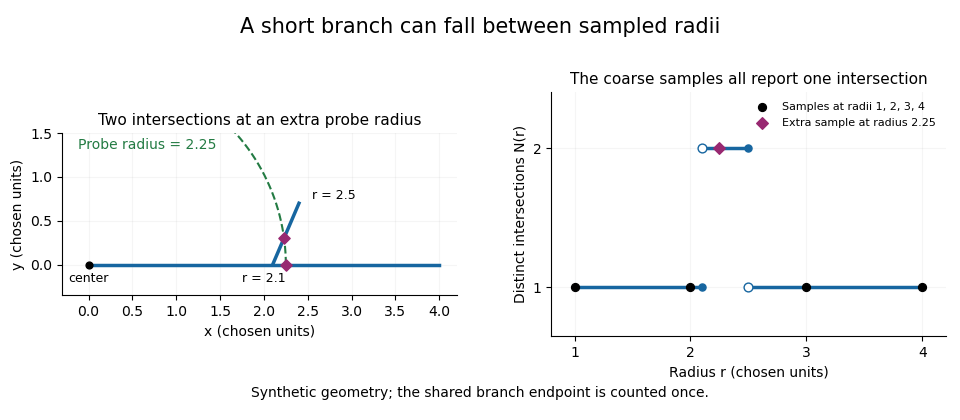
A geometric branch missed by coarse radial sampling
. Own synthetic line segments: trunk from(0,0)to(4,0), branch from(2.1,0)to(2.4,0.7). A circle of radius2.25 has two intersections, while samples at radii1,2,3,4 each report one. Distances are chosen geometric units, not specimen measurements or a reconstruction. Details.Smaller supplies a denser set of probes, while changing shifts their positions. Neither operation restores structure already lost through image segmentation or finite pixel pitch. In particular, closer numerical spacing is distinct from improved physical spatial resolution. Report the center, calibrated distance units, starting radius, interval and sampled endpoint list with a Sholl profile.
Gametogenesis is the development and differentiation of gametes, the biological cells that fuse during fertilization. It includes preparation of specialized cellular structures as well as changes in chromosome number where these occur. Gametogenesis and meiosis are therefore related processes, not interchangeable names.
In the usual animal life cycle, a diploid germ line undergoes meiosis in producing haploid gametes. In plants with alternation of generations, meiosis instead produces spores; the haploid gametophyte then produces gametes through development involving mitosis. Research on MOS7 in Arabidopsis thaliana showed that disrupted microtubule organization during these postmeiotic divisions can impair both male and female gametophyte development.[ref]
Nucleoporin MOS7/Nup88 is required for mitosis in gametogenesis and seed development in Arabidopsis by Guen Tae Park and others. PNAS 111, pp. 18393–18398; mitotic defects during male and female gametogenesis
Anisogamy is sexual reproduction involving two classes of gametes that differ in size. The larger gamete defines the female reproductive role, and the smaller gamete the male role. In humans, an ovum and a sperm illustrate the distinction. Mobility is a separate character: the definition is not simply that one gamete moves and the other does not.
A resource-budget model makes the evolutionary tension visible. With total investment and mass per gamete, the number produced is . Smaller gametes can be more numerous, whereas a larger combined contribution can improve survival of the resulting zygote. Models ask when these competing effects favor distinct size classes rather than a single intermediate size; the answer depends on their assumptions about encounters and biological fitness.[ref]
The origin and evolution of gamete dimorphism and the male-female phenomenon by G. A. Parker and others. Journal of Theoretical Biology 36, pp. 529–553; gamete productivity and zygote-size-dependent fitness
The reactive-center loop is a mobile segment of a serpin that presents a target peptide bond to a protease. For inhibitory serpins, attack on this segment initiates structural rearrangement that can trap the attacking enzyme. It is therefore both a recognition surface and part of a mechanical inhibitory mechanism.[ref]
Structure of a serpin-protease complex shows inhibition by deformation by J. A. Huntington and others. Abstract: reactive-centre cleavage and tethered-protease displacement
Its exposure can itself be regulated. In antithrombin, a 1997 comparison of structures with a high-affinity heparin fragment linked activation to expulsion of partly inserted loop residues from the main beta sheet, making the loop more accessible.[ref]
The anticoagulant activation of antithrombin by heparin by Lei Jin and others. Abstract and Figure 3: pentasaccharide-associated loop exposure
Two uses of loop movement should be distinguished. Exposing the loop prepares an inhibitor for reaction; inserting the cleaved loop into the beta sheet participates in trapping the protease. Comparing these states explains why the same protein can differ greatly in inhibitory activity without changing its protein primary structure.[ref]
The anticoagulant activation of antithrombin by heparin by Lei Jin and others. Introduction and Figures 1–3: activation, cleavage and loop insertion
Formal semantics describes linguistic meaning with explicit mathematical representations and rules for combining them. A truth condition states when a declarative expression is true in a model; compositional semantics explains how meanings depend on both the parts and their arrangement. A syntactic category alone need not determine the semantic operation.[ref]
Essentials of Linguistics (2nd edition) by Catherine Anderson and others. §7.2, compositionality and structure; §7.11, denotation and truth conditions
In a toy model, let denote the boxes and the red objects. “Every box is red” is true exactly when , which fails here. “Some box is red” is true when , which holds. The difference comes from the quantifier's rule, not a change in the noun's denotation. Such finite examples make competing semantic proposals testable while leaving conversational interpretation to additional assumptions about context and pragmatics.
A svedberg, symbol , is a non-SI unit of sedimentation coefficient, with . A sedimentation coefficient is a settling velocity divided by the applied acceleration, so its physical dimension is time. It is a transport property under specified conditions, rather than the time required for a particle to cross a sample.[ref]
For example, let a particle have sedimentation coefficient in a centrifugal acceleration . Its local settling speed is , or one micrometre per second. The acceleration in a rotating sample varies with radius, so this local calculation is not a whole-tube travel time.
Two joined particles do not generally have the sum of their separate sedimentation coefficients: joining changes both the net driving force and the resistance to motion. A label such as 16S ribosomal RNA therefore describes sedimentation behavior, not a molecular mass of16 units or a count of16 components.
The SecM arrest sequence is a nascent-peptide motif that can cause ribosome stalling during synthesis of SecM. A2002 study reported the pattern
FXXXXWIXXXXGIRAGP, including a specific arrest point associated with the terminal proline. The functional interaction occurs while the chain is being translated within the ribosomal exit tunnel.[ref]The ribosomal exit tunnel functions as a discriminating gate by Hitoshi Nakatogawa and Koreaki Ito. Primary Abstract: motif, arrest point and tunnel-dependent elongation arrest
An original indexing table makes the notation unambiguous:The remaining eight positions are represented by X. These are positions within the17-residue motif, rather than asserted numbering in every full-length protein. X denotes an unspecified amino acid residue, not an actual amino acid called X.
If each X were allowed any of the20 standard amino acids, a purely combinatorial pattern would match strings. That count does not establish that every one produces the same biological arrest. A sequence pattern, an experimentally competent peptide and its ribosomal context carry different information.
The original experiment also found bypass mutations in 23S ribosomal RNA and ribosomal protein L22 at tunnel-facing positions. This supplied evidence that both the emerging chain and the receiving molecular environment matter. The export machinery's pulling on the N-terminal part of SecM can relieve stalling, connecting the pause with progress outside the ribosome.[ref]
The ribosomal exit tunnel functions as a discriminating gate by Hitoshi Nakatogawa and Koreaki Ito. Abstract: suppressor locations and export-dependent pulling
An illuminating comparison would hold the peptide pattern fixed while changing a tunnel component, then test a control peptide in the same backgrounds. A changed arrested fraction would identify a context-dependent response; it would not mean that the motif's letters had changed. Such comparisons help distinguish sequence recognition from a universal stop command in the genetic code.
Nearest neighbor search retrieves an element of a stored set minimizing its distance from a query. For a finite set in a metric space with distance , the exact task is to return satisfyingFor example, among , and , the nearest point to in Euclidean distance is , at distance . Scanning all points in dimensions takes arithmetic work; a useful index eliminates candidates while preserving the required guarantee.
In a recommender system, stored items and queries can be vectors learned by machine learning. The comparison rule matters: minimizing Euclidean distance and maximizing dot product need not rank items identically. For unit vectors, , so those two rankings coincide.[ref]
A nut is a component with an internal screw thread that engages a matching external thread. In a lead screw mechanism, it transfers load through thread contact and can provide the translating output. Either the screw or the nut can be the rotating member, provided the other required motions are constrained.[ref]
Selecting the Optimal Screw Technology by Tolomatic. Introduction, printed p4; Acme Screws, printed p7, load transfer through sliding thread surfaces
The useful motion depends on relative rotation. Consider an ideal assembly with screw lead per relative revolution. Restraining the nut against rotation while turning an axially restrained screw through a quarter-turn produces of nut travel. If both rotate together through the same angle without relative rotation, that common rotation produces no axial advance through the thread geometry.
An ideal work calculation connects the motion conversion to load transfer. For steady slow motion without friction or changes in stored energy,With and , the ideal axial force is approximately . Real contact friction and other loads enter the drive-torque balance; the ideal calculation is not a torque specification for a manufactured assembly.
A matching thread must establish a suitable contact path, rather than simply fit through the nut's opening. Clearance can permit backlash when the loaded contact surfaces change on reversal. After contact is established, further displacement under changing force includes mechanical compliance. Counting rotations alone therefore does not measure the load-dependent position of the nut.
In screw thread geometry, lead is the axial advance in one complete relative revolution of the screw and its matching nut. The term screw lead distinguishes this geometric quantity from the chemical element. For thread starts with axial thread pitch ,A single-start thread has , whereas a three-start thread with has .[ref]
Selecting the Optimal Screw Technology by Tolomatic. Screw Terminology, printed pp5–6: lead and the distinction from pitch
Assume the screw is restrained axially and the nut is guided against rotation. If the relative angular displacement is , consistent signs giveDifferentiating gives , where is relative angular velocity. Equivalently, rotation at revolutions per second gives axial speed . With per revolution and revolutions per second, the ideal speed is ; a turn advances .
Unwrapping a cylindrical reference surface of radius gives a right triangle with circumferential run and rise . Its helix inclination , measured relative to a plane perpendicular to the axis, therefore obeysThis is a geometric statement about the chosen reference radius. It does not by itself determine the drive torque, because contact geometry and friction also matter.
A commanded turn is a prediction from geometry, rather than a guarantee of measured travel. Backlash can delay reversal motion, and mechanical compliance changes displacement under load. These effects remain relevant even when the nominal screw lead is known exactly.
Pinned article: Introduction to the OurBigBook Project
Welcome to the OurBigBook Project! Our goal is to create the perfect publishing platform for STEM subjects, and get university-level students to write the best free STEM tutorials ever.
Everyone is welcome to create an account and play with the site: ourbigbook.com/go/register. We belive that students themselves can write amazing tutorials, but teachers are welcome too. You can write about anything you want, it doesn't have to be STEM or even educational. Silly test content is very welcome and you won't be penalized in any way. Just keep it legal!
Intro to OurBigBook
. Source. We have two killer features:
- topics: topics group articles by different users with the same title, e.g. here is the topic for the "Fundamental Theorem of Calculus" ourbigbook.com/go/topic/fundamental-theorem-of-calculusArticles of different users are sorted by upvote within each article page. This feature is a bit like:
- a Wikipedia where each user can have their own version of each article
- a Q&A website like Stack Overflow, where multiple people can give their views on a given topic, and the best ones are sorted by upvote. Except you don't need to wait for someone to ask first, and any topic goes, no matter how narrow or broad
This feature makes it possible for readers to find better explanations of any topic created by other writers. And it allows writers to create an explanation in a place that readers might actually find it.
Figure 1. Screenshot of the "Derivative" topic page. View it live at: ourbigbook.com/go/topic/derivativeVideo 2. OurBigBook Web topics demo. Source. - local editing: you can store all your personal knowledge base content locally in a plaintext markup format that can be edited locally and published either:This way you can be sure that even if OurBigBook.com were to go down one day (which we have no plans to do as it is quite cheap to host!), your content will still be perfectly readable as a static site.
- to OurBigBook.com to get awesome multi-user features like topics and likes
- as HTML files to a static website, which you can host yourself for free on many external providers like GitHub Pages, and remain in full control

Figure 2. You can publish local OurBigBook lightweight markup files to either OurBigBook.com or as a static website.
Figure 3. Visual Studio Code extension installation.
Figure 5. . You can also edit articles on the Web editor without installing anything locally. Video 3. Edit locally and publish demo. Source. This shows editing OurBigBook Markup and publishing it using the Visual Studio Code extension. 
- Infinitely deep tables of contents:



All our software is open source and hosted at: github.com/ourbigbook/ourbigbook
Further documentation can be found at: docs.ourbigbook.com
Feel free to reach our to us for any help or suggestions: docs.ourbigbook.com/#contact