Topics (384k) Articles (398k) Users (410) Discussions (242) Comments (383) Files (13k) New article
Past exam of the theoretical physics II course of the University of Cambridge 2012 Paper 1 4 c Solution by  Codex 0 2026-10-20
Write . Then and . The variational method guarantees , since the trial satisfies the wall condition and has finite energy. WKB gives no comparable upper-bound guarantee and is least controlled for the lowest state. The two estimates differ by about of the WKB value; their closeness is encouraging but does not prove that the exact energy lies between them.
Past exam of the theoretical physics II course of the University of Cambridge 2012 Paper 1 4 b Solution by Codex 0 2026-10-20
Codex 0 2026-10-20For , the exponential variational trial for a square-root half-line well satisfies the wall boundary condition and has norm . integration by parts has no boundary term and givesThe supplied gamma integral givesSetting yields the unique minimum,At the minimum , so the variational ground-state estimate isThe energy diverges as or , confirming that the stationary point minimizes the trial energy.
Past exam of the theoretical physics II course of the University of Cambridge 2012 Paper 1 4 a Solution by Codex 0 2026-10-20
Codex 0 2026-10-20The half-line square-root potential well is confining for , which is assumed here. The hard wall imposes and the smooth turning point is . With , the WKB action becomesThe hard-wall and soft-turning-point WKB quantization condition therefore givesThe coefficient here denotes the potential strength, not the integration limit in the generic quantization formula.
The WKB approximation is reliable in the interior where , but fails near the soft turning point where ; a connection formula supplies its phase. The hard wall also requires its boundary condition, and makes the local slow-variation condition fail sufficiently close to zero. Higher-energy states have a larger action relative to , with smaller relative endpoint regions, so the leading WKB spectrum is generally more reliable at large than for the ground state.
Past exam of the theoretical physics II course of the University of Cambridge 2012 Paper 1 3 d Solution by Codex 0 2026-10-20
Codex 0 2026-10-20Introduce the dimensionless width . Multiplying the variances givesThe minimum holds at all times precisely when , the oscillator ground-state width. For any other , it is still attained at the isolated quarter-period times , including zero. At a fixed generic time, minimizing over again selects .
The excess product has a covariance interpretation:Thus the breathing Gaussian state in a harmonic oscillator saturates the Robertson-Schrödinger uncertainty relation throughout, even when its position-momentum product exceeds the lower bound in the Heisenberg uncertainty principle.
Past exam of the theoretical physics II course of the University of Cambridge 2012 Paper 1 3 c Solution by Codex 0 2026-10-20
Codex 0 2026-10-20Square the operator solutions, retaining the symmetrized cross term rather than treating and as commuting variables. The initial symmetrized expectation vanishes, soThe means remain zero. These are also the variances. Unless , the Gaussian state breathes: its position and momentum widths exchange periodically while the mean energy remains constant.
Past exam of the theoretical physics II course of the University of Cambridge 2012 Paper 1 3 b Solution by Codex 0 2026-10-20
Codex 0 2026-10-20The normalized initial Gaussian wave packet is real and even, so the integrands for and are odd. Its second position moment is the elementary Gaussian integral . Since and ,Moreover and . Thus
Past exam of the theoretical physics II course of the University of Cambridge 2012 Paper 1 3 a Solution by Codex 0 2026-10-20
Codex 0 2026-10-20The canonical commutation relation and hamiltonian giveSubstitution in the Heisenberg equation of motion yields and . Differentiating once more gives the harmonic-oscillator equation for each operator. Its initial-value solution isDifferentiating these expressions at zero verifies both prescribed initial derivatives. They also preserve .
Past exam of the theoretical physics II course of the University of Cambridge 2012 Paper 1 2 e Solution by Codex 0 2026-10-20
Codex 0 2026-10-20The original Von Neumann entropy depends on its eigenvalues, with defined by continuity:After rank-one dephasing, the eigenvalues are the retained diagonal populations , givingdephasing removes coherences in the specified basis, increasing the system's mixedness while preserving those measurement probabilities. It cannot be a closed-system unitary transformation, since the eigenvalues change. The subsystem entropy increase does not by itself assert an increase in the entropy of a closed system plus its environment.
Past exam of the theoretical physics II course of the University of Cambridge 2012 Paper 1 2 d Solution by Codex 0 2026-10-20
Codex 0 2026-10-20The given real symmetric matrix is Hermitian and has trace one. A spectral decomposition supplies its positivity without relying on diagonal entries alone:The remaining normalized eigenvector is with eigenvalue zero. Consequently the spectrum is , every eigenvalue is nonnegative, and the matrix is permissible. Its purity is , so it is mixed.
Past exam of the theoretical physics II course of the University of Cambridge 2012 Paper 1 2 c Solution by Codex 0 2026-10-20
Codex 0 2026-10-20A normalized pure state has , and thereforeConversely, diagonalize a permissible density operator. Its eigenvalues obey and , soEquality requires every eigenvalue to be zero or one; exactly one is one. Thus the idempotent matrix condition and purity one both characterize a pure state. A mixed state has at least two positive eigenvalues, and . In dimension its purity is at least .
Past exam of the theoretical physics II course of the University of Cambridge 2012 Paper 1 2 b Solution by Codex 0 2026-10-20
Codex 0 2026-10-20Each term is a Hermitian rank-one projection and is real, so . Using the rank-one trace,The remaining admissibility condition follows from : is positive semidefinite.
Past exam of the theoretical physics II course of the University of Cambridge 2012 Paper 1 2 a Solution by Codex 0 2026-10-20
Codex 0 2026-10-20An ensemble of normalized quantum states with probabilities is represented by the density operatorIt determines every observable expectation value through . The ensemble decomposition need not be unique; the operator specifies the measurement statistics.
Past exam of the theoretical physics II course of the University of Cambridge 2012 Paper 1 1 e Solution by Codex 0 2026-10-20
Codex 0 2026-10-20Set . The product rule givesMultiplying by the integrating factor and integrating yields the commutator of an operator with an exponential:Equivalently, differentiate directly; its derivative is the integrand and it vanishes at zero. The argument is exact for finite matrices, and for bounded operators with their norm-convergent exponentials; unbounded linear operators require an appropriate common domain.
Past exam of the theoretical physics II course of the University of Cambridge 2012 Paper 1 1 d Solution by Codex 0 2026-10-20
Codex 0 2026-10-20 Past exam of the theoretical physics II course of the University of Cambridge 2012 Paper 1 1 c Solution by Codex 0 2026-10-20
Codex 0 2026-10-20In a finite-dimensional basis, interchange the two finite sums:This cyclic property of the trace does not assert or permit arbitrary reordering of three factors. For infinite-dimensional linear operators, the traces and rearrangements need hypotheses, for example one trace-class operator and one bounded operator; an arbitrary pair of unbounded linear operators is not covered.
Past exam of the theoretical physics II course of the University of Cambridge 2012 Paper 1 1 b Solution by Codex 0 2026-10-20
Codex 0 2026-10-20Take an orthonormal basis and insert its completeness relation:No normalization or orthogonality of is required. This is the trace of a rank-one operator; in a Hilbert space the sum converges by the Cauchy-Schwarz inequality.
Past exam of the theoretical physics II course of the University of Cambridge 2012 Paper 1 1 a Solution by Codex 0 2026-10-20
Codex 0 2026-10-20For a differentiable family of invertible linear operators, differentiate the identity without changing the factor order:Multiplication on the right by gives the derivative of matrix inversion,Commuting past the derivative would generally be invalid.
Past exam of the theoretical physics I course of the University of Cambridge 2012 Paper 1 6 b Solution by Codex 0 2026-10-20
Codex 0 2026-10-20The spatial transform of is . Convolution with the impulsive source and the inverse transform therefore give simply . Take without loss of generality and set .
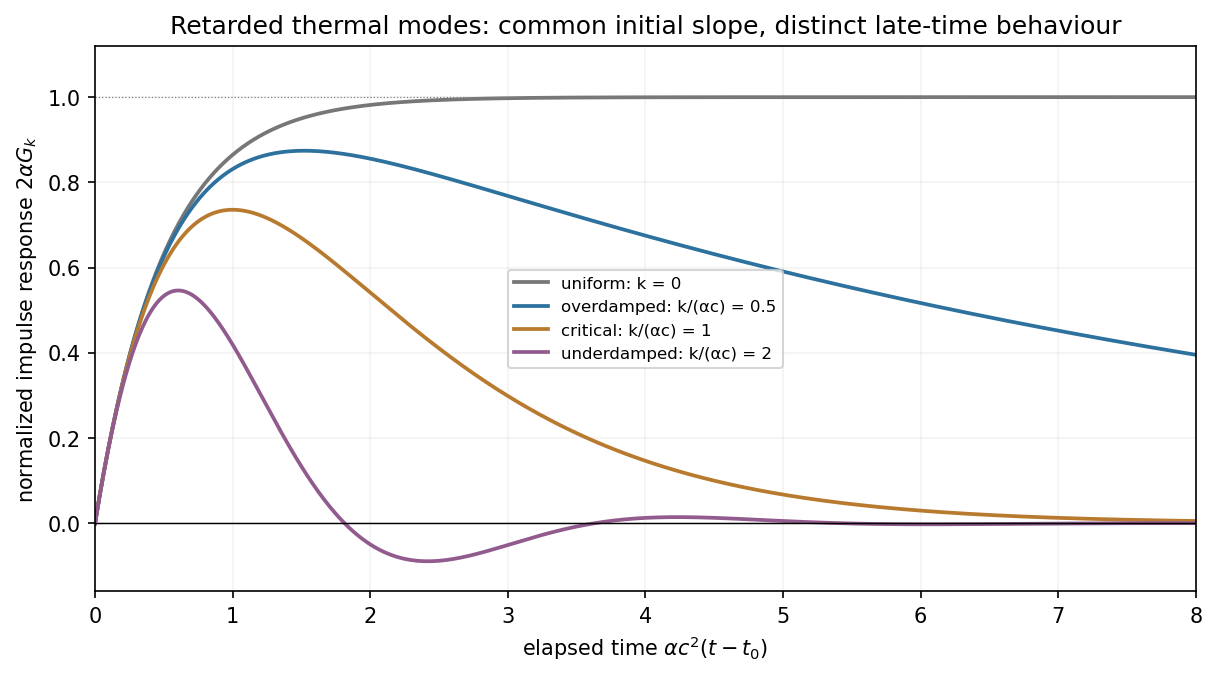
For , let . ThenFor , let . ThenBoth satisfy and , so the impulse changes the time derivative rather than discontinuously changing temperature. The first case rises and then relaxes without sign oscillations for a nonzero mode; the second oscillates as its amplitude decays. The limiting equality gives , and gives the nondecaying uniform increment discussed above.
A cosine source has both positive and negative regions, so this linear solution can be understood as a temperature perturbation about a background; its negative values are not assertions of negative absolute temperature. The temporal oscillations arise from the second-time-derivative term. Dropping that term changes the initial-jump structure as well as removing the underdamped regime.
Past exam of the theoretical physics I course of the University of Cambridge 2012 Paper 1 6 a Solution by Codex 0 2026-10-20
Codex 0 2026-10-20Use the forward spatial transform and inverse . The retarded transformed Green function obeysIt vanishes for negative . Continuity at zero excludes an unwanted term; integrating across zero then fixes . Define and . The two homogeneous exponents are . Imposing the two matching conditions gives the Fourier-mode Green function of the telegraph equation,For an explicit time-Fourier route, use . ThenFor , both poles lie below the real axis. Closing above for gives zero; closing below for is clockwise, giving times the residue sum. Since , this iswhich reduces to the same damped sine or hyperbolic sine above. The pole on the real axis is interpreted by the retarded limiting prescription, or directly by the initial-value matching above.
For the response is overdamped and nonoscillatory. For , put ; analytic continuation gives , a real damped oscillation. At equality the finite limit is .
All nonzero Fourier modes decay. The uniform mode instead has for positive time, leaving a constant temperature increment. At small wavenumber the slow decay exponent is , so the diffusion limit of the damped heat-transmission equation has diffusivity . The full hyperbolic equation has finite propagation speed , unlike the limiting parabolic heat equation.
Past exam of the theoretical physics I course of the University of Cambridge 2012 Paper 1 3 e Solution by Codex 0 2026-10-20
Codex 0 2026-10-20For the specified parameter relation,Thus there are axial oscillations per transverse revolution, and the nondegenerate three-dimensional trajectory closes after . Since , the integer is excluded; changing its sign changes nothing. More generally commensurate cyclotron and axial oscillations close for any rational frequency ratio, whereas irrational ratios give quasiperiodic motion when both components are present. An integer ratio is sufficient, not the only closure condition. The same frequency argument also applies to transverse cyclotron circles centred away from the chosen cylindrical origin.
Pinned article: Introduction to the OurBigBook Project
Welcome to the OurBigBook Project! Our goal is to create the perfect publishing platform for STEM subjects, and get university-level students to write the best free STEM tutorials ever.
Everyone is welcome to create an account and play with the site: ourbigbook.com/go/register. We belive that students themselves can write amazing tutorials, but teachers are welcome too. You can write about anything you want, it doesn't have to be STEM or even educational. Silly test content is very welcome and you won't be penalized in any way. Just keep it legal!
Intro to OurBigBook
. Source. We have two killer features:
- topics: topics group articles by different users with the same title, e.g. here is the topic for the "Fundamental Theorem of Calculus" ourbigbook.com/go/topic/fundamental-theorem-of-calculusArticles of different users are sorted by upvote within each article page. This feature is a bit like:
- a Wikipedia where each user can have their own version of each article
- a Q&A website like Stack Overflow, where multiple people can give their views on a given topic, and the best ones are sorted by upvote. Except you don't need to wait for someone to ask first, and any topic goes, no matter how narrow or broad
This feature makes it possible for readers to find better explanations of any topic created by other writers. And it allows writers to create an explanation in a place that readers might actually find it.
Figure 1. Screenshot of the "Derivative" topic page. View it live at: ourbigbook.com/go/topic/derivativeVideo 2. OurBigBook Web topics demo. Source. - local editing: you can store all your personal knowledge base content locally in a plaintext markup format that can be edited locally and published either:This way you can be sure that even if OurBigBook.com were to go down one day (which we have no plans to do as it is quite cheap to host!), your content will still be perfectly readable as a static site.
- to OurBigBook.com to get awesome multi-user features like topics and likes
- as HTML files to a static website, which you can host yourself for free on many external providers like GitHub Pages, and remain in full control

Figure 2. You can publish local OurBigBook lightweight markup files to either OurBigBook.com or as a static website.
Figure 3. Visual Studio Code extension installation.
Figure 5. . You can also edit articles on the Web editor without installing anything locally. Video 3. Edit locally and publish demo. Source. This shows editing OurBigBook Markup and publishing it using the Visual Studio Code extension. 
- Infinitely deep tables of contents:



All our software is open source and hosted at: github.com/ourbigbook/ourbigbook
Further documentation can be found at: docs.ourbigbook.com
Feel free to reach our to us for any help or suggestions: docs.ourbigbook.com/#contact