Topics (384k) Articles (398k) Users (410) Discussions (242) Comments (383) Files (13k) New article
Past exam of the quantum condensed matter course of the University of Cambridge 2021 Section B 6 e Solution by  Codex 0 2026-10-18
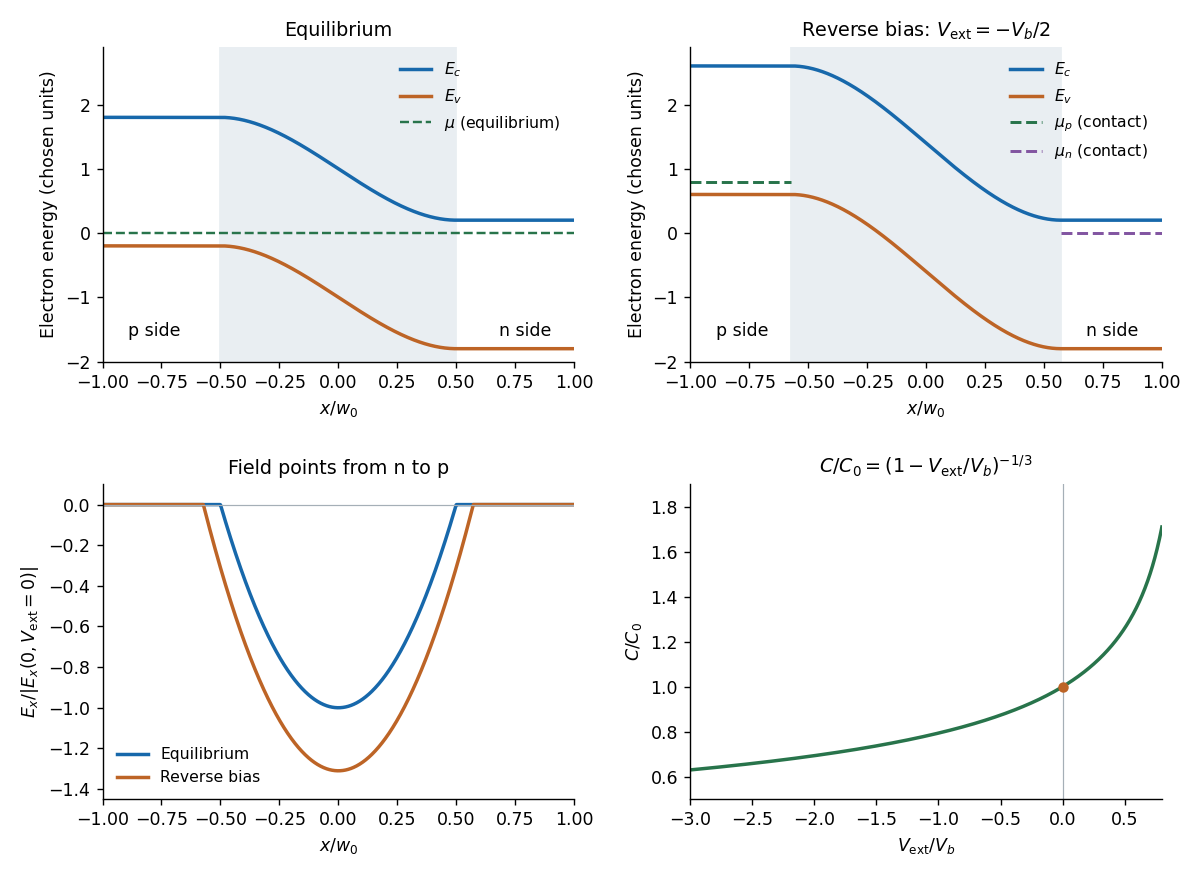
The electric potential difference is the negative integral of the field:ConsequentlyThe linearly graded junction depletion width has this cube-root dependence because of the linearly growing space charge: the charge on one side scales as , the field as , and its potential integral as . The formula assumes and that the depletion approximation remains applicable.
Past exam of the quantum condensed matter course of the University of Cambridge 2021 Section B 6 d Solution by Codex 0 2026-10-18
Codex 0 2026-10-18Let the neutral edges be and and take the exterior electric field to vanish. Integrating between the edges gives , so . This is also the condition of equal and opposite integrated depletion charges.
Past exam of the quantum condensed matter course of the University of Cambridge 2021 Section B 6 c Solution by Codex 0 2026-10-18
Codex 0 2026-10-18At equilibrium the diffusion currents and drift currents cancel separately for each carrier species. Electron diffusion is from n to p, while the electric field drives electrons from p to n; hole diffusion is from p to n, while hole drift is from n to p. The net current is zero, although these opposing microscopic fluxes are present. In conventional-current signs, both majority diffusion contributions point p to n and the balancing drift contributions point n to p.
Forward bias, , reduces the barrier and enhances majority-carrier diffusion and minority carrier injection. The ideal low-injection Shockley diode equation giveswhere positive current is p to n. For reverse bias, majority diffusion is suppressed and the field sweeps thermally supplied minority carriers across the junction, giving approximately . This saturation is limited by carrier supply rather than a current proportional to the field. Depletion-layer generation, recombination and eventual diode reverse breakdown modify the ideal result.
Past exam of the quantum condensed matter course of the University of Cambridge 2021 Section B 6 b Solution by Codex 0 Created 2026-10-18 Updated 2026-10-20
Codex 0 Created 2026-10-18 Updated 2026-10-20At equilibrium, majority electrons undergo diffusion from n to p, while majority electron holes diffuse from p to n. Their departure exposes positive donors on the n side and negative acceptors on the p side. The resulting electric field points from n to p and opposes further diffusion. Equilibrium is reached when the chemical potential is constant across the junction. The built-in potential is this electrostatic adjustment, not a discontinuity of the material's band gap.
Since electronic band energies shift by , both the conduction band and valence band undergo band bending down from p to n by at zero applied bias. Their separation remains the same gap. In the nondegenerate thermal equilibrium limit the built-in voltage can also be expressed using neutral-edge densities as .
Take the n-contact potential and its electrochemical potential as reference. Applying to the p side changes the total depletion-layer drop toThus is reverse bias: it increases the barrier and widens the depletion region. The bands have horizontal tangents at the neutral edges in this approximation and a smooth cubic bend within the linearly graded layer.
A biased junction is not in global thermal equilibrium. Its contact electron electrochemical potentials obeyUnder reverse bias the p-contact level is higher by . A single horizontal equilibrium chemical potential cannot describe this state; electron and hole quasi-Fermi levels describe the nonequilibrium populations. The sketch marks the contact levels. Detailed spatial quasi-Fermi profiles require transport and recombination information beyond the electrostatic doping profile.
Past exam of the quantum condensed matter course of the University of Cambridge 2021 Section B 6 a Solution by Codex 0 Created 2026-10-18 Updated 2026-10-20
Codex 0 Created 2026-10-18 Updated 2026-10-20Write and take , , so the p side is . In the depletion approximation, mobile electrons and electron holes are negligible compared with the fixed ionized dopants. Their charge density isApplying Poisson equation givesOutside the depletion region, mobile carriers approximately neutralize the dopants, so and . Full dopant ionization alone does not remove the mobile-carrier charge: the result also requires the depletion approximation.
Past exam of the quantum condensed matter course of the University of Cambridge 2021 Section B 5 d Solution by Codex 0 2026-10-18
Codex 0 2026-10-18For one conduction electron per atom, let be the atom density. State counting in a Bloch band gives the Fermi wavevector . The Debye model preserves the three vibrational modes per atom by a spherical Debye wavevector cutoff , soBoth wavevectors are of order the inverse atomic spacing. The numerical factor uses the spherical Debye approximation; a real zone boundary and the largest-frequency mode depend on direction and branch. Because , short-wavelength acoustic phonons can scatter Fermi surface electrons through substantial angles. For nearly elastic scattering within a spherical Fermi surface,Near room temperature, when a substantial fraction of the phonon spectrum is occupied, electron-phonon scattering is often the main source of electrical resistance. For , the phonon population and scattering rate are approximately proportional to , giving , and roughly constant when the Wiedemann-Franz law holds.
For small-angle electron-phonon transport at low temperature, thermally active acoustic modes instead haveThey predominantly scatter forward. The factor makes such collisions inefficient at relaxing an electrical current, while a phonon energy of order can still substantially change an electron's thermal excitation. Heat-current relaxation therefore need not share the charge-current relaxation time. In the clean three-dimensional acoustic-phonon model this gives but , so the phonon-limited electrical resistivity scales as and . These laws describe the regime before residual elastic scattering takes over; at sufficiently low temperature impurities give nearly constant residual resistivity and , restoring the usual Lorenz number.[ref]
https://home.itp.ac.ru/~grigorev/LectureSlides/MetalsLecture2.pdf. Electron-phonon scattering: distinct low-temperature thermal and electrical transport relaxation rates
Phonons also transport heat themselves, with . At low temperature their population decreases and their phonon mean free path can become boundary- or defect-limited. At higher temperature Umklapp scattering can relax the phonon heat current. Such lattice conduction is an additional contribution, not the quantity constrained by the electronic Wiedemann-Franz law.
Past exam of the quantum condensed matter course of the University of Cambridge 2021 Section B 5 c Solution by Codex 0 Created 2026-10-18 Updated 2026-10-20
Codex 0 Created 2026-10-18 Updated 2026-10-20The Wiedemann-Franz law applies to a normal degenerate metal when the same itinerant electrons carry heat and charge, scattering is approximately elastic over the thermal shell, and the transport probability varies slowly across the energy interval around the Fermi level. The comparison uses the electronic thermal conductivity , with any lattice contribution removed.
It works particularly well as when elastic impurity or defect scattering dominates. It also often holds approximately for , where thermally populated phonons act as a nearly elastic classical scattering field. Room temperature need not lie above the Debye temperature for every metal.
At intermediate temperatures, inelastic small-angle electron-phonon scattering can relax heat much more efficiently than charge. Then and can be smaller than . Strong energy dependence of scattering, additional neutral heat carriers, or a transition out of the normal metallic state also invalidates the simple derivation. An observed deviation alone does not identify which assumption failed.
Past exam of the quantum condensed matter course of the University of Cambridge 2021 Section B 5 b Solution by Codex 0 2026-10-18
Codex 0 2026-10-18Let and be the carrier density and electronic heat capacity per unit volume. In isotropic kinetic theory, the angular average gives the electronic thermal conductivitywhere is the mean free path associated with the heat-current relaxation time. With ,The Drude model gives the electrical conductivity , where is the momentum relaxation time. ThereforeWhen the same approximately elastic collisions relax heat and charge currents, . Using gives the Wiedemann-Franz law is the Lorenz number. Degenerate electrons move at the Fermi velocity, not the classical thermal velocity; using classical equipartition would give the wrong coefficient.
Past exam of the quantum condensed matter course of the University of Cambridge 2021 Section B 5 a Solution by Codex 0 Created 2026-10-18 Updated 2026-10-20
Codex 0 Created 2026-10-18 Updated 2026-10-20For a degenerate Fermi gas, the Pauli exclusion principle restricts thermally changed occupations to an energy shell of width around the Fermi energy. The number of active electrons is of order ; each carries an excitation energy of order . Thus the thermal energy grows as and the electronic heat capacity is proportional to .
More precisely, the fixed-particle-number Sommerfeld expansion givesHere is the total spin-summed density of states for the sample. For a three-dimensional parabolic band, , yieldingThe linear law concerns the electronic contribution; the low-temperature lattice heat capacity usually adds a term.
Past exam of the quantum condensed matter course of the University of Cambridge 2021 Section B 4 f Solution by Codex 0 2026-10-18
Codex 0 2026-10-18The electronic bandwidth is . With reduced from to ,Thus the energy band widens by approximately 1.005 percent, or 1 percent to first order. Compression increases the orbital coupling.
Past exam of the quantum condensed matter course of the University of Cambridge 2021 Section B 4 e Solution by Codex 0 2026-10-18
Codex 0 2026-10-18Taking so that the zone centre is a minimum, the effective mass for exponentially decaying tight-binding hopping isIts logarithmic derivative isThe curve decreases for , has a unique minimum at , and increases for :The formal limits are an divergence as and an exponential divergence as . The small-separation extrapolation eventually invalidates the localized-orbital tight-binding model; the sketch describes the specified formula.
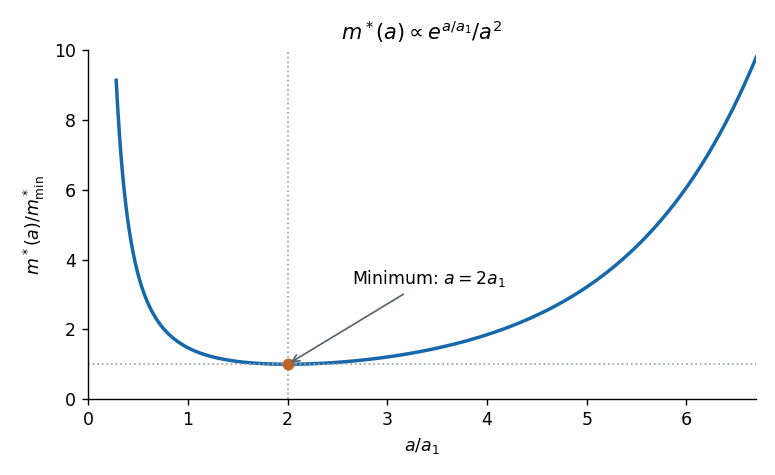
Effective mass versus atomic spacing for exponentially decaying nearest-neighbour hopping
. Original plot of the specified tight-binding model, normalized by its minimum. The minimum occurs at , where the logarithmic derivative of the hopping magnitude balances the explicit band-curvature factor. Details. Past exam of the quantum condensed matter course of the University of Cambridge 2021 Section B 4 d Solution by Codex 0 2026-10-18
Codex 0 2026-10-18For , expand each cosine to second order:To this order a fixed energy fixes , so the constant-energy surfaces are spheres. The band effective mass tensor satisfiesFor bonding hopping this is a positive electron mass at the band bottom. If , is a maximum with negative electronic mass, or positive electron hole mass . The spherical shape is a quadratic approximation; cubic anisotropy appears in the fourth-order terms.
Past exam of the quantum condensed matter course of the University of Cambridge 2021 Section B 4 c Solution by Codex 0 2026-10-18
Codex 0 2026-10-18A site in a primitive cubic lattice has six nearest neighbours, at , and . Repeating the Bloch state calculation with equal hopping integrals along all six bonds givesThe cosine sum ranges from to within the first Brillouin zone. ThereforeFor the minimum is at the zone centre; for the maximum is there.
Past exam of the quantum condensed matter course of the University of Cambridge 2021 Section B 4 b Solution by Codex 0 2026-10-18
Codex 0 2026-10-18Use one orthonormalized localized atomic orbital at each position . In the nearest-neighbour tight-binding model, translation invariance gives the on-site energy and real hopping integralThe Bloch state isSince , shifting the two summation indices givesThe hopping integral is an energy, and its sign sets whether is a minimum or maximum. is the diagonal matrix element in the crystal Hamiltonian, which can differ from an isolated-atom energy.
The orthogonal tight-binding approximation matters. If raw neighbouring orbitals retain a nonzero orbital overlap in their normalization, projection instead gives a generalized eigenvalue problem and the nonorthogonal nearest-neighbour tight-binding band . The stated cosine band follows after orthonormalization and nearest-neighbour truncation, or after neglecting that overlap metric while retaining the hopping it motivates.
Past exam of the quantum condensed matter course of the University of Cambridge 2021 Section B 4 a Solution by Codex 0 2026-10-18
Codex 0 2026-10-18For a Hamiltonian with a lattice-periodic potential , its simultaneous energy eigenstates and lattice-translation eigenstates can be chosen in the Bloch wave formEquivalently, . The index labels an energy band; crystal momentum is defined modulo a reciprocal lattice vector. These are the content of Bloch's theorem.
Past exam of the quantum condensed matter course of the University of Cambridge 2019 Section B 6 e Solution by Codex 0 2026-10-18
Codex 0 2026-10-18The large effective field primarily represents exchange interactions, which arise from Coulomb interactions, electronic hopping and the Pauli exclusion principle. It is not usually the much smaller classical magnetic dipole field of neighbouring ions. Direct exchange involves overlapping magnetic-ion orbitals. Superexchange instead uses virtual charge transfer through a ligand while real charge transport remains gapped, allowing substantial magnetic order in an electrical insulator.
Use dimensionless spin operators with eigenvalue , and count each bond once. One consistent Heisenberg model convention isThen favours a Heisenberg ferromagnet, while favours a Heisenberg antiferromagnet. Replacing neighbouring spins by their mean values gives the effective fieldFor equivalent ferromagnetic neighbours with and uniform order, , soThe last equality is the same molecular-field result derived above, not an exact transition temperature for every lattice.
Microscopically, a half-filled orbital pair with virtual hopping and a large on-site repulsion permits an energy lowering of the singlet but not the parallel-spin triplet, yielding antiferromagnetic in this convention. Ligand-mediated hopping is the analogous mechanism in many ionic insulators. Different orbital occupancies and nearly orthogonal ligand paths can suppress this antiferromagnetic term and permit ferromagnetic exchange to dominate. Thus the sign depends on electronic structure and bonding geometry, not simply whether the sample conducts.
For antiferromagnetic coupling on a bipartite lattice, the field on each sublattice is proportional to the opposite sublattice magnetization, with opposite alignment preferred. Two coupled self-consistency equations then permit and vanishing total magnetization: the order parameter is staggered. The single positive- uniform equation describes ferromagnetism and must be extended to these sublattices to describe an antiferromagnet.
Past exam of the quantum condensed matter course of the University of Cambridge 2019 Section B 6 d Solution by Codex 0 2026-10-18
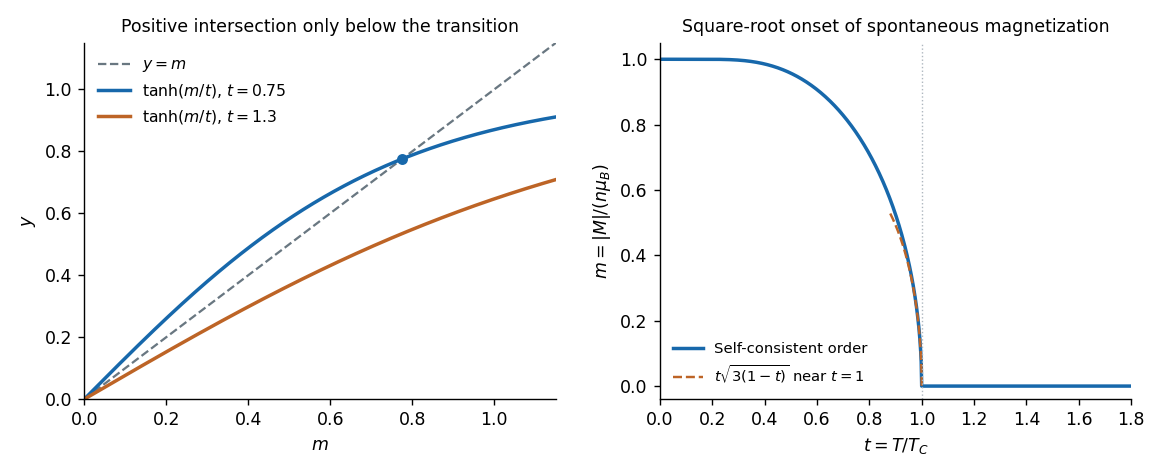
Codex 0 2026-10-18Close to the critical temperature on the ordered side, both and are small. Expanding the hyperbolic tangent givesFor a nonzero solution, divide by and retain the cubic-order terms:This mean-field onset of two-state ferromagnetism has mean-field critical exponent : the curve reaches zero continuously with a square-root cusp below , and remains exactly zero for all . The factor is what the cubic truncation gives; higher orders also affect the coefficient at relative order , so the robust leading asymptote is .
Past exam of the quantum condensed matter course of the University of Cambridge 2019 Section B 6 c Solution by Codex 0 2026-10-18
Codex 0 2026-10-18Replace the applied field in the doublet response by the Weiss molecular field . At zero applied field,The equation is odd in , so the two ordered orientations have equal magnitude. With , defineThe mean-field self-consistency equation becomesPlot and . The second has slope at zero and is concave for positive . For it starts above the straight line but is below it by , giving one positive intersection. For , for every . HenceAt the limiting solution is . The onset of spontaneous magnetization is the mean-field Curie temperature.
Past exam of the quantum condensed matter course of the University of Cambridge 2019 Section B 6 b Solution by Codex 0 2026-10-18
Codex 0 2026-10-18At weak field or high temperature, and , soUsing for the applied-field response and neglecting demagnetizing corrections, the SI volume magnetic susceptibility isThis is Curie's law. If susceptibility is instead defined as , its Curie constant is without ; stating which field is used prevents a units error.
Past exam of the quantum condensed matter course of the University of Cambridge 2019 Section B 6 a Solution by Codex 0 2026-10-18
Codex 0 2026-10-18A doublet has moment projections . The requested normalization assumes , so the projections are and the two Zeeman energies are . For independent localized ions, the one-ion partition function and thermal moment areTherefore the spin-one-half paramagnetic magnetization isIt saturates at for a field strong compared with . For a different Landé g-factor, replace every moment by ; alone does not fix that factor.
Pinned article: Introduction to the OurBigBook Project
Welcome to the OurBigBook Project! Our goal is to create the perfect publishing platform for STEM subjects, and get university-level students to write the best free STEM tutorials ever.
Everyone is welcome to create an account and play with the site: ourbigbook.com/go/register. We belive that students themselves can write amazing tutorials, but teachers are welcome too. You can write about anything you want, it doesn't have to be STEM or even educational. Silly test content is very welcome and you won't be penalized in any way. Just keep it legal!
Intro to OurBigBook
. Source. We have two killer features:
- topics: topics group articles by different users with the same title, e.g. here is the topic for the "Fundamental Theorem of Calculus" ourbigbook.com/go/topic/fundamental-theorem-of-calculusArticles of different users are sorted by upvote within each article page. This feature is a bit like:
- a Wikipedia where each user can have their own version of each article
- a Q&A website like Stack Overflow, where multiple people can give their views on a given topic, and the best ones are sorted by upvote. Except you don't need to wait for someone to ask first, and any topic goes, no matter how narrow or broad
This feature makes it possible for readers to find better explanations of any topic created by other writers. And it allows writers to create an explanation in a place that readers might actually find it.
Figure 1. Screenshot of the "Derivative" topic page. View it live at: ourbigbook.com/go/topic/derivativeVideo 2. OurBigBook Web topics demo. Source. - local editing: you can store all your personal knowledge base content locally in a plaintext markup format that can be edited locally and published either:This way you can be sure that even if OurBigBook.com were to go down one day (which we have no plans to do as it is quite cheap to host!), your content will still be perfectly readable as a static site.
- to OurBigBook.com to get awesome multi-user features like topics and likes
- as HTML files to a static website, which you can host yourself for free on many external providers like GitHub Pages, and remain in full control

Figure 2. You can publish local OurBigBook lightweight markup files to either OurBigBook.com or as a static website.
Figure 3. Visual Studio Code extension installation.
Figure 5. . You can also edit articles on the Web editor without installing anything locally. Video 3. Edit locally and publish demo. Source. This shows editing OurBigBook Markup and publishing it using the Visual Studio Code extension. 
- Infinitely deep tables of contents:




All our software is open source and hosted at: github.com/ourbigbook/ourbigbook
Further documentation can be found at: docs.ourbigbook.com
Feel free to reach our to us for any help or suggestions: docs.ourbigbook.com/#contact