Topics (384k) Articles (398k) Users (410) Discussions (242) Comments (383) Files (13k) New article
Past exam of the soft condensed matter course of the University of Cambridge 2022 Section B 4 f Solution by  Codex 0 2026-10-18
For the usual interpretation of a real chain in a good solvent, the detachment force is smaller in the weak-adsorption regime. Excluded volume swells the chain, increasing the cost of confinement near the substrate. The adsorbed layer becomes thicker and its binding free energy per monomer decreases. The same contact energy therefore does not mean the same total binding strength.
The scaling argument can include both adsorption and stretching. Let , where for an ideal chain and approximately for a self-avoiding walk in three dimensions. With the same contact-fraction approximation,Minimization gives and . At detachment, a tensile blob of size costs approximately ; its monomer count is . Equating the stretching gain per monomer to givesThus , compared with , so their ratio scales as for weak attraction. These are scaling relations, not exact prefactors. The real-chain adsorption exponents here use the same simple uniform-contact model as the earlier parts; a more detailed surface theory of critical phenomena can refine them. The thicker, more weakly bound layer reflects the higher cost of confining a good solvent chain.[ref]
https://dasher.wustl.edu/bio5357/readings/rubinstein-chapter3.pdf. Rubinstein and Colby, Polymer Physics, chapter 3, equations (3.59)–(3.66)
“Real” alone does not specify solvent quality: a collapsed chain in a poor solvent, strong adsorption, or substantial bending stiffness requires a different comparison. The smaller-force conclusion concerns the flexible good solvent chain implicit in the excluded-volume correction.
Past exam of the soft condensed matter course of the University of Cambridge 2022 Section B 4 e Solution by Codex 0 2026-10-18
Codex 0 2026-10-18During slow peeling in atomic force microscopy, adjusts to minimize the Helmholtz free energy at each imposed height. Define the positive binding gain for the adsorbed segment. The stationary point satisfiesSince , this is a minimum while . The upward pulling force is the height derivative of the minimized free energy. The implicit term vanishes because , givingUsing ,It is independent of : extra pulling height releases more monomers while leaving the fractional extension of the stretched part unchanged. Equivalently . This is the equilibrium peeling force of an adsorbed Gaussian chain.
The plateau ends when , atThereafter all monomers are detached and the Gaussian chain force is , agreeing continuously with the plateau at . Very near the start and final release, finite-chain and junction effects lie outside the blob approximation.
Past exam of the soft condensed matter course of the University of Cambridge 2022 Section B 4 d Solution by Codex 0 2026-10-18
Codex 0 2026-10-18The stretched segment is a Gaussian chain of Kuhn length steps, with unperturbed root-mean-square end-to-end distance . Its end-to-end probability density is proportional to , so its leading elastic Helmholtz free energy is . Adding the remaining segment's adsorption free energy givesAn additive constant independent of is irrelevant. At the optimal adsorption height this becomesThe original PDF's hint labels the positive quantity proportional to an entropy. It has units of energy and is the stretching free energy. The corresponding change of conformational entropy is . This dimensional and sign correction is essential to the minimization.
This is the leading extensive Gaussian chain approximation: endpoint normalization and junction corrections give subleading terms. It requires many stretched monomers and , rather than extension near the full contour length.
Past exam of the soft condensed matter course of the University of Cambridge 2022 Section B 4 c Solution by Codex 0 2026-10-18
Codex 0 2026-10-18Minimize the Helmholtz free energy at fixed . Its derivative isThe physical stationary point for isTo check the minimum directly, put . Then , which is globally minimized at . The binding free energy gain per monomer is consequently .
The weak-adsorption blob picture requires , or in this model. If is too large, the layer saturates at a monomer-scale thickness; if too small, a many-blob adsorbed layer has not formed.
Past exam of the soft condensed matter course of the University of Cambridge 2022 Section B 4 b Solution by Codex 0 2026-10-18
Codex 0 2026-10-18Here is the absolute temperature and the Boltzmann constant. An adsorption blob contains monomers, so there are such blobs. Confining a blob removes an amount of conformational entropy of order ; thus the positive confinement contribution to the Helmholtz free energy isThe statement about one blob's entropy is used as an entropy loss relative to the free chain, rather than as an absolute entropy.
In the assumed slab model, contacts occur within a monomer-scale distance of the substrate. The contact fraction is approximately , giving . Multiplying this by the negative contact energy yieldsThe two contributions express the competition between loss of conformational entropy and gain of adsorption energy. The numerical coefficients are the ones stipulated by this blob approximation.
Past exam of the soft condensed matter course of the University of Cambridge 2022 Section B 4 a Solution by Codex 0 2026-10-18
Codex 0 2026-10-18For an ideal chain, independent Kuhn length steps give the random walk relationwhere denotes the end-to-end displacement of a subchain. Equivalently the mass-size fractal exponent is . Numerical factors depend on the chosen definition of blob diameter.
A subchain smaller than the adsorption height explores three dimensions much as a free ideal chain does. At scales exceeding , adsorption restricts its perpendicular extent to order , so the coil is anisotropic. Its in-plane projection may still have a random walk law for an ideal chain, but the isotropic three-dimensional blob construction cannot be extrapolated to . This is the reason to use adsorption blobs of size .
Past exam of the soft condensed matter course of the University of Cambridge 2021 Section B 6 e Solution by Codex 0 2026-10-18
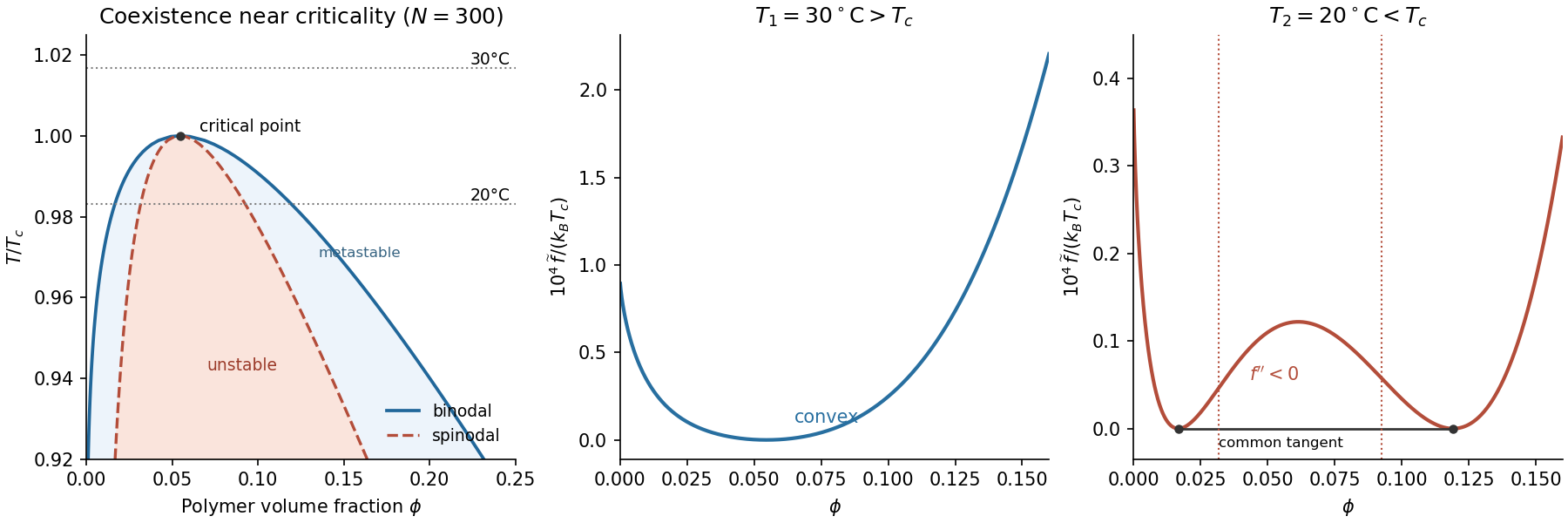
Codex 0 2026-10-18Interpret the stated transition as an upper critical miscibility temperature: cooling increases the effective through . Above , the homogeneous mixing free energy is convex throughout , with no two-phase common tangent. Below , it acquires a region with , bordered by the spinodal. A lower straight line touches the curve at two binodal compositions and ; this common-tangent construction gives the equilibrium polymer-poor and polymer-rich phases.
The precise raw curve need not have two equal minima: subtracting an affine function of changes reference chemical potentials without changing curvature or coexistence compositions. The free-energy panels above subtract the tangent at from the upper-temperature curve and the common tangent from the lower-temperature curve. This makes the common tangent and the convex-versus-nonconvex distinction visible.
If the mean initial composition lies inside the low-temperature spinodal region, an arbitrarily small separation into equal-volume regions with compositions changes the mean free energy bySmall fluctuations therefore grow spontaneously: this is spinodal decomposition. Interfacial costs limit very short-wavelength fluctuations, and the polymer-poor and polymer-rich domains subsequently coarsen towards their binodal compositions.
If lies just outside a spinodal branch but still inside the binodal, then . Small fluctuations increase free energy, so the uniform mixture is metastable. Separation requires a sufficiently large nucleus to overcome the interfacial barrier, followed by nucleation and growth. There is no guarantee that this happens rapidly. If the initial composition is outside the binodal as well, it remains a stable uniform phase after cooling.
For a mean composition in the coexistence interval, conservation of polymer fixes the volume fraction of the rich phase by the lever rule:The temperatures alone do not determine which mechanism occurs without the initial composition. Numerical free-energy curves additionally require ; the plotted example uses with absolute temperatures , and .
Past exam of the soft condensed matter course of the University of Cambridge 2021 Section B 6 d Solution by Codex 0 2026-10-18
Codex 0 2026-10-18For , the critical polymer volume fraction isIf is the volume assigned to one amino acid in the lattice model, the critical number densities are exactlyThe extra physical approximation needed to use the given radius of gyration is that a chain in a poor solvent is a compact polymer globule. Its size then scales as with , so . This gives the standard scaling estimatesWith , numerical substitution givesUsing only the leading large- value gives and , respectively. These are scaling estimates, not geometrically exact densities.
For comparison, a specifically uniform spherical compact protein has the radius of gyration of a uniform sphere, , so its physical volume is . Taking instead gives and . The factor between these conventions is geometric. The PDF does not give a monomer volume, globule density or shape model, and a radius of gyration alone does not determine an exact molecular volume. The model-independent conclusions are the formulas in terms of and the 300:1 ratio of monomer to protein number density.
Past exam of the soft condensed matter course of the University of Cambridge 2021 Section B 6 c Solution by Codex 0 2026-10-18
Codex 0 2026-10-18At the thermodynamic critical point, the two spinodal branches merge: and . The third derivative isFor , its zero gives . Substitution in the spinodal relation yieldsAn absolute critical temperature requires an interaction–temperature relation. Under the usual energetic approximation , define the theta temperature , at which an infinite chain has . ThenThus tends to a nonzero constant, , while . It is the temperature deficit, not itself, that scales as .
More generally, if a smooth obeys and , thenThis is the critical point of a Flory–Huggins polymer solution. The same leading chain-length exponent follows for a smooth temperature law, while its coefficient depends on the omitted solvent thermodynamics. The lattice interpretation connects the chain-length dependence of mixing entropy to the theta condition .[ref].
Past exam of the soft condensed matter course of the University of Cambridge 2021 Section B 6 b Solution by Codex 0 2026-10-18
Codex 0 2026-10-18Local compositional stability requires positive curvature of the mixing free energy. Differentiating twice at fixed temperature, with independent of composition as in the given model, givesThe spinodal occurs where this vanishes:Between the two spinodal compositions at sufficiently large , and a homogeneous mixture is unstable to infinitesimal composition fluctuations. The binodal is instead fixed by the common-tangent construction, and encloses a larger coexistence region. Between binodal and spinodal the mixture is locally stable but metastable.
A phase diagram with a conventional upper critical temperature additionally assumes that decreases with , for example with . Then high temperature gives a uniform mixture; cooling produces an asymmetric coexistence dome whose critical composition is on the dilute-polymer side. The spinodal lies inside the binodal dome. An arbitrary need not give this orientation, so the free-energy formula alone does not specify a unique temperature axis.
Past exam of the soft condensed matter course of the University of Cambridge 2021 Section B 6 a Solution by Codex 0 2026-10-18
Codex 0 2026-10-18The Flory–Huggins solution theory treats a polymer solution as an incompressible lattice mixture, with one solvent molecule occupying one site and one chain occupying connected sites. Thus the supplied is naturally the mixing free energy per lattice site; if a site has volume , the free-energy density is .
The term is the polymer translational entropy of mixing contribution. There are only as many independently translating chains as monomers, which explains the factor . The term is the solvent entropy of mixing contribution. Both lower the mixing free energy for .
The term is the mean-field excess interaction contribution from replacing like contacts with polymer–solvent contacts. In the simplest energetic lattice model,where counts neighboring contacts and the are pair contact energies. Positive penalizes unlike contacts and can favor demixing. Because chain connectivity suppresses the polymer's translational mixing entropy, relatively modest unfavorable interactions can cause separation of long chains. More general effective can also include entropic effects.
Past exam of the soft condensed matter course of the University of Cambridge 2021 Section B 5 f Solution by Codex 0 2026-10-18
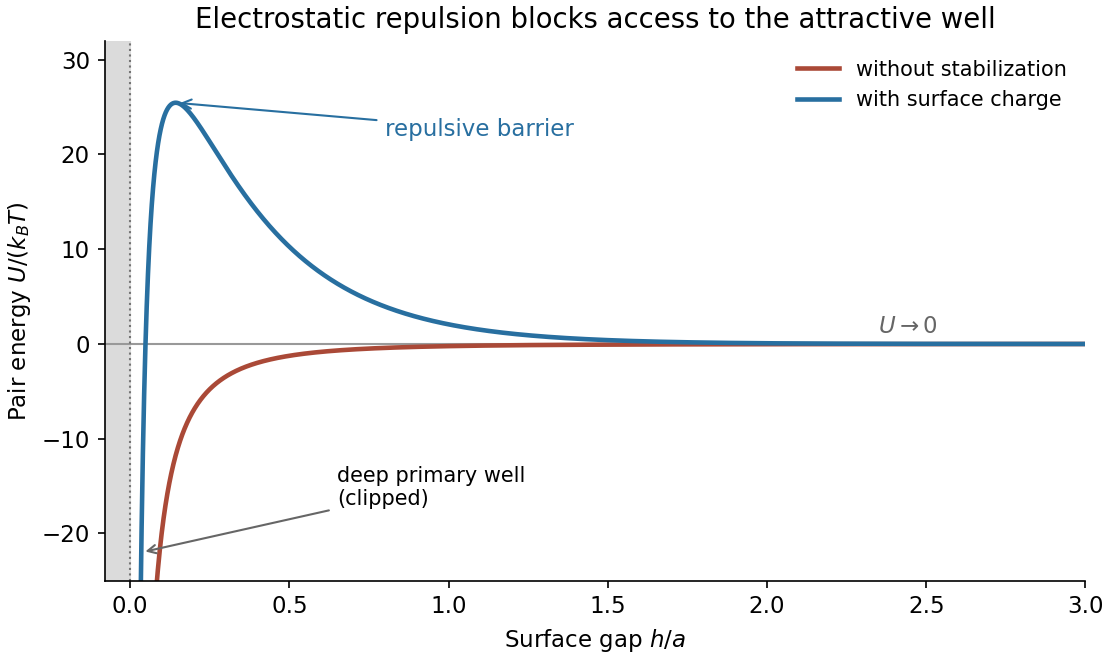
Codex 0 2026-10-18Without stabilization, the potential energy is predominantly attractive outside the molecular core and drops into a deep primary minimum. With the charging treatment, the DLVO theory sum develops a positive barrier between distant particles and that primary minimum. The barrier must be large compared with to inhibit aggregation on the experimental timescale. A shallow secondary minimum can remain at larger separation, depending on parameters.
Attractive and electrostatically stabilized colloidal pair potentials
. Original illustrative curves for two equal spheres. The unstabilized curve uses the nonretarded sphere–sphere attraction; the stabilized curve adds screened electrostatic repulsion. The molecular core is excluded and the deep near-contact well is clipped by the plotting range. Potential depths and screening parameters are illustrative, not data supplied by the paper. Details.The horizontal axis is the surface gap, so the molecular exclusion boundary is at its origin. Both interactions tend to zero at large separation. Raising salt concentration shortens the Debye–Hückel screening length and can reduce the barrier, allowing particles to stick again.
Past exam of the soft condensed matter course of the University of Cambridge 2021 Section B 5 e Solution by Codex 0 2026-10-18
Codex 0 2026-10-18One method is to give every particle a sufficiently large surface charge density of the same sign. For example, attach ionizable sulfonate groups covalently to the surface. Dissociation leaves negatively charged surface groups and releases mobile positive counterions into the water. A surfactant with a strongly bound head group can provide another charging route, provided it does not desorb during the experiment.
Each charged particle is surrounded by an electric double layer. As two such particles approach, overlap of these ionic clouds raises the electrostatic and ionic free energy, producing repulsion. In a dilute electrolyte, the range is set by the Debye–Hückel screening length,For identical weakly charged spheres a representative screened Coulomb pair potential isIts sum with the Van der Waals force attraction is the DLVO theory pair potential. Choose the charging level so that the repulsive barrier is many high; particles then rarely reach the primary attractive well during the observation time. This is kinetic stabilization rather than removal of all attraction.
Deionized water is useful because low added ionic strength gives a long-ranged repulsion. It does not mean that the charged dispersion contains no ions: the surface's own counterions are unavoidable and contribute to screening. Surface dissociation, contamination and particle concentration therefore matter even without added salt. An alternative valid route is a dense, firmly attached layer of water-soluble polyethylene glycol, producing steric stabilization without relying on a large electrostatic barrier.
Past exam of the soft condensed matter course of the University of Cambridge 2021 Section B 5 d Solution by Codex 0 2026-10-18
Codex 0 2026-10-18Colloidal particles experience attractive Van der Waals forces, arising from correlated molecular charge fluctuations and other dipolar interactions. Integrating many weak molecular attractions over two particles can give a deep near-contact well. For identical spheres of radius and surface gap , a positive Hamaker constant gives approximatelyBrownian motion brings particles into encounters. Without a repulsive barrier, they can reach the attractive primary minimum; if the binding energy is much larger than , thermal motion rarely separates them again. Repeated sticking produces aggregates. This is a kinetic stability statement: thermal agitation causes encounters but does not itself supply a stabilizing interparticle repulsion. The molecular cutoff and hard sphere exclusion prevent the unphysical divergence of the continuum attraction.
Past exam of the soft condensed matter course of the University of Cambridge 2021 Section B 5 c Solution by Codex 0 2026-10-18
Codex 0 2026-10-18For an ideal smooth homogeneous substrate in thermodynamic equilibrium, Young's equation iswhere denotes air, the solid, and the chosen liquid. It follows either by balancing tangential interfacial forces at the contact line or by varying the wetted area at fixed drop volume.
The dry Teflon–air surface energy is the same in the two measurements, so subtracting the two equations eliminates it:ThereforeThe water–Teflon interface has the higher interfacial free energy per unit area. Neither individual solid–liquid surface energy is determined without the solid–air value; the difference is determined.
Past exam of the soft condensed matter course of the University of Cambridge 2021 Section B 5 b Solution by Codex 0 2026-10-18
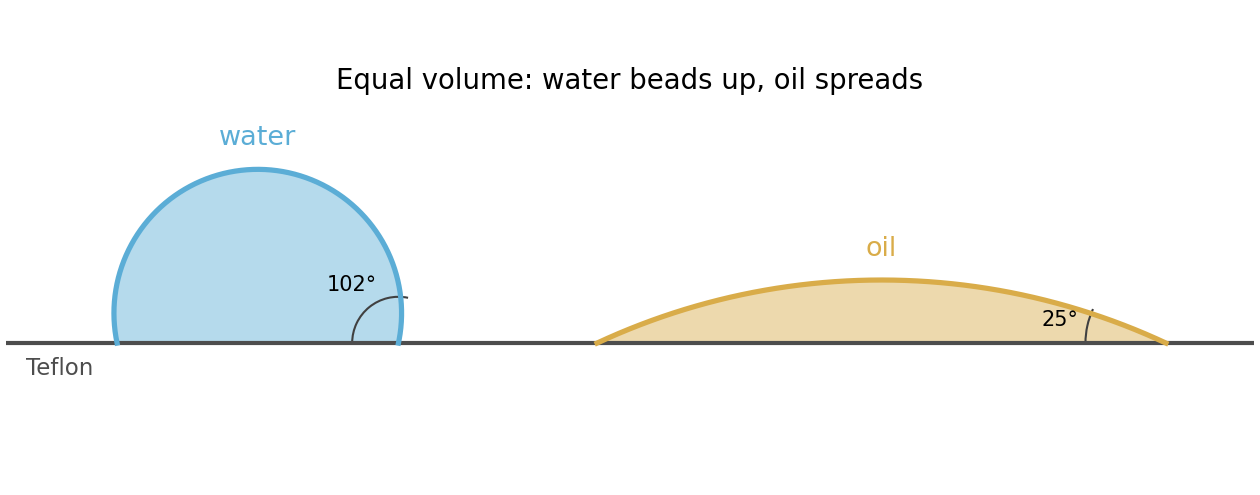
Codex 0 2026-10-18On Teflon, the water drop has an obtuse contact angle and beads up, whereas the oil drop has an acute contact angle and spreads into a shallower patch. For small drops with negligible Bond number, both can be drawn as spherical caps.
Past exam of the soft condensed matter course of the University of Cambridge 2021 Section B 5 a Solution by Codex 0 2026-10-18
Codex 0 2026-10-18A hydrophobic surface is poorly wetted by water: on a smooth surface its equilibrium contact angle, measured through the liquid, exceeds . A drop therefore tends to bead up, limiting its contact area. Hydrophobicity does not mean that the surface exerts a mysterious repulsive force on every water molecule.
The waxy coating has a largely nonpolar exterior. Water molecules form favorable hydrogen bonds with one another, whereas a hydrocarbon-rich wax surface offers few suitable hydrogen bond donors or hydrogen bond acceptors. Water–surface adhesion is weak relative to water's cohesion. The drop shape minimizes the combined solid–air, solid–water and water–air interfacial free energies, not merely the liquid's exposed area.
In terms of Young's equation, . A contact angle greater than corresponds to : replacing dry surface by wetted surface has an interfacial cost. The balancing liquid interface then favors a small wetted patch. Microscopic leaf texture can amplify the apparent hydrophobicity, especially when it traps air under the drop as a Cassie–Baxter state; the chemistry of a smooth wax layer alone does not guarantee an extremely large apparent angle.
Past exam of the soft condensed matter course of the University of Cambridge 2021 Section B 4 e Solution by Codex 0 2026-10-18
Codex 0 2026-10-18A Kelvin-Voigt model has no finite instantaneous elastic compliance: the viscous element prevents a sudden deformation under a finite stress step. Its creep compliance isConversely an ideal strain step requires an impulsive stress,After the impulse the held-strain response is simply constant. There is no finite stress-decay interval, and the loss modulus grows without bound as . This fails to represent a material with both a finite instantaneous stiffness and delayed stress relaxation.
The added series spring resolves this particular defect. At the instant of loading the Kelvin element cannot move but the added spring can. The standard linear solid model consequently hasandIts instantaneous stiffness is , its long-time stiffness is , and it exhibits genuine stress relaxation as well as delayed creep. The creep retardation time differs from the stress-relaxation time . These properties also follow directly from its constitutive equation,It remains an idealized solid with one relaxation mode: it cannot describe unrestricted long-time viscous flow, nonlinear response, or a broad spectrum of relaxation times.
Past exam of the soft condensed matter course of the University of Cambridge 2021 Section B 4 d Solution by Codex 0 2026-10-18
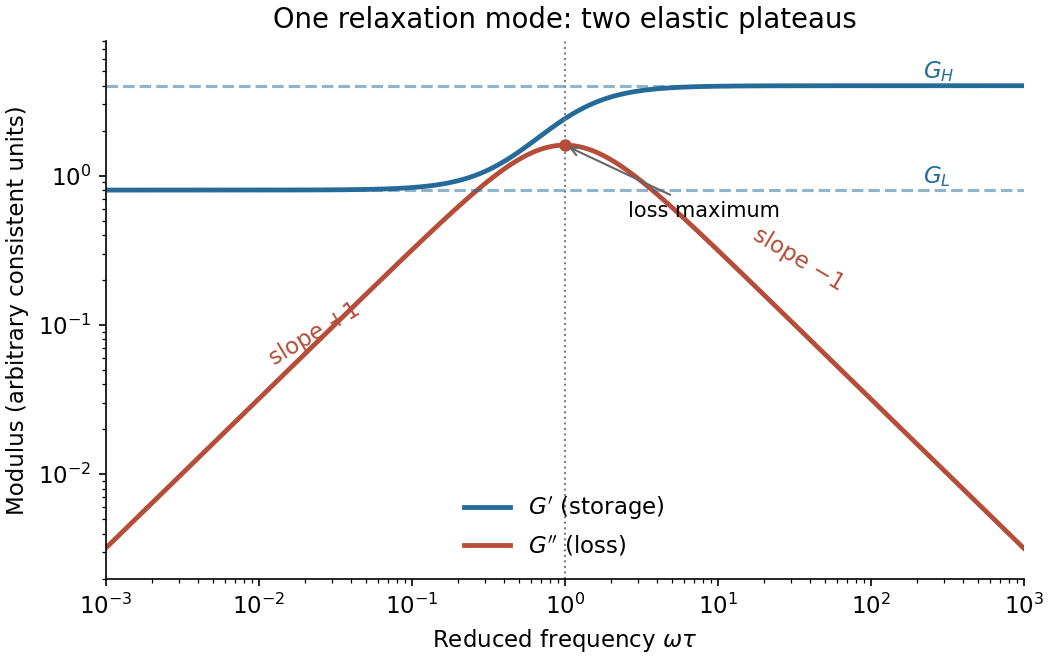
Codex 0 2026-10-18For elements in series the stress is common and the strains add. If and are the Kelvin element and added spring amplitudes, thenThe compliances therefore add, yieldingThis is a standard linear solid model. DefineWriting , its storage modulus and loss modulus areThus increases from the low-frequency plateau to the high-frequency plateau . The loss modulus has low-frequency slope and high-frequency slope on a log-log plot, with maximum at . At that frequency . There need not be a crossing of the two curves for arbitrary spring constants.
Past exam of the soft condensed matter course of the University of Cambridge 2021 Section B 4 c Solution by Codex 0 2026-10-18
Codex 0 2026-10-18Parallel elements have the same strain, while their stresses add. The spring supplies and the viscous element supplies , so the Kelvin-Voigt model has constitutive equationFor the oscillatory deformation this givesPhysical stress and strain are the real parts of these expressions. Thus the storage modulus is , independent of frequency, and the loss modulus is . The equation is the quasistatic material law; an inertial equation for an attached mass would require additional mechanical data.
Pinned article: Introduction to the OurBigBook Project
Welcome to the OurBigBook Project! Our goal is to create the perfect publishing platform for STEM subjects, and get university-level students to write the best free STEM tutorials ever.
Everyone is welcome to create an account and play with the site: ourbigbook.com/go/register. We belive that students themselves can write amazing tutorials, but teachers are welcome too. You can write about anything you want, it doesn't have to be STEM or even educational. Silly test content is very welcome and you won't be penalized in any way. Just keep it legal!
Intro to OurBigBook
. Source. We have two killer features:
- topics: topics group articles by different users with the same title, e.g. here is the topic for the "Fundamental Theorem of Calculus" ourbigbook.com/go/topic/fundamental-theorem-of-calculusArticles of different users are sorted by upvote within each article page. This feature is a bit like:
- a Wikipedia where each user can have their own version of each article
- a Q&A website like Stack Overflow, where multiple people can give their views on a given topic, and the best ones are sorted by upvote. Except you don't need to wait for someone to ask first, and any topic goes, no matter how narrow or broad
This feature makes it possible for readers to find better explanations of any topic created by other writers. And it allows writers to create an explanation in a place that readers might actually find it.
Figure 1. Screenshot of the "Derivative" topic page. View it live at: ourbigbook.com/go/topic/derivativeVideo 2. OurBigBook Web topics demo. Source. - local editing: you can store all your personal knowledge base content locally in a plaintext markup format that can be edited locally and published either:This way you can be sure that even if OurBigBook.com were to go down one day (which we have no plans to do as it is quite cheap to host!), your content will still be perfectly readable as a static site.
- to OurBigBook.com to get awesome multi-user features like topics and likes
- as HTML files to a static website, which you can host yourself for free on many external providers like GitHub Pages, and remain in full control

Figure 2. You can publish local OurBigBook lightweight markup files to either OurBigBook.com or as a static website.
Figure 3. Visual Studio Code extension installation.
Figure 5. . You can also edit articles on the Web editor without installing anything locally. Video 3. Edit locally and publish demo. Source. This shows editing OurBigBook Markup and publishing it using the Visual Studio Code extension. 
- Infinitely deep tables of contents:




All our software is open source and hosted at: github.com/ourbigbook/ourbigbook
Further documentation can be found at: docs.ourbigbook.com
Feel free to reach our to us for any help or suggestions: docs.ourbigbook.com/#contact