Topics (384k) Articles (398k) Users (410) Discussions (242) Comments (383) Files (13k) New article
Past exam of the quantum condensed matter course of the University of Cambridge 2019 Section B 5 e Solution by  Codex 0 2026-10-18
At large inverse field, and the cyclotron frequency are small, so the orbital spacing becomes comparable with both disorder broadening and the Fermi occupation's thermal width. Scattering of quantum lifetime gives a typical half-width ; overlapping levels lose their density-of-states contrast. The fundamental Dingle factor and thermal damping of quantum oscillations areBoth shrink rapidly as falls. Well-resolved oscillations require a sufficiently large and a temperature small compared with the orbital spacing. The scattering time in this broadening argument is not automatically the transport time inferred from mobility; small-angle events affect the two differently.
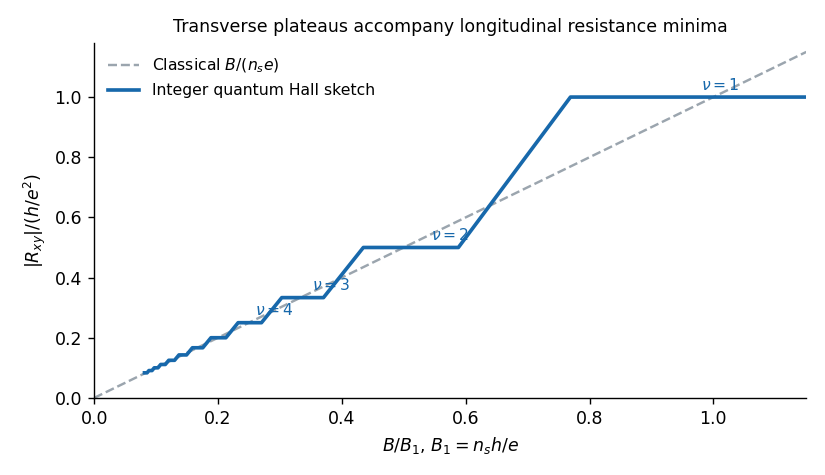
The transverse Hall resistance is approximately in the classical weak-field regime. At stronger fields the integer quantum Hall effect produces plateausaccompanied by nearly vanishing longitudinal resistance. Localized bulk states between extended Landau states allow plateau intervals, while current can be carried by quantum Hall edge states. At still larger fields and sufficiently low temperature, the cleanest samples show the fractional quantum Hall effect, with interaction-generated incompressible states at fractional fillings such as . The sign of depends on the contact and magnetic-field orientation; the sketch shows its magnitude.
Past exam of the quantum condensed matter course of the University of Cambridge 2019 Section B 5 d Solution by Codex 0 2026-10-18
Codex 0 2026-10-18For interface area , each resolved spin branch has one state per flux increment , so its degeneracy of a Landau level isIf such branches are occupied, including fractional occupation of the highest, the filling factor givesThe filling counts spin and any other internal branches separately; it is an integer when a whole number of resolved levels are full.
From the visible PDF axes, approximately ten unsplit periods lie between and , giving . Consecutive unsplit orbital peaks differ by two occupied spin branches, so carrier density from spin-degenerate quantum oscillations givesThe precision is limited by reading the plotted trace, roughly a few percent. The factor two assumes only spin remains unresolved in that part of the graph; counting individual spin-split peaks would instead use a one-branch filling increment.
Past exam of the quantum condensed matter course of the University of Cambridge 2019 Section B 5 c Solution by Codex 0 2026-10-18
Codex 0 2026-10-18The two voltage contacts in the inset lie along the current direction. The measured signal is therefore longitudinal resistance in a Hall bar, not the transverse Hall voltage.
The peaks are Shubnikov-de Haas oscillations: a broadened Landau level passes through the Fermi level, increasing the density of accessible extended states and longitudinal dissipation. Between levels the longitudinal resistance falls. At smaller , hence larger , some orbital peaks resolve into separate spin branches because of Zeeman splitting, . The splitting becomes visible when it exceeds the disorder broadening and thermal smearing. Its ratio to the orbital spacing can remain roughly constant while both become larger relative to these smearing scales.
Without material or spin information one cannot exclude other internal degeneracies in every conceivable 2D system, but the conventional interpretation requested here is unresolved spin degeneracy at low field and resolved spin peaks at high field.
Past exam of the quantum condensed matter course of the University of Cambridge 2019 Section B 5 b Solution by Codex 0 2026-10-18
Codex 0 2026-10-18As changes, each quantized orbit area grows linearly with field while the Fermi surface cross-section stays approximately fixed. Landau energies repeatedly cross the Fermi energy, making the density of states there oscillate. If the relevant extremal orbit has area , its crossings satisfyThus the oscillations are periodic in inverse field rather than field. In three dimensions integration over longitudinal momentum makes extremal cross-sections dominate.
One observable is the de Haas-van Alphen effect: the field-dependent occupation changes the electronic free energy, so its field derivative, the magnetization, oscillates. The corresponding oscillations of longitudinal electrical resistance are the Shubnikov-de Haas effect. Both probe Fermi-surface geometry.
Past exam of the quantum condensed matter course of the University of Cambridge 2019 Section B 5 a Solution by Codex 0 2026-10-18
Codex 0 2026-10-18A magnetic field quantizes the transverse cyclotron motion into Landau levels. For a parabolic band, this is a harmonic oscillator with , , where and the half arises from its zero-point energy. Equivalently, semiclassical orbit quantization gives the stated flux sequence in increments of .
To relate real and momentum space, take and electron charge . The semiclassical Lorentz force isConsequently and . The real-space orbit is a rotated copy of the transverse wavevector orbit, scaled by . Their areas satisfy . Since ,This is Onsager quantization for the ordinary half-integer phase. For a circular parabolic orbit, reproduces the Landau energy spacing. The flux increment here concerns a single electron; it is distinct from the superconducting pair flux unit.
Past exam of the quantum condensed matter course of the University of Cambridge 2019 Section B 4 e Solution by Codex 0 2026-10-18
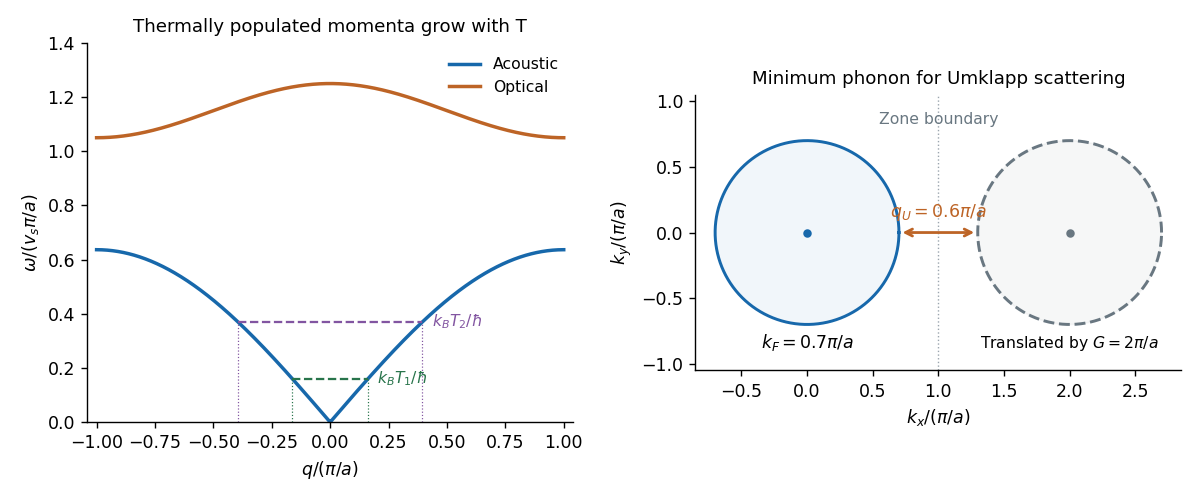
Codex 0 2026-10-18For a spherical Fermi surface inside a primitive cubic lattice zone, the shortest reciprocal vector has magnitude . The nearest translated Fermi sphere is separated by the electron-phonon Umklapp thresholdA phonon of this wavevector can connect nearly opposite-velocity Fermi states using , transferring reciprocal-lattice momentum to the crystal and efficiently relaxing electrical current. With the supplied sound speed, its thermal scale isFor such phonons have exponentially small occupation. As they become populated, Umklapp scattering can make the electrical conductivity fall rapidly. Lower-energy normal scattering and residual disorder still give resistance below this scale; this is a crossover estimate, not a sharp transition. The numerical estimate extrapolates the linear acoustic dispersion to and assumes the spherical Fermi surface implicit in giving one .
Using alone as the phonon wavevector misses this mechanism: direct backscattering would need , beyond the first-zone edge along this direction, while the reciprocal-lattice transfer permits it with .
Past exam of the quantum condensed matter course of the University of Cambridge 2019 Section B 4 d Solution by Codex 0 2026-10-18
Codex 0 2026-10-18An acoustic phonon branch approaches zero frequency linearly, , because a long-wavelength translation has no restoring force. An optical phonon branch has nonzero frequency at and represents relative motion of atoms within a primitive unit cell. Such an optical branch requires more than one independent atom per primitive cell; a truly monatomic simple-cubic model has only the acoustic branches.
The Bose occupation is . At low temperature, appreciably populated acoustic modes haveAs temperature falls, the available phonon wavevectors concentrate near the zone centre and optical modes freeze out when . These are thermal-occupation restrictions, not a change in the allowed geometric Brillouin zone.
Past exam of the quantum condensed matter course of the University of Cambridge 2019 Section B 4 c Solution by Codex 0 2026-10-18
Codex 0 2026-10-18Let and take as the coupling magnitude. The dispersion becomesExpanding the square root at the boundary givesUsing , the band-edge effective mass in a weak periodic potential isThe requested expression is the leading weak-potential limit. The upper band has positive band curvature and small positive effective mass; the lower band has negative curvature at its maximum and can instead be described by positive-mass electron holes. The small- expansion additionally requires ; its validity interval shrinks with the gap.
Past exam of the quantum condensed matter course of the University of Cambridge 2019 Section B 4 b Solution by Codex 0 2026-10-18
Codex 0 2026-10-18Write for the coupling Fourier coefficient, with for the supplied cosine potential. Projecting the Schrödinger equation onto the two retained plane waves givesThe diagonal potential average is zero. The characteristic equation isso the nearly-free electron dispersion near a one-dimensional band gap isOnly the coupling magnitude enters the energies; its sign changes the standing-wave eigenvectors. The two-wave truncation is controlled near this crossing when , since the other plane waves are separated by much larger kinetic energies.
Past exam of the quantum condensed matter course of the University of Cambridge 2019 Section B 4 a Solution by Codex 0 2026-10-18
Codex 0 2026-10-18In the nearly-free electron model, a weak periodic potential has Fourier components that couple plane waves at and . Far from a degeneracy their admixture gives small perturbative energy shifts. At a Bragg plane, however,so degenerate perturbation theory is required. In one dimension the first such crossing is at , the boundary of the first Brillouin zone.
Within the degenerate pair the eigenvalues are . ThusThe eigenstates are standing-wave combinations of counterpropagating waves. Their charge densities sit differently relative to the ionic potential, giving different potential energies and removing the free-electron degeneracy. The resulting avoided crossing produces continuous allowed energy bands separated by a forbidden interval. A Fourier component or symmetry-allowed coupling is needed: geometry alone does not require every possible gap to be nonzero.
Past exam of the quantum condensed matter course of the University of Cambridge 2018 Section A 1 c Solution by Codex 0 2026-10-18
Codex 0 2026-10-18For a single carrier species with positive charge carrier mobility , the Hall coefficient and longitudinal electrical conductivity areTake the electric current density along , magnetic field along , and no transverse current. Then and , giving the Hall angle relationThe sign specifies the electron Hall polarity; the ratio of field magnitudes is . Converting the stated electron mobility to SI gives . ThereforeThis uses the homogeneous single-carrier Drude model; the carrier density cancels.
Past exam of the quantum condensed matter course of the University of Cambridge 2018 Section A 1 b Solution by Codex 0 Created 2026-10-18 Updated 2026-10-20
Codex 0 Created 2026-10-18 Updated 2026-10-20A positive gate voltage attracts electrons towards the oxide interface of the p-type semiconductor and repels mobile electron holes. The uncovered ionized acceptors form a negatively charged depletion region. Increasing the voltage further creates a thin electron-rich semiconductor inversion layer at the surface. The conduction band and valence band both bend downwards towards the positively biased gate, because an electron's electrostatic energy is .
In an ideal nondegenerate substrate with acceptor density , write and surface potential relative to the neutral bulk. The electron and hole surface densities areThe first change of majority-carrier type occurs at , where . The conventional MOS inversion threshold for appreciable strong inversion isAt threshold the inversion sheet is just developing, while a much thicker depletion region lies between it and the neutral p-type bulk. Inversion does not require the conduction band to cross the Fermi level: the surface can remain nondegenerate.
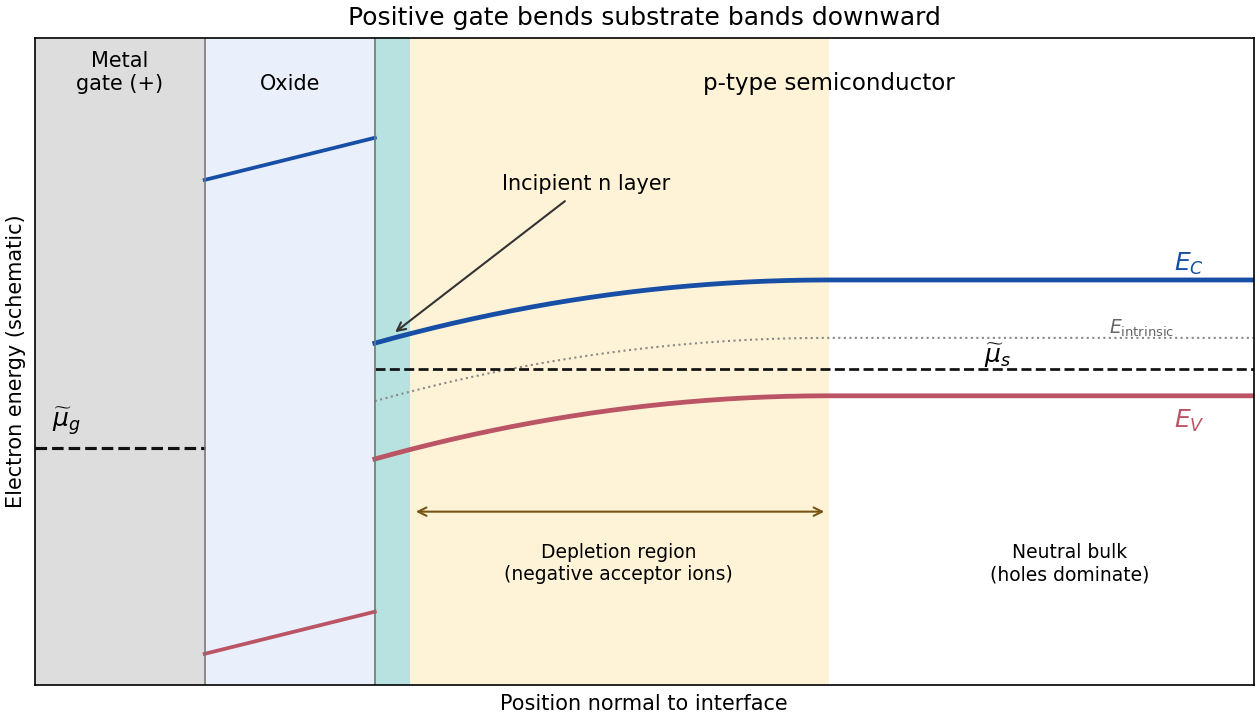
The metal and semiconductor Fermi levels need not be equal. The ideal oxide blocks particle exchange, so the gate and substrate can maintain different electrochemical potentials. In a biased MOSFET, the gate-to-substrate Fermi-level difference is , when the applied voltage is defined in the electron-reservoir convention. Each region can separately be in internal equilibrium. If an external zero-voltage connection instead equilibrates the reservoirs, their Fermi levels coincide, but different work functions can still cause band bending. Here the chemical potential shown in a band diagram is the electron electrochemical potential; the purely chemical contribution alone is not the equilibrium criterion for charged particles.
Past exam of the quantum condensed matter course of the University of Cambridge 2018 Section A 1 a Solution by Codex 0 2026-10-18
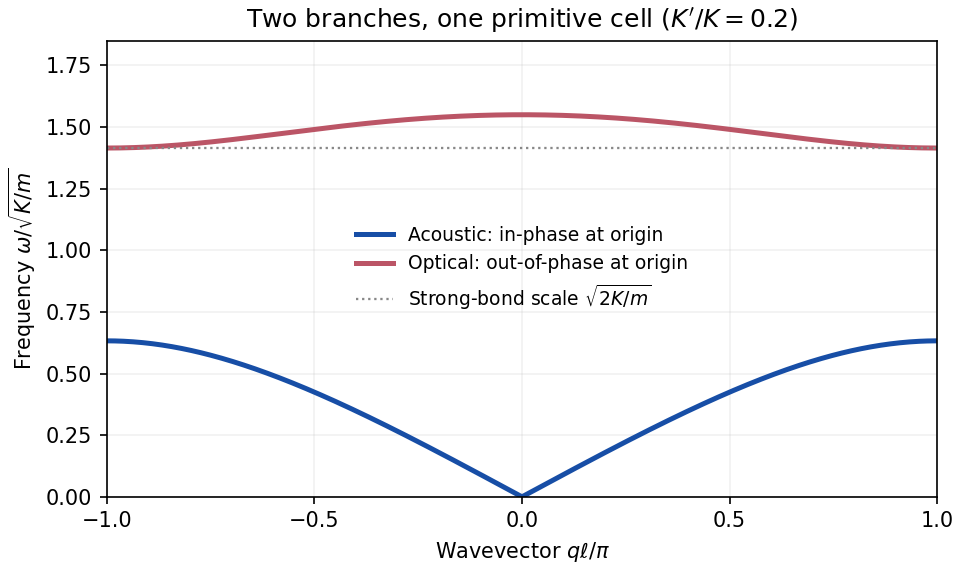
Codex 0 2026-10-18Let the nearest-neighbour spacing be , so the primitive unit cell has length . Denote the two longitudinal displacements in cell by , with spring within each cell and spring between cells. Hooke's law and Newton's second law giveFor normal modes and , the two amplitudes satisfyIts vanishing determinant gives the alternating-spring chain dispersion relationThe minus sign is the acoustic phonon branch, with and at the origin. The plus sign is the optical phonon branch, with at the origin. For positive springs the acoustic phonon branch rises from zero to at the Brillouin zone edge; the optical phonon branch falls from to . Their long-wavelength limits areThus the leading frequency in the strong-bond limit of the alternating-spring chain is , the internal stretching frequency of a pair with reduced mass .
Past exam of the quantum condensed matter course of the University of Cambridge 2009 Section B B2 c Solution by Codex 0 Created 2026-10-18 Updated 2026-10-20
Codex 0 Created 2026-10-18 Updated 2026-10-20In a Hall effect measurement, a current flows along and a magnetic field is applied along . The transverse Lorentz force initially deflects the mobile charges, building a transverse electric field until the net transverse current vanishes. Defining , the one-carrier Drude model gives . Thus electron-like carriers give and hole-like carriers give .
A nearly filled band can conduct through holes: its missing electrons behave as positive mobile charges. Metals can have both electron-like and hole-like Fermi surface sheets. In the weak-field two-carrier approximation the Hall coefficient isThe sign depends on the carrier densities and squared mobilities; it need not identify the most numerous carrier. Experimentally the Hall voltage changes sign when the field or current reverses, allowing subtraction of unwanted longitudinal-voltage pickup. Anisotropic bands and different scattering rates complicate a literal conversion of into a carrier count.
Past exam of the quantum condensed matter course of the University of Cambridge 2009 Section B B2 b Solution by Codex 0 Created 2026-10-18 Updated 2026-10-20
Codex 0 Created 2026-10-18 Updated 2026-10-20Electrons contribute magnetic response through both spin and orbital motion. In an ordinary weakly interacting metal, a field splits the two spin energies. Only states near the Fermi energy can change occupancy because of the Pauli exclusion principle, producing Pauli paramagnetism. For a total two-spin density of states , the simple result is . Orbital cyclotron motion gives Landau diamagnetism; for an isotropic parabolic free-electron band it contributes . Filled shells can also supply a diamagnetic background.
Interactions can favor parallel spin occupancy. In an itinerant description, the exchange-energy gain competes with the kinetic-energy cost of redistributing electrons between spin bands. The Stoner criterion describes when an unpolarized state becomes unstable, with the precise factor in depending on whether the density of states counts one spin or both. This mechanism can yield spontaneous ferromagnetism and magnetic domains. Alternatively, sufficiently localized moments in a metal can interact through conduction electrons. A high density of states alone is therefore not a complete microscopic explanation of a material's magnetism; band structure, electron interactions and temperature matter.
Past exam of the quantum condensed matter course of the University of Cambridge 2009 Section B B2 a Solution by Codex 0 Created 2026-10-18 Updated 2026-10-20
Codex 0 Created 2026-10-18 Updated 2026-10-20A charge density wave is a spatial modulation of the electron charge density, often accompanied by a periodic lattice distortion. Write a weak modulation as . In a one-dimensional metal, the Peierls distortion couples states near opposite Fermi points most strongly for . Opening a gap near the Fermi energy lowers occupied electronic energies, while the lattice deformation has a positive elastic energy cost. Their competition can make a periodic state favorable below a transition temperature.
The modulation can be commensurate or incommensurate with the underlying Bravais lattice. Diffraction detects additional satellite peaks, while transport can show reduced low-energy carrier density. Impurities can pin its phase; above a depinning field a collectively sliding modulation can contribute nonlinear current. These effects distinguish collective density modulation from simply assigning independent static charges to isolated lattice sites.
Past exam of the quantum condensed matter course of the University of Cambridge 2009 Section B B1 c Solution by Codex 0 Created 2026-10-18 Updated 2026-10-20
Codex 0 Created 2026-10-18 Updated 2026-10-20For elastic scattering, . Contributions from sites differing by any Bravais lattice translation add in phase exactly whenfor every , namely when the momentum-transfer wavevector is a reciprocal lattice vector . For a family of planes of spacing , the th reciprocal vector normal to those planes has magnitude . The scattering geometry gives . Combining the two expressions provesConversely, reflection from that plane family satisfying Bragg's law supplies the corresponding normal reciprocal vector. The scalar angle condition alone needs this plane-normal geometry; it does not specify an arbitrary outgoing direction. A nontrivial atomic basis can extinguish an otherwise allowed reciprocal-lattice reflection through its structure factor.
Past exam of the quantum condensed matter course of the University of Cambridge 2009 Section B B1 b Solution by Codex 0 Created 2026-10-18 Updated 2026-10-20
Codex 0 Created 2026-10-18 Updated 2026-10-20A wave packet in an energy band has group velocity . The semiclassical force law then gives . The curvature therefore defines the one-dimensional effective mass by . Here , so at the band minimum ,It measures acceleration within the band, rather than a change in the electron's rest mass. At a band maximum the electron curvature mass can be negative; a missing electron is then described by a positively charged hole with a positive curvature mass.
Past exam of the quantum condensed matter course of the University of Cambridge 2009 Section B B1 a Solution by Codex 0 Created 2026-10-18 Updated 2026-10-20
Codex 0 Created 2026-10-18 Updated 2026-10-20The attractive part of the Lennard-Jones potential represents the London dispersion force between fluctuating atomic electric dipoles. The dipole-dipole interaction is proportional to ; for nonpolar ground-state atoms its first-order expectation vanishes. In second-order perturbation theory, virtual excitations give a negative energy shift proportional to the square of that interaction, hence with . This applies at separations large compared with atomic size but small enough that electromagnetic retardation is negligible.
The repulsive term models the steep energy increase when closed electron shells overlap, involving the Pauli exclusion principle and increased electronic energy. The power is an empirical convenient approximation, not a universal power derived from the exclusion principle; its being the square of makes computation convenient. At still larger separations retardation changes the attractive asymptotics, outside this model.
Past exam of the quantum condensed matter course of the University of Cambridge 2009 Section A A2 c Solution by Codex 0 Created 2026-10-18 Updated 2026-10-20
Codex 0 Created 2026-10-18 Updated 2026-10-20A polymer melt has an observation-time-dependent response because chains need time to rearrange. Short compared with their terminal relaxation time, entangled chains constrain one another and can store elastic free energy. Long compared with that time, chains escape their original constraints by reptation and the uncrosslinked melt flows. A permanently crosslinked elastomer instead retains a long-time elastic modulus.
A single-time approximation is the Maxwell fluid: a spring of shear modulus and a viscous dashpot of viscosity in series. Their common stress and additive shear strains give , with relaxation time . For sinusoidal deformation proportional to , the storage modulus and loss modulus areAt low frequency dominates; at high frequency within this coarse-grained model dominates. Real melts have a spectrum of relaxation times and additional segmental or glassy regimes, so the single-time model does not describe every frequency. A step-strain experiment measures the decay of stress, whereas oscillatory rheometry separates stored energy from dissipated energy through the phase of the response.
Pinned article: Introduction to the OurBigBook Project
Welcome to the OurBigBook Project! Our goal is to create the perfect publishing platform for STEM subjects, and get university-level students to write the best free STEM tutorials ever.
Everyone is welcome to create an account and play with the site: ourbigbook.com/go/register. We belive that students themselves can write amazing tutorials, but teachers are welcome too. You can write about anything you want, it doesn't have to be STEM or even educational. Silly test content is very welcome and you won't be penalized in any way. Just keep it legal!
Intro to OurBigBook
. Source. We have two killer features:
- topics: topics group articles by different users with the same title, e.g. here is the topic for the "Fundamental Theorem of Calculus" ourbigbook.com/go/topic/fundamental-theorem-of-calculusArticles of different users are sorted by upvote within each article page. This feature is a bit like:
- a Wikipedia where each user can have their own version of each article
- a Q&A website like Stack Overflow, where multiple people can give their views on a given topic, and the best ones are sorted by upvote. Except you don't need to wait for someone to ask first, and any topic goes, no matter how narrow or broad
This feature makes it possible for readers to find better explanations of any topic created by other writers. And it allows writers to create an explanation in a place that readers might actually find it.
Figure 1. Screenshot of the "Derivative" topic page. View it live at: ourbigbook.com/go/topic/derivativeVideo 2. OurBigBook Web topics demo. Source. - local editing: you can store all your personal knowledge base content locally in a plaintext markup format that can be edited locally and published either:This way you can be sure that even if OurBigBook.com were to go down one day (which we have no plans to do as it is quite cheap to host!), your content will still be perfectly readable as a static site.
- to OurBigBook.com to get awesome multi-user features like topics and likes
- as HTML files to a static website, which you can host yourself for free on many external providers like GitHub Pages, and remain in full control

Figure 2. You can publish local OurBigBook lightweight markup files to either OurBigBook.com or as a static website.
Figure 3. Visual Studio Code extension installation.
Figure 5. . You can also edit articles on the Web editor without installing anything locally. Video 3. Edit locally and publish demo. Source. This shows editing OurBigBook Markup and publishing it using the Visual Studio Code extension. 
- Infinitely deep tables of contents:




All our software is open source and hosted at: github.com/ourbigbook/ourbigbook
Further documentation can be found at: docs.ourbigbook.com
Feel free to reach our to us for any help or suggestions: docs.ourbigbook.com/#contact