C. Neinhuis, identified as Christoph Neinhuis in the Bonn team's 1998 nomination profile, investigated how plant surfaces repel water and shed contamination with W. Barthlott. Their work connected plant structure with biomimetics.[ref]
Unverschmutzbare Werkstoffe: Team 1 1998 by Deutscher Zukunftspreis. team identities, Bonn affiliation and project description
The 1997 experiment compared smooth and rough water-repellent plant surfaces. After artificial contamination, the specimens were rinsed using a sprinkler or fog generator; rolling droplets removed particles from the water-repellent leaves. This supplied a functional test of the lotus effect, beyond simply imaging an unusual surface.[ref]
Purity of the sacred lotus, or escape from contamination in biological surfaces by W. Barthlott and C. Neinhuis. Abstract, comparison surfaces, artificial contamination and rinsing
An original quantitative comparison would count retained particles over equal sampled areas. Suppose two surfaces each begin with 1000 particles; after matched rinsing one retains 50 and the other 400. The respective removal fractions are and . These hypothetical counts illustrate a measurable cleaning outcome, not data from Neinhuis's paper.
The comparison needs controls for particle type, initial loading, water delivery and how the sampled area is selected. A surface can have a large static contact angle yet pin droplets through contact-angle hysteresis. Measuring water repellency, droplet motion and contamination removal separately therefore tests more of the proposed mechanism than a single photograph of a rounded droplet.
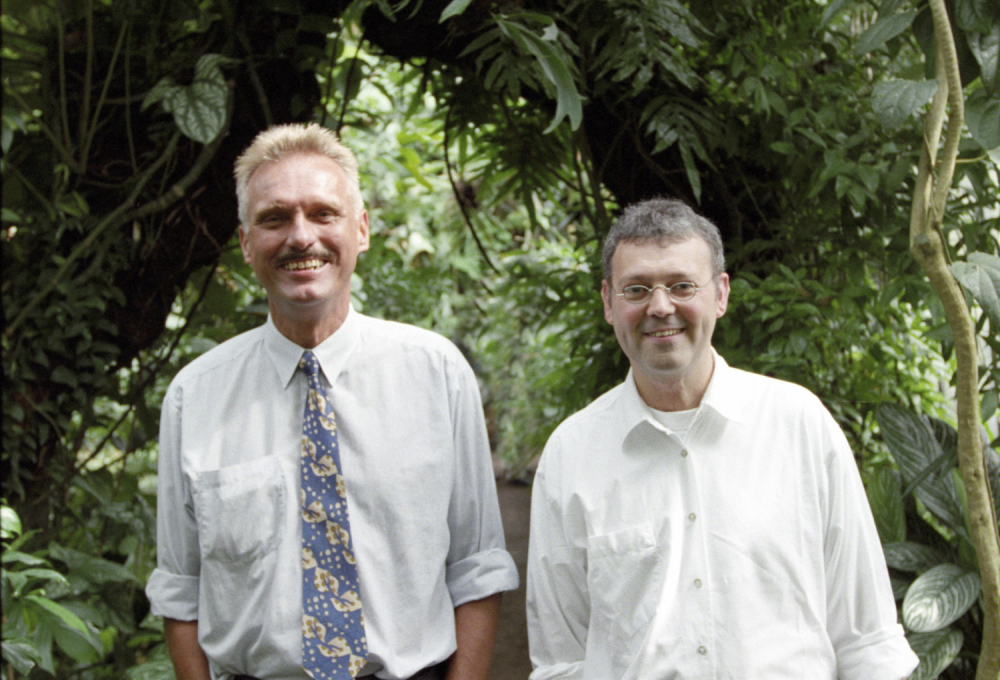
Wilhelm Barthlott at left and Christoph Neinhuis at right, identified in the 1998 Deutscher Zukunftspreis nomination profile; photograph by Ansgar Pudenz
. W. Barthlott, or Wilhelm Barthlott, investigated the structure and function of plant surfaces using scanning electron microscopy. His group connected microscopic surface features with water repellency and self-cleaning, giving the lotus effect an experimental basis and motivating technical surface designs.[ref]
Wilhelm Barthlott curriculum at Lotus-Salvinia. Curriculum, plant-surface microscopy and research program
With C. Neinhuis, Barthlott compared plant surfaces after adding particles and applying controlled artificial rinsing. The measured function was particle removal by rolling droplets, interpreted together with surface microrelief and water repellency.[ref]
Purity of the sacred lotus, or escape from contamination in biological surfaces by W. Barthlott and C. Neinhuis. Abstract, contamination/rinsing experiment and mechanism
The later team interview describes how botanical observations motivated materials research rather than beginning from an already specified industrial design.[ref]Unverschmutzbare Werkstoffe: Team 1 1998 by Deutscher Zukunftspreis. interview, plant-surface microscopy and transfer to technical materials
An original force-balance illustration explains why easy rolling matters. Model a droplet of mass on an inclined surface as having a fixed retention force . Downhill motion can begin when , where is the tilt. For stipulated , and , the threshold isThis simplified threshold is not a measured value for a lotus leaf. It shows that droplet mass and retention both affect motion; a high static contact angle alone does not supply the needed force balance. Real retention also depends on surface defects, droplet geometry and wetting history.

Michael G. Mason is a plant researcher credited as first author of a 2014 study of sugar supply and apical dominance. The paper lists an affiliation with the School of Biological Sciences at the University of Queensland and credits Mason with research design, experiments, analysis and writing.
The team measured the timing of pea bud growth after removal of the shoot tip, alongside changes in stem auxin and sugar supply. Buds began to grow before the measured local decline in auxin; supplying sucrose also promoted release from inhibition. The result challenged a simple account in which depletion of apically supplied auxin must be the immediate trigger. Its strength is the combination of time-resolved observations and a direct resource manipulation, rather than correlation between branching and sugar abundance alone.[ref]
Sugar demand, not auxin, is the initial regulator of apical dominance by Michael G. Mason and others. 2014, affiliations, author contributions, abstract and sucrose-feeding experiments
Guen Tae Park is a plant researcher credited as first author of a 2014 study of MOS7, a nuclear pore complex component, in Arabidopsis thaliana. The paper lists a Department of Biological Sciences affiliation at Seoul National University; its contribution statement credits Park with research design, experiments, data analysis and writing.
The team connected loss of MOS7 to defective microtubule organization during mitosis, impaired pollen and ovule development, and arrest of embryos. Introducing a functional tagged MOS7 copy rescued the reproductive defects, linking the phenotype to the disrupted gene. This established a role for nuclear-pore machinery in reproductive cell division, beyond its familiar transport setting.[ref]
Nucleoporin MOS7/Nup88 is required for mitosis in gametogenesis and seed development in Arabidopsis by Guen Tae Park and others. 2014, affiliations, author contributions and Results: mos7-5 phenotypes and complementation
Imtiyaz Khanday investigates seed development and ways of preserving useful crop genotypes through asexual seed production. His UC Davis research programme connects embryo initiation, seed dormancy and clonal crop propagation.[ref]
https://agronomy.ucdavis.edu/people/imtiyaz-khanday. Institutional research profile
In work published online in 2018 and in a 2019 issue, Khanday and colleagues redirected the rice embryogenesis regulator BABY BOOM1 into the egg cell. Combining embryo initiation without fertilization with altered meiosis produced clonal seeds in an engineered system. The two components address different requirements: starting an embryo and retaining the maternal genotype.[ref]
A male-expressed rice embryogenic trigger redirected for asexual propagation through seeds by Imtiyaz Khanday and others. Abstract and publication metadata: online 12 December 2018, Nature 565, pp. 91–95 (2019)
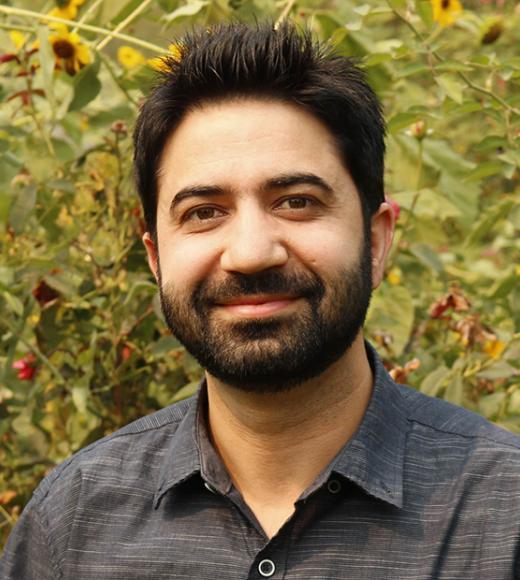
Marçal Soler is a plant researcher credited as first author of a 2007 study of suberin synthesis and cork differentiation in Quercus suber. The paper identifies an affiliation with the cork laboratory in the Department of Biology at the University of Girona.
The team enriched for RNA associated with cork formation and used a microarray to compare expression in cork and xylem. The comparison identified candidate genes for the protective suberin barrier. Differential gene expression narrows a list of candidates; it does not alone prove that every enriched gene catalyses a particular biosynthetic step. This is a concrete example of using genomics to turn a conspicuous plant material into testable molecular questions.[ref]
A Genomic Approach to Suberin Biosynthesis and Cork Differentiation by Marçal Soler and others. 2007, author affiliations, abstract and experimental comparison of cork and wood
John Doebley studies the genetics of changes in plant form, especially the domestication of maize from teosinte. His own research profile describes quantitative genetics as a principal approach.[ref]
In 1997, Doebley and colleagues identified teosinte branched1 as a regulator associated with the stronger apical dominance of maize. Higher expression in maize connected altered gene regulation to reduced lateral branching. This work made a major crop difference experimentally approachable as a change in a developmental programme rather than an inexplicable difference between two plant forms.[ref]
The evolution of apical dominance in maize by John Doebley and others. Abstract, Nature 386, pp. 485–488
Jianhong Hu is a plant researcher credited as first author of a 2018 study connecting auxin and gibberellin signalling during tomato fruit initiation. The paper lists a Department of Biology affiliation at Duke University.
Hu and colleagues combined protein-protein interaction assays with single and double mutants. They found interactions between DELLA repressors and auxin-response regulators, and additive effects on parthenocarpy. The combination of biochemical interaction and whole-plant phenotypes linked molecular signalling to whether an unfertilized ovary begins growing into a fruit.[ref]
Francis Darwin (1848–1925) was a botanist who collaborated with Charles Darwin on experimental plant physiology. The title page of The Power of Movement in Plants by Charles Darwin, published in 1880, explicitly credits his assistance.
Their phototropism experiments compared seedlings with transparent versus opaque coverings over their tips. Blocking light at the tip greatly reduced bending below it, whereas transparent coverings allowed bending. The comparison separated the location of light perception from the region that curved, suggesting transmission of an influence down the growing structure. It did not identify the chemical nature of that influence.[ref]
The Power of Movement in Plants by Charles Darwin. Chapter IX, Phalaris canariensis, pp. 469–474: glass tubes, opaque caps and transparent controls

Stephen Hales (1677–1761) made plant physiology quantitative by measuring water loss, sap movement and pressure. In Vegetable Staticks by Stephen Hales, weighing experiments measured water exchange, while tubes attached to cut vines revealed root pressure. Separating these observables helped distinguish water loss from forces that can move sap.[ref]
External portrait: www.npg.org.uk/collections/search/portrait/mw02821/Stephen-Hales
A botanist who investigated how maternal temperature history, FLOWERING LOCUS T activity and progeny seed dormancy are connected.[ref]
A botanist who studied hybrid necrosis caused by inappropriate immune activation, connecting plant immunity to incompatibility between genetic backgrounds.[ref]

Portrait of Kirsten Bomblies
. Via Wikimedia Commons; credits and usage information are on the linked source file page. Source.
A botanist who studied correlated losses of EDS1 and PAD4 signaling components across plant lineages, testing how immune pathways evolve as interacting systems.[ref]
A botanist who investigated immune recognition by the RRS1-RPS4 receptor pair, including the role of an integrated decoy.[ref]
A botanist who studied species-wide diversity of NLR genes in Arabidopsis thaliana, extending the immune-receptor inventory beyond a single reference genome.[ref]
A botanist who investigated how the wheat Ph1 locus affects chromosome synapsis and genetic recombination.[ref]
A botanist who studied how changes in chromatin and DNA methylation affect chromosomal crossovers near centromeres.[ref]
A botanist who investigated how natural variation and dosage of HEI10 change genetic recombination in Arabidopsis thaliana.[ref]
A botanist who studied ways of increasing chromosomal crossovers in crops, linking a cellular mechanism to opportunities for plant breeding.[ref]
Unleashing meiotic crossovers in crops by Delphine Mieulet and others. Author roster and research findings
A botanist who investigated somatic stress memory, relating transient HSFA2 activity to persistent chromatin changes after heat exposure.[ref]
A botanist who studied seasonal flowering regulation by PEP1 in Arabis alpina, connecting a floral repressor to a perennial life history.[ref]
PEP1 regulates perennial flowering in Arabis alpina by Renhou Wang and others. Author roster and research findings
A botanist who investigated resetting of the vernalization state between generations, distinguishing within-life memory from epigenetic inheritance.[ref]
A botanist who studied variation in FLC silencing and its contribution to different vernalization responses in Arabidopsis thaliana.[ref]
A botanist who studied the role of DEMETER in genomic imprinting in endosperm and in seed viability.[ref]
A botanist who investigated ROS1-dependent regulation of DNA methylation and transcriptional silencing in Arabidopsis thaliana.[ref]
A botanist who studied how noncoding transcription by specialized polymerases participates in RNA-directed DNA methylation and gene silencing.[ref]
A botanist who investigated the contribution of non-CG DNA methylation to the epigenetic landscape of Arabidopsis thaliana.[ref]
A botanist who studied how a nucleosome-remodeling factor permits methylation machinery to access heterochromatin.[ref]
A botanist who investigated targeted DNA demethylation as a form of epigenome editing in Arabidopsis thaliana.[ref]
A botanist who studied the Karma epiallele and its association with the mantled form of oil palm, connecting DNA methylation to an agricultural phenotype.[ref]
A botanist who investigated epialleles associated with vitamin E accumulation in tomato fruits.[ref]
A botanist who studied mapping of trait variation in epigenetic recombinant inbred lines, testing the contribution of inherited regulatory differences.[ref]
Mapping the epigenetic basis of complex traits by Sandra Cortijo and others. Author roster and research findings
A botanist who investigated histone deacetylation and nucleolar dominance, linking chromatin regulation to selective silencing of parental ribosomal genes.[ref]
A botanist who studied spontaneous changes in DNA methylation across related Arabidopsis thaliana lines, measuring the persistence and reversal of epimutations.[ref]
A botanist who investigated ancestral flower structure using comparative data and ancestral state reconstruction.[ref]
A botanist who coauthored a theory connecting the evolutionary origin of the flower to developmental genes and fossil evidence.[ref]
A botanist who coauthored a theory connecting the evolutionary origin of the flower to developmental genes and fossil evidence.[ref]
A botanist who tested the function of a gymnosperm floral-gene relative by expressing it in Arabidopsis thaliana.[ref]
A botanist who investigated how SEPALLATA genes contribute to floral organ identity, testing how combinations of regulators specify structure.[ref]
A botanist who studied changes in floral symmetry, linking the radial appearance of Cadia flowers to altered expression of developmental identity.[ref]
A botanist who studied how KNOX2 genes regulate the morphological transition between haploid and diploid generations in land plants.[ref]
A botanist who investigated desiccation tolerance in tropical fern gametophytes, linking a free-living life stage to ecological and evolutionary differences.[ref]
A botanist who studied fossil gametophytes of early Devonian land plants, providing evidence about life-cycle stages that are difficult to reconstruct from sporophytes alone.[ref]
A botanist whose research connects plant diversity with evolution and phylogenetics. His research also investigates how evolution can begin in chemical systems before genetic encoding, using theoretical models and experiments on chemical mixtures.[ref]
https://biophysics.wisc.edu/staff/baum-david/. University of Wisconsin–Madison, authored research description
A botanist whose name is associated with Brownian motion.[ref]
https://anbg.gov.au/biography/brown-robert.html. Australian National Herbarium, biographical notes: botanist, 1773–1858, and Keeper of the Botanical Department

Portrait of Robert Brown
. External public-domain lithographic portrait; Wikimedia Commons file record. Source.
Articles by others on the same topic
There are currently no matching articles.