Topics (374k) Articles (387k) Users (410) Discussions (242) Comments (383) Files (13k) New article

For a sphere partially below a planar melting isotherm, write and depth . Local premelting gives film thickness . Conservation in the thin spherical film gives flux and pressure . Integrating vertical repulsive and hydraulic stresses over the wetted cap yields the displayed speed. The unknown thermodynamic constant cancels, but a narrow rim where the film ceases to be thin is excluded from the leading approximation.
If and the state is the in-vacuum, put and . The canonical commutation relations give . Acting with on the vacuum produces and a two-particle vector whose squared norm is , because its two possible vacuum contractions have equal contributions. This proves the displayed second moment and . A thermal-mode formula requires ; a general squeezed vacuum state need not satisfy that restriction.
An axisymmetric gravity-current box model with no entrainment and negligible suspended-particle volume loss has constant bulk volume , uniform height , and uniform particle volume fraction . For an absorbing horizontal bed and downward settling velocity , particle mass conservation gives . A constant front Froude number closes spreading by , where is buoyancy per unit volume fraction. This model describes the mixed bulk and its head closure, not the initial inertial blast or a resolved head shape.
With reduced gravity and settling velocity , a mixed rectangular-channel current obeys , , , where . The characteristic speeds are , with . Along the latter curves,The density differential matters: are Riemann invariants only when the reduced gravity is constant without deposition.
A steady well-mixed dilute particle-laden gravity current above an absorbing porous bed loses carrier fluid at speed and particles at total downward speed , where is their relative settling velocity magnitude. Volume conservation and the particle budget give and for . The momentum conservation equation is if the withdrawn fluid carries its local horizontal velocity. Consequently . At , and the momentum flux is constant.
The quantifier-free type of a tuple records all atomic and negated atomic formulas it satisfies, equivalently all quantifier-free formulas. Equal such types identify the generated substructures by sending each term value at one tuple to the value of the same term at the other tuple. Equality formulas make this correspondence well defined, and the relational formulas make it an isomorphism.
Define away from the origin and zero at the origin. Both partial derivatives exist everywhere and are zero at the origin, yet along the function is , so it is not continuous there. Coordinate-axis derivative tests do not control all neighboring directions.
At nonzero along-field wavenumber, put , and . After pressure minimization the energy density completes to . Choosing the square to vanish and then taking a sufficiently small nonzero gives negative energy exactly when the displayed strict criterion holds somewhere. A fixed prescribed wavenumber retains the stabilizing tension term; the criterion asserts existence of an allowed nonzero wavenumber. The associated along-field displacement lets material drain while magnetic flux bends.
From a point light source , a caster point projects onto a receiving surface along the displayed ray. On a regular transverse branch, differentiating gives . Newton method correction and certified patch/curve bounds support continuation and isolation of all visible branches. If the shadow's second derivative is bounded by on an interval of width , its chord error is at most . A fixed sample grid can miss entire shadow components; surface boundaries, occlusion changes and grazing rays require explicit treatment.
Intersecting a parametric curve with a plane reduces to isolating zeros of a scalar function. A certified range for rejects intervals that do not contain zero. On an interval whose derivative range excludes zero, a sign-changing endpoint bracket gives exactly one root, which bisection method or a safeguarded Newton root-finding iteration refines. Other intervals are subdivided conservatively; tangencies and coplanar pieces need multiplicity or identity tests supported by the representation. An unresolved small interval is a possible contact, not a proof of an intersection. With finitely many transverse intersections and convergent enclosures, isolation terminates to any prescribed tolerance.
For , a jointly Gaussian colored medium has covariance . Averaging the equation gives a term ; the Furutsu–Novikov formula expresses it through the random propagator and the functional derivative of . It does not generally close in the mean field alone. A phase-screen product followed by Gaussian averaging gives a formal exact mean propagator, with factor for each transverse path. In the longitudinal white-noise limit the covariance collapses to equal slices, and the mean closes as .
For with a self-adjoint transverse differential operator , differentiating the squared L2 norm gives . Reality of the refractive coefficient and vanishing transverse boundary flux are required. This is exact for the scalar envelope model. Its physical interpretation as leading paraxial power uses a fixed reference impedance; a varying local impedance or a longitudinal electromagnetic polarization requires a consistent Maxwell calculation and cannot be inferred from this invariant alone.
A parabolic wave equation driven by longitudinal Gaussian white noise with transverse covariance kernel has the displayed closed mutual coherence equation. The noise is the derivative of a longitudinal Brownian field with transverse covariance; the physical smooth-noise limit uses the Stratonovich integral. Conversion to the Itô integral supplies the attenuation drift and the cross variation supplies the term. For unit plane-wave incidence and transverse statistical homogeneity, . General Gaussian colored media do not have this local closure.
The free parabolic wave equation multiplies each transverse Fourier mode by , of unit modulus. A statistically stationary input therefore keeps its uncentered spectral measure and mean intensity. A pure phase screen of unit incident amplitude has total mean intensity one even when its coherent intensity is smaller. This statement does not require a Gaussian joint phase distribution; second-order stationarity and free paraxial propagation suffice.
For , the disc corresponds under to . The transformed map is , so . Thus and there. The Fatou component containing the disc has locally uniformly by normality and the identity theorem. It is forward invariant. The point in the disc has the entire fiber , so the Fatou component containing an entire fiber is completely invariant criterion gives . Zero itself is a Julia point: a normal subsequential limit near zero would be zero by the disc limit, but every iterate has derivative one at zero, contradicting derivative convergence.
For positive integer severities with probability mass function and independent count in the Panjer claim-count class, the aggregate probability mass function starts at and satisfies the displayed recurrence. If are the count, severity and aggregate probability generating functions, respectively, then and . Equating the coefficient of gives . The positivity assumption excludes zero severities; otherwise the initial value and recursion denominator change.
Let be independent fair bits, and let be their exclusive or: precisely when . The four possible triples are , each with probability . Each coordinate is a fair bit. Writing out all eight patterns givesEvery pair has all four cells with probability :For , the four allowed triples project to ; for they project to . Each projection lists each pair exactly once, proving pairwise independence. But differs from the product , so the three are not independent random variables. Indeed, any two determine the third. A single coordinate reveals nothing about another, while two coordinates together reveal it completely.
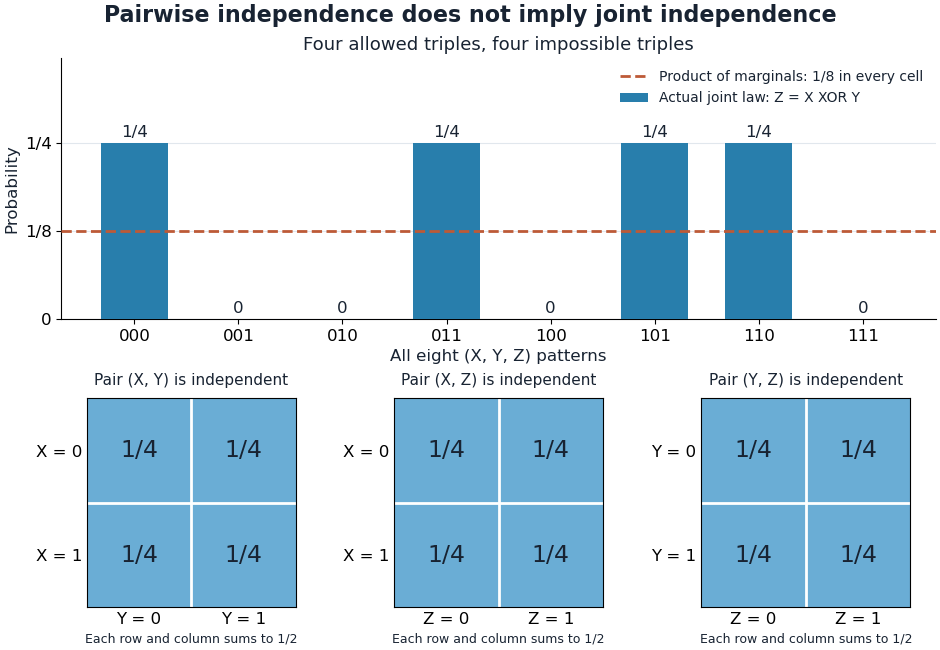
The XOR example hides joint dependence from every pairwise probability table
. The bars show all eight triple patterns against the reference for three independent fair bits. Below, all three pairwise joint probability mass functions have four equal cells of . Details.The exclusive or example is the complementary-bit version of the two-toss exercise in Grinstead and Snell, Introduction to Probability, section 4.1, exercise 7, printed page 151. It is a compact reason to check the full product rule whenever a calculation uses three-way or higher events.
A Y-piece is a compact curvature- hyperbolic surface homeomorphic to a pair of pants, with three geodesic boundary curves. Its labelled boundary lengths determine it up to isometry. Cutting along the three mutually perpendicular seams produces two congruent right-angled hyperbolic hexagons with alternating sides . Conversely, doubling the hexagon along its other three sides constructs the Y-piece for arbitrary positive lengths.
For a steady accretion disk with arbitrary rotation law and a zero-torque inner boundary condition at , the outward viscous torque in an accretion disk is . The dissipation per unit planar area summed over both disk faces is . Integrating gives in the Paczyński-Wiita potential. The radiative flux from one face is , preventing a factor-of-two error in the luminosity.
The limiting inward departure from the marginal Paczyński-Wiita circular orbit at conserves the displayed specific angular momentum and specific orbital energy. In the Paczyński-Wiita potential, its inward speed satisfies . The exactly marginal circular orbit does not depart without a perturbation; the formula describes the separatrix limit of inward releases.
Pinned article: Introduction to the OurBigBook Project
Welcome to the OurBigBook Project! Our goal is to create the perfect publishing platform for STEM subjects, and get university-level students to write the best free STEM tutorials ever.
Everyone is welcome to create an account and play with the site: ourbigbook.com/go/register. We belive that students themselves can write amazing tutorials, but teachers are welcome too. You can write about anything you want, it doesn't have to be STEM or even educational. Silly test content is very welcome and you won't be penalized in any way. Just keep it legal!
Intro to OurBigBook
. Source. We have two killer features:
- topics: topics group articles by different users with the same title, e.g. here is the topic for the "Fundamental Theorem of Calculus" ourbigbook.com/go/topic/fundamental-theorem-of-calculusArticles of different users are sorted by upvote within each article page. This feature is a bit like:
- a Wikipedia where each user can have their own version of each article
- a Q&A website like Stack Overflow, where multiple people can give their views on a given topic, and the best ones are sorted by upvote. Except you don't need to wait for someone to ask first, and any topic goes, no matter how narrow or broad
This feature makes it possible for readers to find better explanations of any topic created by other writers. And it allows writers to create an explanation in a place that readers might actually find it.
Figure 1. Screenshot of the "Derivative" topic page. View it live at: ourbigbook.com/go/topic/derivativeVideo 2. OurBigBook Web topics demo. Source. - local editing: you can store all your personal knowledge base content locally in a plaintext markup format that can be edited locally and published either:This way you can be sure that even if OurBigBook.com were to go down one day (which we have no plans to do as it is quite cheap to host!), your content will still be perfectly readable as a static site.
- to OurBigBook.com to get awesome multi-user features like topics and likes
- as HTML files to a static website, which you can host yourself for free on many external providers like GitHub Pages, and remain in full control

Figure 2. You can publish local OurBigBook lightweight markup files to either OurBigBook.com or as a static website.
Figure 3. Visual Studio Code extension installation.
Figure 5. . You can also edit articles on the Web editor without installing anything locally. Video 3. Edit locally and publish demo. Source. This shows editing OurBigBook Markup and publishing it using the Visual Studio Code extension. 
- Infinitely deep tables of contents:



All our software is open source and hosted at: github.com/ourbigbook/ourbigbook
Further documentation can be found at: docs.ourbigbook.com
Feel free to reach our to us for any help or suggestions: docs.ourbigbook.com/#contact