Topics (384k) Articles (398k) Users (410) Discussions (242) Comments (383) Files (13k) New article
The locus of midpoints between the two sides of a spectral-line profile at equal intensities. Variations with depth or time diagnose changes in line asymmetry; a null result has finite sensitivity.
In the absence of additional dephasing, a transition whose excited-state population has lifetime has a field-coherence decay time . Its Lorentzian line shape has angular-frequency half-width and full width . Population decay time, amplitude decay time and linewidth conventions must therefore be distinguished. Extra dephasing shortens the optical coherence time without necessarily changing the population lifetime.
The electron single-particle spectral function , in a convention normalized to unit energy integral per orbital and spin, describes addition and removal energies. For the fermionic retarded Green function, , energy is referenced to the chemical potential. The occupied removal spectrum is , with Fermi-Dirac distribution . In the noninteracting limit, is a delta peak at the band energy; interactions can shift, broaden, and redistribute its weight.
A normalized retarded amplitude , with constant , has Fourier transform . Consequently is the displayed positive Lorentzian line shape, of unit frequency integral. Its maximum is at and its half width at half maximum is . The energy half-width is . Amplitude decays on time whereas probability decays on time . A general interacting electron has quasiparticle residue and incoherent spectral weight in addition to this normalized local pole model; frequency-dependent width or self-energy can invalidate a global Lorentzian.
The enantiomeric excess of an enantiomer pair is the magnitude of the difference between their relative mole fractions, , often reported as a percentage. Here counts the pair only, excluding solvent; the signs label optical rotation under the specified conditions, not R and S configuration.
In the model above, and give . Keep the same total pair concentration , path length, solvent, temperature and wavelength. The two contributions areThe pure-member reference therefore gives . This ratio measures signed population imbalance only for a pure pair with additive linear responses under matching conditions. Adding unrelated solutes, changing total concentration, or changing chemical equilibrium can invalidate that inference. For , the racemate gives zero net optical rotation by cancellation; each molecule remains chiral. A zero reading alone proves neither a racemate nor molecular achirality.
Every real orthogonal two-by-two matrix of determinant one has the unique formIndeed the first column is a unit vector, the perpendicular second column has one of two signs, and positive determinant selects the displayed one. The map from the circle group is bijective and satisfies by direct multiplication, proving a group isomorphism. Writing parametrizes these matrices as planar rotations, with the angle defined modulo .
For a solid of revolution formed by rotating about the horizontal axis, with nonnegative continuous radius on , each perpendicular slice is a disk of area . Adding the slice volumes by a definite integral gives . If the rotated region instead has inner and outer radii , subtract the missing inner disks: . This is often called the washer method. A complete revolution is already included in the circular cross-sectional area, so no further factor of belongs in the volume integral.
Consider a flat circular disk of radius , with its center a perpendicular distance from the viewpoint . The line from to its center is normal to the disk. Its rim defines a right circular cone with and . The solid angle of a circular cone immediately givesFor , this is the same half-opening example: about steradians. Both the radius and distance enter; doubling both leaves the solid angle unchanged.
A useful local version applies to a small surface patch of area , at distance from . If is the angle between its unit normal and the line to , its unsigned geometric contribution isThe numerator is the projected area. For a visible patch, perpendicular projection followed by radial projection onto a small piece of a sphere gives this formula. Integrating counts the directions once provided no direction encounters multiple counted patches. For an opaque detector, use its unoccluded face. At grazing view, the projected area tends to zero.
For this on-axis disk, a ring of radius has and . Its polar coordinates gives , so the same answer follows directly from the surface integral:The changing distance and obliquity are both already accounted for; an extra detector-wide cosine factor would count the projection twice.
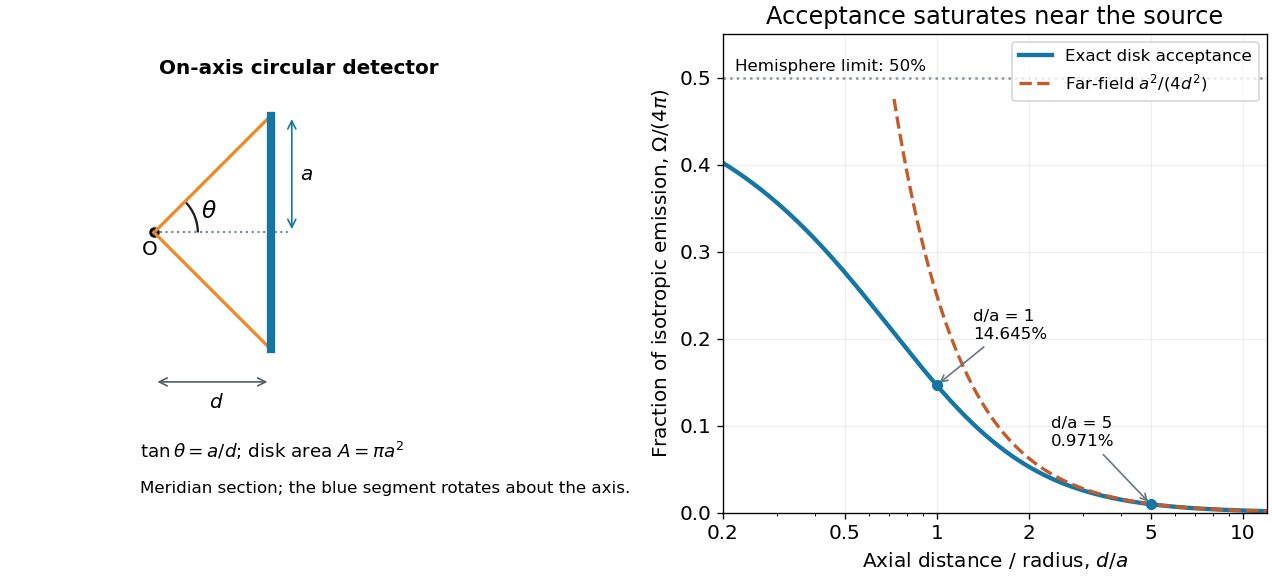
For , the Taylor series of givesThus the accepted fraction of an ideal point emitter's isotropic output is approximately , where . This is the geometry behind the inverse-square law for a small detector. At fixed , however, taking gives , so the accepted fraction approaches rather than diverging.
For a chosen numerical example, let and . The exact solid angle is approximately steradians, giving an acceptance fraction . An ideal point emitter with isotropy and total radiant flux would therefore send about onto the disk. The distant-source approximation gives , about high. This calculation assumes unobstructed propagation and counts incident radiant flux; photon absorption, detector response, and any optical attenuator require separate factors.
A right circular cone with vertex selects all directions within a half-opening angle of its axis. Here is measured from the axis to a boundary direction, so the full opening in a meridian plane is . For , interpret the selected directions as a spherical cap; for , this is a region larger than a hemisphere.
The spherical coordinate system gives the area element on the sphere. Dividing by and integrating over the cap yieldsThe factor matters: a thin angular strip near a pole contains fewer directions than an equally wide strip near the equator. Treating equal intervals of both spherical coordinates as equal solid angles would overcount the polar directions.
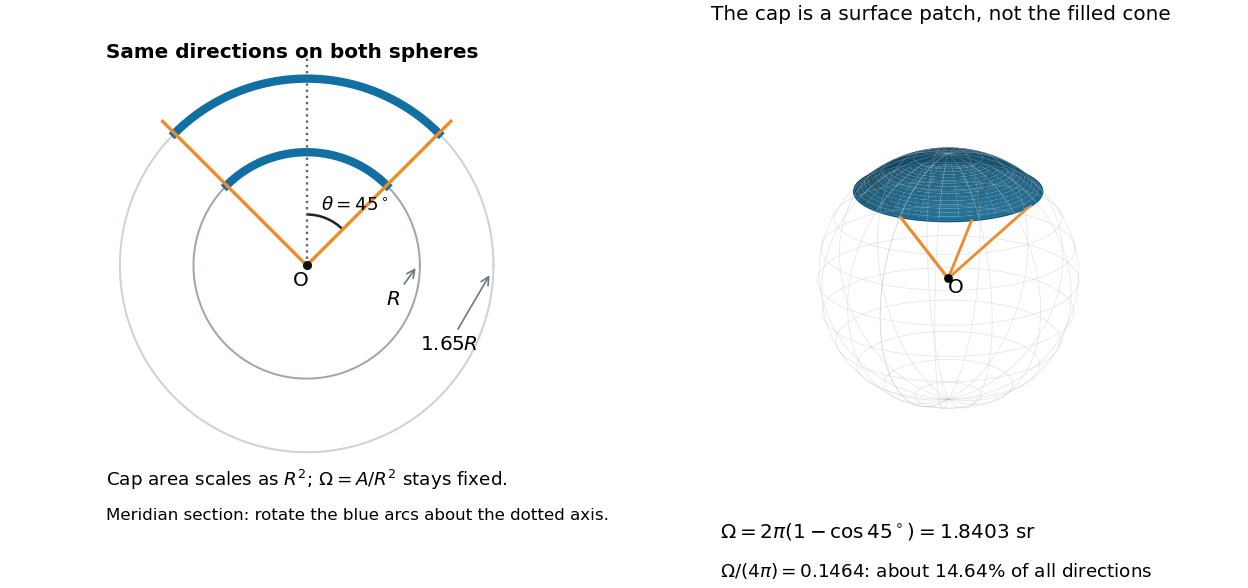
At , the solid angle is steradians, or about of all directions. At it is steradians, and at it is steradians. For a small measured in radians, the Taylor series gives the small-angle approximation . Doubling a narrow half-opening angle therefore approximately quadruples its coverage.
A crystal is a solid with long-range spatial order in its constituents. In a periodic crystal, translation by a lattice vector reproduces the structure; a unit cell and its constituent arrangement describe the repeating pattern. The atomic structure is distinct from the visible external shape: an irregularly cut specimen can remain a single ordered crystal.
Diffraction probes that order because radiation scattered from many regularly arranged sites can reinforce at selected directions. The resulting pattern reveals structural spacings and orientation, rather than merely showing the specimen's outer faces. A single crystal maintains one coherent orientation across the specimen, while a polycrystalline material contains many crystal grains. Crystal orientation can make properties anisotropic, so a test along one direction need not predict response along another. Surface shape additionally depends on equilibrium surface free energy and growth kinetics.
The dynamic modulus is the complex stress-amplitude to strain-amplitude ratio in steady oscillatory response. With the convention , the real part is the storage modulus and the imaginary part is the loss modulus. For , . The average supplied power is , fixing the loss-sign convention. The elastic coefficient is a shear or extension modulus according to the deformation measured; it is unrelated to the complex modulus meaning absolute value of a complex number.
For a real skew-symmetric matrix , is symmetric and . On an eigenspace with eigenvalue , every unit vector has unit partner , orthogonal to , with and . Its plane and its orthogonal complement are invariant under . Repeating gives real orthogonal two-dimensional blocks and a zero block. Thus every nonzero eigenvalue of has even multiplicity, the zero multiplicity has the parity of , and the number of distinct eigenvalues is at most for even and for odd . Distinct positive block parameters attain the bound, with one zero direction added when is odd.
A real skew-symmetric matrix is an orthogonal matrix exactly when its square is minus the identity matrix. Indeed, . Such a matrix can exist only in even dimension: taking determinants of would otherwise give . In two dimensions every example isThese are rotation matrices through opposite right angles. Their orthogonal similarity transforms preserve eigenvalues, but do not in general produce a diagonal matrix.
Functions of a two-dimensional antisymmetric matrix by  Codex 0 Created 2026-10-18 Updated 2026-10-25
Every real antisymmetric matrix has the form , where . Thus , , and . In particular,A convergent scalar power series applied to can therefore be reduced into an even scalar multiple of plus an odd scalar multiple of . For real coefficients and , this is , provided the series converges at . Absolute convergence justifies separating even and odd terms. This converts many small matrix series problems into ordinary scalar series, without computing eigenvectors.
Singularity forced by an odd-dimensional transpose-inverse identity by Codex 0 Created 2026-10-18 Updated 2026-11-05
Codex 0 Created 2026-10-18 Updated 2026-11-05Let be an invertible matrix and a real square matrix of the same odd order. If the displayed identity holds, multiply it on the left by to obtain . Taking determinants givesThus . Since is real, the first factor is positive, forcing to be a singular matrix. Both odd dimension and reality matter: an invertible real antisymmetric matrix exists in even dimension, while over the complex numbers a squared determinant can equal .
In the product basis for two spin-one particles, total magnetic quantum number zero allows only , and . Applying the total ladder operators to givesA singlet state is annihilated by and , so . Wavefunction normalization gives the displayed state, up to an overall phase. Here the ket on the left of the title formula has total-spin labels, while its right-hand kets have individual magnetic labels. The state is symmetric under exchanging the particles, although no exchange constraint is needed for distinguishable particles.
A barycentric coordinate system assigns to a point in the affine span of the vertices of a nondegenerate simplex its unique vertex weights , constrained to sum to one. Uniqueness follows because form a basis of the translation space: expand in that basis and set . A point lies in the closed simplex exactly when every weight is nonnegative. An affine function satisfies , which makes these coordinates useful for interpolation and the integral of an affine function over a simplex.
A point mass constrained to a straight guide through the axis of a uniformly rotating reference frame, with signed central displacement and Hooke's law force , satisfies . The transverse Coriolis force is balanced by the guide. The central equilibrium is stable for and unstable above it. At equality the restoring coefficient vanishes and : a small initial velocity causes unbounded drift in the ideal guide. The threshold therefore has no positive oscillation frequency. The angular frequency is the positive square root in the title.
Rectangular-pulse cancellation of an undamped oscillator by Codex 0 Created 2026-10-18 Updated 2026-10-20
Codex 0 Created 2026-10-18 Updated 2026-10-20For during and zero force afterwards, with zero initial displacement and velocity, the causal Green function gives during the pulse. For it gives . For , both outgoing displacement and velocity vanish precisely when is an integer number of full natural periods. Cancellation requires both initial data for the subsequent homogeneous equation, not only zero displacement at switch-off.
The SRP receptor receives the SRP–ribosome–nascent chain complex for handoff to the translocon.[ref]
Membrane Protein Insertion at the Endoplasmic Reticulum by Sichen Shao and Ramanujan S. Hegde. Shao and Hegde, 2011; “Cotranslational Targeting”, Figure 3
Pinned article: Introduction to the OurBigBook Project
Welcome to the OurBigBook Project! Our goal is to create the perfect publishing platform for STEM subjects, and get university-level students to write the best free STEM tutorials ever.
Everyone is welcome to create an account and play with the site: ourbigbook.com/go/register. We belive that students themselves can write amazing tutorials, but teachers are welcome too. You can write about anything you want, it doesn't have to be STEM or even educational. Silly test content is very welcome and you won't be penalized in any way. Just keep it legal!
Intro to OurBigBook
. Source. We have two killer features:
- topics: topics group articles by different users with the same title, e.g. here is the topic for the "Fundamental Theorem of Calculus" ourbigbook.com/go/topic/fundamental-theorem-of-calculusArticles of different users are sorted by upvote within each article page. This feature is a bit like:
- a Wikipedia where each user can have their own version of each article
- a Q&A website like Stack Overflow, where multiple people can give their views on a given topic, and the best ones are sorted by upvote. Except you don't need to wait for someone to ask first, and any topic goes, no matter how narrow or broad
This feature makes it possible for readers to find better explanations of any topic created by other writers. And it allows writers to create an explanation in a place that readers might actually find it.
Figure 1. Screenshot of the "Derivative" topic page. View it live at: ourbigbook.com/go/topic/derivativeVideo 2. OurBigBook Web topics demo. Source. - local editing: you can store all your personal knowledge base content locally in a plaintext markup format that can be edited locally and published either:This way you can be sure that even if OurBigBook.com were to go down one day (which we have no plans to do as it is quite cheap to host!), your content will still be perfectly readable as a static site.
- to OurBigBook.com to get awesome multi-user features like topics and likes
- as HTML files to a static website, which you can host yourself for free on many external providers like GitHub Pages, and remain in full control

Figure 2. You can publish local OurBigBook lightweight markup files to either OurBigBook.com or as a static website.
Figure 3. Visual Studio Code extension installation.
Figure 5. . You can also edit articles on the Web editor without installing anything locally. Video 3. Edit locally and publish demo. Source. This shows editing OurBigBook Markup and publishing it using the Visual Studio Code extension. 
- Infinitely deep tables of contents:




All our software is open source and hosted at: github.com/ourbigbook/ourbigbook
Further documentation can be found at: docs.ourbigbook.com
Feel free to reach our to us for any help or suggestions: docs.ourbigbook.com/#contact