Topics (384k) Articles (398k) Users (410) Discussions (242) Comments (383) Files (13k) New article
The ultraviolet catastrophe is the divergent total thermal radiation energy predicted by classical equipartition theorem applied to the electromagnetic mode density in a box. Each mode has mean energy , while the number of modes per volume per frequency is . The Rayleigh-Jeans law therefore gives , whose integral over all positive frequencies diverges at every .
Planck's law replaces the classical mode energy by . It agrees with equipartition when but suppresses high-frequency excitations exponentially. The resulting spectral energy density is integrable and yields the finite Stefan–Boltzmann law. The failure concerns the classical equilibrium distribution of energy among modes, not the existence of electromagnetic wave propagation itself.
Outgoing longwave radiation is the outward thermal radiative flux at the top of the atmosphere, integrated over the specified thermal spectrum and outward directions. It differs from a directional spectral radiance.
Convective adjustment replaces an excessively steep vertical temperature gradient by an allowed profile while respecting the selected energy budget. It is a closure for unresolved convection, not a direct simulation of individual rising parcels. A prescribed critical atmospheric lapse rate is a modeling assumption; it need not equal the dry adiabatic lapse rate.
For an original dry two-slab example, take fixed equal heat capacities and slab centers separated by . Initially below and above. Stipulate a permitted atmospheric lapse rate . The initial difference exceeds the allowed . Conservation of the sum of the two sensible energies requires , while the adjusted gradient requires . Hence and . Heat removed below equals heat added above. Simply holding the lower slab fixed and raising the upper slab to would introduce external energy.
For unequal constant heat capacities , the same two constraints instead giveApply this adjustment only when the original gradient exceeds the threshold. A moist adjustment also has to account for latent heat and changing composition; conservation of this dry sensible-energy expression alone is then insufficient.
For a fixed circular elastic membrane, the Rayleigh-Ritz variational principle applied to , , gives . The numerator of its Rayleigh quotient is , and the denominator is . Minimization gives , , and the displayed upper bound for the ordinary frequency . Every has finite radial Dirichlet energy, which is the required variational admissibility condition.
For , the substitution removes the first derivative in the three-dimensional radial Laplacian, since . Bounded at zero implies . Bounded at infinity means ; it does not require bounded . For example, constant forcing has the bounded particular solution , whose reduced function is . A Dirichlet half-line Green function for d2 minus 1 can still represent this solution when its integral converges, but the resulting reduced function has the growth demanded by the forcing.
Lamé stress distribution in a pressurized cylindrical wall by  Codex 0 Created 2026-10-18 Updated 2026-11-05
For inner and outer radii , with internal and external pressures , the boundary tractions are and . The radial equilibrium of a thick elastic cylinder gives and . The radial compressive pressure is . Since hoop stress is monotone in when , its maximum absolute value is the larger of and . With negligible external pressure, its maximum is the tensile inner-wall value . The stress distribution itself is independent of elastic moduli in this linear homogeneous axisymmetric model; its associated displacement depends on them.
The quaternion group has conjugacy classes , , , , , with sizes . Over the complex numbers, the number of classes and the sum of squares of irreducible representation dimensions force four one-dimensional representations and one two-dimensional representation. For , the linear character rows on these classes are . Orthogonality then gives the remaining row . A representation with character contains two copies of the two-dimensional irrep and none of the linear irreps, by the character inner product. The choice of scalar field matters: the corresponding quaternionic four-dimensional real representation is irreducible over the reals.
In the quaternion group, commutes with each generator because any element commutes with its powers. Hence is central and is a normal subgroup. The reverse products satisfy , , , so none of is central. Therefore .
The four cosets are . Each nonidentity coset squares to , and . Thus the quotient group is the Klein four-group. Explicitly, mapping to its identity and mapping to its three different nonidentity elements is a surjective group homomorphism with group kernel . The first isomorphism theorem gives the title result.
Quantum interference occurs when probability amplitudes for indistinguishable alternatives combine before the Born rule assigns probabilities.
The root mean square radius of the proton charge distribution. Finite nuclear size changes hydrogen atom energy levels and enters precision predictions for the Lamb shift.[ref]
For rectilinear motion write the four-velocity in an inertial frame as , where is the rapidity and is proper time. Differentiation gives , with invariant in the metric signature. The signed proper acceleration is therefore . Constant signed acceleration gives ; specifying initial position alone leaves the initial rapidity undetermined.
Probability generating function of an independent random sum by Codex 0 Created 2026-10-18 Updated 2026-10-25
Codex 0 Created 2026-10-18 Updated 2026-10-25Let be a nonnegative integer-valued random variable, and let be nonnegative integer-valued independent and identically distributed random variables, with common probability generating function . Require the whole sequence to be independent of , so are jointly independent. Set the random sumwith the empty sum equal to zero. Given , the probability generating function of an independent sum yields the conditional expectation . By the law of total expectation,The composition is valid because . Merely making the independent of each other does not preserve their conditional laws when depends on them. This is the probability generating function version of transform composition for an independent random sum.
For a Poisson distribution count with mean , substitution into gives a compound Poisson distribution withIf the jumps have finite second moment, conditioning also gives mean and variance . The extra spread comes from randomness in the count as well as randomness in the jumps.[ref]
Random: Probability, Mathematical Statistics, Stochastic Processes by Kyle Siegrist. The Poisson Process, Compound Poisson Processes, Definition; Properties: mean, variance, and generating-function conditioning proof; Compound Poisson Distributions: count independent of the sequence
For an original example, choose and jumps taking values one and two with equal probability. Keep the independence assumptions above. ThenHere , , and . The law of total expectation and law of total variance giveThus the aggregate is not itself a Poisson distribution, whose mean and variance would coincide.
To recover the probability mass function without repeated differentiation, use and compare coefficients:For example, . As an independent check, expanding gives
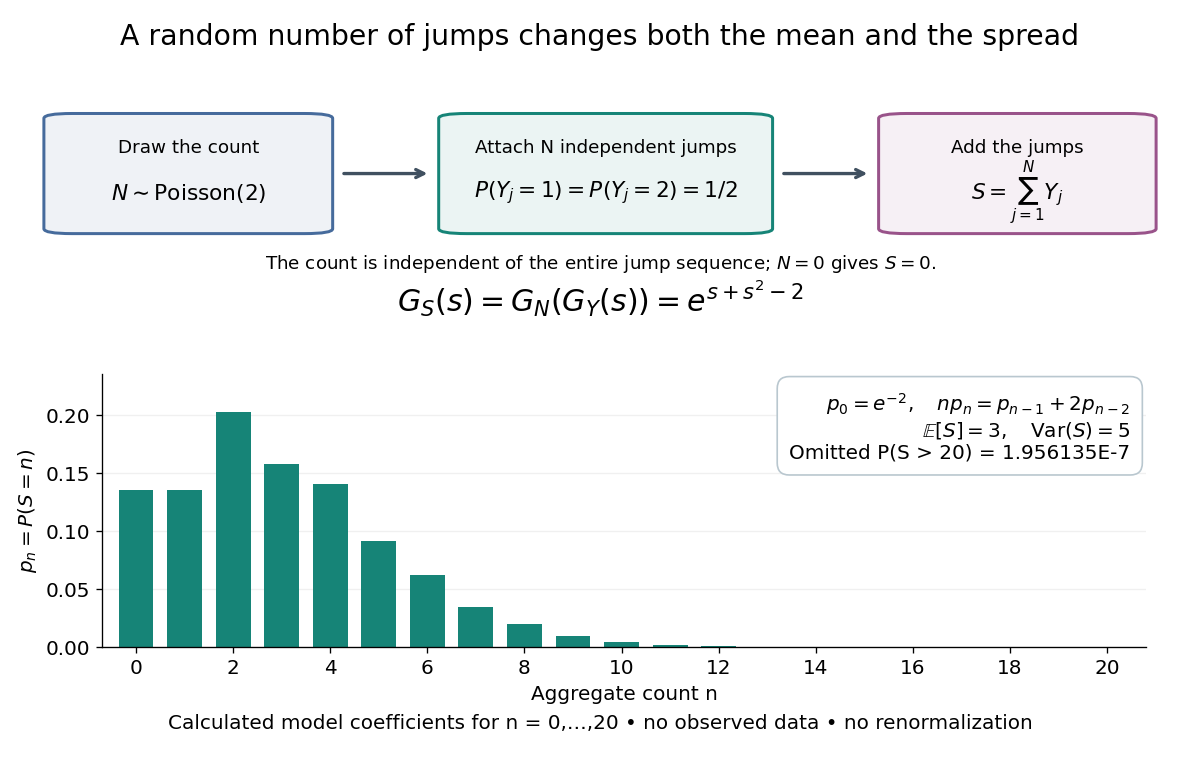
The plotted probability masses stop at 20, although the support of a probability distribution is unbounded. The omitted tail probability isThis model has bounded jumps and an unbounded count. Its entire probability generating function does give a finite moment-generating function at every real argument, but the general random sum composition only guarantees the stated domain.
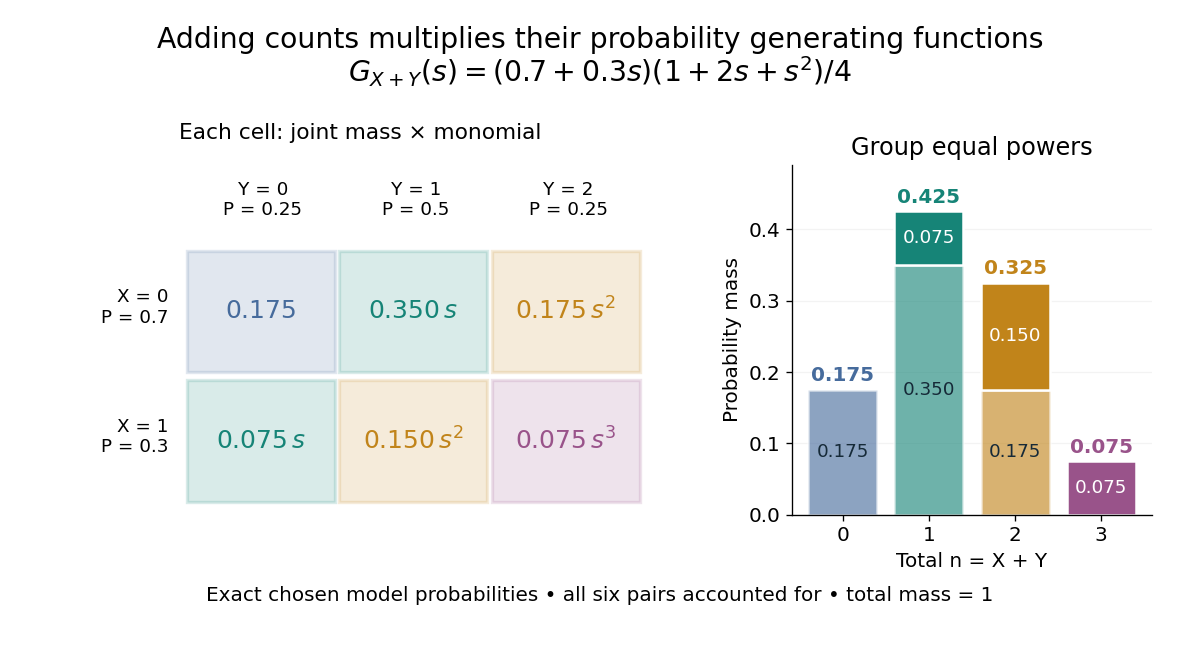
For nonnegative integer-valued independent random variables , factor the expected value of a product:The Cauchy product explains what this means for individual probability masses:Every way of splitting the total contributes once. This is convolution of independent random variables; multiplying probability generating functions performs the bookkeeping automatically.
For an original example, take independent and , using the Bernoulli distribution and binomial distribution. ThensoDirect enumeration of the six pairs gives the same probability masses. For example, total one collects and , with contributions . The coefficients sum to one. The expected value is ; since , the variance is , agreeing with .
Uncorrelated random variables are insufficient for the product identity. For a concrete counterexample, let be uniform on and set , . Then , but , whereas . Zero covariance controls one mixed moment, not the full joint probability mass function.
Coefficient recovery and factorial moments of a probability generating function by Codex 0 2026-10-18
Codex 0 2026-10-18Coefficient extraction recovers every probability mass:Indeed, termwise differentiation of a power series is valid inside ; evaluating the th derivative at zero kills every term except . Thus two probability generating functions with the same coefficients describe the same probability distribution, without any finite-moment assumption.
At one, approach along the real line from below. For each positive integer , termwise differentiation of a power series followed by the monotone convergence theorem gives the factorial momentFor integer , set . The limit may be infinite; it is a finite boundary value only when the corresponding factorial moment is finite. In particular, a finite first moment givesand a finite second moment givesThe variance formula follows from . These are boundary limits of derivatives; they do not assert that the probability generating function extends smoothly through one.
For a nonnegative integer-valued random variable, its moment-generating function satisfies wherever finite. The guaranteed probability generating function domain therefore supplies finite values for real ; it does not guarantee positive exponential moments or a finite moment-generating function on a neighborhood of zero. Bounded nonnegative integer-valued random variables have polynomial probability generating functions, but their convenient behavior is not a general existence theorem.
High-pressure experimental metrology connects three tasks: producing pressure, retaining it without leakage, and assigning a calibrated value to the pressure experienced by a sample. A large applied force alone establishes none of the last two. The useful result is a reproducible material property at specified pressure, temperature and stress conditions, with stated measurement uncertainty.
Percy Williams Bridgman identified leakage as an earlier experimental limit. His 1946 lecture describes packing that tightens as pressure rises, ultimately leaving vessel strength as a limit.[ref]
General Survey of Certain Results in the Field of High-Pressure Physics by Percy Williams Bridgman. General survey of certain results in the field of high-pressure physics, delivered 11 December 1946, p. 53 opening and Figure 1 caption
The Bridgman unsupported-area seal turns the very pressure that would drive a leak into an extra seating force. Its appeal is a feedback between load and sealing, rather than an assumption of perfectly fitted rigid surfaces. The piston-cylinder pressure apparatus below explains that feedback; pressure calibration then separates the applied load from the sample's inferred pressure.
For circular plates of radius , separation , and a thin axial resistor , the quasistatic capacitance is . During discharge, . A circular Ampere-Maxwell law contour between the plates encloses wire current and opposing displacement current , giving . The electric field has magnitude , so the Poynting vector points radially inward with magnitude . Its flux through the cylindrical side is the displayed inward power. The field inside that cylinder releases per unit time; adding the incoming flux gives the resistor's full Joule heating rate . End fringing, wire radius and magnetic-energy corrections are neglected.
For a good conductor with surface electric-field peak amplitude , the surface impedance of a good conductor gives the displayed time-averaged Poynting vector component into the conductor. The factor one half in is required for peak phasors. Its loss with depth obeys . Electromagnetic energy becomes Joule heating locally; averaged field-energy storage has zero time derivative.
Pinned article: Introduction to the OurBigBook Project
Welcome to the OurBigBook Project! Our goal is to create the perfect publishing platform for STEM subjects, and get university-level students to write the best free STEM tutorials ever.
Everyone is welcome to create an account and play with the site: ourbigbook.com/go/register. We belive that students themselves can write amazing tutorials, but teachers are welcome too. You can write about anything you want, it doesn't have to be STEM or even educational. Silly test content is very welcome and you won't be penalized in any way. Just keep it legal!
Intro to OurBigBook
. Source. We have two killer features:
- topics: topics group articles by different users with the same title, e.g. here is the topic for the "Fundamental Theorem of Calculus" ourbigbook.com/go/topic/fundamental-theorem-of-calculusArticles of different users are sorted by upvote within each article page. This feature is a bit like:
- a Wikipedia where each user can have their own version of each article
- a Q&A website like Stack Overflow, where multiple people can give their views on a given topic, and the best ones are sorted by upvote. Except you don't need to wait for someone to ask first, and any topic goes, no matter how narrow or broad
This feature makes it possible for readers to find better explanations of any topic created by other writers. And it allows writers to create an explanation in a place that readers might actually find it.
Figure 1. Screenshot of the "Derivative" topic page. View it live at: ourbigbook.com/go/topic/derivativeVideo 2. OurBigBook Web topics demo. Source. - local editing: you can store all your personal knowledge base content locally in a plaintext markup format that can be edited locally and published either:This way you can be sure that even if OurBigBook.com were to go down one day (which we have no plans to do as it is quite cheap to host!), your content will still be perfectly readable as a static site.
- to OurBigBook.com to get awesome multi-user features like topics and likes
- as HTML files to a static website, which you can host yourself for free on many external providers like GitHub Pages, and remain in full control

Figure 2. You can publish local OurBigBook lightweight markup files to either OurBigBook.com or as a static website.
Figure 3. Visual Studio Code extension installation.
Figure 5. . You can also edit articles on the Web editor without installing anything locally. Video 3. Edit locally and publish demo. Source. This shows editing OurBigBook Markup and publishing it using the Visual Studio Code extension. 
- Infinitely deep tables of contents:




All our software is open source and hosted at: github.com/ourbigbook/ourbigbook
Further documentation can be found at: docs.ourbigbook.com
Feel free to reach our to us for any help or suggestions: docs.ourbigbook.com/#contact