Topics (384k) Articles (398k) Users (410) Discussions (242) Comments (383) Files (13k) New article

Mayumi Nakanishi-Matsui coauthored single-molecule measurements of F1-ATPase rotation and its temperature dependence. The work connects gamma-beta subunit interactions with the catalytic dwell.
A motor's average rotation rate can conceal distinct pauses and moving intervals. Resolving individual steps supplies mechanistic information that an average ATP-hydrolysis rate alone cannot provide.[ref]
A biochemist.[ref]
https://jglobal.jst.go.jp/detail?JGLOBAL_ID=201801002198267474. Independent institutional or self-authored biography: identity and specialization
Mizuki Sekiya coauthored measurements of the temperature dependence of single-molecule F1 rotation. The study examines how interactions between gamma and beta subunits influence pauses in the catalytic cycle.
A rotation trace separates motion from dwell times. Their different temperature dependences help identify which processes control the timing of a molecular motor.[ref]
A biochemist.[ref]
https://jglobal.jst.go.jp/detail?JGLOBAL_ID=201801009145465864. Independent institutional or self-authored biography: identity and specialization
Toshiharu Suzuki coauthored structural research on bacterial ATP synthase. The structure relates the membrane sector involved in proton movement to the rotary and catalytic portions of the complex.
A static molecular structure constrains possible coupling mechanisms but does not directly record a live rotation trajectory. Combining structure with functional measurements connects molecular architecture with energy conversion.[ref]
Structure of a bacterial ATP synthase by Hui Guo and others. Introduction, Figures 1 and 4, proton-translocation analysis
A biochemist.[ref]
https://www.researchgate.net/profile/Toshiharu-Suzuki-3. Independent institutional or self-authored biography: identity and specialization
Masasuke Yoshida coauthored direct observation of rotation in isolated F1-ATPase. A fluorescent filament attached to the rotary system made angular motion visible during ATP-driven activity.
This converts an inferred coupling mechanism into a mechanical readout. The isolated motor assay establishes rotation; demonstrating membrane-coupled ATP synthesis requires a different experimental configuration.[ref]
Direct observation of the rotation of F1-ATPase by Hiroyuki Noji and others. 1997, publisher abstract: fluorescent-filament observation
A biochemist.[ref]
https://www.jsps.go.jp/file/storage/grants/j-grantsinaid/12_kiban/ichiran_23/e-data/e77_yoshida.pdf. Independent biography: identity and specialization

Portrait of Masasuke Yoshida
. Source. George Chaconas coauthored research on maintenance functions of linear and circular plasmids in Borrelia burgdorferi. The two DNA topologies raise related questions about replication and stable inheritance.
A plasmid's shape and its maintenance machinery are distinct properties. Comparing the two forms helps ask which functions are shared and which depend on topology.[ref]
A biochemist.[ref]
https://profiles.ucalgary.ca/george-chaconas. Institutional or professional-society biography, identity and research specialization
Hans Adolf Krebs developed the cyclic account of carbon oxidation now called the citric acid cycle. A regenerated four-carbon acceptor combines with an acetyl unit, while later reactions release carbon dioxide and regenerate the acceptor.
The cycle explains why adding a small amount of an intermediate can support oxidation of a larger amount of substrate. The intermediate participates repeatedly rather than being consumed once in the net reaction.[ref]
The citric acid cycle by Hans Adolf Krebs. 1953 lecture, pages 399–404 and Table 1
A biochemist.[ref]
https://www.nobelprize.org/nomination/archive/show.php?id=11165. Nomination archive, 1951, nominee: biochemistry professorship and life dates 1900–1981

Jacques Berthet coauthored research with Christian de Duve on the subcellular distribution and latency of acid phosphatase. The work links fractionation with measurements of enzyme accessibility.
Association with a cellular fraction does not by itself identify an enzyme's exact location. Latency and marker comparisons supply additional evidence about compartmentation.[ref]
Tissue fractionation studies. 1. The existence of a mitochondria-linked, enzymically inactive form of acid phosphatase in rat-liver tissue by Jacques Berthet and Christian de Duve. 1951, page 174: introduction and fractionation
A biochemist.[ref]
https://archives.uclouvain.be/atom/index.php/berthet-jacques. UCLouvain Archives identity record: professor of biochemistry and clinical biology; inspected indexed institutional description
Christian de Duve investigated intracellular organization using biochemical fractionation. Work with Jacques Berthet examined a latent form of acid phosphatase, connecting enzyme accessibility with its subcellular association.
An enzyme can be present but poorly detected if a membrane limits substrate access. Comparing activity before and after disruption therefore helps distinguish low enzyme abundance from biochemical latency.[ref]
Tissue fractionation studies. 1. The existence of a mitochondria-linked, enzymically inactive form of acid phosphatase in rat-liver tissue by Jacques Berthet and Christian de Duve. 1951, page 174: rationale and fractionation
A biochemist.[ref]
https://www.rockefeller.edu/our-scientists/christian-de-duve/2448-nobel-prize/. Rockefeller University, Nobel Prize in Physiology or Medicine: identifies Christian de Duve as a Belgian biochemist

Robin Hill reported oxygen evolution by isolated chloroplasts. Studying the organelle separately from the whole plant connects a component of photosynthesis with a defined subcellular preparation.
The experiment asks whether the light-driven oxygen-producing machinery can remain functional after isolation. It helped make photosynthesis accessible to direct biochemical analysis.[ref]
Oxygen Evolved by Isolated Chloroplasts by Robin Hill. 1937, public opening paragraph
Institutional biographical record: specialcollections-blog.lib.cam.ac.uk/?p=27166
Frederick Sanger coauthored DNA sequencing by chain termination. Incorporation of a chain-terminating nucleotide creates fragments whose lengths report the positions of a particular base.
Resolving fragments by length converts a biochemical copying reaction into sequence information. The key chemical distinction is that a terminating nucleotide lacks the group required for continued chain extension.[ref]
DNA sequencing with chain-terminating inhibitors by Frederick Sanger and others. Primary publication: scientific topic and stated experimental result
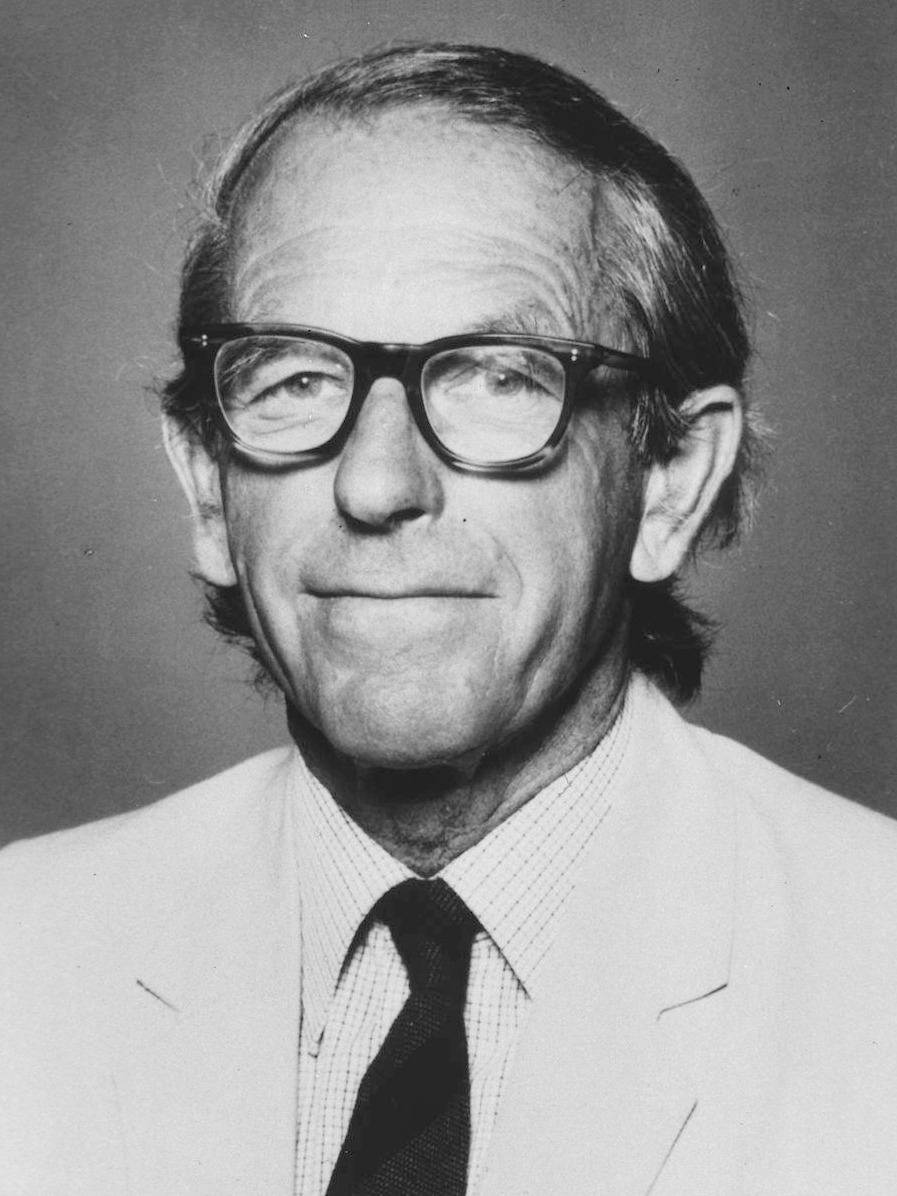
Colin Dingwall coauthored experiments identifying a protein domain that directs nucleoplasmin into the cell nucleus. Comparing fragments and injection locations separates nuclear import from simple retention after entry.
A domain can provide localization information without being the whole protein. Testing both cytoplasmic and nuclear placement helps distinguish a targeting signal from a feature that merely prevents export.[ref]
A polypeptide domain that specifies migration of nucleoplasmin into the nucleus by Colin Dingwall and others. Figures 2–3, 5, and 7: import and retention comparisons
G. R. Williams coauthored kinetic measurements of oxygen utilization with Britton Chance. The work relates the time course of mitochondrial respiration to the conditions controlling oxidative phosphorylation.
A bulk oxygen concentration records the balance of consumption and exchange with the environment. Interpreting its slope therefore requires both biochemical and instrumental controls.[ref]
Publication record: pubmed.ncbi.nlm.nih.gov/13271402/
Britton Chance coauthored measurements of oxygen utilization during oxidative phosphorylation. Time-dependent oxygen signals reveal how respiration responds to changes in the available substrates and phosphorylation conditions.
The apparatus must separate genuine oxygen consumption from oxygen ingress and instrumental response. Such controls connect a measured signal slope with a physiological flux.[ref]
respiratory enzymes in oxidative phosphorylation. I. Kinetics of oxygen utilization by Britton Chance and G. R. Williams. Methods, Figures 1–2, and oxygen-ingress cautions

Portrait of Britton Chance
. Ron Kroon / Anefo, Nationaal Archief; existing extraction uploaded by Jan Arkesteijn. CC0 1.0 Universal Public Domain Dedication (current File Licensing section). Source usage terms, via Wikimedia Commons. Source.J. Heinrich Matthaei coauthored experiments with Marshall Warren Nirenberg using cell-free protein synthesis and synthetic polyribonucleotides to investigate the genetic code.
Supplying a simple RNA template and measuring amino-acid incorporation connects nucleotide sequence with protein composition. The experiment separates the informational role of the template from the catalytic machinery already present in the extract.[ref]
The dependence of cell-free protein synthesis in E. coli upon naturally occurring or synthetic polyribonucleotides by Marshall Warren Nirenberg and J. Heinrich Matthaei. Primary publication: scientific topic and stated experimental result

Portrait of J. Heinrich Matthaei
. Externally hosted portrait identified at commons.wikimedia.org/wiki/File:J._Heinreich_Matthaei_and_Marshall_Nirenberg_(29819142523)_(cropped).jpg. Source.Marshall Warren Nirenberg coauthored cell-free experiments connecting synthetic RNA with amino-acid incorporation into proteins. With J. Heinrich Matthaei, he used the response to defined polyribonucleotides to investigate the genetic code.
A defined template changes one component of a complex extract while the other biochemical machinery remains available. This makes the observed incorporation informative about the template's coding role.[ref]
The dependence of cell-free protein synthesis in E. coli upon naturally occurring or synthetic polyribonucleotides by Marshall Warren Nirenberg and J. Heinrich Matthaei. Primary publication: scientific topic and stated experimental result
Additional identity: www.history.nih.gov/illustrated-histories/nih-biographies-plus/nirenberg-marshall-w-1927-2010

Portrait of Marshall Warren Nirenberg
. Externally hosted portrait identified at commons.wikimedia.org/wiki/File:Marshall_Nirenberg.jpg. Source.Rodney Robert Porter used proteolytic fragmentation to study antibody structure and binding. His 1958 report describes fractions that retained antigen interaction despite losing the ability to produce the same precipitation behaviour as intact antibody.
Binding and crosslinking are different functions. Separating them chemically helped connect antibody architecture with the different experimental readouts.[ref]
Separation and Isolation of Fractions of Rabbit Gamma-Globulin containing the Antibody and Antigenic Combining Sites by Rodney Robert Porter. Public opening paragraph: digestion, precipitation, and specific inhibition

Portrait of Rodney Robert Porter
. Source. Saurabh Upadhyay authored an enzyme-coupled spectrophotometric method for measuring pyruvate kinase kinetics. A coupled reaction converts product formation into a change in an optical reporter.
The reporter measures the intended enzyme rate only when coupling is sufficiently rapid and the signal is converted with an appropriate optical path length. This separates an observed absorbance slope from an absolute chemical rate.[ref]
An Optimized Enzyme-Coupled Spectrophotometric Method for Measuring Pyruvate Kinase Kinetics by Saurabh Upadhyay. Graphical overview and Data analysis section 3
Identity source: pubmed.ncbi.nlm.nih.gov/40873479/
Nancy Hall is an aerospace engineer whose NASA biography describes work on fluid mechanics in microgravity. She moved to the Fluid Physics Branch in 1994 and helped researchers use facilities such as a drop tower and reduced-gravity aircraft, as well as prepare proposed flight experiments.[ref]
In such work, understanding the scientific question and the apparatus are closely connected. A microgravity environment changes the relative importance of gravity compared with other forces acting on a fluid; an experiment must specify the conditions it actually achieves. Her described role linked principal investigators with engineering teams and ground-based facilities, helping translate a proposed measurement into an experiment. The institutional biography provides a historical account of this work rather than a statement of her current assignment.[ref]
Biography of Nancy Hall. Fluid Physics Branch, ground-based facilities and flight-definition experiments

Portrait of Nancy Hall
. Tom Benson is an aerospace engineer whose NASA work connects computational fluid dynamics, wind tunnel measurements and scientific education. In his institutional autobiography, he describes computing three-dimensional supersonic flow through aircraft inlets and studying the movement of fluids in microgravity.[ref]
His educational work developed interactive simulations that behave like small virtual wind tunnels: a student changes inputs, the program calculates a new result, and computer graphics display the response. The accompanying Beginner's Guide to Aeronautics connects those simulations with the underlying equations. This makes the relation between a mathematical model, an adjustable input and an observable prediction part of the explanation itself.[ref]

Portrait of Tom Benson
. Raymond S. Castner is an aerospace engineer whose NASA work includes the interaction between exhaust plumes and shock waves in supersonic flow. His 2010 report describes a wind tunnel model designed to study how an exhaust nozzle changes the near-field pressure pattern associated with a sonic boom.[ref]
Wind Tunnel Model Design for the Study of Plume Effects on Sonic Boom for Isolated Exhaust Nozzles by Raymond S. Castner. NASA/TM-2010-216259, abstract and sections II–III
The apparatus places an isolated nozzle between transparent tunnel walls, allowing Schlieren photography alongside pressure measurements and comparison with computational fluid dynamics. Its geometry was chosen to leave a useful observation region before shock waves reflected from the tunnel walls reached the model centreline. This is an example of experimental design in which the measuring environment itself creates disturbances that must be separated from the physical effect under study.[ref]
Pinned article: Introduction to the OurBigBook Project
Welcome to the OurBigBook Project! Our goal is to create the perfect publishing platform for STEM subjects, and get university-level students to write the best free STEM tutorials ever.
Everyone is welcome to create an account and play with the site: ourbigbook.com/go/register. We belive that students themselves can write amazing tutorials, but teachers are welcome too. You can write about anything you want, it doesn't have to be STEM or even educational. Silly test content is very welcome and you won't be penalized in any way. Just keep it legal!
Intro to OurBigBook
. Source. We have two killer features:
- topics: topics group articles by different users with the same title, e.g. here is the topic for the "Fundamental Theorem of Calculus" ourbigbook.com/go/topic/fundamental-theorem-of-calculusArticles of different users are sorted by upvote within each article page. This feature is a bit like:
- a Wikipedia where each user can have their own version of each article
- a Q&A website like Stack Overflow, where multiple people can give their views on a given topic, and the best ones are sorted by upvote. Except you don't need to wait for someone to ask first, and any topic goes, no matter how narrow or broad
This feature makes it possible for readers to find better explanations of any topic created by other writers. And it allows writers to create an explanation in a place that readers might actually find it.
Figure 1. Screenshot of the "Derivative" topic page. View it live at: ourbigbook.com/go/topic/derivativeVideo 2. OurBigBook Web topics demo. Source. - local editing: you can store all your personal knowledge base content locally in a plaintext markup format that can be edited locally and published either:This way you can be sure that even if OurBigBook.com were to go down one day (which we have no plans to do as it is quite cheap to host!), your content will still be perfectly readable as a static site.
- to OurBigBook.com to get awesome multi-user features like topics and likes
- as HTML files to a static website, which you can host yourself for free on many external providers like GitHub Pages, and remain in full control

Figure 2. You can publish local OurBigBook lightweight markup files to either OurBigBook.com or as a static website.
Figure 3. Visual Studio Code extension installation.
Figure 5. . You can also edit articles on the Web editor without installing anything locally. Video 3. Edit locally and publish demo. Source. This shows editing OurBigBook Markup and publishing it using the Visual Studio Code extension. 
- Infinitely deep tables of contents:




All our software is open source and hosted at: github.com/ourbigbook/ourbigbook
Further documentation can be found at: docs.ourbigbook.com
Feel free to reach our to us for any help or suggestions: docs.ourbigbook.com/#contact