Topics (384k) Articles (398k) Users (410) Discussions (242) Comments (383) Files (13k) New article
A U-tube differential manometer contains a connected column of liquid with one gas connection above each liquid meniscus. Write for the left and right pressures, and for the meniscus heights on an upward vertical coordinate. Assume constant mass density and downward gravitational acceleration of magnitude ; neglect the gas column's mass density and differences in capillary pressure. The signed vertical length difference then givesLarger left pressure means a lower left liquid meniscus: implies . Equal pressures give equal meniscus heights.
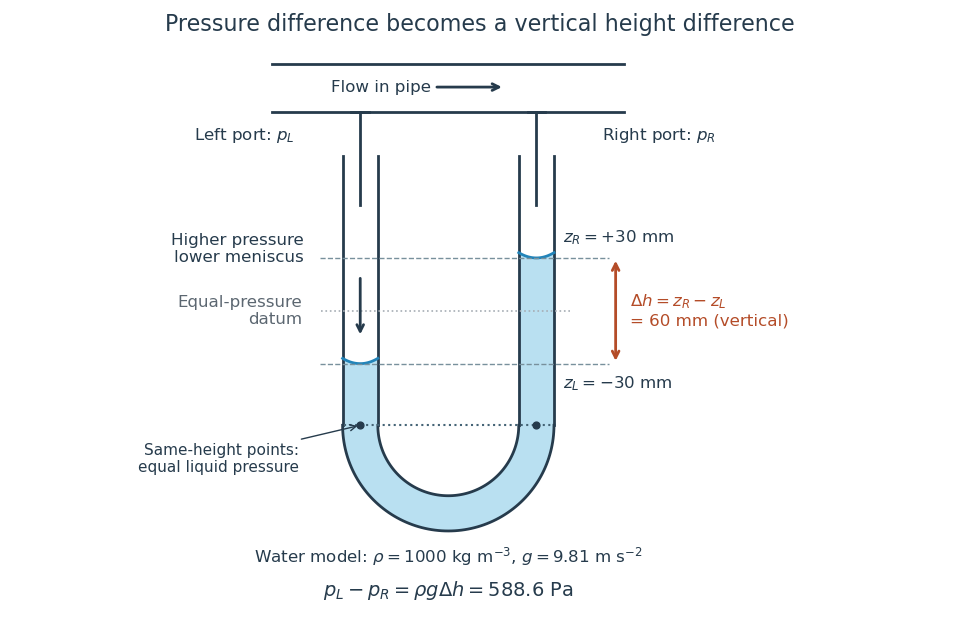
The balance follows directly from hydrostatic pressure. At a common height below both surfaces, the two points in the connected homogeneous liquid have equal pressure:Subtracting cancels the common bottom depth and leaves . The same-height rule follows from hydrostatic equilibrium, : a horizontal displacement changes no pressure, and for constant the quantity is constant throughout the connected liquid. Equal height alone is insufficient for unrelated vessels or for fluid flow with significant acceleration.
For an original constructed example, choose water of stipulated mass density , gravitational acceleration , and vertical length difference . ThenThe SI pressure unit is the pascal: the product has units . Swapping the two connections gives and reverses which liquid meniscus is lower. In equal-bore arms, volume conservation makes each surface move from its initial equal-height position; using only one surface's displacement would halve the inferred pressure. With unequal arm areas , a left fall and right rise instead obey , while the vertical length difference is still .
If the right port is open to the local atmosphere, is the left gauge pressure. Only with that reference and known atmospheric pressure can one obtain absolute pressure fromFor an explicitly stipulated atmospheric pressure of , the example gives absolute pressure. If the right port is connected to another vessel or a pressure tapping, the same reading is a differential pressure and supplies no absolute pressure without knowing that reference.[ref]
A magnetic circuit approximates a narrow core and its gaps by sections carrying a common magnetic flux . With negligible leakage and approximately uniform magnetic flux density across each section, Gauss's law for magnetism gives . The magnetostatic Ampère law then gives . This requires an appropriate material relation; constant magnetic permeability is an approximation for an actual magnetic core.
Magnetic field of a rotating charged solid cylinder by  Codex 0 Created 2026-10-18 Updated 2026-11-05
An infinite solid cylinder with radius , prescribed uniform volume charge density , and angular velocity has current density . Treat a shell at radius and thickness as a solenoid carrying surface current . With no applied background magnetic field and permeability ,The same result follows from Ampère's circuital law, since inside.
Ferrimagnetism has opposing, generally unequal ordered magnetic sublattices, with net magnetization in a collinear model. Louis Néel used it to explain magnetic oxides.[ref]
Magnetism and the local molecular field by Louis Néel. §8, pp.328–330: unequal sublattice contributions
The counting example in magnetic sublattice gives . Unequal populations also suffice: four sites carrying and two carrying give , even with identical individual magnitudes. Thus one must compare total sublattice contributions per common volume, rather than merely asking whether two atomic species carry different magnetic moments.
Both ferromagnetism and ferrimagnetism can produce a macroscopic magnet. Their internal organization differs: the latter retains opposing contributions. This makes ferrimagnetism a useful bridge between net magnetization and microscopic magnetic order: reducing one opposing contribution can increase the net sum, even though the total sum of moment magnitudes decreases.
Antiferromagnetism is ordered compensation of magnetic moments. In the collinear two-sublattice model, : net magnetization vanishes but staggered magnetization remains. Louis Néel developed this possibility.[ref]
Magnetism and the local molecular field by Louis Néel. §5, pp.324–326: opposing ordered sublattices
For an original local energy check, perturb the antiparallel pair in exchange interaction by writing . ThenFor , a small relative rotation costs positive energy. This verifies a pair's preference; it does not prove a bulk ordering temperature. A whole crystal must satisfy many bonds simultaneously, and thermal fluctuations and quantum effects matter. The Heisenberg antiferromagnet and antiferromagnetic Ising model specify different assumptions about those collective degrees of freedom.
Why is the distinction useful? A measurement of zero magnetization cannot decide between an ordered alternating arrangement, a disordered ensemble, and oppositely magnetized magnetic domains. A spatial probe such as magnetic neutron diffraction tests the pattern directly. The manganese monoxide neutron diffraction experiment is a particularly clear example: the order adds a new periodic scattering signal even though the net magnetic moment cancels.
The exchange interaction is an effective interaction between spins originating in the quantum mechanics of electrons. Its sign convention must accompany any formula. For the illustrative classical fixed-length spin pair used here, writeWith this plus-sign convention, favors antiparallel spins: , compared with . The energy difference is . If instead the Hamiltonian is written with an overall minus sign, the same physical preference has a negative coupling. This prevents a sign convention in the Ising model from being mistaken for a disagreement about the ordering.
Magnetic order is a reproducible spatial organization of microscopic magnetic moments. A net magnetization describes their sum; a staggered magnetization describes an alternating pattern. These are different order parameters. For example, an alternating row of equal up and down arrows has zero sum but a definite pattern, whereas randomly oriented arrows can have a small sum without that pattern.
A magnetometer measures a magnetic field or a specimen's magnetic dipole moment. A vibrating-sample magnetometer determines the latter from the electromotive force induced in pickup coils by specimen motion.
Diamagnetism is a magnetic response in which the induced magnetization opposes the applied magnetic field intensity. In a linear isotropic description, with negative magnetic susceptibility .
Interlayer exchange coupling is an interaction that favors particular relative orientations of magnetization in different magnetic layers. In a metallic multilayer, spacer electrons can mediate coupling even when a nonmagnetic layer separates the magnets.
A simple model writes energy per area as . Positive favors parallel alignment and negative favors antiparallel alignment. Spacer material and thickness affect the coupling; magnetic-field sweeps can reveal the field needed to overcome it. Correlated interface roughness can instead produce orange-peel coupling, so a preferred alignment alone does not uniquely establish exchange mediation. [ref]
https://www.nist.gov/publications/interlayer-exchange-coupling. NIST publication record, Interlayer Exchange Coupling: spacer-electron mediation
The magneto-optic Kerr effect is a change in the polarization of an electromagnetic wave upon reflection from a magnetized material. The magnetic response can change both polarization orientation and ellipticity. It differs from the Faraday effect, which is observed in transmission.
A polarizer, reflective sample, analyzer and photodetector turn a small polarization change into an intensity signal. Sweeping an applied magnetic field while recording the signal can trace changes of magnetization and switching. The probed component depends on optical and magnetic geometry, so interpreting the trace requires calibration rather than identifying arbitrary brightness with total magnetization. [ref]
https://tsapps.nist.gov/publication/get_pdf.cfm?pub_id=620499. NIST-hosted magnetic-imaging chapter: reflected Kerr versus transmitted Faraday response and geometry dependence
Magnetic shielding reduces an unwanted magnetic field in a specified region. Residual fields and fields generated inside the shield still need to be assessed in a magnetometer experiment.
Magnetic anisotropy is a directional dependence of a material's magnetic properties. A preferred direction must be distinguished from an externally imposed magnetic field.
A magnet is a material object or current arrangement that produces a magnetic field. Permanent magnets retain magnetization, while electromagnets use a supplied electric current in a winding.
Coulomb-gauge vector potential of a long solenoid by Codex 0 Created 2026-10-18 Updated 2026-10-24
Codex 0 Created 2026-10-18 Updated 2026-10-24For an ideal infinitely long solenoid with interior magnetic field and radius , an axisymmetric Coulomb gauge representative of the magnetic vector potential isThis follows from by Stokes theorem. The exterior has zero curl but nonzero circulation around the enclosed magnetic flux. The Coulomb gauge condition alone does not eliminate every residual gauge transformation; symmetry and regularity select this customary representative.
For , minimization of the homogeneous Landau free energy gives . The unique minimum near zero has . Therefore its first two derivatives with respect to vanish at zero, whereas its third derivative is . With the first nonzero response diverges as . This is response to the variable through a cubic source, so it differs from the conventional third-order coefficient for a linearly coupled magnetic field. The missing factor would give an incorrect susceptibility if one confused a series coefficient with a derivative.
Grand-canonical spin susceptibility of a half-filled single level by Codex 0 Created 2026-10-18 Updated 2026-10-20
Codex 0 Created 2026-10-18 Updated 2026-10-20One noninteracting spatial orbital with two spin energies , in the grand canonical ensemble with mean occupation one, has chemical potential for every positive temperature. Its spin population difference is , giving total-moment response at zero field. Empty and doubly occupied orbital states are permitted. Fixing exactly one electron instead leaves only the two singly occupied states and gives . The factor of two is an ensemble effect in this small system.
An electromagnet produces a magnetic field using an electric current. Winding an electrical conductor into a coil combines the fields from its turns; a long solenoid is an idealized example. Far from its ends, an air-core solenoid has approximatelywhere turns carry electric current over length . Reversing reverses the axial magnetic field. [ref]
The Feynman Lectures on Physics, Volume II by Richard Feynman and others. Section II.13–5, magnetic field of a straight wire and solenoid
A core with ferromagnetism can concentrate the magnetic flux, but its response depends on magnetic saturation and magnetic hysteresis. The constant-permeability air-core formula cannot simply be extrapolated to arbitrarily large core fields. A magnetic compass near a powered coil provides a qualitative test: switching or reversing the electric current changes the compass orientation.
Pinned article: Introduction to the OurBigBook Project
Welcome to the OurBigBook Project! Our goal is to create the perfect publishing platform for STEM subjects, and get university-level students to write the best free STEM tutorials ever.
Everyone is welcome to create an account and play with the site: ourbigbook.com/go/register. We belive that students themselves can write amazing tutorials, but teachers are welcome too. You can write about anything you want, it doesn't have to be STEM or even educational. Silly test content is very welcome and you won't be penalized in any way. Just keep it legal!
Intro to OurBigBook
. Source. We have two killer features:
- topics: topics group articles by different users with the same title, e.g. here is the topic for the "Fundamental Theorem of Calculus" ourbigbook.com/go/topic/fundamental-theorem-of-calculusArticles of different users are sorted by upvote within each article page. This feature is a bit like:
- a Wikipedia where each user can have their own version of each article
- a Q&A website like Stack Overflow, where multiple people can give their views on a given topic, and the best ones are sorted by upvote. Except you don't need to wait for someone to ask first, and any topic goes, no matter how narrow or broad
This feature makes it possible for readers to find better explanations of any topic created by other writers. And it allows writers to create an explanation in a place that readers might actually find it.
Figure 1. Screenshot of the "Derivative" topic page. View it live at: ourbigbook.com/go/topic/derivativeVideo 2. OurBigBook Web topics demo. Source. - local editing: you can store all your personal knowledge base content locally in a plaintext markup format that can be edited locally and published either:This way you can be sure that even if OurBigBook.com were to go down one day (which we have no plans to do as it is quite cheap to host!), your content will still be perfectly readable as a static site.
- to OurBigBook.com to get awesome multi-user features like topics and likes
- as HTML files to a static website, which you can host yourself for free on many external providers like GitHub Pages, and remain in full control

Figure 2. You can publish local OurBigBook lightweight markup files to either OurBigBook.com or as a static website.
Figure 3. Visual Studio Code extension installation.
Figure 5. . You can also edit articles on the Web editor without installing anything locally. Video 3. Edit locally and publish demo. Source. This shows editing OurBigBook Markup and publishing it using the Visual Studio Code extension. 
- Infinitely deep tables of contents:



All our software is open source and hosted at: github.com/ourbigbook/ourbigbook
Further documentation can be found at: docs.ourbigbook.com
Feel free to reach our to us for any help or suggestions: docs.ourbigbook.com/#contact