Topics (384k) Articles (398k) Users (410) Discussions (242) Comments (383) Files (13k) New article
A magnetic compass uses the orientation of a magnetic needle to indicate the direction of a magnetic field.
A magnetic field gradient describes how a magnetic field varies with position. Because the field is a vector field, its complete local variation is the tensor with components ; the gradient of the field magnitude is a different, vector-valued quantity.
A fixed magnetic dipole moment in a nonuniform field experiences a force in the simple localized-dipole model. A uniform field can exert a torque without that translational force. This distinction underlies spatial separation in the Stern-Gerlach experiment and forces in magnetic tweezers. Measuring the field at neighboring positions tests a gradient; one field reading cannot determine it.
In macroscopic electromagnetism, magnetic field strength is , where is magnetic flux density and is magnetization. In SI units is measured in , while is measured in tesla units. In a linear isotropic medium , where is magnetic permeability. The macroscopic Ampère-Maxwell equation writes its curl in terms of free current and displacement current. The electromagnetic Poynting vector is in this convention.
Lysosomal enzyme latency is the difference between the enzyme activity accessible to an added substrate before disruption of the surrounding membrane and the activity revealed after disruption. Low accessible activity can reflect separation of enzyme from substrate, rather than absence of enzyme. This is an assay-accessibility statement, not a claim that the intact lysosome is inactive in the living biological cell.[ref]
Exploring Cells with a Centrifuge by Christian de Duve. Christian de Duve, Exploring Cells with a Centrifuge (Nobel Lecture, 12 December 1974), printed pp. 157–159, enzyme-latency discussion and Figure 6
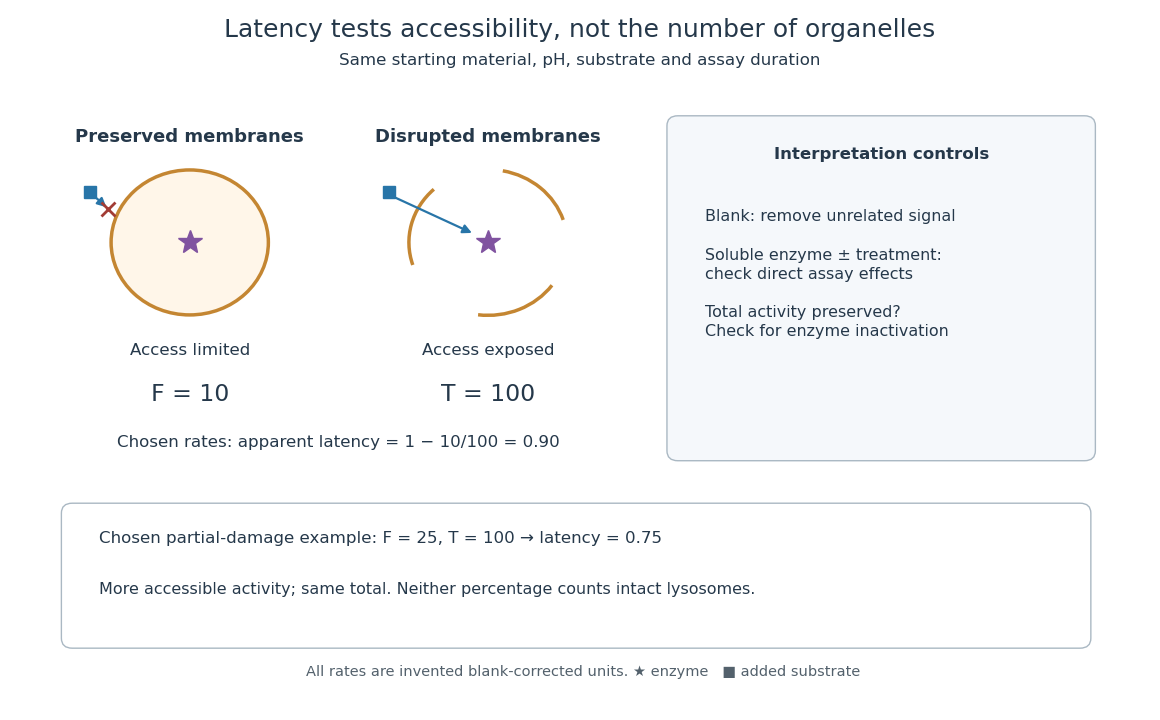
Lysosomal enzyme latency: matched assay conditions and disruption controls
. Original assay-logic diagram and explicitly chosen activity example. The values , and are arbitrary blank-corrected rate units, not historical observations. The soluble-enzyme comparison is an additional control proposed for the schematic, not an asserted measurement from the rat-liver acid-phosphatase latency experiment. Details.Let be the blank-corrected initial rate measured with a membrane-preserving preparation and the rate after a treatment that exposes all assayable enzyme. Use matched amounts of starting material, pH, substrate and measurement time. Define the apparent latent fraction byThis definition requires more than a large treated signal. Disruption must preserve enzyme activity, and the treatment must not independently alter the readout. A soluble-enzyme comparison with and without treatment helps test direct activation or inhibition; an appropriate blank tests signal unrelated to enzyme-catalysed hydrolysis. These are controls for interpreting the constructed assay, rather than additional historical observations.
For a deliberately chosen example, take and arbitrary rate units. Then : ninety percent of the assayable activity was initially inaccessible. After hypothetical partial damage, with unchanged gives . The preparation has lost latency without gaining total assayable activity. These percentages describe activity accessibility; they do not count intact lysosomes. Unequal enzyme contents, partial leakage and mixed particle populations prevent that identification. If , the formula is negative, flagging failure of this simple accessibility interpretation rather than a negative population of hidden enzymes.
To check the logic, divide the same uniformly mixed preparation into two equal portions. If dilution halves both measured rates, , so is unchanged. In contrast, comparing an undiluted untreated portion with a diluted treated portion changes the ratio artificially. Normalization to the same amount of original material is therefore part of the definition, not an optional numerical correction.
Autophagy delivers a biological cell's own material for digestion and recycling in lysosomes. Macroautophagy is the enclosing-carrier route illustrated here; other forms deliver cargo differently. The cargo's internal origin distinguishes this route from uptake by endocytosis.[ref]
Protein Degradation. The Cell: A Molecular Approach, 2nd edition by Geoffrey M. Cooper; Lysosomal Proteolysis, Figure 7.41 and subsequent selective-uptake paragraph: enclosed cargo and alternative uptake
The lysosomal lumen is the aqueous interior of a lysosome, separated from cytosol by its surrounding lipid bilayer. A membrane pump couples ATP hydrolysis to inward transport of hydrogen ions, maintaining an acidic environment for acid hydrolases. Membrane transport proteins export digestion products, including amino acids and sugars, for reuse in metabolism. Compartmentalization combines restricted access with controlled exchange.[ref]
Transport from the Trans Golgi Network to Lysosomes. Molecular Biology of the Cell, 4th edition by Bruce Alberts and others; Lysosomes Are the Principal Sites of Intracellular Digestion, Figure 13-31: ATP-driven acidification and export of digestion products
A luminescent material, for example one that converts some of a blue light-emitting diode's light into longer wavelengths. The name does not require long-lived phosphorescence.
Photoluminescence is light emission following absorption of incident photons. The excitation first puts matter into excited states; subsequent relaxation can emit at a different wavelength. Fluorescence and phosphorescence are distinct forms whose timing and transition mechanisms differ.
An excitation source, sample, rejection filter and spectrometer form a simple experiment. Place collection optics away from the directly transmitted beam and suppress excitation light before measuring the emission optical spectrum. Recording an empty holder or solvent blank helps identify background. Emission intensity alone does not determine absorption or quantum yield, because collection geometry and nonradiative relaxation also affect the signal.
Electroluminescence is nonthermal light emission driven by electrical excitation. In a light-emitting diode, injected electrons and holes can undergo radiative electron-hole recombination, converting part of the supplied electrical energy into photons.
The emitted optical spectrum depends on the available transitions rather than solely on temperature, unlike an ideal blackbody. Measuring both the electric current and emitted radiant power tests conversion efficiency. Increasing electric current need not increase useful emission proportionally: nonradiative recombination, heating and extraction losses can all matter.
An RC low-pass filter places a resistor between input and output, with a capacitor from output to their common return. The ideal model prescribes the input electric potential difference and leaves the output unloaded. It is a first-order low-pass filter with unit eventual gain.[ref]
Lab 3: Filters by University of Colorado Boulder, Physics Undergraduate Labs. Lab 3: Filters, §5.4: RC topology and voltage transfer
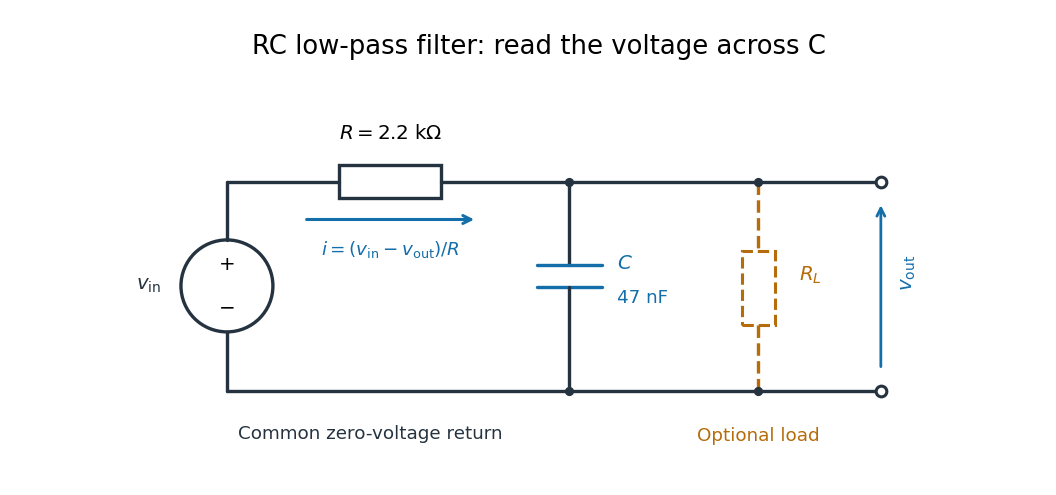
For electrical resistance and capacitance , Ohm's law gives the electric current through the resistor as . The capacitor relation gives . Equating them by Kirchhoff's current law yields the ordinary differential equationThe time constant has units of time. A rapid change in electric potential difference requires a large electric current into the capacitor; the finite electrical resistance limits that rate. A slowly maintained voltage instead lets the capacitor approach the input voltage. The same equation therefore predicts both smoothing of sustained oscillations and a rounded response to a sudden change.
An RL circuit with the output measured across its resistor is a first-order low-pass filter. For an ideal inductor, an ideal voltage source and a high-resistance output instrument, the electrical impedances and giveThe gain approaches one at low angular frequency and at high angular frequency; at it is . The time-domain equation is and , so the time constant is . Instrument loading, source resistance and nonideal inductance can change the response.
Universality of an invariant speed under boost composition by  Codex 0 Created 2026-10-18 Updated 2026-10-20
Suppose standard collinear boosts have the Lorentz transformation form, but initially assign speed scales and to two successive transformations with relative velocities and . Their composition has spatial and temporal diagonal factors proportional to and , respectively. Closure within the same calibrated transformation family requires these factors to agree, forcing for generic nonzero boosts.
This argument fixes a universal reciprocal squared speed; it does not establish that it is nonzero. The common limit gives the consistent Galilean transformation family. A finite invariant speed of light is an additional empirical property of spacetime and electromagnetism, expressed by the second of the postulates of special relativity. It cannot be deduced by excluding the Galilean limit through boost composition alone.
A decreasing measure used to prove algorithm termination. A nonnegative integer loop variant must strictly decrease after every completed body whose condition was true; the body itself must terminate.[ref]
Loop invariants. CS 2112 Fall 2019; Loop invariants, Using loop invariants to show code is correct: Termination and the decrementing function
The prefix maximum correctness example uses . It counts unread entries and is independent of whether the new entry changes the maximum. Ties therefore cannot stall progress: increases even when stays the same. An integer bounded below cannot strictly decrease indefinitely, which supplies the missing algorithm termination argument.
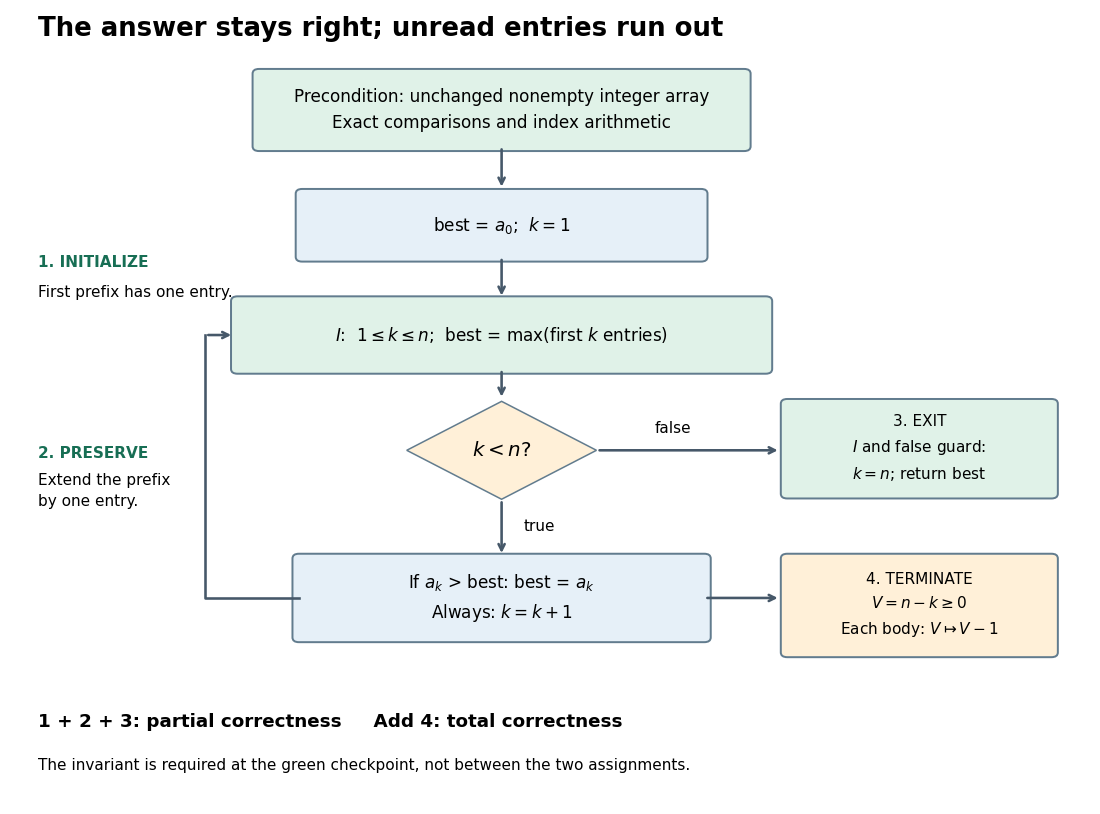
Control flow and four proof obligations for the prefix maximum correctness example
. Initialization, preservation, and exit establish partial correctness; the loop variant establishes algorithm termination and hence total correctness. The loop invariant is restored after both variable assignments. The input array stays unchanged throughout. Details.David Howells is a software engineer who has contributed technical documentation for the Linux kernel. With Paul E. McKenney, he authored a guide to circular buffers, including the interaction between index arithmetic and synchronization.[ref]
Circular Buffers by David Howells and Paul E. McKenney. Author byline and opening summary
Their example separates the producer's insertion index from the consumer's removal index. With one producer and one consumer, memory barriers publish initialized data before an index advertises it as available. This illustrates why a correct data structure needs both an indexing convention and an account of what concurrent operations can observe.[ref]
Circular Buffers by David Howells and Paul E. McKenney. Using memory barriers with circular buffers, The producer and The Consumer
Pinned article: Introduction to the OurBigBook Project
Welcome to the OurBigBook Project! Our goal is to create the perfect publishing platform for STEM subjects, and get university-level students to write the best free STEM tutorials ever.
Everyone is welcome to create an account and play with the site: ourbigbook.com/go/register. We belive that students themselves can write amazing tutorials, but teachers are welcome too. You can write about anything you want, it doesn't have to be STEM or even educational. Silly test content is very welcome and you won't be penalized in any way. Just keep it legal!
Intro to OurBigBook
. Source. We have two killer features:
- topics: topics group articles by different users with the same title, e.g. here is the topic for the "Fundamental Theorem of Calculus" ourbigbook.com/go/topic/fundamental-theorem-of-calculusArticles of different users are sorted by upvote within each article page. This feature is a bit like:
- a Wikipedia where each user can have their own version of each article
- a Q&A website like Stack Overflow, where multiple people can give their views on a given topic, and the best ones are sorted by upvote. Except you don't need to wait for someone to ask first, and any topic goes, no matter how narrow or broad
This feature makes it possible for readers to find better explanations of any topic created by other writers. And it allows writers to create an explanation in a place that readers might actually find it.
Figure 1. Screenshot of the "Derivative" topic page. View it live at: ourbigbook.com/go/topic/derivativeVideo 2. OurBigBook Web topics demo. Source. - local editing: you can store all your personal knowledge base content locally in a plaintext markup format that can be edited locally and published either:This way you can be sure that even if OurBigBook.com were to go down one day (which we have no plans to do as it is quite cheap to host!), your content will still be perfectly readable as a static site.
- to OurBigBook.com to get awesome multi-user features like topics and likes
- as HTML files to a static website, which you can host yourself for free on many external providers like GitHub Pages, and remain in full control

Figure 2. You can publish local OurBigBook lightweight markup files to either OurBigBook.com or as a static website.
Figure 3. Visual Studio Code extension installation.
Figure 5. . You can also edit articles on the Web editor without installing anything locally. Video 3. Edit locally and publish demo. Source. This shows editing OurBigBook Markup and publishing it using the Visual Studio Code extension. 
- Infinitely deep tables of contents:




All our software is open source and hosted at: github.com/ourbigbook/ourbigbook
Further documentation can be found at: docs.ourbigbook.com
Feel free to reach our to us for any help or suggestions: docs.ourbigbook.com/#contact