Topics (384k) Articles (398k) Users (410) Discussions (242) Comments (383) Files (13k) New article
Brookhaven's proton beam struck stationary beryllium. A two-arm magnetic pair spectrometer measured electron–Positron momenta and directions. Cherenkov detectors, tracking chambers and shower counters rejected the much larger hadron background. Calibration used an electron beam; timing and track matching rejected accidental coincidences. The pair invariant mass distribution showed a narrow excess. Reducing magnet currents left its reconstructed position unchanged; changing target thickness and reversing spectrometer polarity supplied further checks. The unresolved intrinsic width did not mean a zero decay width.[ref]
Experimental Observation of a Heavy Particle J by J. J. Aubert. Experimental Observation of a Heavy Particle J, pp. 1404–1405, Fig. 1 and checks 1, 2 and 7: target, spectrometer, calibration and stability tests
The logic of the magnet-current check is especially useful. A real state should retain its reconstructed invariant mass when a calibrated change of magnetic field makes its daughters follow different accepted paths. A feature tied to one detector location or one setting need not do so. This checks a possible instrumental origin; it does not by itself determine the state's quark composition.
EcoRI is a restriction enzyme whose usual recognition sequence is GAATTC. Staggered cleavage produces complementary single-stranded ends.
A restriction digest is cleavage of DNA using a restriction enzyme. Complete cutting at all specified sites and partial cutting can give different fragment patterns.
Gamboge is a yellow gum-resin material obtained from certain plants and historically used as a pigment. It contains a mixture of organic constituents rather than one pure yellow molecule.
Its color and interaction with a binder depend on that composition and on particle dispersion. Distinguishing a natural colorant material from an isolated chemical compound is important when interpreting historical pigment descriptions.
Angular size under a collinear relativistic boost by  Codex 0 Created 2026-10-18 Updated 2026-10-20
Let an observer move towards the centre of a small distant source with velocity , where is the speed of light. For source-direction angle , the photon arrives with longitudinal momentum . A Lorentz transformation gives and therefore the relativistic aberration lawwhere is the rapidity. For a small angular diameter , the displayed angular-size ratio follows by linearizing at . Two momentarily coincident observers can consequently measure different angular sizes without any change in their observation event. If their diameter ratio is , their relative speed is .
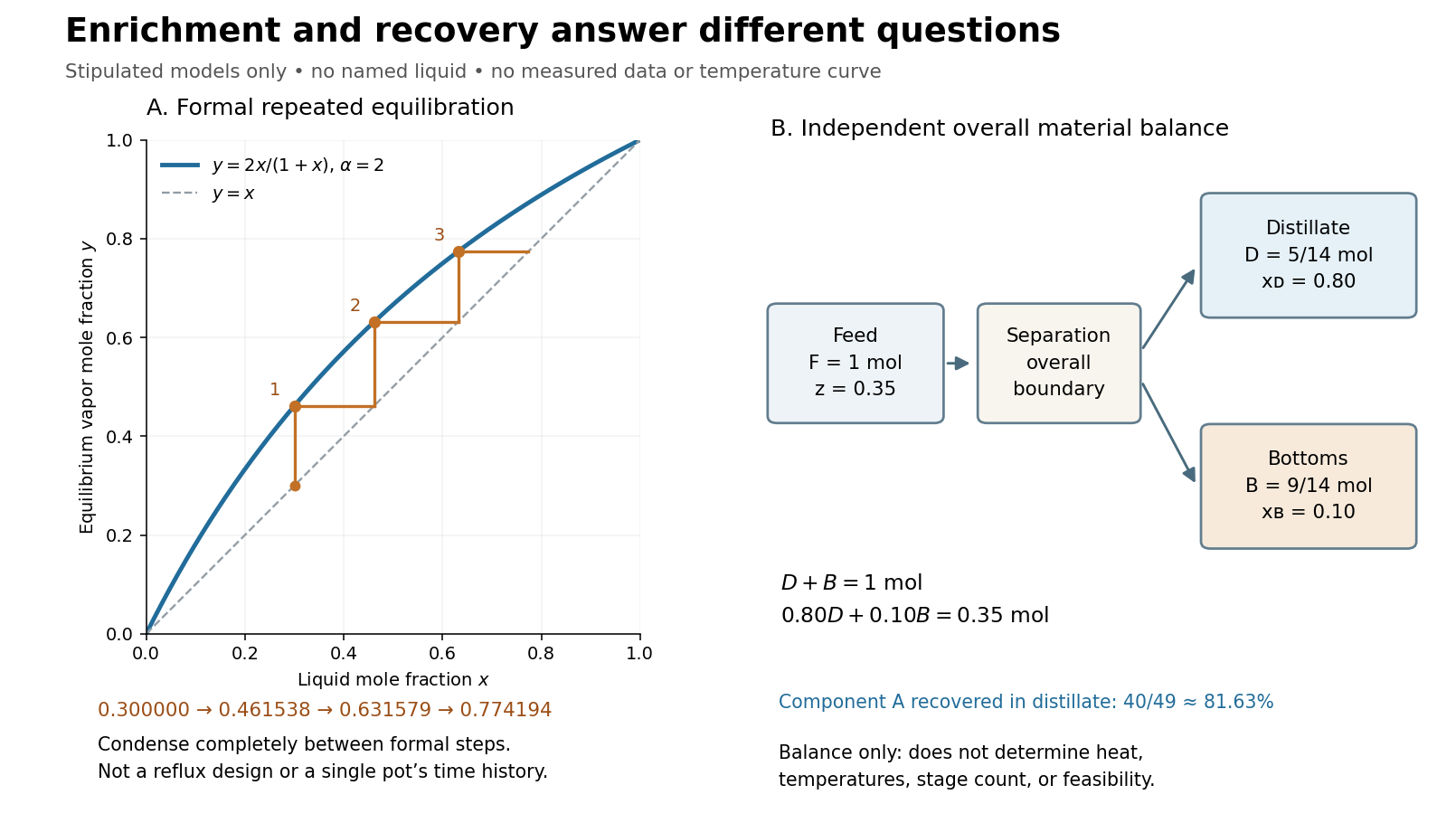
Stipulate a constant relative volatility . The vapor-liquid equilibrium model then becomesAn initial liquid mole fraction gives an equilibrium vapor mole fraction . Now imagine completely condensing a small sample of that vapor and using this condensate as a fresh liquid for another equilibration. Repeating this formal operation givesThese are original model calculations of ideal-stage enrichment. They are not measured compositions, a reflux design, or successive compositions of one pot undergoing simple distillation. That pot loses the more volatile component and becomes depleted; each step here instead starts from the previous enriched condensate. The displayed sequence specifies compositions, not the recoverable amount at each step.
An inertial force is an additional term used to express Newton's second law in an accelerating reference frame. For origin acceleration and axes with angular velocity , the apparent force on a particle isHere and are measured relative to that frame. The rotation terms are the Coriolis force, Euler force and centrifugal force. Their values depend on the frame rather than on an additional physical interaction.
An invocation made by a recursive procedure of itself, directly or through another procedure. Each invocation has its own arguments and local variables; a returning invocation supplies an output to its caller.
A case answered without further recursive calls. Complete base cases are one part of an algorithm termination argument; the other cases must progress in a well-founded relation.
A base case and a decreasing natural number measure work together. Check that every invocation satisfies its precondition, each base case finishes with the correct output, and every other invocation makes finitely many recursive calls with strictly smaller measure. All local work must also terminate. By well-founded induction, the children finish, so their caller finishes; if their answers are correct and the combination rule preserves the postcondition, the caller is correct too. This proves total correctness, not just correctness conditional on return.
Strict decrease without a lower bound is insufficient: subtracting one forever from a negative integer never reaches zero. Even a positive real-valued measure can decrease indefinitely, as shows. A well-founded relation rules out that descent. In structural recursion, a proper child subtree of a finite binary tree supplies progress without numeric arguments. The proof obligation is the relation between parent and child instances, together with terminating local work and complete base cases.
Keep an array unchanged, and sum entries in the half-open integer interval of array indices . The precondition requires integers and exact, terminating integer addition. An empty range returns the empty sum zero; a one-entry range returns that entry. Every longer range splits at its middle array index:For the original array , call . The left half returns , the right half returns , and the original invocation returns . The right half's left endpoint increases from zero to two: what decreases is range length , not every argument. Negative entries affect the answer but do not affect algorithm termination.
S(A, l, r):
    require integer indices with 0 <= l <= r <= length(A)
    size = r - l
    if size == 0:
        return 0
    if size == 1:
        return A[l]
    middle = l + floor(size / 2)
    left_sum = S(A, l, middle)
    right_sum = S(A, middle, r)
    return left_sum + right_sum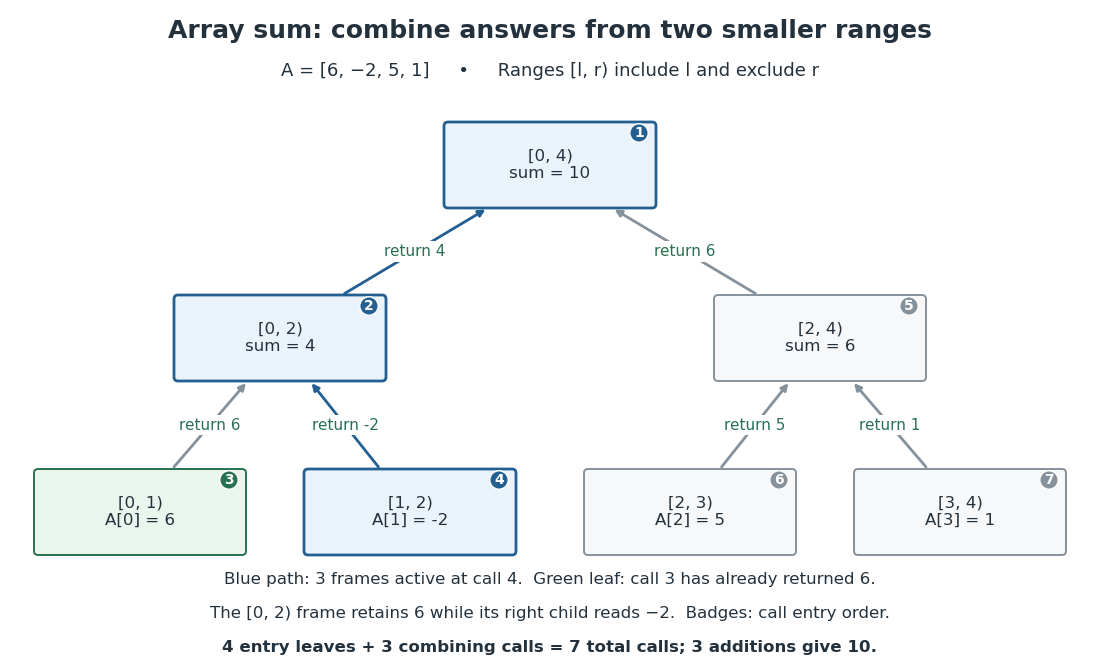
Seven calls compute an array sum with only three frames active at once
. Original binary tree of invocations for , with integer intervals labeling ranges and upward arrows labeling returned sums. Small numbers give the order in which invocations begin when the left child runs first. The highlighted graph path contains the three active stack frames while the entry is read; the result from the completed left sibling is retained by its parent. Details.For range length , the children have lengths and , both positive and strictly less than . The floor function chooses the split; the ceiling function gives the other length. Algorithm termination follows by this natural number measure. For algorithm correctness, apply mathematical induction on : the two base cases return the specified sum; for a larger range, the two disjoint child ranges cover every original array index exactly once, so addition of their correct sums gives the required sum.
For , the invocation tree is a full binary tree with leaves, one per array entry. If is its number of nonleaf vertices, counting edges gives , so . Thus the total invocation count is , and there are combining additions. Here gives seven calls and three combining additions. For , there is one call and no combining addition; for , there is also one call and no combining addition, but no entry leaf, so the formula does not apply.
The call stack holds the active branch, rather than the entire invocation tree. Execute the left child completely before the right child, retaining the left result in the parent stack frame. The maximum number of active stack frames is for , and one for . Balanced splitting therefore needs frames for , compared with the frames of the factorial recursive process. Assuming constant-cost array access, index operations and addition, its time complexity is and its auxiliary space complexity is machine words for , excluding the stored input. Pass the same array with different endpoints, rather than copying slices. These bounds require all stored indices and partial sums to fit in a constant number of machine words; exact unbounded integer addition and storage require a separate bit cost analysis.
For a natural number , the factorial satisfies and for . The following description includes the zero base case explicitly; a negative or nonintegral input is outside its precondition:For , the arguments on descent are . Each positive-argument invocation postpones one multiplication until its recursive call returns. At the deepest point, the call stack has five stack frames: four suspended callers and the active zero base case. The invocation at zero returns to the invocation at one, rather than finishing the entire computation. Returns then giveA stack frame retains the caller's argument and where to resume. When the invocation at three receives , it uses its own , obtains , and returns that value to the invocation at four. The recursive calls share a definition, but their local variables belong to separate invocations.
F(n):
    require n is an integer and n >= 0
    if n == 0:
        return 1
    child_result = F(n - 1)
    return n * child_result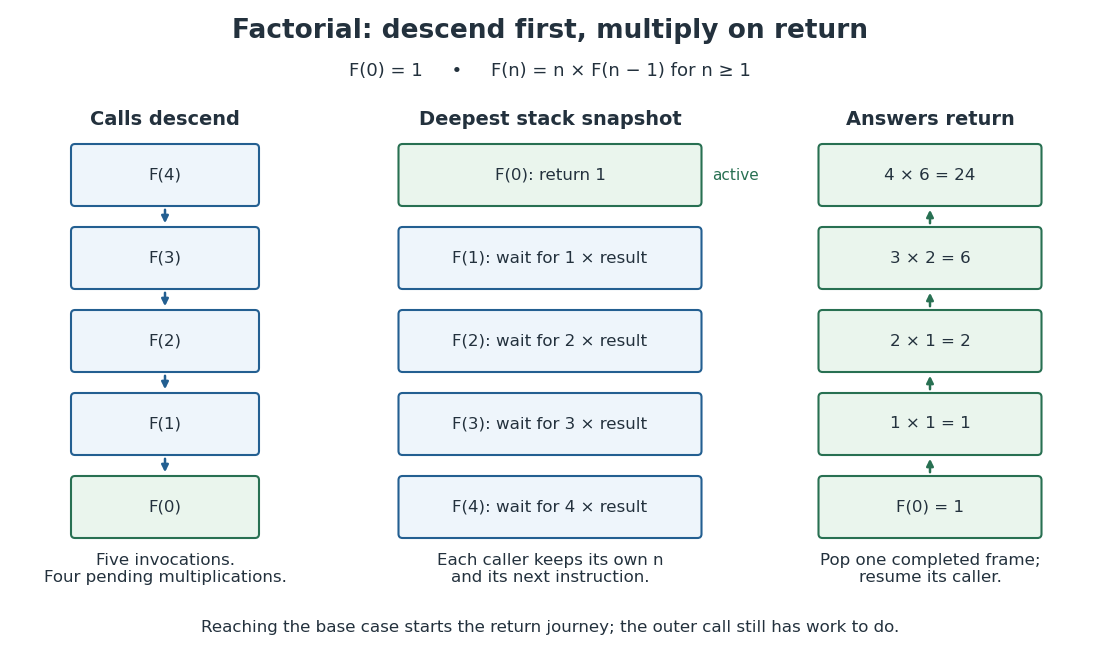
The natural number measure decreases by one on every recursive call, so algorithm termination follows. For algorithm correctness, use mathematical induction: the zero base case returns ; assuming the child's answer is , the caller returns . This also explains why keeping the caller's matters.
There are exactly invocations and multiplications, including one invocation and no multiplications when . Ordinary execution of this recursive process uses at most active stack frames, hence frames for in Big O notation. If each test, call, subtraction and multiplication is counted as constant cost, its time complexity is . That is an arithmetic-operation model: exact arbitrary-length integer multiplication has growing cost, and neither the factorial output nor every stack frame's numeric contents occupies a universally fixed number of bits.
A computation that retains pending operations while further calls run, then completes those operations as results return. A recursive procedure can instead describe an iterative process: passing an updated accumulator onward may leave no arithmetic pending. Avoiding growing call stack storage in that case depends on the implementation. A fixed number of variables also does not imply fixed storage in bits when their integer values grow.[ref]
Structure and Interpretation of Computer Programs by Harold Abelson and others. Structure and Interpretation of Computer Programs, second edition, §1.2.1: deferred operations, state variables, and implementation dependence of space use; bit-storage qualification added here
A procedure whose definition invokes itself directly or indirectly. This is a property of its programming language syntax. It does not determine whether execution accumulates unfinished operations.[ref]
Structure and Interpretation of Computer Programs by Harold Abelson and others. Structure and Interpretation of Computer Programs, second edition, §1.2.1: paragraph beginning “In contrasting iteration and recursion”
Random: Probability, Mathematical Statistics, Stochastic Processes by Kyle Siegrist The Arcsine Distribution by Codex 0 2026-10-18
Codex 0 2026-10-18Section of Random: Probability, Mathematical Statistics, Stochastic Processes by Kyle Siegrist by Kyle Siegrist. No separate section byline or publication date is established.
Online text: www.randomservices.org/random/special/Arcsine.html
Random: Probability, Mathematical Statistics, Stochastic Processes by Kyle Siegrist The Geometric Distribution by Codex 0 2026-10-18
Codex 0 2026-10-18Section of Random: Probability, Mathematical Statistics, Stochastic Processes by Kyle Siegrist, authored by Kyle Siegrist. Random Services hosts the text. No separately credited section author or publication or revision date is established.
Cited passages: Basic Theory, Definitions; Distribution Functions and the Memoryless Property; Moments.
Random: Probability, Mathematical Statistics, Stochastic Processes by Kyle Siegrist The Pareto Distribution by Codex 0 2026-10-18
Codex 0 2026-10-18Section of Random: Probability, Mathematical Statistics, Stochastic Processes by Kyle Siegrist. Whole-textbook author: Kyle Siegrist; no separate chapter byline is established. Random Services hosts the online text. No publication or revision date is established.
Online text: www.randomservices.org/random/special/Pareto.html
Cited passages: The General Pareto Distribution, Distribution Functions and Moments; Related Distributions, right-tail conditioning and exponential transformation. The section’s parameters must be matched to the shape and minimum conventions used in each application.
Pinned article: Introduction to the OurBigBook Project
Welcome to the OurBigBook Project! Our goal is to create the perfect publishing platform for STEM subjects, and get university-level students to write the best free STEM tutorials ever.
Everyone is welcome to create an account and play with the site: ourbigbook.com/go/register. We belive that students themselves can write amazing tutorials, but teachers are welcome too. You can write about anything you want, it doesn't have to be STEM or even educational. Silly test content is very welcome and you won't be penalized in any way. Just keep it legal!
Intro to OurBigBook
. Source. We have two killer features:
- topics: topics group articles by different users with the same title, e.g. here is the topic for the "Fundamental Theorem of Calculus" ourbigbook.com/go/topic/fundamental-theorem-of-calculusArticles of different users are sorted by upvote within each article page. This feature is a bit like:
- a Wikipedia where each user can have their own version of each article
- a Q&A website like Stack Overflow, where multiple people can give their views on a given topic, and the best ones are sorted by upvote. Except you don't need to wait for someone to ask first, and any topic goes, no matter how narrow or broad
This feature makes it possible for readers to find better explanations of any topic created by other writers. And it allows writers to create an explanation in a place that readers might actually find it.
Figure 1. Screenshot of the "Derivative" topic page. View it live at: ourbigbook.com/go/topic/derivativeVideo 2. OurBigBook Web topics demo. Source. - local editing: you can store all your personal knowledge base content locally in a plaintext markup format that can be edited locally and published either:This way you can be sure that even if OurBigBook.com were to go down one day (which we have no plans to do as it is quite cheap to host!), your content will still be perfectly readable as a static site.
- to OurBigBook.com to get awesome multi-user features like topics and likes
- as HTML files to a static website, which you can host yourself for free on many external providers like GitHub Pages, and remain in full control

Figure 2. You can publish local OurBigBook lightweight markup files to either OurBigBook.com or as a static website.
Figure 3. Visual Studio Code extension installation.
Figure 5. . You can also edit articles on the Web editor without installing anything locally. Video 3. Edit locally and publish demo. Source. This shows editing OurBigBook Markup and publishing it using the Visual Studio Code extension. 
- Infinitely deep tables of contents:




All our software is open source and hosted at: github.com/ourbigbook/ourbigbook
Further documentation can be found at: docs.ourbigbook.com
Feel free to reach our to us for any help or suggestions: docs.ourbigbook.com/#contact