Topics (384k) Articles (398k) Users (410) Discussions (242) Comments (383) Files (13k) New article

Thomas precession is the kinematic rotation arising when the successive instantaneous rest frames of an accelerated particle are connected by noncollinear Lorentz boosts. Its contribution is needed in deriving the leading atomic spin-orbit coupling: for an electron in central potential energy , the corrected term is . A rest-field argument alone gives twice this coefficient.[ref]
Topics in Quantum Mechanics by David Tong. §3.1.3, printed pp. 71–75, especially the correction from the accelerated electron frame
Special relativity connects measurable clock rates, length contraction, light propagation, and four-momentum through the Lorentz transformation. Tests probe particular predictions rather than measuring a coordinate transformation in isolation. Examples include cosmic-ray muon time-dilation experiments, muon storage-ring time-dilation experiments, the Michelson-Morley experiment, the Fizeau experiment, and particle-collision energy and momentum balances.
The first postulate is Einstein's principle of relativity: nongravitational laws have the same form in every inertial frame. The second states that light in vacuum propagates at the same finite speed of light in every inertial frame, independently of the source's motion. Together with the usual spacetime symmetries and calibrated coordinates, these postulates yield the Lorentz transformation. The relativity principle alone also admits the Galilean transformation with its infinite invariant-speed limit.
Filtration separates suspended solid particles from a fluid using a porous barrier. Dissolved ions can pass with the fluid; the separation does not establish the filtrate's composition. Solubility product measurement by titration requires removal of undissolved calcium hydroxide before acid-base titration.
An ideal solution is a chemical solution whose component chemical potentials depend on composition throughHere is an amount of substance, its mole fraction, the molar gas constant, and the pure-component liquid reference at the same temperature and pressure . This model applies to every component across the composition range; it is stronger than an approximation valid only near a pure solvent.[ref]
With this pure-liquid standard state convention, the thermodynamic activity satisfies , so an ideal solution has , or activity coefficient .[ref]
ideal mixture. IUPAC Compendium of Chemical Terminology, fifth edition (Gold Book) by International Union of Pure and Applied Chemistry; Ideal mixture, definition: activities equal mole fractions, equivalently unit activity coefficients; I02938, online version 5.0.0
This statement concerns the liquid. Assuming that a coexisting vapor is an ideal gas mixture is an additional approximation. Its mole fractions generally differ from the liquid mole fractions .For an original two-component example, stipulate and pure-component vapor pressures and . A and B are invented distinguishable components; these numbers are chosen model inputs, not material data. Combine an ideal solution with an ideal gas vapor, neglect the pure-liquid reference's pressure correction, and exclude other gases. At liquid mole fractions and , Raoult's law and addition of partial pressures giveThus the coexisting vapor contains about A by amount of substance, although the liquid contains only . The total pressure is neither pure-component vapor pressure, and cannot be substituted for . This enrichment is the basis of distillation.
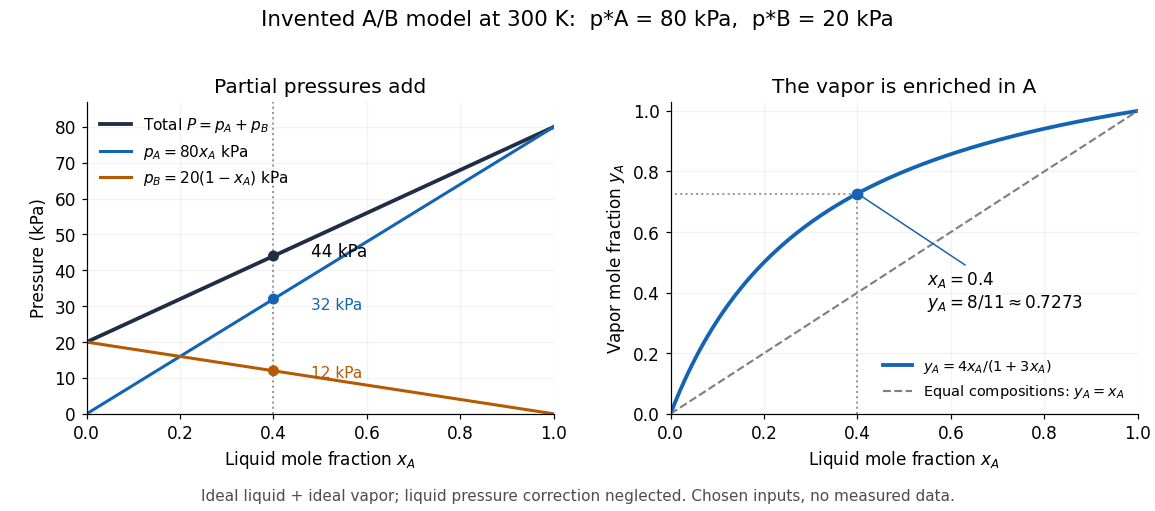
The usefulness of the ideal solution is that one composition law connects chemical potentials, vapor-liquid equilibrium, entropy of mixing and Gibbs free energy of mixing. Its liquid components can interact strongly: the defining condition is their composition dependence, rather than the absence of all interactions as in an ideal gas model.
A chemical solution with a polymer as a solute. The polymer conformation and interactions depend on the solvent and concentration.
Test coverage measures which selected program elements a test run exercises. Statement coverage counts executed statements; branch coverage counts executed control-flow alternatives. Exercising both sides of a conditional can reveal gaps missed by statement coverage, but even full branch coverage need not exercise all paths or meaningful value combinations. Coverage records execution, not whether assertions checked the right behaviour. A suite that calls every function and verifies nothing can have impressive coverage while failing to detect wrong results.
Soft matter physics studies the physical behaviour of soft matter, including its response to mechanical and thermal perturbations.
A power spectral density distributes the mean square of a signal over frequency. Its integral over the specified frequency domain gives that mean square. State whether the convention is one-sided or two-sided and whether frequency is measured in hertz or as angular frequency. For a zero-mean stationary signal, the mean square is its variance; spectral density of a stationary process gives the discrete-time convention.
A signal-to-noise ratio compares a chosen measure of a signal with the corresponding noise measure. For a constant measured electric potential difference and a root mean square noise voltage , an amplitude ratio is ; the corresponding power ratio under equal electrical resistance is its square. State the convention and measurement signal bandwidth, since changing either changes the numerical ratio.
A quantum well confines a particle in one spatial direction while allowing motion along the layer. In a semiconductor heterostructure, band offsets can create that confinement. The following finite square well model makes the resulting discrete transverse energy levels explicit.
A double heterostructure sandwiches one semiconductor between two layers of another, for example gallium arsenide between aluminium gallium arsenide layers. Suitable band offsets confine injected charge carriers centrally.[ref]
A heterojunction joins different semiconductors; its two sides need not have opposite semiconductor doping.[ref]
Pinned article: Introduction to the OurBigBook Project
Welcome to the OurBigBook Project! Our goal is to create the perfect publishing platform for STEM subjects, and get university-level students to write the best free STEM tutorials ever.
Everyone is welcome to create an account and play with the site: ourbigbook.com/go/register. We belive that students themselves can write amazing tutorials, but teachers are welcome too. You can write about anything you want, it doesn't have to be STEM or even educational. Silly test content is very welcome and you won't be penalized in any way. Just keep it legal!
Intro to OurBigBook
. Source. We have two killer features:
- topics: topics group articles by different users with the same title, e.g. here is the topic for the "Fundamental Theorem of Calculus" ourbigbook.com/go/topic/fundamental-theorem-of-calculusArticles of different users are sorted by upvote within each article page. This feature is a bit like:
- a Wikipedia where each user can have their own version of each article
- a Q&A website like Stack Overflow, where multiple people can give their views on a given topic, and the best ones are sorted by upvote. Except you don't need to wait for someone to ask first, and any topic goes, no matter how narrow or broad
This feature makes it possible for readers to find better explanations of any topic created by other writers. And it allows writers to create an explanation in a place that readers might actually find it.
Figure 1. Screenshot of the "Derivative" topic page. View it live at: ourbigbook.com/go/topic/derivativeVideo 2. OurBigBook Web topics demo. Source. - local editing: you can store all your personal knowledge base content locally in a plaintext markup format that can be edited locally and published either:This way you can be sure that even if OurBigBook.com were to go down one day (which we have no plans to do as it is quite cheap to host!), your content will still be perfectly readable as a static site.
- to OurBigBook.com to get awesome multi-user features like topics and likes
- as HTML files to a static website, which you can host yourself for free on many external providers like GitHub Pages, and remain in full control

Figure 2. You can publish local OurBigBook lightweight markup files to either OurBigBook.com or as a static website.
Figure 3. Visual Studio Code extension installation.
Figure 5. . You can also edit articles on the Web editor without installing anything locally. Video 3. Edit locally and publish demo. Source. This shows editing OurBigBook Markup and publishing it using the Visual Studio Code extension. 
- Infinitely deep tables of contents:



All our software is open source and hosted at: github.com/ourbigbook/ourbigbook
Further documentation can be found at: docs.ourbigbook.com
Feel free to reach our to us for any help or suggestions: docs.ourbigbook.com/#contact