Topics (384k) Articles (398k) Users (410) Discussions (242) Comments (383) Files (13k) New article

A coil-stretch transition is a sharp change from a coiled to a substantially extended polymer conformation under sufficiently strong extensional flow. The driving extensional strain rate must compete with the chain's relaxation rate, and the available residence time matters. A long polymer relaxation time lets a weak but sustained flow produce a large effect. The Hookean dumbbell in planar extension below isolates this competition; its unbounded growth signals a model limitation, rather than a prediction of infinitely long molecules.
Polymer adsorption binds a polymer near an attractive interface through contacts of some of its monomers. The binding energy competes with the loss of conformational entropy. A chain need not lie flat: noncontacting loops and tails can extend into the solvent. In a weak-adsorption blob model, the layer thickness exceeds the Kuhn length and local chain statistics remain approximately those of the free chain below that thickness.
A tensile blob is the scale below which thermal conformations of a stretched polymer are weakly disturbed by tension . Balancing stretching work with gives . For free-chain size law , each blob contains monomers. A stretched string of blobs has extension and stretching free energy of order . This description requires blobs larger than individual statistical segments and smaller than the unperturbed coil.
Reptation is the snake-like motion of a long polymer through the constraints imposed by neighboring chains or a fixed porous matrix. A tube model restricts large transverse motion while allowing curvilinear motion along the chain contour. For a flexible chain with additive segment friction, contour diffusion scales as and the time to renew a contour of length proportional to scales as . With coil size squared proportional to , this gives a centre-of-mass diffusion coefficient proportional to . Applying this tube picture to weak-field DNA gel electrophoresis gives an inverse-length mobility over its appropriate regime; field-induced orientation and trapping can invalidate that simple law.
The end-to-end vector joins the two ends of a polymer chain. In an isotropic unforced polymer solution, its vector expected value is zero; a useful measure of chain size is its root-mean-square length. For an ideal chain with independent isotropic steps of length , the cross terms in the square of the step sum have zero expected value, so . For a long Gaussian chain, its radius of gyration obeys . If counts chemical repeat units instead of independent Kuhn length segments, the statistical length used in must be calibrated to that choice of ; it is not automatically the physical bond length or the Kuhn length itself.
A polymer melt is a dense fluid of polymer chains with little or no solvent. For a long flexible chain in a homogeneous melt, other chains screen its long-range excluded volume interactions: distant segments of the chosen chain displace statistically similar segments belonging to its neighbours. On scales above local stiffness, equilibrium chain dimensions are consequently approximately those of an ideal chain, even though monomers still cannot physically overlap. Entanglements can strongly affect dynamics without changing this leading large-scale equilibrium size law. Crystallinity, strong orientational order or unusual topological constraints require separate treatment.
A polymer entanglement is a constraint on a chain's motion caused by the inability of neighbouring chain contours to pass through one another. It is not a permanent chemical cross-link. In a dense polymer melt, these constraints can create long relaxation times and a transient rubbery plateau. Chains eventually release constraints through mechanisms such as reptation and motion of their neighbours. Entanglement therefore strongly affects dynamics even when the equilibrium size of a long chain remains approximately that of an ideal chain because excluded-volume interactions are screened.
Jones calculus represents a fully polarized monochromatic light field by a two-component Jones vector of transverse complex amplitudes. An ideal linear optical element acts by a complex matrix; successive elements act by the ordered product of their matrices. The order matters because the transformations need not commute.
For transverse axes , an ideal polarizer transmitting has matrix , so . A quarter-wave plate aligned with those axes can be represented, up to a common phase factor and the chosen sign convention, by . It changes the relative wave phase, enabling conversion between linear polarization and elliptical polarization. Rotating the elements tests these predictions by changes in transmitted light intensity. A single Jones vector does not describe arbitrary partially polarized light; that requires statistics of the field rather than one fixed pair of amplitudes.
The optical coherency matrix records the second moments of transverse complex amplitudes. Normalize its trace to light intensity. Under a deterministic Jones matrix , . Unpolarized light has , so its output intensity is ; it cannot be represented by one fixed Jones vector.
The degree of polarization quantifies how strongly a transverse optical field departs from an unpolarized mixture. Here are the eigenvalues of its coherency matrix. For two mutually uncorrelated orthogonal linear components of intensities , . It is undefined when the total light intensity is zero. A signed difference is a separate convention that also identifies a preferred polarization direction.
Pure polarization means that the transverse components of a light field have a fixed complex amplitude ratio. A single Jones vector describes the state; its coherency matrix has rank one. Removing overall intensity and a common phase leaves two real parameters, which determine its polarization ellipse.
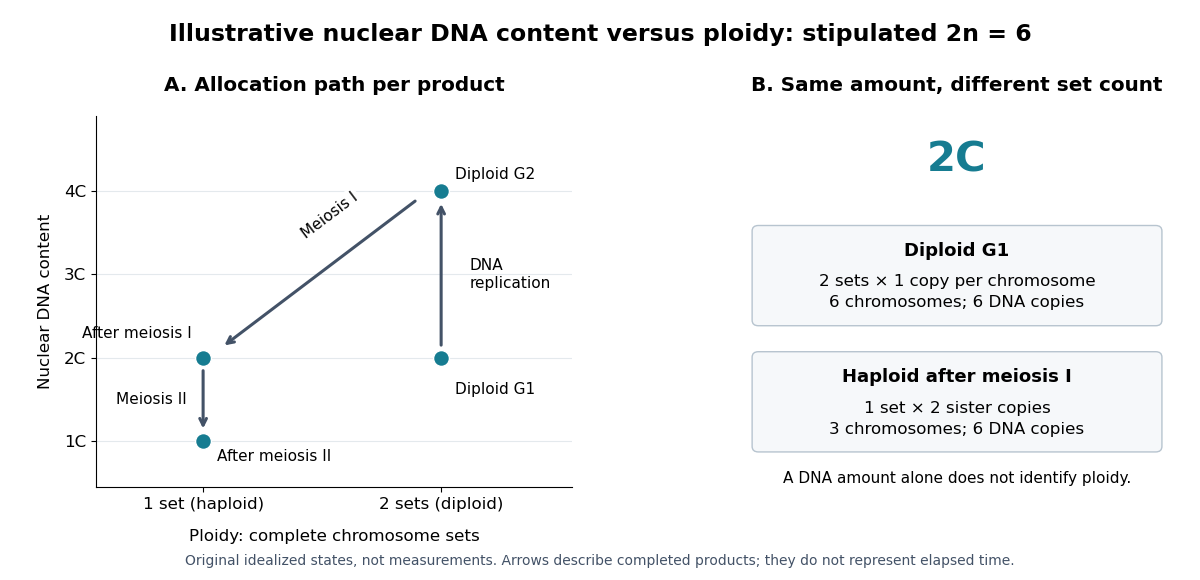
Nuclear DNA content is the amount of DNA in a specified cell nucleus. Define relative to one unreplicated haploid set of the chosen species. It includes coding and non-coding DNA and excludes DNA outside the cell nucleus, such as a mitochondrion's genome. is an amount, whereas is a chromosome count; neither fixes the other across different species.
For an original numerical model, assign the three chromosome types unreplicated DNA amounts of 3, 2 and 1 arbitrary units. Then units: diploid G1 phase contains 12 units, G2 phase 24, each completed meiosis I product 12, and each completed meiosis II product 6. The totals and check conservation after copying. Equal chromosome counts alone would not justify equal DNA amounts if the sets had different sequence lengths.
How can an experiment measure the amount independently of chromosome counting? UCL's Cell Cycle Analysis by Propidium Iodide Staining, pp. 1–2, specifies a flow cytometric DNA-content assay. Washed biological cells receive cold 70% ethanol dropwise while vortexing, then at least 30 minutes on ice. After centrifugation and two washes, ribonuclease A removes RNA that would also bind the dye. Propidium iodide stains the preparation. A flow cytometry instrument such as the listed BD LSR II records individual-event fluorescence on a linear scale. Signal area versus height or width excludes doublets and clumps; acquisition is below 400 events per second, retaining at least 10,000 single-cell events. These are protocol settings, not measured results.[ref]
For a ploidy comparison, add a known diploid G1 phase reference processed with the same staining and detector settings, and an unstained background control. These are proposed comparison controls, beyond the protocol's clump-exclusion procedure. Proportional fluorescence then estimates relative Nuclear DNA content; it does not count chromosomes. A event could be a diploid G1 phase product or a replicated haploid product; could be replicated diploid material or an unreplicated four-set cell nucleus. Peaks alone therefore cannot establish ploidy or cell cycle stage without a reference and biological context. Uneven staining, residual RNA and unresolved doublets limit this inference; two particles can mimic one event.
A transverse magnetic polarization electromagnetic wave bound to an interface through coupling to the material's collective charge response. Its fields propagate along the interface and decay away from it on both sides. In an ideal nonmagnetic lossless planar vacuum-material interface, a real negative relative permittivity below supports the bound branch described by the lossless planar surface-plasmon dispersion. Material losses generally make the propagation constant complex.
For mobile thermal electrons with a fixed neutralizing background, the Debye length is the characteristic distance over which plasma screening suppresses an electrostatic perturbation. Linearizing the Boltzmann density response and using Poisson's equation gives the displayed scale. Other mobile species contribute additively to through .
In an unmagnetized plasma, an electron displacement driven by obeys . Its dipole moment is , giving electric polarization . With , this yields the displayed relative permittivity and . Ions contribute a further negative term smaller by for one ion species of charge . Neglecting it requires heavy ions at electron-wave frequencies; collisions, background magnetization and pressure dispersion are excluded. The transverse electromagnetic wave relation is .
Unsigned laboratory chapter; publication date unknown.
Laboratory chapter: physics.wm.edu/~evmik/classes/2019_fall_Experimental_Atomic_Physics_251/manual/faraday_rotation.pdf
Cited passages: pp. 1–7, Introduction, Experimental Setup, Experimental Procedure and Data Analysis.
Pinned article: Introduction to the OurBigBook Project
Welcome to the OurBigBook Project! Our goal is to create the perfect publishing platform for STEM subjects, and get university-level students to write the best free STEM tutorials ever.
Everyone is welcome to create an account and play with the site: ourbigbook.com/go/register. We belive that students themselves can write amazing tutorials, but teachers are welcome too. You can write about anything you want, it doesn't have to be STEM or even educational. Silly test content is very welcome and you won't be penalized in any way. Just keep it legal!
Intro to OurBigBook
. Source. We have two killer features:
- topics: topics group articles by different users with the same title, e.g. here is the topic for the "Fundamental Theorem of Calculus" ourbigbook.com/go/topic/fundamental-theorem-of-calculusArticles of different users are sorted by upvote within each article page. This feature is a bit like:
- a Wikipedia where each user can have their own version of each article
- a Q&A website like Stack Overflow, where multiple people can give their views on a given topic, and the best ones are sorted by upvote. Except you don't need to wait for someone to ask first, and any topic goes, no matter how narrow or broad
This feature makes it possible for readers to find better explanations of any topic created by other writers. And it allows writers to create an explanation in a place that readers might actually find it.
Figure 1. Screenshot of the "Derivative" topic page. View it live at: ourbigbook.com/go/topic/derivativeVideo 2. OurBigBook Web topics demo. Source. - local editing: you can store all your personal knowledge base content locally in a plaintext markup format that can be edited locally and published either:This way you can be sure that even if OurBigBook.com were to go down one day (which we have no plans to do as it is quite cheap to host!), your content will still be perfectly readable as a static site.
- to OurBigBook.com to get awesome multi-user features like topics and likes
- as HTML files to a static website, which you can host yourself for free on many external providers like GitHub Pages, and remain in full control

Figure 2. You can publish local OurBigBook lightweight markup files to either OurBigBook.com or as a static website.
Figure 3. Visual Studio Code extension installation.
Figure 5. . You can also edit articles on the Web editor without installing anything locally. Video 3. Edit locally and publish demo. Source. This shows editing OurBigBook Markup and publishing it using the Visual Studio Code extension. 
- Infinitely deep tables of contents:



All our software is open source and hosted at: github.com/ourbigbook/ourbigbook
Further documentation can be found at: docs.ourbigbook.com
Feel free to reach our to us for any help or suggestions: docs.ourbigbook.com/#contact