Topics (384k) Articles (398k) Users (410) Discussions (242) Comments (383) Files (13k) New article

For a uniform solid sphere of radius , the squared radius of gyration about its centre is the mass-weighted mean of :Thus its volume is , about . A nonuniform object or a different shape need not obey this conversion. This distinction matters when estimating molecular number density from scattering measurements of a radius of gyration.
Marie Curie's thesis describes powdered material on the lower plate of a capacitor, biased by a battery. Radiation made the intervening air conduct. The upper plate connected to an electrometer and a loaded piezoelectric crystal of quartz. Adjusting the load supplied a known compensating electric charge while keeping the electrometer at zero; charge divided by elapsed time determined the electric current. Voltage scans identified a collection plateau. Contact potentials affected weak-field readings; excessively strong fields could instead introduce additional ionization. Fixed geometry and plateau operation made comparisons meaningful.[ref]
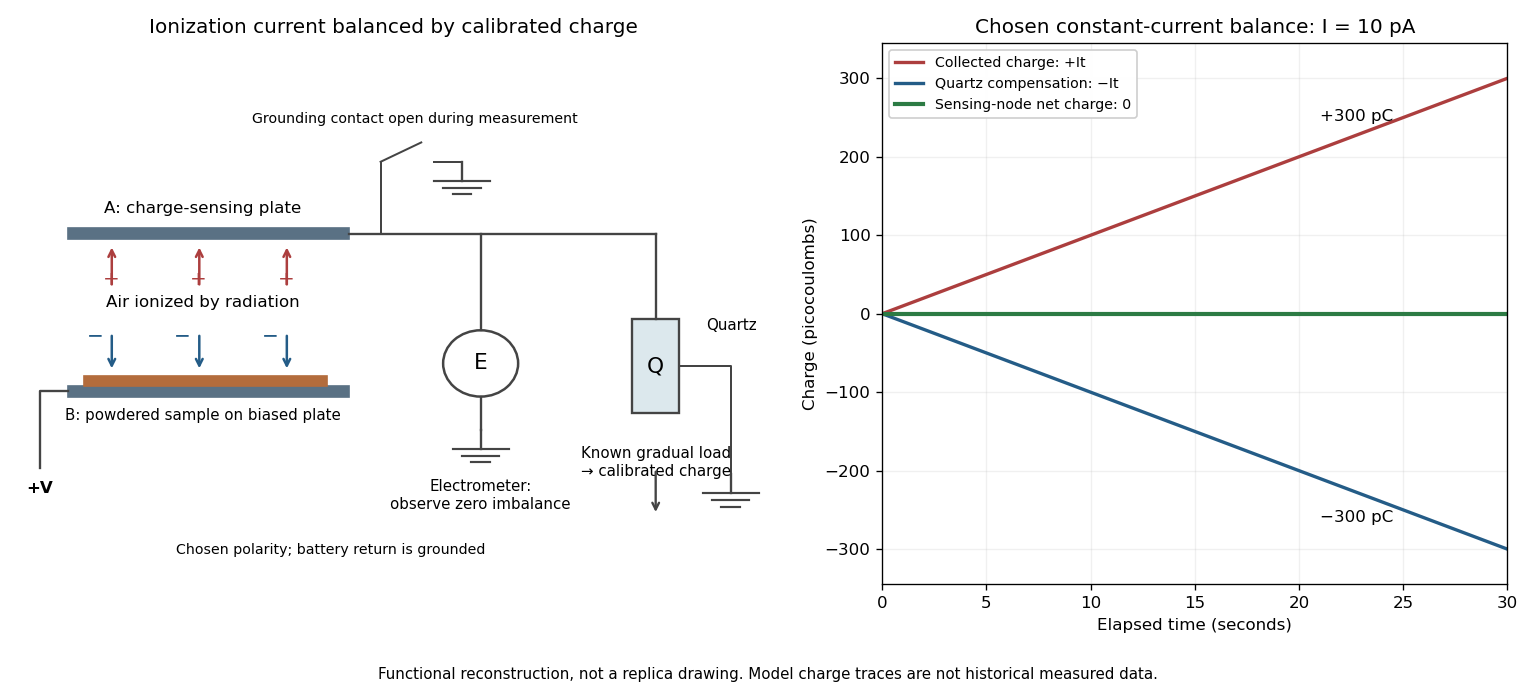
The null method turns a weak signal into a balance against a known quantity. In the diagram's chosen constant-current model, for givesSupplying over the same interval leaves zero net electric charge at the sensing node. The electrometer detects imbalance; the compensating-charge calibration supplies the numerical measurement.
This electric current measures collected charge produced by ionization. Converting it to becquerels additionally requires the energy deposition and charge-collection response per transformation. The apparatus can compare preparations without already possessing that complete source-to-signal calibration.
In his 2 March 1896 report, Henri Becquerel described uranium salt crystals acting on a photographic plate through opaque wrapping. A copper cross weakened the exposure behind it. Plates prepared during intermittent sunshine were left in a drawer and developed on 1 March; unexpectedly strong images prompted deliberate dark tests. He placed a plate and crystals inside two opaque boxes in a drawer; one crystal was separated from the emulsion by glass. After five hours, both produced images. The separation tested transmission without direct chemical contact.[ref]
The result challenged a dependence on immediate illumination. Henri Becquerel still considered long-lasting invisible phosphorescence a possibility, and explicitly withheld a final explanation. The photographic readout established an effect through intervening material; it did not count nuclear transformations or measure a nuclear decay constant.[ref]
Sur les radiations invisibles émises par les corps phosphorescents by Henri Becquerel. Final two paragraphs: tentative invisible-phosphorescence hypothesis and limits of the inference
With parent atomic nuclei present, the conditional expected number of transformations in a short interval is approximately . The corresponding radioactive activity is . Averaging over the finite-population radioactive decay model gives . Its unit is the becquerel.[ref]
10.3 Radioactive Decay. University Physics Volume 3 by Samuel J. Ling and others; Equations 10.17–10.20 and the following becquerel definition
For a finite counting interval, depletion matters. Suppose each transformation is recorded independently with detection efficiency , with at most one count per transformation and no background. The expected value of the count between and isOnly when does this become approximately . A count rate therefore needs a detector model before it can be interpreted as the source's radioactive activity.
Take independently decaying atomic nuclei, each with lifetime drawn from an exponential distribution of rate . With no replenishment, the survivor count isEach indicator variable has success probability , so the binomial distribution givesThe smooth population law is the expected value , satisfying . One realization instead loses whole atomic nuclei at discrete times. An observed count above the smooth curve need not contradict the mathematical model.
For an original chosen example, let and half-life . Then . After , the survival probability is , givingThe standard deviation describes variation between repeated populations governed by these assumptions. It is not an uncertainty interval for a noiseless deterministic curve.
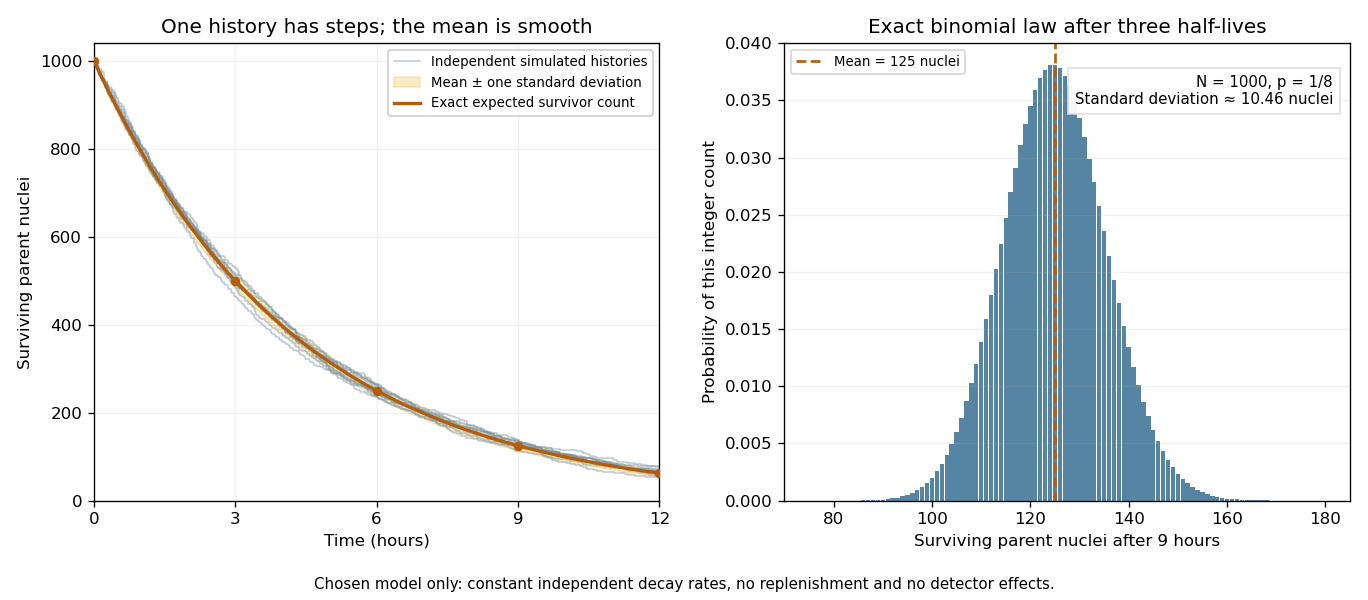
Random survivor counts and the smooth radioactive-decay law
. Original constant-rate model with independent parent atomic nuclei and a half-life. Simulated histories are compared with their exact expected value and a one-standard deviation band. The second panel shows the exact binomial distribution after three half-lives. These are model calculations, not measurements from a historical sample. Details.In the constant-rate mathematical model, an undecayed atomic nucleus has conditional probabilityof decaying during the next positive interval . The nuclear decay constant has units of inverse time. Its value describes a rate; it does not specify a scheduled death time for one atomic nucleus. The conditional probability is independent of the age , the memorylessness of the exponential distribution.
Beta decay is a weak interaction process changing the proton-to-neutron composition of an atomic nucleus while preserving its mass number. In beta-minus decay, a neutron converts to a proton with an emitted electron and electron antineutrino; in beta-plus decay, a proton converts to a neutron with an emitted Positron and electron neutrino, when the complete energy balance permits it.[ref]
DOE Explains Beta Decay by United States Department of Energy. Beta-minus and beta-plus transformations and emitted particles
The emitted beta particle is created in the transition rather than being an ordinary orbital electron expelled from the atom. Its kinetic energy varies because the available Q value is shared with the neutrino and daughter recoil. A magnetic electron spectrometer can separate different emitted momenta; a detector then records a continuous distribution rather than one universal electron energy.
Conservation of electric charge, energy and angular momentum constrains the final state. Nuclear binding matters: a free proton cannot undergo ordinary beta-plus decay, although an energetically allowed proton-to-neutron transition can occur within an appropriate atomic nucleus.
Alpha decay is radioactive decay emitting an alpha particle, a bound group of two protons and two neutrons. The daughter atomic nucleus therefore has atomic number reduced by two and mass number reduced by four.
A released alpha particle must escape the Coulomb barrier outside the short-range nuclear attraction. Quantum tunnelling explains how emission can occur even when the alpha particle's measured kinetic energy is below the barrier's classical height. The strong sensitivity of tunnelling to energy helps explain widely differing decay lifetimes.
For a specified transition from a parent initially at rest, the alpha particle and daughter share the available Q value through two-body recoil. Different daughter nuclear energy levels can produce distinct alpha lines. Their line energies and populations provide information beyond simply counting the sample's total radioactive activity.
Radiometric dating estimates elapsed time from changes in radionuclide populations, using a known nuclear decay constant and assumptions about the initial composition and subsequent closure to matter exchange.
A radionuclide is a species of atomic nucleus with an unstable nuclear state that undergoes radioactive decay. A sample's expected surviving population decreases with its nuclear decay constant. Carbon-14 is the radioisotope used in radiocarbon dating.
Wireless telegraphy conveys discrete symbols without a connecting message wire. Here the mechanism is radio communication: keyed excitation produces radio waves, a receiving antenna drives a selective electrical circuit, and a detector produces a readable event. This makes a beautiful bridge between resonance and information: accumulating many appropriately timed small electrical disturbances can distinguish one transmission from another. Selectivity is finite, however; resonance alone cannot guarantee immunity to strong unwanted signals or noise.
The 1909 Nobel Prize in Physics recognized Guglielmo Marconi and Karl Ferdinand Braun for contributions to wireless telegraphy.[ref]
The Nobel Prize in Physics 1909 by Nobel Prize Outreach. 1909 award motivation and joint laureates
Their apparatus should be understood as a developing collection of systems. An early coherer receiver, a later tuned receiver and a modern envelope detector are different instruments.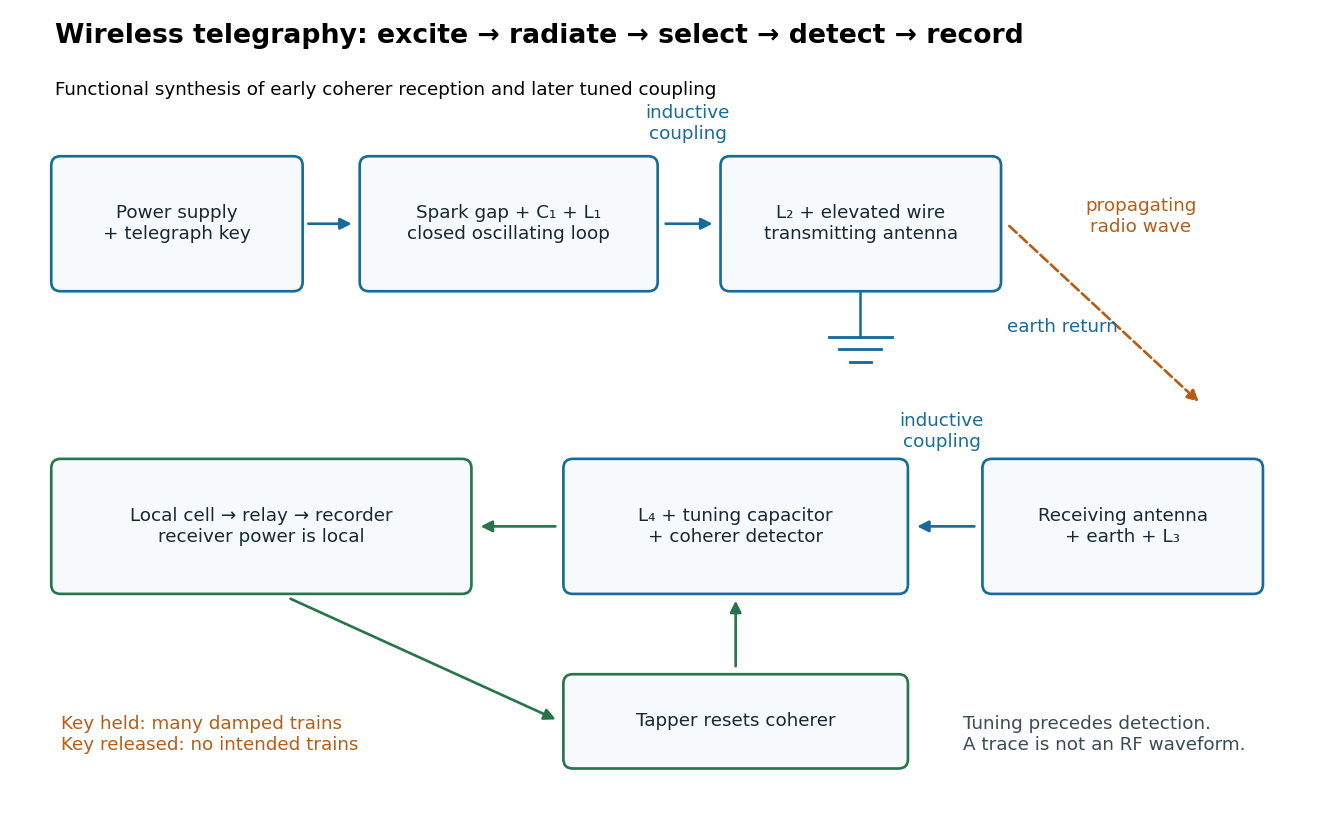
Functional transmit and receive chain for tuned spark wireless telegraphy
. Original functional synthesis of tuned spark wireless apparatus and early coherer reception. Arrows show functional transfer; local battery energy powers recording. Details.A radio receiver selects and detects an incoming radio wave; its frequency selection affects which signals reach its output.
Pinned article: Introduction to the OurBigBook Project
Welcome to the OurBigBook Project! Our goal is to create the perfect publishing platform for STEM subjects, and get university-level students to write the best free STEM tutorials ever.
Everyone is welcome to create an account and play with the site: ourbigbook.com/go/register. We belive that students themselves can write amazing tutorials, but teachers are welcome too. You can write about anything you want, it doesn't have to be STEM or even educational. Silly test content is very welcome and you won't be penalized in any way. Just keep it legal!
Intro to OurBigBook
. Source. We have two killer features:
- topics: topics group articles by different users with the same title, e.g. here is the topic for the "Fundamental Theorem of Calculus" ourbigbook.com/go/topic/fundamental-theorem-of-calculusArticles of different users are sorted by upvote within each article page. This feature is a bit like:
- a Wikipedia where each user can have their own version of each article
- a Q&A website like Stack Overflow, where multiple people can give their views on a given topic, and the best ones are sorted by upvote. Except you don't need to wait for someone to ask first, and any topic goes, no matter how narrow or broad
This feature makes it possible for readers to find better explanations of any topic created by other writers. And it allows writers to create an explanation in a place that readers might actually find it.
Figure 1. Screenshot of the "Derivative" topic page. View it live at: ourbigbook.com/go/topic/derivativeVideo 2. OurBigBook Web topics demo. Source. - local editing: you can store all your personal knowledge base content locally in a plaintext markup format that can be edited locally and published either:This way you can be sure that even if OurBigBook.com were to go down one day (which we have no plans to do as it is quite cheap to host!), your content will still be perfectly readable as a static site.
- to OurBigBook.com to get awesome multi-user features like topics and likes
- as HTML files to a static website, which you can host yourself for free on many external providers like GitHub Pages, and remain in full control

Figure 2. You can publish local OurBigBook lightweight markup files to either OurBigBook.com or as a static website.
Figure 3. Visual Studio Code extension installation.
Figure 5. . You can also edit articles on the Web editor without installing anything locally. Video 3. Edit locally and publish demo. Source. This shows editing OurBigBook Markup and publishing it using the Visual Studio Code extension. 
- Infinitely deep tables of contents:




All our software is open source and hosted at: github.com/ourbigbook/ourbigbook
Further documentation can be found at: docs.ourbigbook.com
Feel free to reach our to us for any help or suggestions: docs.ourbigbook.com/#contact