Topics (384k) Articles (398k) Users (410) Discussions (242) Comments (383) Files (13k) New article

Consider two work-conserving slotted queues in tandem, with upstream service and downstream service , where upstream departures can be served downstream in the same slot. Put . Then and . If , addition gives . Otherwise , so the upstream queue empties and both sides of that identity are zero. Thus total workload obeys the Lindley recursion with service . Starting empty in the remote past yields the displayed identity whenever the upstream workload is finite. Both workloads, and hence their difference, are continuous in the weighted cumulative-input topology for a slotted queue under strictly subcritical mean input .
A quantum Trajectory Theory unravelling represents a Lindblad equation by an ensemble of stochastic pure states. In units , define the non-Hermitian effective HamiltonianFor a normalized state , channel has instantaneous jump rate . During a small interval , that jump occurs with probability and sends the state to . A zero rate means that channel cannot jump. Otherwise, with total no-jump probability , evolve with and renormalize.
To verify the ensemble evolution, put . The conditional normalizations cancel their probability weights, givingExpanding recovers the Lindblad equation. Different monitoring choices can give different trajectories with the same ensemble density matrix. For spontaneous emission, gives jump rate and resets the atom to its ground state.[ref]
A Wave Function approach to dissipative processes by Yvan Castin and others. Sections 1–2, equations (4)–(16), jump probabilities, conditional normalization and master-equation equivalence
A Lindblad dissipator is the non-Hamiltonian generator associated with a Lindblad operator . It preserves the trace because cyclicity gives , cancelling the two anticommutator terms. It preserves Hermiticity and satisfies ; it need not preserve the identity or the purity of a density operator.
Every nonempty closed boundary subset invariant under a non-elementary Kleinian group contains the Kleinian limit set. Such a subset cannot be a singleton. Its hyperbolic convex hull contains an interior point, whose orbit lies in the hull; in the Klein ball model the boundary of this hull is contained in the original closed boundary subset.
An equivalence-invariant lifting property permits the underlying cone of the lift to be identified with the chosen cone by an isomorphism, rather than requiring literal equality. Lifts are unique up to a unique isomorphism compatible with that identification. A monadic adjunction defined by equivalence of its comparison functor has this property by monad algebra forgetful functor creates limits. Literal creation follows if the comparison is an isomorphism over the base, or suitable strict transport of objects is part of the convention. An equivalence alone does not guarantee a literally prescribed underlying object lies in the image.
A Bartlett correction rescales a regular likelihood-ratio test statistic so that its null expected value matches its limiting chi-squared degrees of freedom to a higher asymptotic order. If , divide by . The operation uses a model-specific Bartlett correction coefficient; matching the mean alone is not a general proof of any claimed distributional error rate.
A log-likelihood ratio compares two likelihoods on an additive scale. For independent observations its increments add. Under distributions with suitable integrability and common support, and , where is Kullback-Leibler divergence. This sign change motivates likelihood-based sequential monitoring.
A conditional likelihood evaluates the conditional distribution of the observed data given a specified statistic. If that distribution does not involve a nuisance parameter, it permits inference about the remaining parameter without estimating the nuisance parameter. The conditioning statistic need not be ancillary; possible information loss must be assessed within the model. Conditional maximum likelihood maximizes this function.
If a statistic T has marginal density depending on a parameter of interest but not on a nuisance parameter, that density gives a likelihood for the interest parameter. It is obtained by integrating out other observed coordinates. In contrast, profile likelihood maximizes the full likelihood over the nuisance parameter. This sampling-statistic construction is different from Bayesian model evidence, which integrates parameters against a prior. No prior is required for a nuisance-free sampling marginal.
On a patch with , use worldsheet diffeomorphisms and worldsheet supersymmetry to fix and . The Virasoro constraints and superconformal current constraints then determine the longitudinal modes by the displayed transverse bilinears. In the Ramond sector, reduction of the fermionic zero modes includes the zero-mode Dirac constraint; fixing only nonzero modes does not complete the reduction. Eight transverse bosons and eight transverse fermions remain in the critical ten-dimensional RNS string.
Use the cross-product Lie algebra convention , , , so . Put and , using the matrix exponential. The finite group commutator isHere and big O notation refers to any fixed matrix norm. Active rotation matrices act on column vectors from right to left: first rotate about by , then about by , then about by , and finally about by . Swapping and replaces the product by its inverse and changes the leading Lie bracket to .
Writing and , direct matrix multiplication givesFor radians, , whereas . Thus the residual is a positive rotation about to leading order; at finite it also has smaller components. The Lie bracket captures the leading effect of the four moves rather than their entire finite motion. See Etingof, Section 7.2, Proposition 7.11.
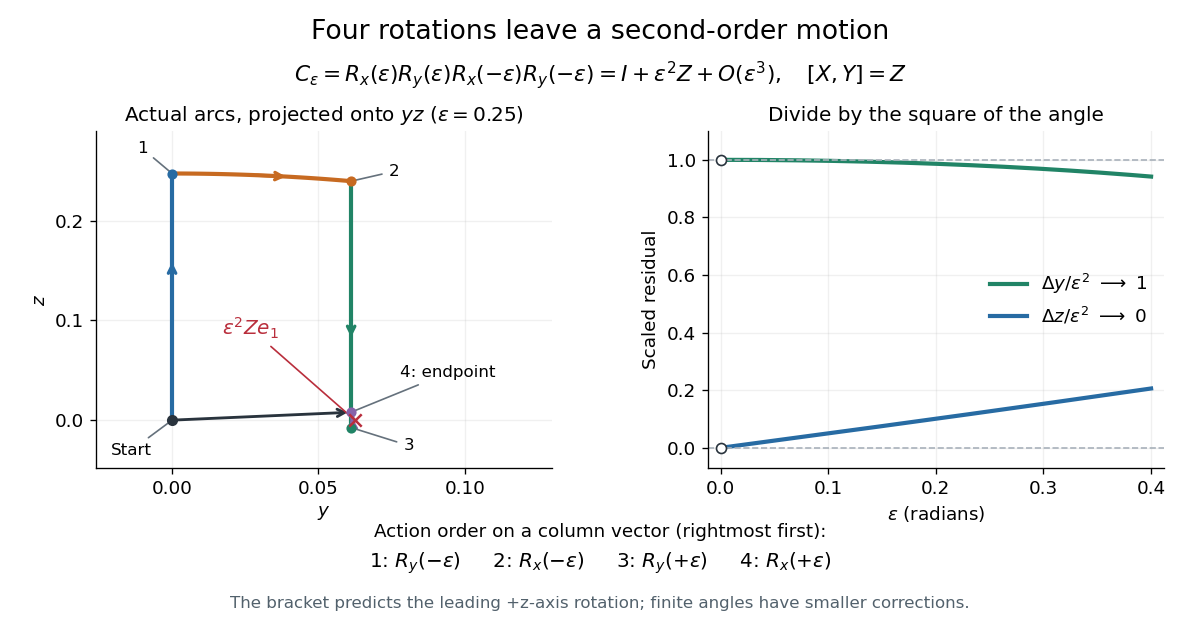
The left panel projects the actual four arcs onto the -plane for ; the start and endpoint are close but distinct. The right panel divides the residual coordinates by , making the limit visible. This is a numerical picture of in the SO(3) Lie algebra.
For a Lie subalgebra , its defining representation is its given action on the vector space . The Lie bracket identity verifies the representation property. For the special linear Lie algebra, diagonal trace-zero matrices have coordinate weights of a representation on the standard basis; for a Special orthogonal Lie algebra, the same action preserves the defining symmetric bilinear form.
The representation ring of finite-dimensional modules for a complex semisimple Lie algebra is the abelian group generated by module classes, with , and multiplication . Weyl complete reducibility theorem makes the classes of irreducible representations a free integral basis. The formal character map identifies this ring with the Weyl group invariant part of the group ring of a weight lattice. Injectivity follows from distinct highest weights; surjectivity follows by subtracting the character with each maximal dominant weight, whose highest-weight coefficient is one, from a Weyl-invariant finite sum.
// Target: semisimple-lie-algebra.bigb
For three vectors in oriented Euclidean three-space, the scalar triple product is and the vector triple product is . The former is their signed volume; the latter is the vector operation appearing in the vector triple product identity.
The quotient model of a lens space splits into two solid tori. In the boundary angle lattice , choose and . The other meridian is . A second column completing this primitive slope to a determinant-one matrix specifies a gluing map after reversing one boundary-basis convention. Different completions differ by a meridional Dehn twist extending across the second solid torus, so they give the same three-manifold.
This second-order linear differential equation extends the Legendre differential equation by its order parameter . Its solutions are associated Legendre functions. In a degree-one potential problem, with , two explicit solutions are and . Their Wronskian with respect to is , so the two formulas are not a fundamental pair at or .
On a hemisphere of SU(2) as the three-sphere, write , with real coefficients satisfying . Right multiplication by gives . This right multiplication flow defines left-invariant tangent fields. With the displayed factor , they obey , since . Applying the commutator to and using the Pauli matrix commutator identity gives . The entries of contain every coordinate, so this determines the vector-field identity, not just its action in one isolated representation.
For inducing , the Eilenberg-Moore comparison functor has a left adjoint exactly when every algebra has a coequalizer of . Transposition identifies maps equalizing this pair with monad algebra morphisms , proving both directions of the criterion. The unit is and satisfies . In the base category, is a split coequalizer of , split by and . Consequently is invertible exactly when is also a coequalizer. The unit is invertible everywhere precisely when preserves all these specified coequalizers; preservation of arbitrary coequalizers is not required.
With signed active covariate columns and their positive-definite Gram matrix , the displayed direction has unit norm and . Thus it makes equal angles with unit-length signed active covariates, and movement along it reduces their signed residual correlations at the common rate . The regression coefficient direction is , with inactive components zero.
For initially pristine gas, zero bulk mass return, a constant stellar yield and a well-mixed galactic outflow of mass-loading factor , gas conservation gives and metal accounting gives . Consequently with . Since , complete depletion gives a normalized mass-weighted metallicity distribution function and mean stellar metallicity . A time-independent initial mass function makes the distribution of surviving tracers proportional to this distribution; a sample selected by light need not have the same weights.
Pinned article: Introduction to the OurBigBook Project
Welcome to the OurBigBook Project! Our goal is to create the perfect publishing platform for STEM subjects, and get university-level students to write the best free STEM tutorials ever.
Everyone is welcome to create an account and play with the site: ourbigbook.com/go/register. We belive that students themselves can write amazing tutorials, but teachers are welcome too. You can write about anything you want, it doesn't have to be STEM or even educational. Silly test content is very welcome and you won't be penalized in any way. Just keep it legal!
Intro to OurBigBook
. Source. We have two killer features:
- topics: topics group articles by different users with the same title, e.g. here is the topic for the "Fundamental Theorem of Calculus" ourbigbook.com/go/topic/fundamental-theorem-of-calculusArticles of different users are sorted by upvote within each article page. This feature is a bit like:
- a Wikipedia where each user can have their own version of each article
- a Q&A website like Stack Overflow, where multiple people can give their views on a given topic, and the best ones are sorted by upvote. Except you don't need to wait for someone to ask first, and any topic goes, no matter how narrow or broad
This feature makes it possible for readers to find better explanations of any topic created by other writers. And it allows writers to create an explanation in a place that readers might actually find it.
Figure 1. Screenshot of the "Derivative" topic page. View it live at: ourbigbook.com/go/topic/derivativeVideo 2. OurBigBook Web topics demo. Source. - local editing: you can store all your personal knowledge base content locally in a plaintext markup format that can be edited locally and published either:This way you can be sure that even if OurBigBook.com were to go down one day (which we have no plans to do as it is quite cheap to host!), your content will still be perfectly readable as a static site.
- to OurBigBook.com to get awesome multi-user features like topics and likes
- as HTML files to a static website, which you can host yourself for free on many external providers like GitHub Pages, and remain in full control

Figure 2. You can publish local OurBigBook lightweight markup files to either OurBigBook.com or as a static website.
Figure 3. Visual Studio Code extension installation.
Figure 5. . You can also edit articles on the Web editor without installing anything locally. Video 3. Edit locally and publish demo. Source. This shows editing OurBigBook Markup and publishing it using the Visual Studio Code extension. 
- Infinitely deep tables of contents:



All our software is open source and hosted at: github.com/ourbigbook/ourbigbook
Further documentation can be found at: docs.ourbigbook.com
Feel free to reach our to us for any help or suggestions: docs.ourbigbook.com/#contact