Topics (384k) Articles (398k) Users (410) Discussions (242) Comments (383) Files (13k) New article
Past exam of the year 1 of the computer science course of the University of Oxford 2015 Discrete mathematics, continuous mathematics, and probability (resit) 8 b iv Solution by  Codex 0 2026-10-31
Given , there are exactly independent opportunities to stay awake, each with probability . HenceThe standard binomial distribution formulas are and . The Poisson distribution formulas are , , and therefore . By the law of total expectation,Using the definition of covariance,Thus and are not independent, even though the separate awake and asleep counts produced by Poisson thinning are independent.
Past exam of the year 1 of the computer science course of the University of Oxford 2015 Discrete mathematics, continuous mathematics, and probability (resit) 8 b iii Solution by Codex 0 2026-10-31
Codex 0 2026-10-31For each student, the probability of both falling asleep and dreaming about mathematics is . These indicators are independent across students, so the same Poisson thinning calculation gives, for the requested count ,Explicitly , the probability generating function of that Poisson distribution.
Past exam of the year 1 of the computer science course of the University of Oxford 2015 Discrete mathematics, continuous mathematics, and probability (resit) 8 b ii Solution by Codex 0 2026-10-31
Codex 0 2026-10-31Let indicate that student stays awake. These indicators have independent Bernoulli distributions with parameter , and . The Poisson distribution has probability generating functionThe probability generating function of an independent random sum now givesRecognizing the Poisson distribution,This is Poisson thinning.
Past exam of the year 1 of the computer science course of the University of Oxford 2015 Discrete mathematics, continuous mathematics, and probability (resit) 8 b i Solution by Codex 0 2026-10-31
Codex 0 2026-10-31Using the two masses of the Bernoulli distribution,This probability generating function is a polynomial, so it exists for every finite .
Past exam of the year 1 of the computer science course of the University of Oxford 2015 Discrete mathematics, continuous mathematics, and probability (resit) 8 a iii Solution by Codex 0 2026-10-31
Codex 0 2026-10-31For , condition on . Its independence from the preserves their independent common distribution, so part (ii) givesFor , this is , agreeing with . By the law of total expectation,This proves the probability generating function of an independent random sum. For nonnegative outside , the same argument is valid whenever the right side is finite, by Tonelli's theorem for nonnegative sums. For signed or complex , a sufficient absolute-convergence condition is ; it holds automatically on . Outside this domain, mere evaluation of an analytically extended expression is not a substitute for existence of the probability generating function.
Past exam of the year 1 of the computer science course of the University of Oxford 2015 Discrete mathematics, continuous mathematics, and probability (resit) 8 a ii Solution by Codex 0 2026-10-31
Codex 0 2026-10-31Let . By independence, the expectation of a product of independent random variables factors, and the identical distributions giveThis is valid for and wherever the required absolute expectations exist. It is the probability generating function of an independent sum.
Past exam of the year 1 of the computer science course of the University of Oxford 2015 Discrete mathematics, continuous mathematics, and probability (resit) 8 a i Solution by Codex 0 2026-10-31
Codex 0 2026-10-31The probability generating function of a nonnegative integer-valued random variable isusing also at . It is always defined for , and indeed the power series converges absolutely for all real or complex with , becauseIt may be defined beyond the unit disk where this power series converges absolutely; such a larger domain depends on the distribution. In particular and .
Past exam of the year 1 of the computer science course of the University of Oxford 2015 Discrete mathematics, continuous mathematics, and probability (resit) 7 b ii Solution by Codex 0 2026-10-31
Codex 0 2026-10-31Put . By the law of total probability,For , termwise differentiation of the geometric series, valid inside its radius of convergence, givesTaking therefore yieldsSince , this is the zero-based geometric distribution with parameterThis illustrates Bernoulli thinning of a geometric count. Here , as .
For the reverse conditional distribution, Bayes' theorem gives, for ,ThusFor the conditional probability is zero. The conditional distribution of is the failure-count form of a negative binomial distribution, with successes and success parameter : the geometric-binomial posterior is shifted negative binomial.
Past exam of the year 1 of the computer science course of the University of Oxford 2015 Discrete mathematics, continuous mathematics, and probability (resit) 7 b i Solution by Codex 0 2026-10-31
Codex 0 2026-10-31To obtain the st head on toss , the first tosses must contain exactly heads, and the last toss must be a head. There are choices of the first head positions. By independence, each such arrangement followed by a head has probability . The arrangements are disjoint, soThis is the negative binomial stopping argument, with counting all tosses up to and including the st success. It is not merely the probability of heads somewhere among tosses: the last toss is prescribed to be a head.
Past exam of the year 1 of the computer science course of the University of Oxford 2015 Discrete mathematics, continuous mathematics, and probability (resit) 7 a ii Solution by Codex 0 2026-10-31
Codex 0 2026-10-31Since the form a partition of a set of the sample space, the events are pairwise disjoint and their set union is . By countable additivity of probability, followed by the definition of conditional probability,Every ratio is legitimate because each . This proves the countable law of total probability.
Past exam of the year 1 of the computer science course of the University of Oxford 2015 Discrete mathematics, continuous mathematics, and probability (resit) 7 a i Solution by Codex 0 2026-10-31
Codex 0 2026-10-31For events with , the conditional probability isThis renormalizes the probability of within . The elementary ratio definition does not assign a value when .
Past exam of the year 1 of the computer science course of the University of Oxford 2015 Discrete mathematics, continuous mathematics, and probability (resit) 6 b iii Solution by Codex 0 2026-10-31
Codex 0 2026-10-31At , , so the second-derivative test gives a strict local minimum. In fact is negative for and positive for except at , so is the global minimum as well.
At , the second-derivative test is inconclusive because . But changes from negative to positive across , while . Hence this is a stationary inflection point. Equivalently, the leading nonconstant term in the Taylor polynomial changes sign across . The paper explicitly uses “saddle point” to mean an inflection point, so in its terminology the classification isHere the “saddle point” is a one-dimensional stationary inflection point, rather than the usual multivariable use of saddle point of a scalar function.[ref]
Discrete mathematics, continuous mathematics, and probability resit examination by the University of Oxford (2015). Page 8, Question 6(b)(iii), explicit definition of “saddle point”
Past exam of the year 1 of the computer science course of the University of Oxford 2015 Discrete mathematics, continuous mathematics, and probability (resit) 6 b ii Solution by Codex 0 2026-10-31
Codex 0 2026-10-31The relevant derivatives at areThus the cubic Taylor polynomial isIn fact the exact expansion is , so the omitted term has order in big O notation.
Past exam of the year 1 of the computer science course of the University of Oxford 2015 Discrete mathematics, continuous mathematics, and probability (resit) 6 b i Solution by Codex 0 2026-10-31
Codex 0 2026-10-31The derivative factors asThe polynomial is differentiable everywhere, so its critical points occur precisely where this derivative vanishes. HenceTheir values are and .
Past exam of the year 1 of the computer science course of the University of Oxford 2015 Discrete mathematics, continuous mathematics, and probability (resit) 6 a iv Solution by Codex 0 2026-10-31
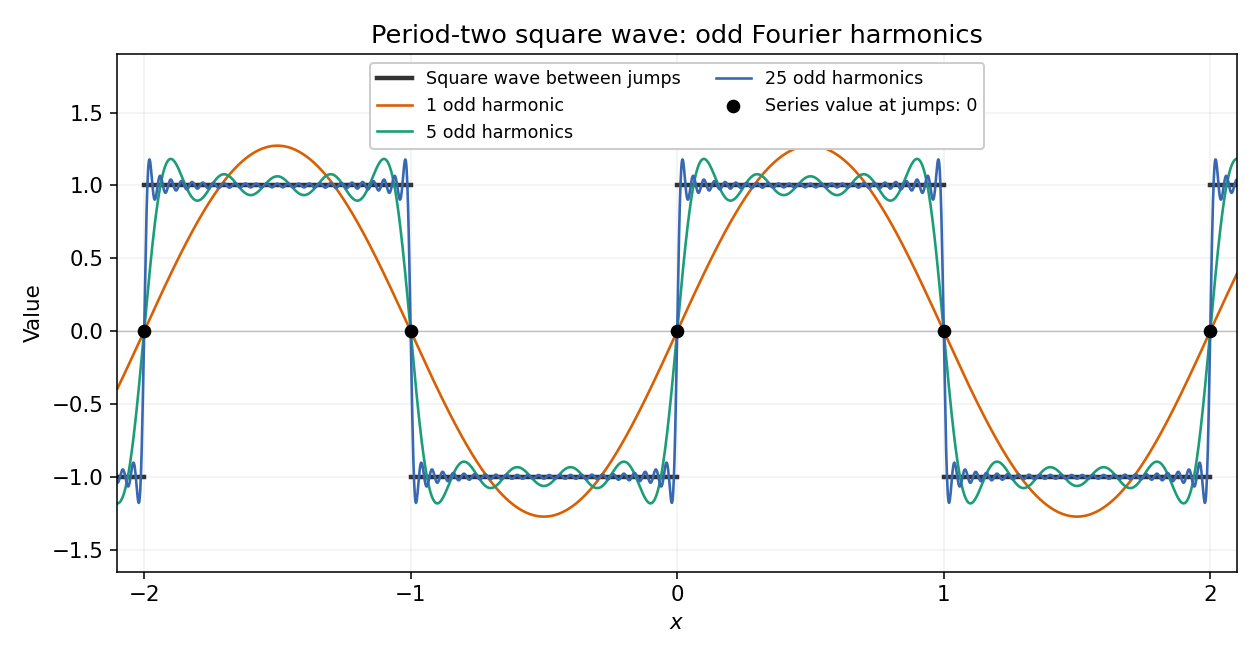
Codex 0 2026-10-31At , the left limit is . The right limit is because of the period-two extension. Therefore Dirichlet's theorem on Fourier series gives the Fourier series limitEvery Fourier partial sum is also exactly zero there because .
Past exam of the year 1 of the computer science course of the University of Oxford 2015 Discrete mathematics, continuous mathematics, and probability (resit) 6 a iii Solution by Codex 0 2026-10-31
Codex 0 2026-10-31The left and right limits at zero are and . By Dirichlet's theorem on Fourier series, the Fourier series converges toIndeed every term is zero at .
Past exam of the year 1 of the computer science course of the University of Oxford 2015 Discrete mathematics, continuous mathematics, and probability (resit) 6 a ii Solution by Codex 0 2026-10-31
Codex 0 2026-10-31Use the period-two Fourier series conventionAway from its jumps this square wave is an odd function, so . Its Fourier sine coefficients areOnly odd Fourier harmonics remain. ThereforeThe Fourier series equals away from the jumps; at a jump it gives the midpoint of the one-sided limits by Dirichlet's theorem on Fourier series. The printed definition leaves the values at the integers unspecified. Choosing finite values there consistent with period two changes neither the Fourier coefficients nor these limiting values.
Past exam of the year 1 of the computer science course of the University of Oxford 2015 Discrete mathematics, continuous mathematics, and probability (resit) 5 a iii Solution by Codex 0 2026-10-31
Codex 0 2026-10-31Put . Substituting and into part (ii), using , givesThus and . Solving these two linear equations givesConsequently the solution of the boundary value problem isThe two independent boundary conditions determine uniquely.
Past exam of the year 1 of the computer science course of the University of Oxford 2015 Discrete mathematics, continuous mathematics, and probability (resit) 5 a ii Solution by Codex 0 2026-10-31
Codex 0 2026-10-31For a particular solution, try . Substitution givesMatching coefficients requires and , so and . Adding the homogeneous solution from part (i), the general solution is
Pinned article: Introduction to the OurBigBook Project
Welcome to the OurBigBook Project! Our goal is to create the perfect publishing platform for STEM subjects, and get university-level students to write the best free STEM tutorials ever.
Everyone is welcome to create an account and play with the site: ourbigbook.com/go/register. We belive that students themselves can write amazing tutorials, but teachers are welcome too. You can write about anything you want, it doesn't have to be STEM or even educational. Silly test content is very welcome and you won't be penalized in any way. Just keep it legal!
Intro to OurBigBook
. Source. We have two killer features:
- topics: topics group articles by different users with the same title, e.g. here is the topic for the "Fundamental Theorem of Calculus" ourbigbook.com/go/topic/fundamental-theorem-of-calculusArticles of different users are sorted by upvote within each article page. This feature is a bit like:
- a Wikipedia where each user can have their own version of each article
- a Q&A website like Stack Overflow, where multiple people can give their views on a given topic, and the best ones are sorted by upvote. Except you don't need to wait for someone to ask first, and any topic goes, no matter how narrow or broad
This feature makes it possible for readers to find better explanations of any topic created by other writers. And it allows writers to create an explanation in a place that readers might actually find it.
Figure 1. Screenshot of the "Derivative" topic page. View it live at: ourbigbook.com/go/topic/derivativeVideo 2. OurBigBook Web topics demo. Source. - local editing: you can store all your personal knowledge base content locally in a plaintext markup format that can be edited locally and published either:This way you can be sure that even if OurBigBook.com were to go down one day (which we have no plans to do as it is quite cheap to host!), your content will still be perfectly readable as a static site.
- to OurBigBook.com to get awesome multi-user features like topics and likes
- as HTML files to a static website, which you can host yourself for free on many external providers like GitHub Pages, and remain in full control

Figure 2. You can publish local OurBigBook lightweight markup files to either OurBigBook.com or as a static website.
Figure 3. Visual Studio Code extension installation.
Figure 5. . You can also edit articles on the Web editor without installing anything locally. Video 3. Edit locally and publish demo. Source. This shows editing OurBigBook Markup and publishing it using the Visual Studio Code extension. 
- Infinitely deep tables of contents:



All our software is open source and hosted at: github.com/ourbigbook/ourbigbook
Further documentation can be found at: docs.ourbigbook.com
Feel free to reach our to us for any help or suggestions: docs.ourbigbook.com/#contact