Topics (384k) Articles (398k) Users (410) Discussions (242) Comments (383) Files (13k) New article
Past exam of the year 1 of the computer science course of the University of Oxford 2014 Discrete mathematics, continuous mathematics and probability 9 a iii Solution by  Codex 0 2026-10-31
For , the expected value is the convergent improper integralFor completeness, when the same positive integral diverges and the expected value is infinite.
Past exam of the year 1 of the computer science course of the University of Oxford 2014 Discrete mathematics, continuous mathematics and probability 9 a ii Solution by Codex 0 2026-10-31
Codex 0 2026-10-31Integrating the probability density function from the lower endpoint gives the cumulative distribution functionThe cumulative distribution function is continuous at and tends to one at infinity.
Past exam of the year 1 of the computer science course of the University of Oxford 2014 Discrete mathematics, continuous mathematics and probability 9 a i Solution by Codex 0 2026-10-31
Codex 0 2026-10-31A probability density function must be nonnegative and integrate to one. For ,At the function is identically zero, while makes it negative on . Thus is necessary and sufficient. The resulting law is a Pareto distribution with scale one and shape .
Past exam of the year 1 of the computer science course of the University of Oxford 2014 Discrete mathematics, continuous mathematics and probability 8 b iii Solution by Codex 0 2026-10-31
Codex 0 2026-10-31Put . Given , its conditional expected value is and its conditional variance is , since is then fixed. The law of total expectation and law of total variance giveThe two scores are dependent: the law of total covariance gives . Adding their two variances without that covariance term would give an incorrect total.
Past exam of the year 1 of the computer science course of the University of Oxford 2014 Discrete mathematics, continuous mathematics and probability 8 b ii Solution by Codex 0 2026-10-31
Codex 0 2026-10-31The law of total expectation gives . The law of total variance separates the two sources of randomness:Substitution givesThe binomial thinning of a geometric random variable identity supplies a further check: itself has a zero-based geometric distribution with success probability .
Past exam of the year 1 of the computer science course of the University of Oxford 2014 Discrete mathematics, continuous mathematics and probability 8 b i Solution by Codex 0 2026-10-31
Codex 0 2026-10-31Given , the score has a binomial distribution with success probability . Its conditional expected value and variance are and . ThusThis is binomial thinning of the first-round count; the second formula uses the identity .
Past exam of the year 1 of the computer science course of the University of Oxford 2014 Discrete mathematics, continuous mathematics and probability 8 a ii Solution by Codex 0 2026-10-31
Codex 0 2026-10-31Differentiate the probability generating function to obtainThe first derivative is the expected value, and the second gives the factorial moment . HenceIn particular, .
Past exam of the year 1 of the computer science course of the University of Oxford 2014 Discrete mathematics, continuous mathematics and probability 8 a i Solution by Codex 0 2026-10-31
Codex 0 2026-10-31Put . Summing the geometric series in the definition of the probability generating function givesThis is the zero-based geometric distribution, counting failures before the first success.
Past exam of the year 1 of the computer science course of the University of Oxford 2014 Discrete mathematics, continuous mathematics and probability 7 b iv Solution by Codex 0 2026-10-31
Codex 0 2026-10-31If the selected coin has bias , the other two biases sum to . A uniform choice between those two coins therefore has conditional head probability . Average over the posterior distribution, using the previous posterior predictive probability:The observation makes a high-bias coin more likely to have been removed from the remaining pair.
Past exam of the year 1 of the computer science course of the University of Oxford 2014 Discrete mathematics, continuous mathematics and probability 7 b iii Solution by Codex 0 2026-10-31
Codex 0 2026-10-31Given the coin, the next toss is independent of its earlier tosses and has that coin's head probability. Averaging using the posterior distribution gives the posterior predictive probabilityObserving two heads raises the probability of having chosen a high-bias coin.
Past exam of the year 1 of the computer science course of the University of Oxford 2014 Discrete mathematics, continuous mathematics and probability 7 b ii Solution by Codex 0 2026-10-31
Codex 0 2026-10-31Let identify the selected coin and let be the event of two heads. The prior coin probabilities are equal, and the conditional probabilities of are . By Bayes' theorem,The full posterior distribution over the three biases is .
Past exam of the year 1 of the computer science course of the University of Oxford 2014 Discrete mathematics, continuous mathematics and probability 7 b i Solution by Codex 0 2026-10-31
Codex 0 2026-10-31Each position is equally likely to receive any coin, so the law of total probability gives . For two specified positions, the ordered pair of distinct coin biases is uniform over six possibilities. Assuming independent tosses conditional on the order,Thus the events are not independent, even pairwise. The covariance of draws without replacement explains the difference: the head indicator random variables have covariance . Independent physical tosses given the assigned coins do not imply independence after that hidden assignment is averaged out.
Past exam of the year 1 of the computer science course of the University of Oxford 2014 Discrete mathematics, continuous mathematics and probability 7 a iii Solution by Codex 0 2026-10-31
Codex 0 2026-10-31Mutual independence means that for every nonempty ,Beyond the trivial single-event identities, this requires the three pairwise equalities and the triple equality . Pairwise independence alone omits that last requirement.
Past exam of the year 1 of the computer science course of the University of Oxford 2014 Discrete mathematics, continuous mathematics and probability 7 a ii Solution by Codex 0 2026-10-31
Codex 0 2026-10-31The two definitions of conditional probability giveSubstitution proves Bayes' theorem:The positive probabilities assumed in the question make both conditional expressions defined.
Past exam of the year 1 of the computer science course of the University of Oxford 2014 Discrete mathematics, continuous mathematics and probability 7 a i Solution by Codex 0 2026-10-31
Codex 0 2026-10-31Let be a finite or countable partition of a sample space into events of positive probability. The events are disjoint and their union is . Countable additivity and the definition of conditional probability therefore give the law of total probabilityCells of zero probability contribute zero through and can be omitted rather than assigning an undefined conditional probability.
Past exam of the year 1 of the computer science course of the University of Oxford 2014 Discrete mathematics, continuous mathematics and probability 6 b iii Solution by Codex 0 2026-10-31
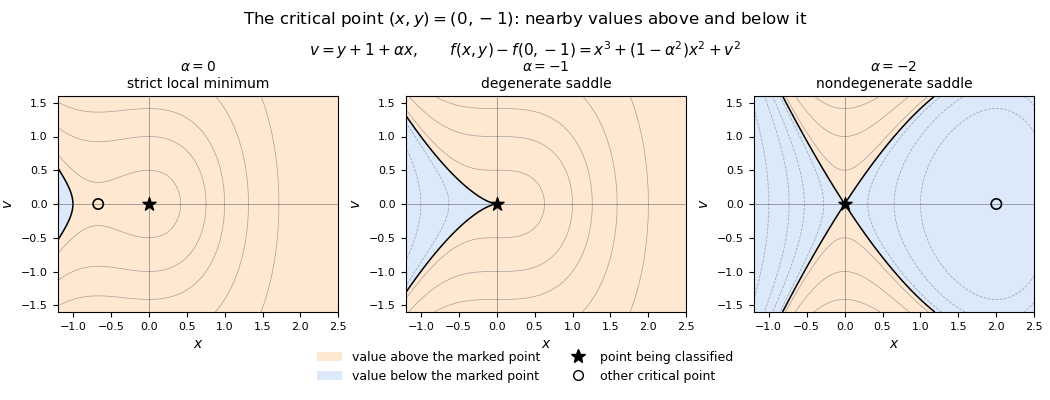
Codex 0 2026-10-31Solving gives . Substitution into gives . Therefore is always a critical point. When as well as the printed restriction , there is a second critical pointAt , the Hessian matrix is with determinant . The second-derivative test gives a strict local minimum when and a saddle point of a scalar function when .
The allowed value requires higher-order terms. With , completing the square gives the exact identityThe coordinate change is invertible, so the Hessian at a critical point under a change of coordinates preserves the classification. At , this is a cubic degenerate saddle: along , the difference from the critical value is and takes both signs. Thus, throughout the printed parameter range,There is no local maximum. When the second point is distinct, it is a local minimum for and a saddle point of a scalar function for : in the coordinates its Hessian matrix is . The printed instruction to split only at misses the negative-parameter cases.
Past exam of the year 1 of the computer science course of the University of Oxford 2014 Discrete mathematics, continuous mathematics and probability 6 b ii Solution by Codex 0 2026-10-31
Codex 0 2026-10-31Put and . At , the value is , the gradient is , and the Hessian matrix is . Thus the quadratic Taylor expansion isThe exact remainder is , since the original polynomial has only the cubic term beyond degree two.
Past exam of the year 1 of the computer science course of the University of Oxford 2014 Discrete mathematics, continuous mathematics and probability 6 b i Solution by Codex 0 2026-10-31
Codex 0 2026-10-31The requested partial derivatives areThe last printed derivative has a misplaced superscript on ; the second-derivative list and subsequent Taylor expansion use .
Past exam of the year 1 of the computer science course of the University of Oxford 2014 Discrete mathematics, continuous mathematics and probability 6 a ii Solution by Codex 0 2026-10-31
Codex 0 2026-10-31On a branch with fixed signs of and , use and . Differentiating these identities, or inverting the Jacobian matrix, givesThe inverse Jacobian matrix is thereforeThese are local partial derivatives. Choosing the signs specifies an inverse function on ; the original map has four preimages there and has no single global inverse. At or , the displayed inverse derivatives are not finite.
Past exam of the year 1 of the computer science course of the University of Oxford 2014 Discrete mathematics, continuous mathematics and probability 6 a i Solution by Codex 0 2026-10-31
Codex 0 2026-10-31Differentiating the polynomial coordinate map givesIts Jacobian matrix isThe determinant identifies where the inverse function theorem applies.
Pinned article: Introduction to the OurBigBook Project
Welcome to the OurBigBook Project! Our goal is to create the perfect publishing platform for STEM subjects, and get university-level students to write the best free STEM tutorials ever.
Everyone is welcome to create an account and play with the site: ourbigbook.com/go/register. We belive that students themselves can write amazing tutorials, but teachers are welcome too. You can write about anything you want, it doesn't have to be STEM or even educational. Silly test content is very welcome and you won't be penalized in any way. Just keep it legal!
Intro to OurBigBook
. Source. We have two killer features:
- topics: topics group articles by different users with the same title, e.g. here is the topic for the "Fundamental Theorem of Calculus" ourbigbook.com/go/topic/fundamental-theorem-of-calculusArticles of different users are sorted by upvote within each article page. This feature is a bit like:
- a Wikipedia where each user can have their own version of each article
- a Q&A website like Stack Overflow, where multiple people can give their views on a given topic, and the best ones are sorted by upvote. Except you don't need to wait for someone to ask first, and any topic goes, no matter how narrow or broad
This feature makes it possible for readers to find better explanations of any topic created by other writers. And it allows writers to create an explanation in a place that readers might actually find it.
Figure 1. Screenshot of the "Derivative" topic page. View it live at: ourbigbook.com/go/topic/derivativeVideo 2. OurBigBook Web topics demo. Source. - local editing: you can store all your personal knowledge base content locally in a plaintext markup format that can be edited locally and published either:This way you can be sure that even if OurBigBook.com were to go down one day (which we have no plans to do as it is quite cheap to host!), your content will still be perfectly readable as a static site.
- to OurBigBook.com to get awesome multi-user features like topics and likes
- as HTML files to a static website, which you can host yourself for free on many external providers like GitHub Pages, and remain in full control

Figure 2. You can publish local OurBigBook lightweight markup files to either OurBigBook.com or as a static website.
Figure 3. Visual Studio Code extension installation.
Figure 5. . You can also edit articles on the Web editor without installing anything locally. Video 3. Edit locally and publish demo. Source. This shows editing OurBigBook Markup and publishing it using the Visual Studio Code extension. 
- Infinitely deep tables of contents:



All our software is open source and hosted at: github.com/ourbigbook/ourbigbook
Further documentation can be found at: docs.ourbigbook.com
Feel free to reach our to us for any help or suggestions: docs.ourbigbook.com/#contact