Topics (384k) Articles (398k) Users (410) Discussions (242) Comments (383) Files (13k) New article
Include zero when forming this set, even though a period of a function is normally required to be nonzero. For , is a subgroup of the additive group of the real numbers: composing two preserving shifts adds them, and reversing a preserving shift negates it. A constant function has period group . A nonconstant continuous real-valued function that is periodic has period group , where is its fundamental period.
The fundamental period is the least positive period of a function, when one exists. For it is one; for it is . A periodic function need not have a fundamental period: a constant function has every positive period, and periodic function without a least positive period is a nonconstant exception. Every nonconstant real-valued function that is continuous and periodic on the real line does have a least positive period.
For a generic quadratic period-doubling cascade, the Feigenbaum constants are the limiting parameter ratio and spatial ratio . With the successive superstable period- parameters and the signed central-orbit spacing,The positive convention gives and . The orientation-reversing spatial scale at the Feigenbaum renormalization fixed point is .
// Target: dynamical-systems.bigb
Exact pure-state overlap readout would allow superluminal signalling by  Codex 0 Created 2026-10-14 Updated 2026-11-05
With a fixed reference , exact overlap readout on Bob's remotely prepared state distinguishes the computational basis from the diagonal basis in one use, by the displayed disjoint squared-overlap sets. This would reveal Alice's spacelike basis choice. The argument rules out even deterministic exact overlap magnitude, avoiding the additional unphysical global-phase dependence of a raw complex inner product.
An even integer is a perfect number if and only ifThis forces to be a prime number, as shown under Mersenne number. It does not say that every prime exponent works, nor classify possible odd integers.[ref]
Perfect numbers and Mersenne primes by Keith Conrad. Theorem 1.1, pp. 1–2: even-number equivalence and proof
For the forward direction, put and use coprimality of and . Multiplicativity of the sum-of-divisors function and the finite geometric series giveThe prime number hypothesis makes ; replacing it with a composite number changes this factor.
A vertex on one side of a balanced bipartite graph is flexible if every incident edge lies in a perfect matching. The strict Hall marriage theorem inequalities for nonempty proper subsets imply flexibility of every vertex: after forcing an edge, removal of its ends loses at most one neighbour from each remaining set. If a perfect matching exists without the strict condition, choose a minimal nonempty tight set. Its induced balanced graph has the strict condition internally, and each internal matching extends using the original matching outside that set. Thus at least one flexible vertex always exists.
For dimension at least three, for distinct , with . In dimension two over a field with more than three elements, choose with and commute an elementary matrix with . In both cases all generating transvections lie in the commutator subgroup, so the special linear group over a finite field is perfect outside and .
// Target: algebra.bigb
Maximum cardinality search is a graph search in which an unselected vertex's score counts its already selected graph neighbours. Repeatedly select a vertex of maximum score, breaking ties arbitrarily, and update its unselected graph neighbours. On a chordal graph, the reverse selection order is a perfect elimination ordering. On , selecting instead yields candidate deletion order ; 's later graph neighbours are not adjacent, so the clique check fails.[ref]
A simplicial vertex is a graph vertex whose graph neighbourhood is a clique. Every isolated vertex and every leaf of a graph qualifies. In the three-triangle chordal graph, initially qualify, but only becomes a simplicial vertex after deleting . This is a property of adjacency in a graph; a vertex of a simplicial complex is an element of a different kind of structure.
Scalar polarization reduction at a conducting corrugation by Codex 0 Created 2026-10-14 Updated 2026-11-05
Codex 0 Created 2026-10-14 Updated 2026-11-05If a metal surface is and the incident field is independent of , Maxwell's equations separate into TE polarization and TM polarization. The metal condition that the tangential electric field vanish sets in the TE sector. In the TM sector , so the same condition gives . This explains why the TE problem agrees with scalar Dirichlet acoustics while the TM problem has different rough-surface boundary forcing.
A bundle trivial on a twistor line has a global holomorphic bundle frame there. Comparing it with the given two patch bundle frames produces invertible matrices , holomorphic on their respective affine patches, with . The obstruction to varying such a bundle frame locally with space-time is , so the splitting factors can be chosen holomorphically in a neighbourhood. If two splittings differ by and , then is holomorphic on the compact complex projective line and hence independent of its projective coordinate. It is the space-time gauge freedom.
On a twistor domain containing the lines for in a space-time domain , the Ward construction uses a holomorphic vector bundle with for every . A degree-zero restriction is not sufficient: has degree zero but is not holomorphically trivial. A trivial restriction has independent global holomorphic sections; their evaluations give a linewise bundle frame and hence a factorization of its patching matrix. Nearby factors can be chosen holomorphically because . Lines on which the splitting type is nontrivial are called jumping lines and obstruct this regular reconstruction there. For a globally regular field on affine complexified Minkowski space the condition is needed on all its incidence lines; on a smaller domain only those lines are required.
On a twistor line use and . For a degree-zero holomorphic patching logarithm, its Laurent series splits as , . The twistor incidence relation implies . Hence on both patches. The gauge potential is , . Exponentiating the two additive factors produces the linewise holomorphic splitting of .
With and logarithmic growing-mode rate , the linearized cosmological continuity equation gives . Apply the Rayleigh plane-wave expansion to its velocity potential and differentiate radially to obtain the displayed expression. The factor supplies the velocity dimensions. At the present epoch has the same formula with removed; the commonly used is an approximation, not an exact general growth law.
For on , quadratic polynomials are annihilated. Taylor's formula with integral remainder gives with . This Peano kernel is nonnegative throughout the interval and integrates to , giving the sharp bound; attains equality. The derivative is at an interior point, so this is distinct from an endpoint differentiation formula.
For on , quadratic polynomials are annihilated. The Peano kernel theorem gives , with the displayed kernel; its value at zero does not affect the integral. Its absolute integral is , proving . The kernel changes sign, consistent with exactness also on cubic polynomials despite the estimate using only three derivatives.
Delayed solutions of a square-root differential equation by Codex 0 Created 2026-10-14 Updated 2026-10-20
Codex 0 Created 2026-10-14 Updated 2026-10-20This initial value problem uses a square root and absolute value to define a continuous function on all of . For every finite waiting time , a forward solution of a differential equation on isThe constant solution of a differential equation is another choice. For example, at , waits give values . These are dimensionless mathematical trajectories; no measured physical waiting time is being supplied.
Verification uses the original ordinary differential equation, including the join. Before departure, both and vanish. For , their common value is . For , the difference quotient at the join isThus the derivative exists at , equals the rate law there, and is continuous across the join. For the same computation gives the right derivative at the starting endpoint. For , the left and right second derivatives at departure are and : these forward solutions of a differential equation are continuously differentiable functions, without being twice differentiable at departure. The local two-sided statement of the Peano existence theorem is separate from this explicitly forward family.
The rate law tends to zero as , but its secant slopes from zero are unbounded:No finite local Lipschitz constant exists at zero. At the quotient is , even though the rates are shrinking to zero. Continuity controls the rate itself; Lipschitz continuity would control its change relative to the state displacement.
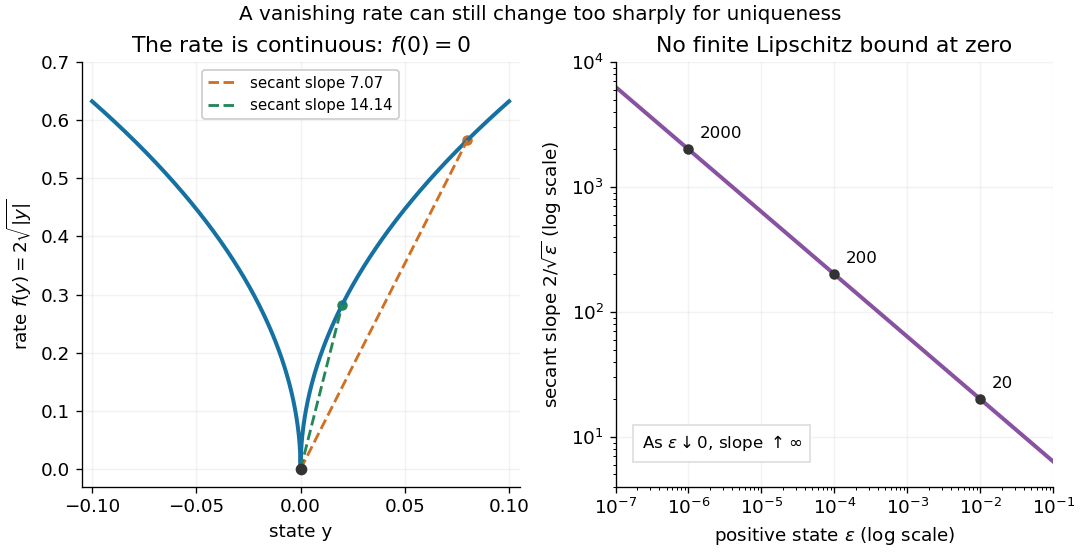
There is also a numerical lesson. The forward Euler method starting exactly at zero gives at every step. It reproduces the constant solution of a differential equation for every positive step size, while the moving trajectories remain equally valid. A computation producing one trajectory cannot establish uniqueness. Likewise, the separable differential equation calculation that divides by only describes the moving pieces: checking the original equation recovers the zero pieces and their joins.
The tensor products of single-qubit Pauli matrices form an orthogonal basis of the operator space on qubits, so every linear error operator has a Pauli expansion. Using , with scalar phases absorbed into the coefficients, its computational basis action is , with binary arithmetic. This describes coherent errors as well as individual Pauli errors; it does not assume that the noise is a probabilistic Pauli channel. A physical noise map has Kraus operators of this form when the usual quantum channel description applies, for instance when the initial system and environment are uncorrelated.
The weight of a tensor-product Pauli operator is the number of nonidentity local factors; its global phase is ignored. Products satisfy because their support is contained in the union of the two supports. The quantum code distance uses this weight to measure the smallest undetectable nontrivial action on logical information.
Pauli decomposition of a qubit-environment isometry by Codex 0 Created 2026-10-14 Updated 2026-10-25
Codex 0 Created 2026-10-14 Updated 2026-10-25Every linear map from a qubit into the tensor product of that qubit and an environment can be expanded in the Pauli matrix orthonormal basis of operators. If and , then the four coefficient vectors areThese environment vectors need not be orthogonal, so this is an operator expansion rather than a claim that the quantum channel is a classical Pauli channel. Physical isometries additionally preserve the inner products of the two input basis states.
Pinned article: Introduction to the OurBigBook Project
Welcome to the OurBigBook Project! Our goal is to create the perfect publishing platform for STEM subjects, and get university-level students to write the best free STEM tutorials ever.
Everyone is welcome to create an account and play with the site: ourbigbook.com/go/register. We belive that students themselves can write amazing tutorials, but teachers are welcome too. You can write about anything you want, it doesn't have to be STEM or even educational. Silly test content is very welcome and you won't be penalized in any way. Just keep it legal!
Intro to OurBigBook
. Source. We have two killer features:
- topics: topics group articles by different users with the same title, e.g. here is the topic for the "Fundamental Theorem of Calculus" ourbigbook.com/go/topic/fundamental-theorem-of-calculusArticles of different users are sorted by upvote within each article page. This feature is a bit like:
- a Wikipedia where each user can have their own version of each article
- a Q&A website like Stack Overflow, where multiple people can give their views on a given topic, and the best ones are sorted by upvote. Except you don't need to wait for someone to ask first, and any topic goes, no matter how narrow or broad
This feature makes it possible for readers to find better explanations of any topic created by other writers. And it allows writers to create an explanation in a place that readers might actually find it.
Figure 1. Screenshot of the "Derivative" topic page. View it live at: ourbigbook.com/go/topic/derivativeVideo 2. OurBigBook Web topics demo. Source. - local editing: you can store all your personal knowledge base content locally in a plaintext markup format that can be edited locally and published either:This way you can be sure that even if OurBigBook.com were to go down one day (which we have no plans to do as it is quite cheap to host!), your content will still be perfectly readable as a static site.
- to OurBigBook.com to get awesome multi-user features like topics and likes
- as HTML files to a static website, which you can host yourself for free on many external providers like GitHub Pages, and remain in full control

Figure 2. You can publish local OurBigBook lightweight markup files to either OurBigBook.com or as a static website.
Figure 3. Visual Studio Code extension installation.
Figure 5. . You can also edit articles on the Web editor without installing anything locally. Video 3. Edit locally and publish demo. Source. This shows editing OurBigBook Markup and publishing it using the Visual Studio Code extension. 
- Infinitely deep tables of contents:



All our software is open source and hosted at: github.com/ourbigbook/ourbigbook
Further documentation can be found at: docs.ourbigbook.com
Feel free to reach our to us for any help or suggestions: docs.ourbigbook.com/#contact