Topics (384k) Articles (398k) Users (410) Discussions (242) Comments (383) Files (13k) New article
For , these continuous functions on have maximum one and integral . Their supports shrink towards zero while their value at zero remains zero. They converge pointwise to zero and their integrals converge to zero, but their convergence is not uniform convergence. Thus convergence of integrals and continuity of the pointwise limit do not imply uniform convergence.
Factorial cosine iterated limit detects rationality by  Codex 0 Created 2026-10-14 Updated 2026-10-25
For fixed , the inner limit is one precisely when is an integer, and zero otherwise, because exactly at integers and powers of a number with modulus below one tend to zero. If is a rational number, divides for every , making the inner limit eventually one. If is an irrational number, multiplication by a nonzero integer cannot make it integral, making every inner limit zero. The order of the two limits is essential to this argument.
For finite matrices satisfying , with not a root of unity, sends the generalized eigenspace of at into the one at . Finiteness of the spectrum makes nilpotent on the sum of the nonzero generalized eigenspaces. Exchanging gives the corresponding statement for . Splitting the zero generalized eigenspace of by that of gives the displayed invariant direct sum; both operators are nilpotent on .
Deflection changes one light ray's direction; focusing concerns relative directions of neighboring light rays and their bundle's cross section. To see the difference for a point-mass gravitational lens, send parallel incident light rays past the lens. A ray at impact parameter meets the optical axis approximately beyond the lens. Doubling quadruples this crossing distance. Thus the lens does not have a common focal length for all rays, although it can produce lensing magnification and an Einstein ring for a specified source-observer geometry.
The point-mass gravitational lens also illustrates why focusing must not be identified just with positive lensing convergence. Away from the central mass, differentiate the reduced deflection : its two-dimensional divergence is zero, so there. Nevertheless its radial and tangential derivatives differ, giving lensing shear of magnitude and . A vacuum ray bundle can be distorted and magnified. In the same ideal transparent geometrical optics model, surface brightness is preserved; the larger apparent solid angle supplies the increased received light.
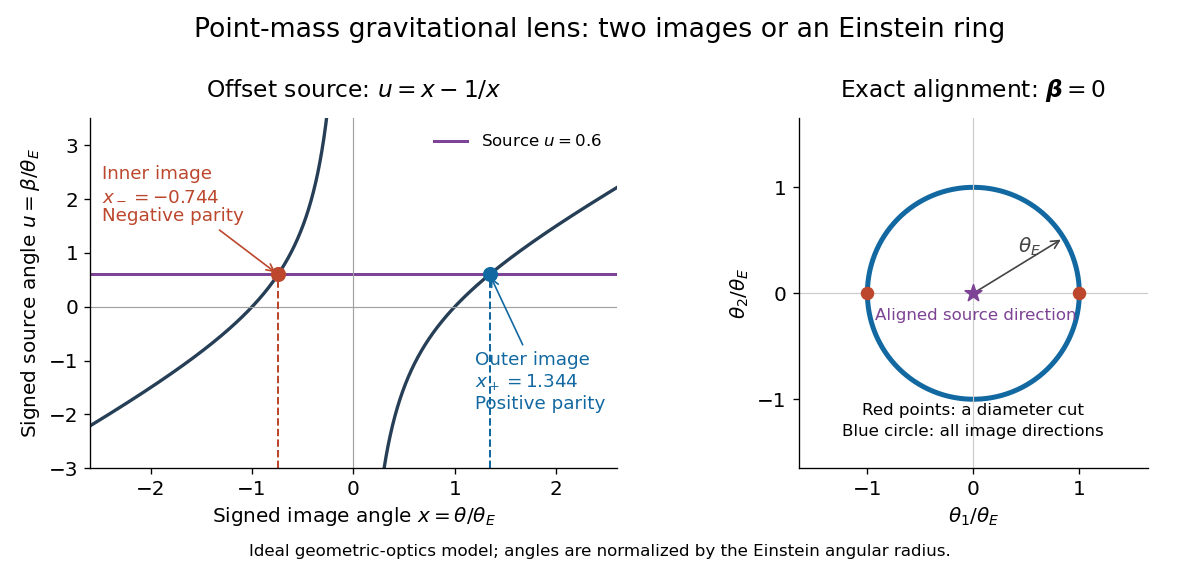
Choose a signed angular coordinate along the source-lens line. The point-mass gravitational lens becomesFor , multiplication by gives the quadratic equation . Its positive discriminant yields the two displayed roots. Their product is , so they lie on opposite sides of the lens. With , and : the outer image lies on the source side. For , the outer image is instead the minus root. These are image directions seen by the observer, not two emitting objects.[ref]
Gravitational Lensing by Matthias Bartelmann. Section 2.2, printed pp. 15-16, equations (100)-(110): point-mass model, two roots, critical circle and magnification
For a dimensionless example, set and . Solving gives and , with separation . The lensing magnification follows from image parity in gravitational lensing: , , and total amplification . Changing or the distances rescales the angles through the Einstein angular radius, while these dimensionless values remain the same.
For , the quadratic equation gives and . Using , the outer image tends to unit lensing magnification and the inner image has . Two mathematical images can therefore look like one at finite sensitivity or angular resolution. Furthermore, the inner impact parameter eventually becomes too small for the stated weak-field approximation or passes through the opaque lens: the ideal formula must then be replaced by an appropriate physical model.
For a nonconstant holomorphic map into the unit disc, the displayed density pulls the target hyperbolic metric back to the source Euclidean coordinate. It is not the operator norm between two hyperbolic tangent spaces, which additionally divides by the source metric density. Away from ramification points ; a ramification point of multiplicity adds times its point mass to the distributional Laplacian.
Under the Cayley transform between the half-plane and disk, a radial segment ending at a boundary point becomes a vertical half-ray. If a point is within hyperbolic distance of that half-ray, it lies in a fixed angular sector. Indeed, in the complex upper half-plane, . This converts bounded hyperbolic approach to a boundary point into nontangential approach, allowing normal-family proof of angular boundary convergence to transfer radial limits of bounded holomorphic functions.
Poincare inequality with a positive-measure zero set by Codex 0 Created 2026-10-14 Updated 2026-10-31
Codex 0 Created 2026-10-14 Updated 2026-10-31Suppose vanishes on a measurable subset of measure at least , with . Writing for its mean, the zero set gives . Thus , and the Poincare-Wirtinger inequality supplies the displayed estimate. An elementary proof of that inequality on a ball bounds differences along line segments and splits the segment parameter at , giving the valid explicit constant . The change of scale from the unit ball multiplies the constant by .
Finite-index invariance of Poincare duality for torsion-free groups by Codex 0 Created 2026-10-14 Updated 2026-11-05
Codex 0 Created 2026-10-14 Updated 2026-11-05For a torsion-free group and finite-index subgroup , is a Poincare duality group of dimension if and only if is. Finite-index induction and coinduction of coincide and give , so Shapiro's lemma identifies their group-ring cohomology as abelian groups. The finite-index finiteness and cohomological-dimension lemmas supply finite projective resolutions. Without torsion-freeness of the converse fails: contains the index-two subgroup but has infinite integral cohomological dimension.
For an extension with kernel a dimension- Poincare duality group and quotient a dimension- Poincare duality group, apply the Lyndon–Hochschild–Serre spectral sequence to the ambient group ring. Kernel cohomology is concentrated in degree and is a regular quotient module with a rank-one orientation twist. Quotient cohomology is then concentrated in degree with underlying group . The extension resolution supplies finiteness and gives cohomological dimension at most , proving duality in that dimension. Orientation actions need not be trivial.
An infinite-index subgroup of an integral dimension- Poincare duality group has integral cohomological dimension at most . No finiteness assumption on the subgroup is needed for this inequality. In dimension three it places every infinite-index subgroup in cohomological dimension at most two.
Every integral dimension-two Poincare duality group is the fundamental group of a closed aspherical topological surface. Orientable examples are the torus and closed surfaces of genus at least two. Nonorientable aspherical closed surfaces supply the orientation-twisted examples.
Let be a normal finitely presented group inside a dimension-three Poincare duality group , with containing an element of infinite order. Then is either a free group or a dimension-two Poincare duality group. The Strebel infinite-index subgroup theorem gives . If the dimension is two, take the preimage of an infinite cyclic subgroup of the quotient. The cyclic-extension shift of group-ring cohomology gives dimension three, forcing this preimage to have finite index by Strebel. Its duality then gives concentrated in degree two with top group . The quotient is virtually cyclic, and surface automorphism realization gives a finite-index surface mapping-torus group.
A Möbius transformation of the ideal two-sphere extends uniquely to an orientation-preserving isometry of three-dimensional hyperbolic space. In upper half-space, translations, complex similarities, and extend respectively to , , and . Each preserves ; composing these extensions constructs the general case. Ball-origin stabilizers are ordinary rotations, represented on the boundary by modulo its central signs.
A minimum-weight set meeting every bottom-to-top path can be chosen entirely in the endpoint layers. The local step is a three-layer channel whose middle layer is a minimum cut. Replacing middle subsets by their successors or predecessors gives expansion inequalities. Sorting middle vertices by incoming degree and top vertices by their largest predecessor degree gives one edge-count inequality; reversing the graph gives the opposite inequality. Equality forces the bottom layer to have the same weight as the middle cut. Replacing the highest intermediate portion of a minimum cut by this bottom layer repeatedly proves the assertion.
The Plücker embedding of is a smooth projective quadric in . An antisymmetric matrix is nonzero and decomposable precisely when its Pfaffian vanishes, giving the displayed equation. The wedge pairing of two points on this quadric vanishes exactly when the corresponding two-planes intersect. Thus the Klein quadric carries the complex conformal null-separation relation of complexified compactified Minkowski space.
A line in real projective space is the span of two independent homogeneous vectors . Its Plücker coordinates are the entries of the displayed rank-two antisymmetric matrix, determined up to a nonzero scalar. They satisfy . With a chosen volume orientation, its dual plane form is . This is projective duality using the volume form, not lowering indices with a Euclidean metric.
A regular icosahedron is a Platonic solid with twenty equilateral triangular faces, twelve vertices and thirty edges. Five faces meet at each vertex. Its orientation-preserving rotational symmetry has order sixty: the orbit-stabilizer theorem gives twenty faces times the three rotations stabilizing a chosen face.
Pinned article: Introduction to the OurBigBook Project
Welcome to the OurBigBook Project! Our goal is to create the perfect publishing platform for STEM subjects, and get university-level students to write the best free STEM tutorials ever.
Everyone is welcome to create an account and play with the site: ourbigbook.com/go/register. We belive that students themselves can write amazing tutorials, but teachers are welcome too. You can write about anything you want, it doesn't have to be STEM or even educational. Silly test content is very welcome and you won't be penalized in any way. Just keep it legal!
Intro to OurBigBook
. Source. We have two killer features:
- topics: topics group articles by different users with the same title, e.g. here is the topic for the "Fundamental Theorem of Calculus" ourbigbook.com/go/topic/fundamental-theorem-of-calculusArticles of different users are sorted by upvote within each article page. This feature is a bit like:
- a Wikipedia where each user can have their own version of each article
- a Q&A website like Stack Overflow, where multiple people can give their views on a given topic, and the best ones are sorted by upvote. Except you don't need to wait for someone to ask first, and any topic goes, no matter how narrow or broad
This feature makes it possible for readers to find better explanations of any topic created by other writers. And it allows writers to create an explanation in a place that readers might actually find it.
Figure 1. Screenshot of the "Derivative" topic page. View it live at: ourbigbook.com/go/topic/derivativeVideo 2. OurBigBook Web topics demo. Source. - local editing: you can store all your personal knowledge base content locally in a plaintext markup format that can be edited locally and published either:This way you can be sure that even if OurBigBook.com were to go down one day (which we have no plans to do as it is quite cheap to host!), your content will still be perfectly readable as a static site.
- to OurBigBook.com to get awesome multi-user features like topics and likes
- as HTML files to a static website, which you can host yourself for free on many external providers like GitHub Pages, and remain in full control

Figure 2. You can publish local OurBigBook lightweight markup files to either OurBigBook.com or as a static website.
Figure 3. Visual Studio Code extension installation.
Figure 5. . You can also edit articles on the Web editor without installing anything locally. Video 3. Edit locally and publish demo. Source. This shows editing OurBigBook Markup and publishing it using the Visual Studio Code extension. 
- Infinitely deep tables of contents:



All our software is open source and hosted at: github.com/ourbigbook/ourbigbook
Further documentation can be found at: docs.ourbigbook.com
Feel free to reach our to us for any help or suggestions: docs.ourbigbook.com/#contact