Topics (384k) Articles (398k) Users (410) Discussions (242) Comments (383) Files (13k) New article
A maximal element has no strictly greater element; a minimal element has no strictly smaller one. Either can be nonunique, unlike a greatest or least element. These notions are defined for arbitrary partially ordered sets.
A greatest element lies above every member of an ordered set, and a least element lies below every member. Antisymmetry makes either unique if it exists. A greatest element is maximal, but a maximal element need not be greatest.
In a partially ordered set , an upper set satisfies and ; a lower set satisfies and . The complement of a set exchanges the two conditions: if and , then would force , so is lower. In a Boolean lattice ordered by inclusion, these are the up-set and down-set conditions.
An ordered group whose partial order is a lattice. Each pair has a join and a meet . Translations preserve these operations, for example . Pointwise maximum and minimum make the order automorphisms of a chain into a lattice-ordered group.
The nonnegative cone determines the partial order by . It contains the identity element, is closed under products and conjugation, and intersects its inverse only in the identity. Conversely these conditions define a two-sided invariant partial order. Its strictly positive part omits the identity; conventions for differ, so specify which is intended.
Ancillary conditioning that eliminates a nuisance parameter by  Codex 0 Created 2026-10-14 Updated 2026-11-05
For a sufficient statistic and parameter , a useful strong reduction requires the law of to be free of and the conditional distribution of given to be free of the nuisance parameter . In the discrete case it giveswhere sums to one on each fiber, sums to one over , and sums to one over separately for every fixed . Ordinary ancillarity, or just the law of being free of , does not by itself guarantee that conditioning removes .
Keep as independent fair bits, introduce an independent Bernoulli random variable with , and set . The extra bit flips the integer parity rule with probability . For each even-integer parity triple the probability is ; for each odd-integer parity triple it is .
Every coordinate remains fair, and every pair remains independent for every . For example, after fixing , the fair independent makes fair regardless of . A pair's joint probability distribution therefore does not change as noise destroys the three-way relation.
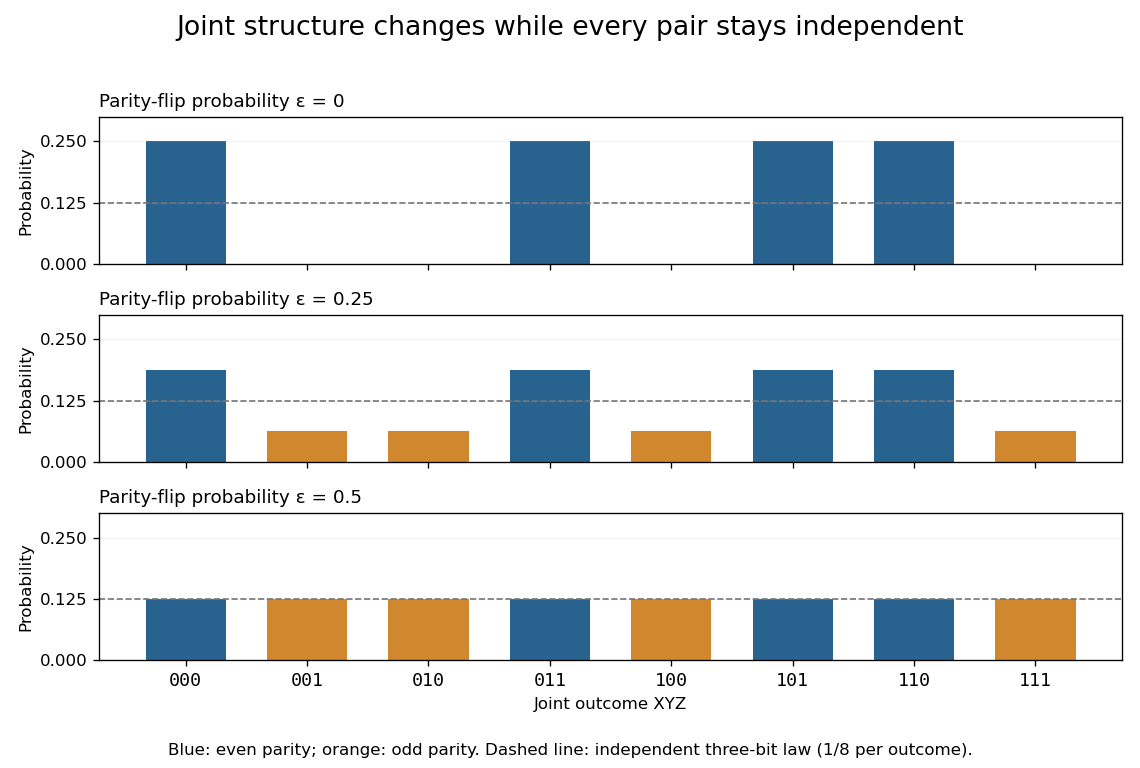
Knowing , uncertainty in is exactly the uncertainty in . The chain rule for information entropy giveswhere is binary entropy. HenceAt , the result is approximately bits, although all three pairwise mutual informations are zero. At , all eight triples have probability , giving joint independence and zero total correlation. At , the complementary integer parity rule is deterministic again, so total correlation returns to one bit.
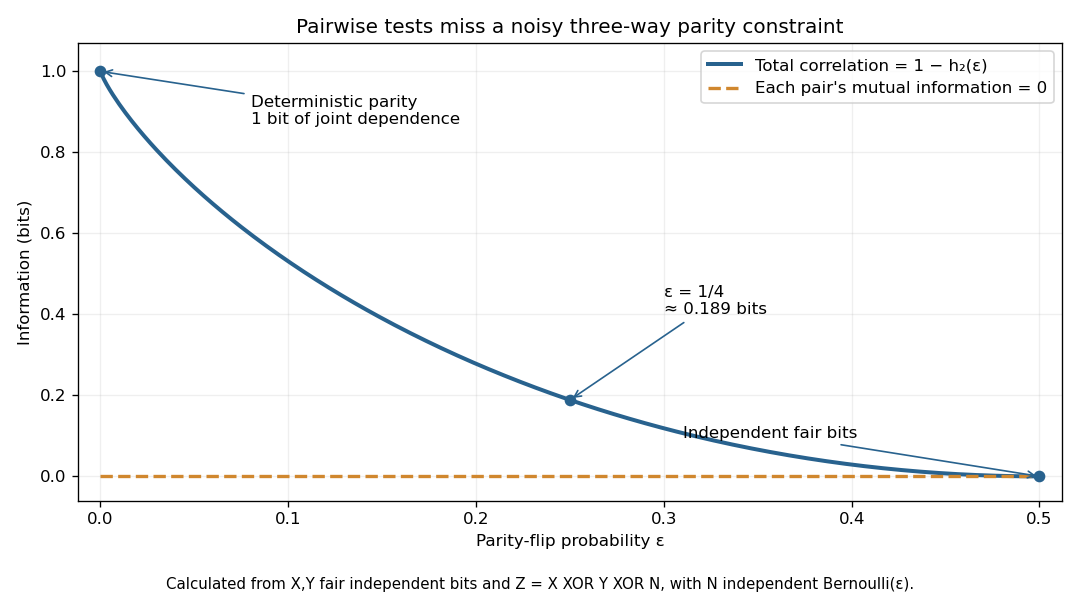
The example distinguishes "there is a dependence" from "a pair reveals it." Once are known together, is predictable at zero noise; knowing either one alone leaves a fair bit. Total correlation detects the joint departure from independence, but does not by itself specify which variables cause which others.
If a binary length- cyclic code has generator of degree and check polynomial of degree , use the coefficient vectors of as the rows of a parity-check matrix. They have distinct leading positions and are independent. Their scalar products with a word are the coefficients of in its product with , which vanish for codewords.
// Target: algebra.bigb
Let over the field with two elements and write . In the quotient ring , multiplication by is represented on coefficient column vectors by the circulant matrixThe kernel is a cyclic code, because multiplication by preserves the condition .
More precisely, set and write , , with and coprime polynomials. Then if and only if . Hence the kernel is generated by , has dimension , and has rank . Selecting independent rows of therefore gives a parity-check matrix for this cyclic code, even when was not supplied as a canonical check polynomial. If for a divisor of , the kernel is exactly the cyclic code generated by .
// Target: algebra.bigb
In the usual column convention, a codeword of a linear code obeys , so its nonzero coordinates give a linear dependence among columns of its parity-check matrix. Conversely a dependence gives a nonzero codeword supported on those coordinates. Minimizing the support gives the minimum Hamming distance of a linear code. In the transposed convention , the corresponding objects are the rows of . The size of a dependent set means the number of its coordinate positions, even when some check vectors coincide.
For a cyclic code whose generator polynomial has distinct roots in a splitting field , the rows impose precisely the codeword conditions . Expanding each value in a basis of over the original finite field, then discarding dependent equations, gives a parity-check matrix over that field of rank . Alternatively choose one root from each Frobenius conjugate orbit and expand its value in the field it generates.
Writing and , the squared amplitude is . Reality of the square root does not guarantee positivity. For example, gives two negative roots. Under the usual supercritical assumptions , the plus root is positive whenever the discriminant is nonnegative.
// Destination: mathematical-biology.bigb
Products of two univariate bases form a surface basis. Nonnegativity, partition of unity and coordinate-wise linear precision pass to the products by multiplication of the respective univariate identities. If the factors are and , each mixed derivative through orders is the product of the corresponding derivatives, giving continuous mixed derivatives and joint regularity.
Core numerical enquiries return a surface point and its derivatives through second order, together with the parameter domain, patch boundaries and regularity information. At a regular point these determine its tangent plane, normal vector, first and second fundamental forms and curvatures. Subdivision and certified enclosing volumes provide spatial search and intersection support. Singular charts or discontinuity boundaries require one-sided or alternative-chart information; a zero cross product does not define a unique normal vector.
For nonnegative barycentric parameters, these total-degree Bernstein basis functions define a surface over a triangle. The triangular control net has points. Its index constraint couples the three exponents, so it is not a tensor product of two independent univariate bases. The multinomial theorem gives nonnegativity and partition of unity.
A general conical surface is swept out by straight generators through one apex . An invertible affine map sends it to another such surface, since it sends each generator to a line through the transformed apex. A projective transformation preserves the projective concurrence of generators, but can send the apex to infinity, producing parallel generators in the affine chart. Therefore finite-apex cones and cylinders are not separately projectively invariant Euclidean classes.
A cycloid is the plane curve traced by a point on a circle rolling without slipping along a straight line. A parametrization with rolling radius is , ; reversing the sign of reflects the curve. Its cusps occur at integer multiples of . A descending cycloidal arc solves the classical brachistochrone problem.
A parametric curve interface supplies its parameter domain, evaluation, and derivatives where they exist. Robust geometric algorithms also need restricted subcurves and certified range or derivative bounds on parameter intervals. Tangent, speed and curvature are derived from point and derivative enquiries when the relevant derivatives are regular. Finite point samples alone cannot certify the absence of every plane intersection of an arbitrary smooth curve.
A variable normal offset displaces a parametric surface along its unit normal vector by a scalar field . Unlike a constant-distance parallel surface, its derivatives also contain and .
// Target: analysis.bigb
Pinned article: Introduction to the OurBigBook Project
Welcome to the OurBigBook Project! Our goal is to create the perfect publishing platform for STEM subjects, and get university-level students to write the best free STEM tutorials ever.
Everyone is welcome to create an account and play with the site: ourbigbook.com/go/register. We belive that students themselves can write amazing tutorials, but teachers are welcome too. You can write about anything you want, it doesn't have to be STEM or even educational. Silly test content is very welcome and you won't be penalized in any way. Just keep it legal!
Intro to OurBigBook
. Source. We have two killer features:
- topics: topics group articles by different users with the same title, e.g. here is the topic for the "Fundamental Theorem of Calculus" ourbigbook.com/go/topic/fundamental-theorem-of-calculusArticles of different users are sorted by upvote within each article page. This feature is a bit like:
- a Wikipedia where each user can have their own version of each article
- a Q&A website like Stack Overflow, where multiple people can give their views on a given topic, and the best ones are sorted by upvote. Except you don't need to wait for someone to ask first, and any topic goes, no matter how narrow or broad
This feature makes it possible for readers to find better explanations of any topic created by other writers. And it allows writers to create an explanation in a place that readers might actually find it.
Figure 1. Screenshot of the "Derivative" topic page. View it live at: ourbigbook.com/go/topic/derivativeVideo 2. OurBigBook Web topics demo. Source. - local editing: you can store all your personal knowledge base content locally in a plaintext markup format that can be edited locally and published either:This way you can be sure that even if OurBigBook.com were to go down one day (which we have no plans to do as it is quite cheap to host!), your content will still be perfectly readable as a static site.
- to OurBigBook.com to get awesome multi-user features like topics and likes
- as HTML files to a static website, which you can host yourself for free on many external providers like GitHub Pages, and remain in full control

Figure 2. You can publish local OurBigBook lightweight markup files to either OurBigBook.com or as a static website.
Figure 3. Visual Studio Code extension installation.
Figure 5. . You can also edit articles on the Web editor without installing anything locally. Video 3. Edit locally and publish demo. Source. This shows editing OurBigBook Markup and publishing it using the Visual Studio Code extension. 
- Infinitely deep tables of contents:




All our software is open source and hosted at: github.com/ourbigbook/ourbigbook
Further documentation can be found at: docs.ourbigbook.com
Feel free to reach our to us for any help or suggestions: docs.ourbigbook.com/#contact