Topics (384k) Articles (398k) Users (410) Discussions (242) Comments (383) Files (13k) New article
Osmotic pressure is the excess pressure needed on a chemical solution to maintain osmotic thermodynamic equilibrium with pure solvent across a semipermeable membrane. For a nearly incompressible solvent, equality of chemical potential gives . It is an equilibrium property; an observed initial swelling rate is a different measurement.[ref]
osmotic pressure. Gold Book, osmotic pressure: equilibrium definition, solvent activity formula and dilute ideal limit
For a dilute ideal chemical solution of retained particles,Here is the amount of substance of independently dissolved solute particles, measured in moles; is the final volume of chemical solution, not the starting volume of pure solvent. Count the resulting ions separately if a solute dissociates; do not multiply twice if already counts them. With in and in , has units . This resembles the ideal gas law, although the particles here are dissolved in a liquid.
The assumptions are uniform temperature, a dilute ideal chemical solution, a nearly incompressible solvent, and a semipermeable membrane that retains the counted solutes while passing solvent. Association, incomplete dissociation and interactions change the relation between added material and independent particles; nonideal thermodynamic activities invalidate simple particle counting. The formula does not describe a concentrated brine merely because the apparatus contains a membrane.
Water potential expresses the chemical potential of water relative to a stated pure-water reference in units of pressure. For a nearly incompressible liquid at fixed temperature, use a constant reference molar volume and writeThe reference is pure water at the same temperature and a chosen pressure . Both sides must use the same reference. Neglecting height differences and interactions with solid surfaces, the approximation isHere is the dimensionless thermodynamic activity of water, the molar gas constant, and the absolute temperature. The natural logarithm is therefore applied to a dimensionless quantity. The pressure contribution increases with pressure; the solute potential is negative when . Across an available passive water route, net water transfer favors higher to lower water potential. The familiar plant description adds effects of height and interactions with solid surfaces when they matter; they are omitted in the two liquid compartments here.[ref]
30.5 Transport of Water and Solutes in Plants. Biology 2e, §30.5, Water Potential, Solute Potential, Pressure Potential and Figure 30.32: component balance and direction of transfer
Adding solute and raising pressure can thus cancel in water potential while each contribution remains nonzero. Equality of water potential does not imply equality of pressure or of every solute concentration. In a supported plant cell, the cell wall permits a positive turgor pressure to balance a negative solute potential; plasmolysis illustrates the opposite loss of support after water leaves.
Let , , and . A decaying outer disturbance matched to the leading translating sphere in Stokes flow isHere and away from zero. The substitution reduces the latter equation to , whose decaying radial solution is proportional to . In the inner overlap, cancellation of the potential monopole gives . The potential source's volume flux is , and its mass flux is . Downstream, the fluid wake width grows as ; its mass deficit balances this source, while its momentum deficit is , the Stokes drag law.
An orthogonal projection residual is the difference between a vector and its orthogonal projection onto a linear subspace . It is orthogonal to every vector in , so for all . The Gram-Schmidt process uses such residuals to remove directions already represented by earlier basis vectors.
This is an optimality condition as well as a geometric description. No permitted change within can remove a further orthogonal component of . In the preceding dot product example, is perpendicular to the line spanned by .
The selected inner product matters. Keep and the same line, but use the weighted Euclidean inner product with . The projection coefficient and residual becomeNow , although . The orthogonality is with respect to , so it need not look perpendicular in the ordinary drawing. The squared weighted error isThe weighted optimum reduces the first-coordinate error from to , at the cost of increasing the magnitude of the second-coordinate error from to . The weights express which errors are more costly.
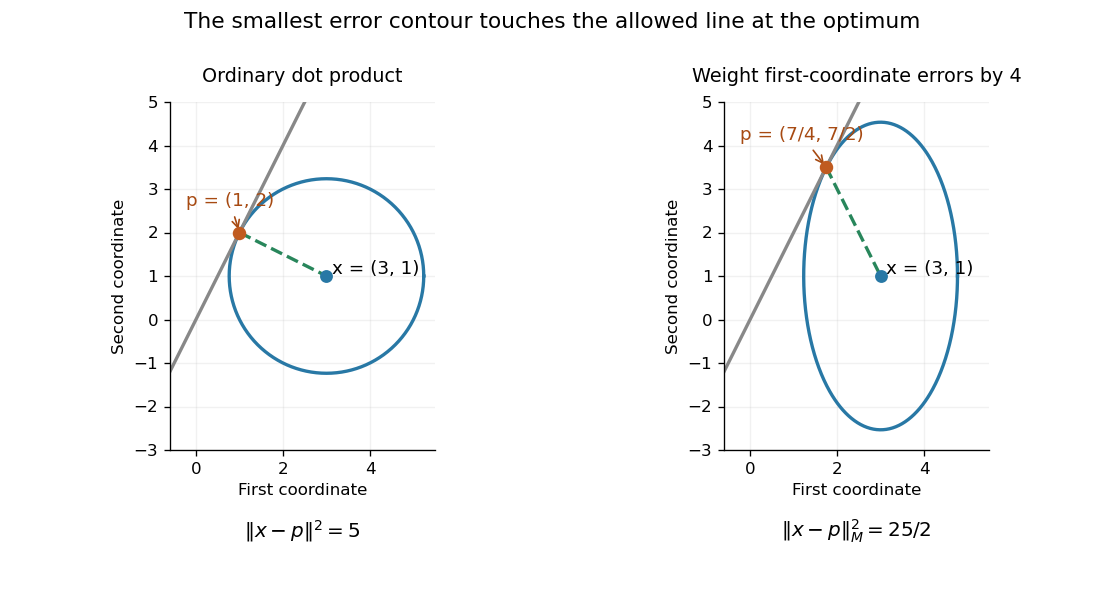
Changing the inner product changes the closest point: a circle and a weighted error ellipse touch the same permitted line at different points
. Details. In linear least squares, residual orthogonality to the column space is expressed by the normal equations for linear least squares. With a weighted Euclidean inner product, the corresponding real-matrix equation is . This makes the choice of error measurement part of the mathematical model, rather than merely a plotting convention.
At in the orientation double cover, use the derivative of the covering projection to transport the chosen orientation to the tangent space of the cover. In local oriented sheets this prescription is smooth, so it defines a global orientation. The involution reverses it.
For a connected smooth manifold, every component of the orientation double cover maps onto the base by the path lifting theorem. There can therefore be at most two components. A global orientation splits the cover into two copies of the base. Conversely, if there are two components, each meets every fibre once, so its inverse projection gives a smooth global choice of orientation.
On the smooth boundary of an orientable surface, let be the chosen unit normal vector and the positively oriented unit tangent vector used by Stokes theorem. The outward conormal is . It is a unit vector, tangent to the surface and orthogonal to its boundary. This convention turns into by cyclic invariance of the scalar triple product.
An oriented atlas is a smooth atlas whose smooth transition maps have positive Jacobian determinants on every overlap. The coordinate bases then give compatible choices of orientation of a vector space on all tangent spaces. A nowhere-vanishing top-degree differential form gives such an atlas: restrict each chart until its coefficient has constant sign, reverse one coordinate if necessary to make that sign positive, and compare the positive coefficients on overlaps. Conversely, a partition of unity glues positive local coordinate top forms to a global volume form.
An orientation of a smooth manifold is a continuous choice of orientation of a vector space in every tangent space, equivalently an orientation of a vector bundle on its tangent bundle. It can be specified by an atlas with positive Jacobian determinants on all overlaps or by a nowhere-vanishing top-degree differential form. On a connected orientable manifold there are two choices, interchanged by reversing every tangent-space orientation.
// Target: differential-geometry.bigb
For a multiplicative set of regular elements satisfying the left Ore condition, represent a fraction by . Pairs and agree when there are with and . Addition uses this common denominator. For multiplication choose with , then . The Ore condition gives common multiples for successive operations; regularity supplies cancellation. In a domain with all nonzero elements, every nonzero fraction has inverse .
// Destination: associative-algebra.bigb
If two nonzero principal right ideals in a right Noetherian domain had zero intersection, the sums would be strictly increasing. Directness follows by splitting the lowest term into and the other terms into , then cancelling and repeating. This contradicts the ascending chain condition. A nonzero common element gives the right Ore condition. The left version follows from the opposite ring. Consequently a noncommutative domain Noetherian on both sides has a single division ring of fractions with both left and right fraction presentations.
This is the localization of a ring at all its regular elements of a ring, with left fractions. It exists precisely when those denominators satisfy the left Ore condition. If embeds in a ring , all regular elements become units in , and every element of is such a fraction, the Ore condition follows by writing , which gives .
In the ordinary topology on infinite subsets, the family of cofinite sets is a countable set, a dense and a meagre set. Countability follows by indexing its members by their finite complements. Each singleton is closed with empty interior, while every basic cylinder with finite initial segment contains . Consequently is not a nowhere dense set. This example uses the ordinary cylinder topology, rather than the Ramsey cone topology.
For ordinals and , there are unique ordinals with the displayed relation. The function is strictly increasing, continuous at limit ordinals and unbounded. Its first value above occurs at a successor, giving the largest with . The ordered tail of after that initial segment gives , and maximality gives .
A fast-growing hierarchy indexes number-theoretic functions by an effective system of ordinal notations. Successor stages iterate the preceding function, while limit stages diagonalize along a chosen fundamental sequence of a limit ordinal. These choices are part of the definition. With the standard Cantor normal form sequences below epsilon zero, each fixed for is provably total in Peano arithmetic, but the uniform endpoint is not. Every function provably total in Peano arithmetic is eventually bounded by some lower level. These classification results are proved in epub.ub.uni-muenchen.de/3843/1/3843.pdf .
For a countable limit ordinal, a fundamental sequence is an increasing cofinal sequence of smaller ordinals. Effective choices allow a fast-growing hierarchy to turn limit recursion into recursion at a finite input. Below epsilon zero, write the final term as . For successor , take ; for nonzero limit , take . Earlier terms in the Cantor normal form remain fixed.
For , ordered Grassmann Gaussian contractions give and . The disconnected contribution has two fermion loops; the connected contribution has one, giving its minus sign. This covariance is an algebraic normalized Berezin integral, rather than a positivity statement about a probability measure.
First ascent in independent continuous observations by  Codex 0 Created 2026-10-14 Updated 2026-11-05
For independent and identically distributed random variables with a continuous probability distribution, let be the index of the first increase. The event requires the first observations to be decreasing; symmetry among their possible strict orders gives probability for . Subtracting successive tails gives the displayed mass function for . The tails tend to zero, so is finite almost surely. The tail-sum formula for expectation gives , independently of the continuous sampling law.
In a second-order reaction with rate law , a large excess of B can keep during the observation window. ThenThis is a pseudo-first-order reaction: the approximate first-order reaction describes that window, while changing the excess B concentration changes . Its units are , distinct from the second-order reaction rate constant . For one-to-one stoichiometry, the maximum fractional depletion of B is ; an original initial excess bounds its change by . A twofold excess permits depletion and does not provide the same control.[ref]
Glossary of Terms Used in Physical Organic Chemistry (IUPAC Recommendations 1994): N and O entries by International Union of Pure and Applied Chemistry. Glossary of Terms Used in Physical Organic Chemistry, IUPAC Recommendations 1994, entry “order of reaction”: constant B, observed coefficient and pseudo-first-order coefficient
Pinned article: Introduction to the OurBigBook Project
Welcome to the OurBigBook Project! Our goal is to create the perfect publishing platform for STEM subjects, and get university-level students to write the best free STEM tutorials ever.
Everyone is welcome to create an account and play with the site: ourbigbook.com/go/register. We belive that students themselves can write amazing tutorials, but teachers are welcome too. You can write about anything you want, it doesn't have to be STEM or even educational. Silly test content is very welcome and you won't be penalized in any way. Just keep it legal!
Intro to OurBigBook
. Source. We have two killer features:
- topics: topics group articles by different users with the same title, e.g. here is the topic for the "Fundamental Theorem of Calculus" ourbigbook.com/go/topic/fundamental-theorem-of-calculusArticles of different users are sorted by upvote within each article page. This feature is a bit like:
- a Wikipedia where each user can have their own version of each article
- a Q&A website like Stack Overflow, where multiple people can give their views on a given topic, and the best ones are sorted by upvote. Except you don't need to wait for someone to ask first, and any topic goes, no matter how narrow or broad
This feature makes it possible for readers to find better explanations of any topic created by other writers. And it allows writers to create an explanation in a place that readers might actually find it.
Figure 1. Screenshot of the "Derivative" topic page. View it live at: ourbigbook.com/go/topic/derivativeVideo 2. OurBigBook Web topics demo. Source. - local editing: you can store all your personal knowledge base content locally in a plaintext markup format that can be edited locally and published either:This way you can be sure that even if OurBigBook.com were to go down one day (which we have no plans to do as it is quite cheap to host!), your content will still be perfectly readable as a static site.
- to OurBigBook.com to get awesome multi-user features like topics and likes
- as HTML files to a static website, which you can host yourself for free on many external providers like GitHub Pages, and remain in full control

Figure 2. You can publish local OurBigBook lightweight markup files to either OurBigBook.com or as a static website.
Figure 3. Visual Studio Code extension installation.
Figure 5. . You can also edit articles on the Web editor without installing anything locally. Video 3. Edit locally and publish demo. Source. This shows editing OurBigBook Markup and publishing it using the Visual Studio Code extension. 
- Infinitely deep tables of contents:



All our software is open source and hosted at: github.com/ourbigbook/ourbigbook
Further documentation can be found at: docs.ourbigbook.com
Feel free to reach our to us for any help or suggestions: docs.ourbigbook.com/#contact