Topics (384k) Articles (398k) Users (410) Discussions (242) Comments (383) Files (13k) New article
The Zanstra method estimates a central star's effective temperature by comparing its observed nonionizing continuum with the absorbed ionizing-photon rate inferred from nebular recombination lines. If , then when the line traces the full appropriate ionizing budget. Both the distance and stellar radius cancel. Density inhomogeneity also cancels from the integrated recombination estimate when the coefficient ratio is known; photon leakage, dust and mixed-species transfer can invalidate the simple budget.
A geomagnetic reversal changes the large-scale polarity of Earth's intrinsic magnetic field. Crustal remanent magnetization records past reversals. The reversal times are not a regular clock; their occurrence reflects time-dependent dynamo action rather than rigid rotation of a permanent magnet.
The geodynamo is the maintenance of Earth's magnetic field by electrically conducting fluid motion in its liquid outer core. Rotation and buoyant convection organize helical flow and permit mean-field poloidal–toroidal regeneration. A scalar homogeneous alpha model explains a mechanism and a threshold but omits spherical boundaries, anisotropy, spatial variations and Lorentz force feedback. Reversals and saturation require dynamical or time-dependent transport information beyond a growing constant-coefficient kinematic mode.
At a jump in buoyancy frequency with continuous background density, incident, reflected and transmitted internal gravity waves share frequency and horizontal wavenumber. Continuity of pressure and normal velocity determines their amplitudes. If amplitudes multiply unit particle-displacement vectors directed along each ray with positive horizontal component, the reflection coefficient is . Using vertical-displacement amplitudes reverses the reflected coefficient's sign because the reflected polarization reverses its vertical component.
The displayed displacement convention is the negative of the usual positive-frequency wave pseudomomentum for a rightgoing internal gravity wave. Here energy per unit reference mass density is . From the buoyancy polarization of a plane internal gravity wave, horizontal averaging gives , where is kinematic pressure. The sign convention changes both density and flux and leaves their propagation at the group velocity unchanged.
A face of a plane graph is a connected component of the Euclidean plane after removing the drawn vertices and edges. Count the outer face too. This is the plane counterpart of a face of a planar map on the sphere.[ref]
Planar Graphs; Bipartite Matching by Albert R. Meyer (6.042J lecture 5f). Planar Graphs; Bipartite Matching, slide lec 5f.6, including the outer face
Two cylindrical bubbles separated by a uniform flat liquid film of half-length drain through short curvature-transition regions at the ends. The elevated gas pressure implies a film liquid pressure approximately above the outer liquid pressure. The transition length is , and its volume flux is nearly constant because . Write and . The planar viscous-sheet stretching equations reduce to , with . Two integrations, matched to a flat film at the inner end, give . Matching the curvature to gives the displayed speed. Uniform-film conservation of mass then gives , hence . There is no finite-time contact in this ideal continuum model.
For a thin planar viscous sheet with zero effective gravity and prescribed tensile force per unit transverse width, force balance gives . Conservation of mass gives , proving uniform subtraction from the initial material thickness. The material map satisfies . Thus the same material thinning creates greater extension wherever the initial sheet is thinner.
A finite group of planar rotations about one point is a cyclic group. For a nontrivial group, choose its smallest positive rotation angle . Subtracting multiples of from any other group angle leaves a group angle in , hence zero. Applying the same argument to shows that for a positive integer . The identity-only group is cyclic as well.
For column coordinate vectors in the fixed Cartesian basis, an active planar rotation sends to . For radians,The endpoint travels counterclockwise through along a circle of radius . Its Euclidean norm stays . The second Cartesian basis direction becomes , whose dot product with is still zero.
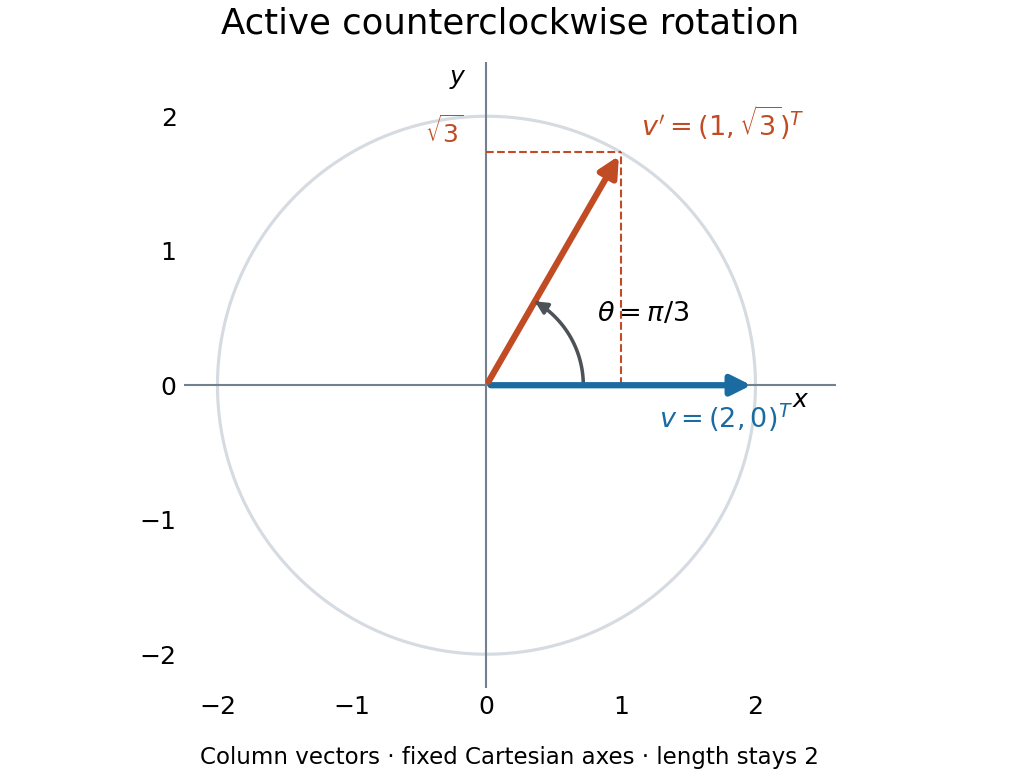
An active counterclockwise planar rotation by : the vector moves while the Cartesian basis stays fixed
. Details. A quick sign check is to look at the first column: must point above the horizontal axis for . The columns have unit Euclidean norm and zero dot product, so ; the determinant is . Finally, the transpose negates the off-diagonal entries, giving : turning back reverses the action. This is the same matrix used for passive rotation of coordinates, though that interpretation keeps the vector fixed.
The first Piola-Kirchhoff stress tensor expresses the current force transmitted through a material surface per unit reference area. In the spatial-first index convention used here,where is the deformation gradient, , the Cauchy stress tensor, and the reference and current unit normal vectors. Nanson's formula supplies the transformation of oriented surface area.
Its first index refers to current force direction and its second to reference surface orientation, so it is generally nonsymmetric even when is symmetric. The mechanical power per reference volume is . In a uniform uniaxial test the relevant component is the axial force divided by original area, connecting this tensor to engineering stress. The material-first nominal stress tensor in this repository is ; keeping this convention explicit prevents misplaced transposes.
The second tensor has two material indices and is symmetric when the Cauchy stress tensor is symmetric. The displayed relation uses the material-first nominal stress tensor convention. In particular, is generally not this tensor. These conventions agree with A. F. Bower's definitions of stress measures.
Two piecewise linear balls of dimension three glued along a common boundary disk form another piecewise linear ball. The Schoenflies theorem identifies each boundary pair with a sphere and a hemisphere. Coning the resulting boundary homeomorphisms extends them over the balls, which then become the two halves of a standard ball. The same argument shows that removing a ball attached along one boundary disk leaves a ball.
Picard iteration replaces a tentative trajectory by the accumulated integral of its proposed rate. For an initial value problem , , define the Picard map and its starting function byHere is the constant starting trajectory; the same symbol without its argument denotes the initial state. A fixed point of solves this integral equation, and the fundamental theorem of calculus gives the original ordinary differential equation.
For , , successive integrals giveAt , the first five values are , while . The fourth polynomial misses by about . On , every omitted term of the exponential series is nonnegative and increasing, so the largest error occurs at . The tail tends to zero, giving uniform convergence to the exponential function on this interval.
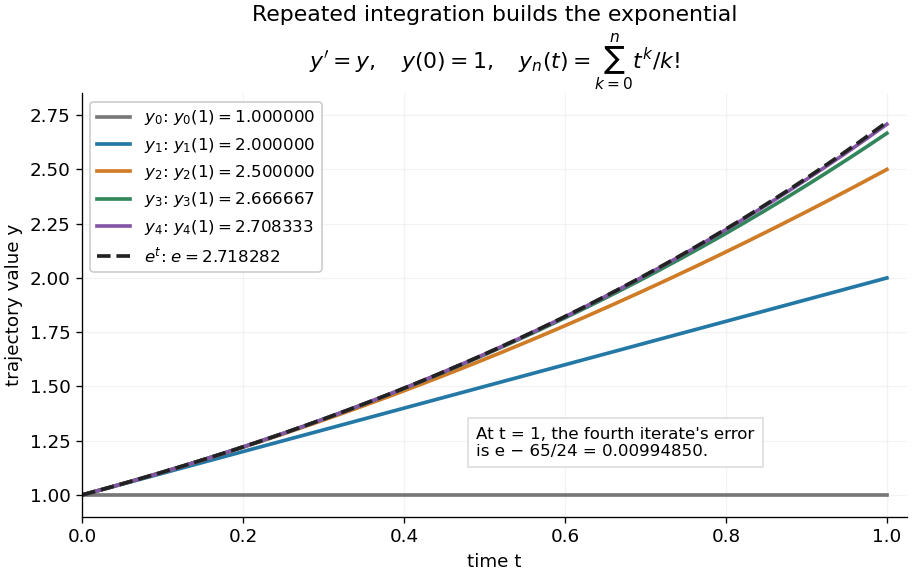
Picard iteration builds the exponential solution by repeated integration
. The first five polynomials approach the exponential function on . Endpoint values are listed in the legend; the last error is approximately . Details.The beauty of Picard iteration is that each proposed trajectory supplies a better rate history for the next one. For this example, one integration adds exactly the next term of the exponential series. In general, the integrals may be difficult to compute, but the construction still explains local existence and uniqueness.
The short contraction mapping argument needs two independent controls. Choose a time-state cylinder on whichThe second bound is the uniform local Lipschitz condition. Set with , and . In the function space of continuous functions , use the supremum norm . On its closed ball , direct integral estimates giveThus the map preserves the closed ball and is a contraction mapping there. This closed ball is a complete metric space, so the contraction mapping theorem gives convergence to exactly one fixed point. Any other local solution of a differential equation stays in the same ball after shortening its interval, and hence agrees there.
For , take , so in the state ball and , . Choosing gives and , with the actual solution satisfying . The plotted interval is longer than this simple guarantee: the explicitly computed exponential series converges there anyway. The condition is sufficient for this one-step contraction mapping argument, rather than a necessary lifespan bound.
For light along , vorticity along and , spherical coordinates give a first orientation-density correction proportional to . The linearized alignment-diffusion operator preserves azimuthal harmonics and the rotation of the axisymmetric equilibrium forces only this sine harmonic. Angular integration makes the first correction to the mean purely vertical. Uniqueness follows from the weighted identity : integration by parts shows the only homogeneous smooth solution is a multiple of , removed by normalization.
Zero-flux pressure gradient in a cell-driven channel by  Codex 0 Created 2026-10-14 Updated 2026-11-05
In the Boussinesq approximation, downward excess cell weight gives . The no-slip boundary condition at both walls and zero total fluid flux determine the excess axial pressure gradient , with . In particular, , . For large , writing and gives the outer profile . A thin layer restores no slip at the illuminated wall. Cells descend there and fluid returns upward on the other side. At the limiting solution is , .
At non-null four-momentum, these complementary projectors satisfy , and . The gauge-fixed Maxwell kinetic operator is ; its inverse gives propagator . Transversality here removes one four-dimensional longitudinal direction, leaving rank three; it does not by itself project onto the two physical photon polarizations. The pole requires the Feynman i-epsilon prescription.
For collected spectral radiant flux and a linear photodiode with spectral responsivity , the dark-subtracted electric current is . A reference optical spectrum sets the conversion from electric current to collected luminous flux. Applying it to another optical spectrum givesAssume nonzero calibration and test signals. Then is the corrected luminous flux. Multiplying either optical spectrum by an overall positive scale leaves unchanged. If is proportional to , for every optical spectrum. Uniformly overfilled aperture measurements use wavelength-resolved irradiance instead, multiplying the electric current expression by aperture area; the same ratio cancellation gives the illuminance correction. This is the algebra behind source-dependent calibration, rather than a new measured correction curve. [ref]
Pinned article: Introduction to the OurBigBook Project
Welcome to the OurBigBook Project! Our goal is to create the perfect publishing platform for STEM subjects, and get university-level students to write the best free STEM tutorials ever.
Everyone is welcome to create an account and play with the site: ourbigbook.com/go/register. We belive that students themselves can write amazing tutorials, but teachers are welcome too. You can write about anything you want, it doesn't have to be STEM or even educational. Silly test content is very welcome and you won't be penalized in any way. Just keep it legal!
Intro to OurBigBook
. Source. We have two killer features:
- topics: topics group articles by different users with the same title, e.g. here is the topic for the "Fundamental Theorem of Calculus" ourbigbook.com/go/topic/fundamental-theorem-of-calculusArticles of different users are sorted by upvote within each article page. This feature is a bit like:
- a Wikipedia where each user can have their own version of each article
- a Q&A website like Stack Overflow, where multiple people can give their views on a given topic, and the best ones are sorted by upvote. Except you don't need to wait for someone to ask first, and any topic goes, no matter how narrow or broad
This feature makes it possible for readers to find better explanations of any topic created by other writers. And it allows writers to create an explanation in a place that readers might actually find it.
Figure 1. Screenshot of the "Derivative" topic page. View it live at: ourbigbook.com/go/topic/derivativeVideo 2. OurBigBook Web topics demo. Source. - local editing: you can store all your personal knowledge base content locally in a plaintext markup format that can be edited locally and published either:This way you can be sure that even if OurBigBook.com were to go down one day (which we have no plans to do as it is quite cheap to host!), your content will still be perfectly readable as a static site.
- to OurBigBook.com to get awesome multi-user features like topics and likes
- as HTML files to a static website, which you can host yourself for free on many external providers like GitHub Pages, and remain in full control

Figure 2. You can publish local OurBigBook lightweight markup files to either OurBigBook.com or as a static website.
Figure 3. Visual Studio Code extension installation.
Figure 5. . You can also edit articles on the Web editor without installing anything locally. Video 3. Edit locally and publish demo. Source. This shows editing OurBigBook Markup and publishing it using the Visual Studio Code extension. 
- Infinitely deep tables of contents:




All our software is open source and hosted at: github.com/ourbigbook/ourbigbook
Further documentation can be found at: docs.ourbigbook.com
Feel free to reach our to us for any help or suggestions: docs.ourbigbook.com/#contact