Topics (384k) Articles (398k) Users (410) Discussions (242) Comments (383) Files (13k) New article
For the constant-speed geodesic from to in a Hadamard space, the displayed inequality follows by repeatedly applying the midpoint inequality and passing from dyadic parameters to all . Applying it on two sides of a triangle gives , where , and . The right side is the squared comparison distance by the Euclidean cosine rule.
Subtract a test function's value at zero before integrating near zero, and retain the ordinary tail integral. This defines an even tempered distribution. Changing the subtraction cutoff adds a multiple of the Dirac delta distribution. Multiplication by gives .
For , this holomorphic function has H1 space on the unit disk norm one: its boundary modulus is the unit-mass Poisson kernel on the circle. The radial integrals are bounded by that boundary integral by subharmonic comparison and tend to it by continuity. Choosing at depth comparable to an arc's length makes bounded below by the reciprocal length throughout its hyperbolic geodesic cap. It tests necessity in the Carleson embedding theorem on the disk.
For an analytic H1 space on the unit disk function, its fixed-aperture non-tangential maximal function obeys the displayed strong bound. First replace by , . The fact that modulus powers of holomorphic functions are subharmonic gives . Since a Poisson maximal function is dominated by the Hardy-Littlewood maximal function, the strong Hardy-Littlewood maximal inequality yields . Pointwise interior convergence and the Fatou lemma remove . Analyticity permits this endpoint estimate; general boundary data have only a weak maximal bound.
A bounded holomorphic function on the unit disc has finite nontangential limits almost everywhere on its boundary. To outline a proof, bounded real and imaginary harmonic parts have boundary representations: apply the Banach-Alaoglu theorem to their circular traces and pass to the limit in the Poisson integral on the unit disk. Almost every boundary point is a Lebesgue point. The fact that a Poisson integral converges nontangentially at Lebesgue points gives the desired limits. Their norm equals the interior supremum norm, and the Poisson integral recovers the original function. Exceptional points can lack even radial limits; is a bounded example at the boundary point one.
Zero-flow steady gyrotactic orientation distribution by  Codex 0 Created 2026-10-14 Updated 2026-11-05
For aligning rate , positive rotational diffusivity and , the zero-current steady Fokker-Planck equation gives . Normalization over the unit sphere gives the displayed density per unit solid angle. Its mean direction is , the Langevin function. As , it concentrates weakly into a point mass at the upward pole; the limit is not an ordinary bounded probability density.
Let weak excess-cell buoyancy be and the swimming stresslet coefficient be . Set and use the leading gyrotactic focusing in a downward pipe flow density . With active stress entering as , the axial momentum equation integrates from the regular axis to the displayed derivative. The wall condition gives . Both terms of the integrand are positive for , so the correction increases downward flow. A negative stresslet strength can oppose this effect; reversal at a given radius requires smaller than minus the ratio of the integrated buoyancy and stresslet coefficients. This convention must be specified before attaching extensile or contractile sign labels.
For a rotor spinning about a principal axis with its support at the centre of mass, uniform gravity supplies no torque about that centre. With other external torques negligible, conservation of angular momentum preserves its direction in an inertial frame. A mount that permits free axis motion lets the housing rotate relative to that persistent direction, giving an orientation reference when external landmarks are unavailable. This is the useful limit opposite to the deliberately off-centre support in the spinning-wheel precession experiment. It supplies a direction, not a position or a full three-axis orientation from one axis alone.
For a small accumulated transverse torque about the centre of mass, the change in the direction unit vector is, to first order,Here is approximately constant over the short interval. Large angular momentum reduces drift for the same integrated transverse torque; parallel torque instead changes its magnitude. For , a constant transverse torque of over produces approximately , or , of direction change. This is another synthetic calculation. The persistent direction belongs to an inertial frame; its components can change in a rotating reference frame even with zero external torque.
Model the assembly as a heavy symmetric top with a fixed frictionless support, a uniform gravitational field, and centre of mass on its symmetry axis. Assume constant spin, negligible damping, and initial conditions prepared for uniform precession of a heavy symmetric top. Large spin means the transverse angular momentum from precession is small: . Also require . A large spin rate alone does not select steady motion after an arbitrary release.
For an original illustrative calculation, stipulateThe transverse principal moments of inertia are about the pivot, including the parallel axis theorem contribution. These inputs giveThe ratio is small; the more direct angular momentum ratio is small too. These are model calculations, not experimental results.
Check the approximation against the existing exact uniform precession of a heavy symmetric top condition. Its total angular momentum isAt constant , differentiating this expression and equating it to the gravitational torque givesFor the slow solution can be evaluated without subtracting two nearly equal numbers:It exceeds by about . The other solution is about and violates the assumed slow precession; the quadratic's two roots must not be conflated. Its discriminant must be nonnegative for these steady solutions to exist.
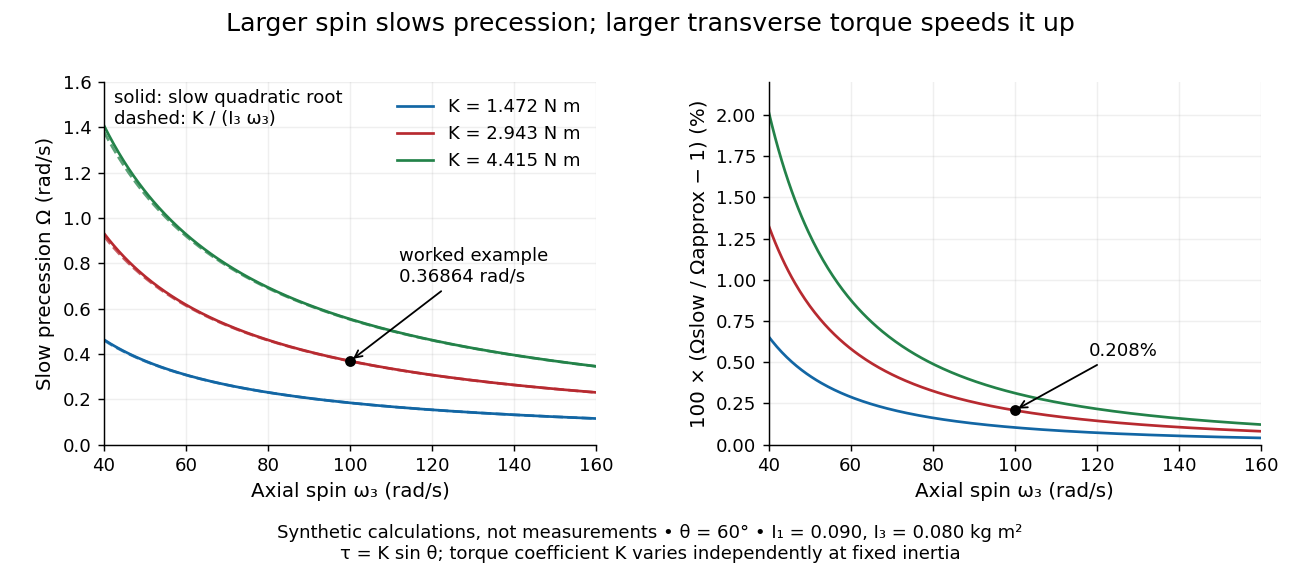
Synthetic steady-precession calculations: larger spin slows the drift and larger transverse torque speeds it up
. Details. The original curves hold fixed and vary spin and the imposed torque coefficient in . For gravity alone, ; the other curves are hypothetical changes in the transverse torque, not observations of this wheel. Solid curves use the slow quadratic root; dashed curves use . The second panel displays their relative difference. Increasing spin improves this approximation for the parameters shown. It does not remove nutation caused by inappropriate initial conditions.
Purdue's Bicycle Wheel Gyroscope demonstration uses a bicycle wheel on a long axle, with a ball at one end seated in a freely rotating socket on a heavy stand. Spin the wheel by hand or with the supplied motor, seat the ball, and release the nearly horizontal axle. The readout is the axle sweeping around the vertical while the wheel continues spinning. Compare with the stopped wheel, which falls when one end is released; reverse the spin with the same support and the precession reverses. These are the page's documented apparatus, presentation, and reversal checks. [ref]
Bicycle Wheel Gyroscope by Purdue University, Department of Physics and Astronomy. 1Q-30, apparatus paragraph, Directions, and Suggestions for Presentation; page updated 30 November 2023
An alternative in Physics Demonstrations by Julien Clinton Sprott (section 1.3, Materials and Procedure) suspends one axle end by stainless steel wire and a fishing-line swivel. The swivel allows precession without winding up the suspension. Sprott describes the axle bobbing as nutation and precession becoming faster as spin decreases. A suspended support can move, whereas the calculation here assumes a fixed ; use the socket version for the closest realization. [ref]
Bicycle Wheel Gyroscope (section 1.3). section 1.3, Bicycle Wheel Gyroscope: Materials, Procedure, and Discussion
A proposed quantitative extension is to record an overhead view of an axle marker against a fixed angle scale, together with a side view for . Time successive overhead passages to estimate ; count passages of a rim mark to estimate . Record the spin sense too. Measure and the centre of mass offset of the whole moving assembly, and determine its axial moment of inertia independently. Wheel, axle, support, release angle, and observation interval should stay the same between spin trials. Measuring both and distinguishes azimuthal precession from nutation; an overhead movie alone can miss the latter. These camera readouts and parameter checks are proposed here, not reported measurements from the demonstration pages.
For slow precession, compare with , and test whether reversing reverses with nearly unchanged magnitude. A brief interval minimizes spin loss from friction; repeat at several starting spin rates rather than interpreting an entire slowing run as one steady state. A suspension restoring torque governed by its torsion constant, socket friction, support motion, a misplaced centre of mass, and a push at release can all supply extra torque or change the initial conditions. The swivel reduces the twist that activates the suspension's torsion constant; it does not demonstrate zero torque.
Steady precession keeps constant; nutation changes while the axle may also precess. Sudden release generally excites both. A small initial drop is consistent with conservation of energy and conserved vertical angular momentum: some gravitational potential energy supplies the motion around the vertical, and the axial contribution to vertical angular momentum adjusts. Bearing friction may damp the bobbing, but an ideal undamped heavy symmetric top need not settle into steady precession. Chapter 20: Rotation in space explicitly distinguishes uniform precession from release transients and nutation (section 20-3, paragraphs following equation 20.15).[ref]
Chapter 20: Rotation in space. section 20-3: sudden release, nutation, and the small drop needed for precessional angular momentum
Choose a fixed support point and nonrotating axes in an inertial frame. All angular momenta, torques, and moments of inertia below refer to . Let point along the axle from toward the centre of mass, and let point vertically upward. Write for their angle. For a rapidly spinning symmetric top, the dominant angular momentum is , where is signed and is the axial principal moment of inertia. The sign of the axial angular velocity follows the right-hand rule.
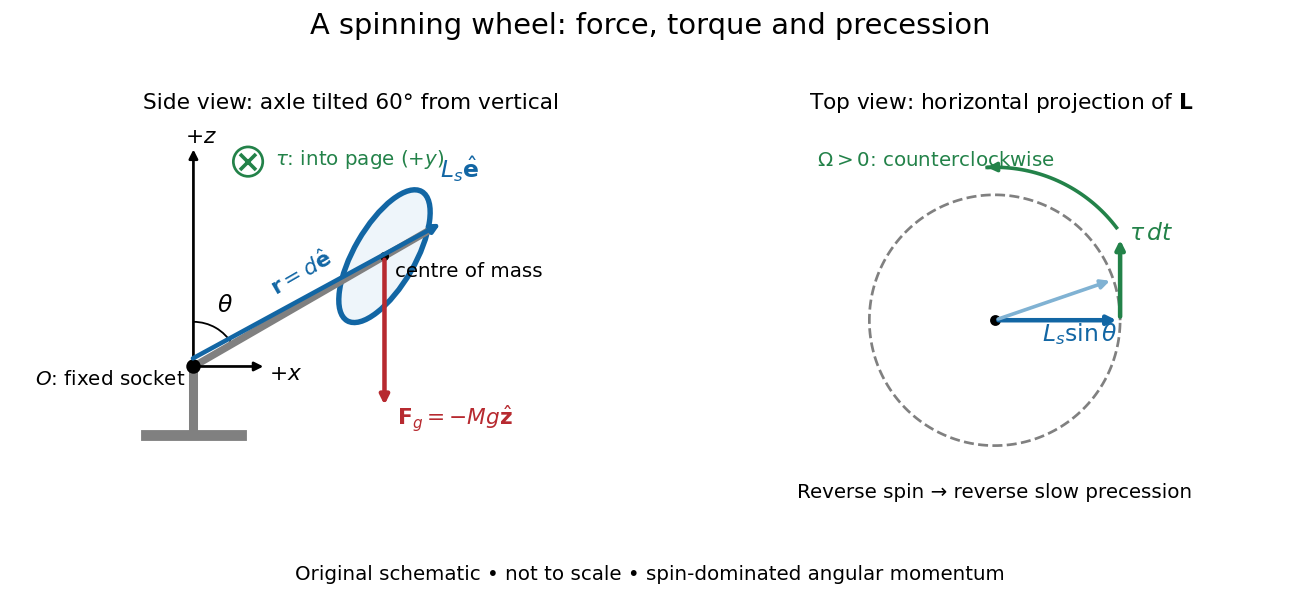
A fixed wheel support separates the downward gravitational force from the transverse torque and sideways precession
. Details. With mass , centre of mass distance , and constant gravitational acceleration , the gravitational force and its torque areAn ideal support applies a force at , so its lever arm and torque about vanish. At the instant the axle lies in the plane with a positive component, the gravitational torque points along . It adds toward , rather than along the downward force. The dot product identity shows why perpendicular torque changes direction without instantly changing magnitude. This vector balance and the slow-turning relation are developed in Chapter 20: Rotation in space (sections 20-2 and 20-3, equations 20.13–20.15).
For steady precession about the vertical, and . Equating the two cross products givesThe angular momentum tip traces a circle of radius : its sideways speed is . Both that radius and the gravitational lever arm contain , explaining its cancellation for . Exactly vertical alignment has zero gravitational torque and no distinguishable azimuthal precession to infer by this cancellation. Positive gives positive precession, counterclockwise viewed from above; reversing the spin reverses the slow precession. [ref]
11.4 Precession of a Gyroscope. University Physics Volume 1, section 11.4, equation 11.12 and the torque and precession-circle derivation
For fixed and , the factor is a translated Gumbel distribution cumulative function, with transition near . Integration by parts transforms the integral to an exponentially small boundary term plus . Expanding the latter against its finite logarithmic moments gives the displayed two terms because , with Euler's constant. The smooth cutoff shifts the first correction even though replacing it by a step gives the leading tail.
If is a left Noetherian ring and a right Noetherian ring, and is a poly-(cyclic or finite) group, then satisfies both chain conditions. Induct along the subnormal series. A finite factor gives a finite free extension on each side, handled by finite-module extension preserves Noetherianity. An infinite cyclic factor gives a skew Laurent polynomial ring, with the twisting automorphism induced by conjugation by a lift of the cyclic generator. The noncommutative Hilbert basis theorem and clearing negative powers prove the required chain conditions at that step. In particular is Noetherian.
In a unital Banach algebra, if a subsequence of inverse norms remained bounded, would be invertible for large subsequence indices by the Neumann series. This contradicts noninvertibility of . If is a closed unital subalgebra of a larger Banach algebra and the lie in , then such a limit cannot be invertible in either: continuity of inversion in a Banach algebra would make their inverses converge in to , which closedness puts in .
A left inverse of an element of a unital associative algebra is an element with . A right inverse instead satisfies . If both exist, they agree: . A one-sided inverse alone need not imply invertibility in an infinite-dimensional Banach algebra.
A right inverse of an element is an element with . A left inverse of an algebra element and a right inverse of an algebra element, when both exist, coincide. For the unilateral shift operator , but , exhibiting the distinction in the Banach algebra of bounded operators.
Suppose in a unital Banach algebra, with each invertible. If , then , so is invertible eventually by the Neumann series. Then is invertible, and . The analogous argument with treats a right inverse of an algebra element. Thus a noninvertible such limit admits neither type of one-sided inverse.
Finite products of Banach algebra exponentials form a subgroup: inverses are and conjugation sends to . Each product is joined to the identity by . The logarithm of an element near the identity puts a norm neighborhood of in this subgroup, so its cosets are open and its complement is open. It is therefore exactly the identity component of a topological group, and is an open, closed, normal subgroup. A product of exponentials need not be a single exponential in a noncommutative algebra.
For a specified finite group action on , extensions are classified by . For an element of prime order , a lift satisfies ; changing the lift changes by . Thus the extension is torsion-free precisely when every restriction to a prime-order cyclic subgroup is nonzero in . Any finite-order element has a prime-order power, so this tests all torsion. An arbitrary finite quotient must not be confused with faithful holonomy on a maximal translation lattice.
Pinned article: Introduction to the OurBigBook Project
Welcome to the OurBigBook Project! Our goal is to create the perfect publishing platform for STEM subjects, and get university-level students to write the best free STEM tutorials ever.
Everyone is welcome to create an account and play with the site: ourbigbook.com/go/register. We belive that students themselves can write amazing tutorials, but teachers are welcome too. You can write about anything you want, it doesn't have to be STEM or even educational. Silly test content is very welcome and you won't be penalized in any way. Just keep it legal!
Intro to OurBigBook
. Source. We have two killer features:
- topics: topics group articles by different users with the same title, e.g. here is the topic for the "Fundamental Theorem of Calculus" ourbigbook.com/go/topic/fundamental-theorem-of-calculusArticles of different users are sorted by upvote within each article page. This feature is a bit like:
- a Wikipedia where each user can have their own version of each article
- a Q&A website like Stack Overflow, where multiple people can give their views on a given topic, and the best ones are sorted by upvote. Except you don't need to wait for someone to ask first, and any topic goes, no matter how narrow or broad
This feature makes it possible for readers to find better explanations of any topic created by other writers. And it allows writers to create an explanation in a place that readers might actually find it.
Figure 1. Screenshot of the "Derivative" topic page. View it live at: ourbigbook.com/go/topic/derivativeVideo 2. OurBigBook Web topics demo. Source. - local editing: you can store all your personal knowledge base content locally in a plaintext markup format that can be edited locally and published either:This way you can be sure that even if OurBigBook.com were to go down one day (which we have no plans to do as it is quite cheap to host!), your content will still be perfectly readable as a static site.
- to OurBigBook.com to get awesome multi-user features like topics and likes
- as HTML files to a static website, which you can host yourself for free on many external providers like GitHub Pages, and remain in full control

Figure 2. You can publish local OurBigBook lightweight markup files to either OurBigBook.com or as a static website.
Figure 3. Visual Studio Code extension installation.
Figure 5. . You can also edit articles on the Web editor without installing anything locally. Video 3. Edit locally and publish demo. Source. This shows editing OurBigBook Markup and publishing it using the Visual Studio Code extension. 
- Infinitely deep tables of contents:




All our software is open source and hosted at: github.com/ourbigbook/ourbigbook
Further documentation can be found at: docs.ourbigbook.com
Feel free to reach our to us for any help or suggestions: docs.ourbigbook.com/#contact