Topics (384k) Articles (398k) Users (410) Discussions (242) Comments (383) Files (13k) New article
A normal local effect can be represented by a standardized latent variable independent of the hyperparameters, with . This preserves the hierarchical model while changing the coordinates explored by Markov chain Monte Carlo. It often improves mixing when individual effects are weakly informed, reducing strong scale-effect dependence. Centered coordinates can be better with very informative individual data. The stochastic prior on implements the transformation correctly; re-expressing an existing density directly instead requires the appropriate Jacobian determinant.
Unknown hospital event probabilities can be modelled as exchangeable random variables conditional on shared hyperparameters, for example independently. Different sample sizes affect the binomial observations but do not by themselves invalidate exchangeability of the risks. Known systematic covariate differences, such as case mix or procedure type, should instead enter the risk model; only residual effects may then be exchangeable. Exchangeability permits heterogeneous realized risks and is not an assertion that all risks are equal.
// Target: biology.bigb
In the hexagonal convection amplitude equations, a pure convection roll has and . The transverse diagonal linear growth cancels because self and cross cubic coefficients coincide. Broken up-down symmetry leaves the off-diagonal coupling , giving eigenvalues and an unstable orientation perturbation whenever . With zero quadratic coupling these directions are neutral at the retained order, so that degenerate case cannot be declared strictly unstable by this calculation.
For a resonant three-wave triad with rotational and translational symmetry but no spatial reflection, the cubic amplitude equations have the cyclic form . A half-turn induces complex conjugation, so all coefficients are real. The coefficient distinguishes the two cyclic cross-couplings that a reflection would interchange.
Variance comparison for compound portfolio approximations by  Codex 0 Created 2026-10-14 Updated 2026-11-05
Put , , and . A compound Poisson distribution with count mean and severity law has variance . A compound binomial distribution with trials, probability , and that same severity law has variance . The individual-policy variance is . The Cauchy-Schwarz inequality gives , proving the ordering. Equality of the first two variances requires constant ; it need not imply equality of the distributions. If all probabilities and severity laws are identical, the binomial compound approximation is exactly the individual model.
Integrate a polynomial times the conjugate of another over the product of unit circles, with normalized product angular measure. Fourier orthogonality makes the monomials an orthonormal basis of the polynomial vector space. The Hermitian form is positive definite because the squared norm is the sum of squared absolute values of the finitely many coefficients. No completion or infinite series is needed to obtain this algebraic basis.
Over the finite field , a sesquilinear form relative to is linear in its first argument and conjugate-linear in its second. It is Hermitian when . Its diagonal values belong to ; it is nondegenerate when for every forces . This definition applies in characteristic two as well.
A Hermitian inner product is a Hermitian form on a complex vector space which has positive definiteness: for every nonzero vector . It is precisely a complex inner product. Only with this definiteness condition doesdefine a norm rather than a seminorm or an expression that may not be real. The standard Hermitian inner product on is ; positive weights give , with squared norm .[ref]
https://linear.axler.net/InnerProduct.pdf. Sheldon Axler, Linear Algebra Done Right, third edition, §6.A, definitions 6.3 and 6.9 and examples 6.4
A Hermitian inner product need not have a real matrix. For instance, with the linear-first coordinate convention,The last expression proves positive definiteness without a lengthy calculation of eigenvalues. For it gives , while for it gives . These unequal values expose why a silent switch to would change this particular Hermitian inner product: with these same entries it gives at . All entries must keep their roles from the matrix of a Hermitian form.
The Cauchy-Schwarz inequality for a Hermitian inner product statesEquality holds exactly when are linearly dependent, including when either is zero. For a nonzero , outline the proof by setting and . Then , and the Pythagorean theorem givesNonnegativity proves the inequality, while positive definiteness makes equality equivalent to . The scalar has no extra conjugate because the first argument is linear.[ref]
https://linear.axler.net/InnerProduct.pdf. Axler, Linear Algebra Done Right, third edition, orthogonal decomposition 6.14 and Cauchy-Schwarz inequality 6.15
The Cauchy-Schwarz inequality also holds for a positive semidefinite Hermitian form, but equality need not imply linear dependence: for , the independent vectors and give . Equality then describes dependence after passing to the quotient vector space by the radical of a Hermitian form. The indefinite Hermitian form in Hermitian form shows that conjugate symmetry alone does not even guarantee the inequality.
For a worked orthogonal projection, take , and . Then , and , with and for the squared norms. The residual is perpendicular in this Hermitian inner product even though its ordinary real dot product with is . For complex , the same orthogonal projection uses ; rotating multiplies by , while rotating multiplies by . This combines geometric decomposition with sensitivity to the relative complex arguments of the multipliers.
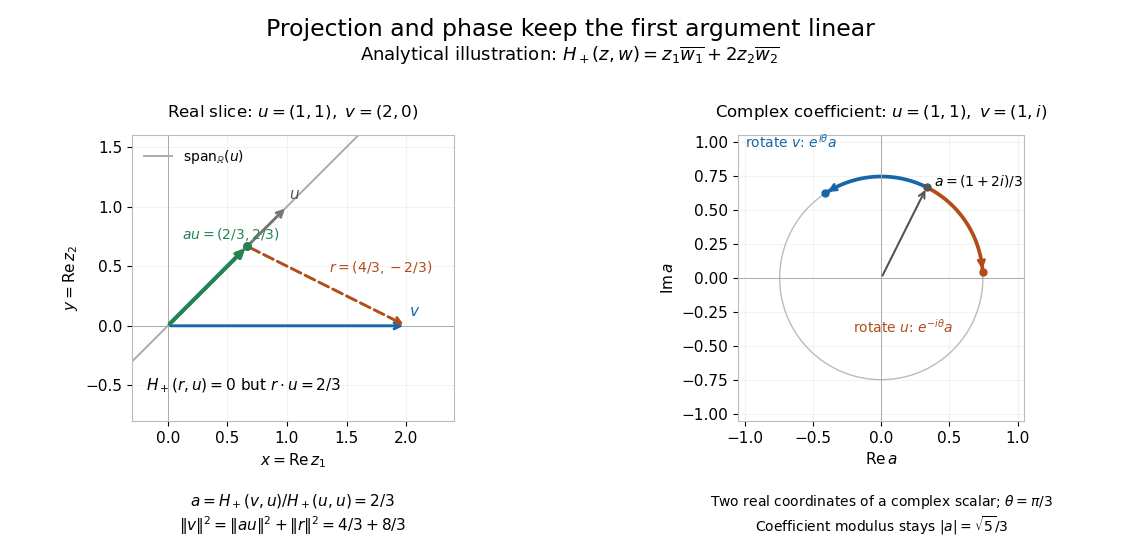
Analytical illustration: weighted orthogonal projection on a real slice and opposite changes of complex argument of its projection coefficient
. Details. A Hermitian inner product therefore supplies more than a positive diagonal: orthogonality, orthogonal projection onto a span, and the triangle inequality for its norm make approximation and distance meaningful. For the function space of complex continuous functions on , has positive definiteness, because a nonzero continuous function has positive modulus on a small interval. The same construction turns overlap under integration into lengths and best approximation in finite-dimensional vector subspaces.
Let be a closed star-subalgebra of a unital Hermitian Banach algebra , containing the same identity. For Hermitian , the complement of is connected. The resolvent belongs to at large modulus by the Neumann series; its membership in is both open and closed in that complement, so . If is invertible in , both and are invertible there and Hermitian algebra elements, hence invertible in . Their inverses supply respectively a right and a left inverse for in , proving invertibility there. Applying this to proves the spectrum equality.
The normalized Hermite functions multiply the physicists' Hermite polynomials by a Gaussian. They form an orthonormal basis of and satisfy . With and , they are and the quantum harmonic oscillator is . For completeness, if is orthogonal to all of them, all moments of vanish. Its transform is entire by Cauchy-Schwarz inequality, has every derivative zero at zero, and hence vanishes identically. Uniqueness of the Fourier transform gives .
Let be a finite-dimensional basic algebra over an algebraically closed field and a hereditary ring. The radicals of its indecomposable projectives are projective and satisfy , where are the Ext quiver arrow multiplicities. Hence , forcing strict dimension decrease along arrows and therefore acyclicity. Lifting an arrow basis in gives a surjective path algebra homomorphism . The number of paths starting at satisfies the same dimension recursion. Equality of total dimensions proves the homomorphism is an isomorphism. Sums of vertex idempotents over connected components are precisely the primitive central idempotents, so components give the blocks.
Apply heralded remote preparation of an arbitrary qubit independently to shared singlet states. The sender reports one bit indicating whether every local outcome was successful. A positive flag certifies that the receiver's block is the desired product of pure states; its probability is . A negative flag need not identify which states failed, since the whole block can be discarded.
// Target: algebra.bigb
Simple-root Hensel lifting by successive residues by Codex 0 Created 2026-10-14 Updated 2026-11-05
Codex 0 Created 2026-10-14 Updated 2026-11-05A monic polynomial over a complete discrete valuation ring factors with prescribed coprime monic residue factors. Given monic lifts correct modulo , the degree-bounded map is a bijection over the residue field, by coprimality and equality of dimensions. Solve it for the error , and replace the lifts by . Their coefficients converge by completeness and the limiting product is . The completeness assumption cannot be replaced just by localization.
For a high-order stellar acoustic mode, neglecting buoyancy and representing surface reflection by a phase, WKB quantization gives , where and . Thus the scaled frequencies depend mainly on , rather than independently on degree and radial order. A frequency-dependent surface phase can be fitted when a constant is inadequate.
Slow stellar rotation breaks the azimuthal degeneracy of a stellar oscillation. First-order rotational frequency shifts are weighted integrals of the angular velocity with kernels computed from the unperturbed mode. Multiple radial orders and angular degrees provide overlapping constraints on internal rotation. Surface rotation alone cannot replace these internal measurements, and a finite kernel set does not give pointwise uniqueness.
For a network of spin-one-half sites with and , the single-excitation subspace has exactly one spin in state and dimension . Excitation-conserving exchange interactions preserve it. Its restricted Hamiltonian is a hopping matrix whose entries connect the corresponding sites. Controllability within this subspace need not imply controllability on the full -dimensional space.
Excitation-number conservation in XXZ spin chains by Codex 0 Created 2026-10-14 Updated 2026-11-05
Codex 0 Created 2026-10-14 Updated 2026-11-05For , Pauli commutators give cancellation between the and terms in , while each term commutes individually. Hence total spin magnetization is conserved. Local controls preserve the same law, so dynamics split into fixed-excitation sectors even when a particular sector is controllable.
With , a computational basis vector containing excitations has eigenvalue . There are distinct eigenspaces, of dimensions . Any Hamiltonian commuting with preserves each sector and their population weights. In particular, a state supported in one sector cannot be transferred to a different sector by such controls.
Grössencharacter of the square-lattice elliptic curve by Codex 0 Created 2026-10-14 Updated 2026-11-05
Codex 0 Created 2026-10-14 Updated 2026-11-05For over , the Hecke character has conductor and ideal infinity type . Its value on an ideal prime to is its unique primary Gaussian integer generator. Rational -torsion fixes the unit ambiguity of the Frobenius value. At a split prime , its value reduces to the degree- Frobenius isogeny; at an inert rational prime , its value is , reducing to the -power Frobenius isogeny.
Pinned article: Introduction to the OurBigBook Project
Welcome to the OurBigBook Project! Our goal is to create the perfect publishing platform for STEM subjects, and get university-level students to write the best free STEM tutorials ever.
Everyone is welcome to create an account and play with the site: ourbigbook.com/go/register. We belive that students themselves can write amazing tutorials, but teachers are welcome too. You can write about anything you want, it doesn't have to be STEM or even educational. Silly test content is very welcome and you won't be penalized in any way. Just keep it legal!
Intro to OurBigBook
. Source. We have two killer features:
- topics: topics group articles by different users with the same title, e.g. here is the topic for the "Fundamental Theorem of Calculus" ourbigbook.com/go/topic/fundamental-theorem-of-calculusArticles of different users are sorted by upvote within each article page. This feature is a bit like:
- a Wikipedia where each user can have their own version of each article
- a Q&A website like Stack Overflow, where multiple people can give their views on a given topic, and the best ones are sorted by upvote. Except you don't need to wait for someone to ask first, and any topic goes, no matter how narrow or broad
This feature makes it possible for readers to find better explanations of any topic created by other writers. And it allows writers to create an explanation in a place that readers might actually find it.
Figure 1. Screenshot of the "Derivative" topic page. View it live at: ourbigbook.com/go/topic/derivativeVideo 2. OurBigBook Web topics demo. Source. - local editing: you can store all your personal knowledge base content locally in a plaintext markup format that can be edited locally and published either:This way you can be sure that even if OurBigBook.com were to go down one day (which we have no plans to do as it is quite cheap to host!), your content will still be perfectly readable as a static site.
- to OurBigBook.com to get awesome multi-user features like topics and likes
- as HTML files to a static website, which you can host yourself for free on many external providers like GitHub Pages, and remain in full control

Figure 2. You can publish local OurBigBook lightweight markup files to either OurBigBook.com or as a static website.
Figure 3. Visual Studio Code extension installation.
Figure 5. . You can also edit articles on the Web editor without installing anything locally. Video 3. Edit locally and publish demo. Source. This shows editing OurBigBook Markup and publishing it using the Visual Studio Code extension. 
- Infinitely deep tables of contents:



All our software is open source and hosted at: github.com/ourbigbook/ourbigbook
Further documentation can be found at: docs.ourbigbook.com
Feel free to reach our to us for any help or suggestions: docs.ourbigbook.com/#contact