Topics (384k) Articles (398k) Users (410) Discussions (242) Comments (383) Files (13k) New article

If a bounded linear operator from a Banach space onto a normed vector space admits the displayed lift for every , then its target is complete. Given a Cauchy sequence, choose a subsequence with summable successive differences. Lift those differences to a summable sequence in the source, and use its convergent sum to produce a limit of the target subsequence. The original Cauchy sequence has the same limit.
For a vector field , define . Its diagonal evaluation is . Along a geodesic this equals , so it is invisible to closed-geodesic integrals. If a fibrewise linear function solves , then gives this convention.
On a closed oriented Riemannian surface this integral identity follows from the canonical commutators and integration by parts against Liouville volume of a surface geodesic flow. If and , substitution gives . Each term is nonnegative, forcing all three derivatives to vanish. For , the fibre equation then makes a constant plus a fibrewise linear function, supplying the potential symmetric 2-tensor kernel.
The displayed one-form on the unit round sphere has zero integral on every closed geodesic. Indeed, the antipodal map pulls it back to its negative, and the second half of an oriented great circle is the antipodal image of the first. Nevertheless is nonzero on an open set, so the one-form is not a closed differential form and cannot be an exact differential form. Thus a curvature-free extension of one-form injectivity fails.
For a surface metric , all coordinate curves are unparametrized geodesics precisely when the displayed identities hold. Parametrize by arc length, so , and substitute into the transverse Euler-Lagrange equation for energy of a curve. This gives the first identity; gives the second. These identities concern geodesic images and do not assert that the coordinate variable itself is an affine parameter.
For in a Riemannian manifold and sufficiently close to zero in , let be the geodesic with and . The exponential map isEquivalently, wherever both sides are defined.
A spacelike geodesic has positive tangent norm in signature and satisfies the geodesic equation with an affine parameter. Metric compatibility preserves that norm along the curve. In Minkowski spacetime these are straight lines whose spatial tangent is larger in magnitude than the time component; their two ends approach spacelike infinity in a conformal completion.
For a surface metric with , an affinely parametrized geodesic has constant energy . Put . The Euler-Lagrange equations give . Thus has derivative zero, proving the displayed additional quadratic integral. This separation structure is a geometric example of Liouville integrability.
The velocity of a geodesic can be extended to one smooth ambient vector field on a sufficiently short neighbourhood of any parameter value. If its initial velocity is zero, uniqueness of the geodesic equation makes it locally constant, and the zero field works. Otherwise one coordinate has nonzero velocity; the inverse function theorem supplies coordinates straightening the small embedded arc to . The coordinate field is the required extension. Shrinking the interval is essential: arbitrary fields along self-intersecting curves need not have one ambient extension.
Two points along a geodesic are conjugate when a nonzero Jacobi field along it vanishes at both points. This detects singularity of the geodesic exponential map and governs loss of local length minimization.
For a continuous map of nonzero mapping degree between closed connected oriented surfaces, rational cohomology injectivity of a nonzero-degree map gives an injection on . Since the first Betti number of an oriented surface of genus is , the source genus is at least the target genus.
For , the principal congruence subgroup has projective index , no effective elliptic stabilizers, and all cusp widths equal to . Hence the number of cusps is , and the genus formula for a modular curve gives the displayed formula. The exceptional levels one and two both have genus zero; the full genus-zero list is . Level six has genus one and every larger level has positive genus.
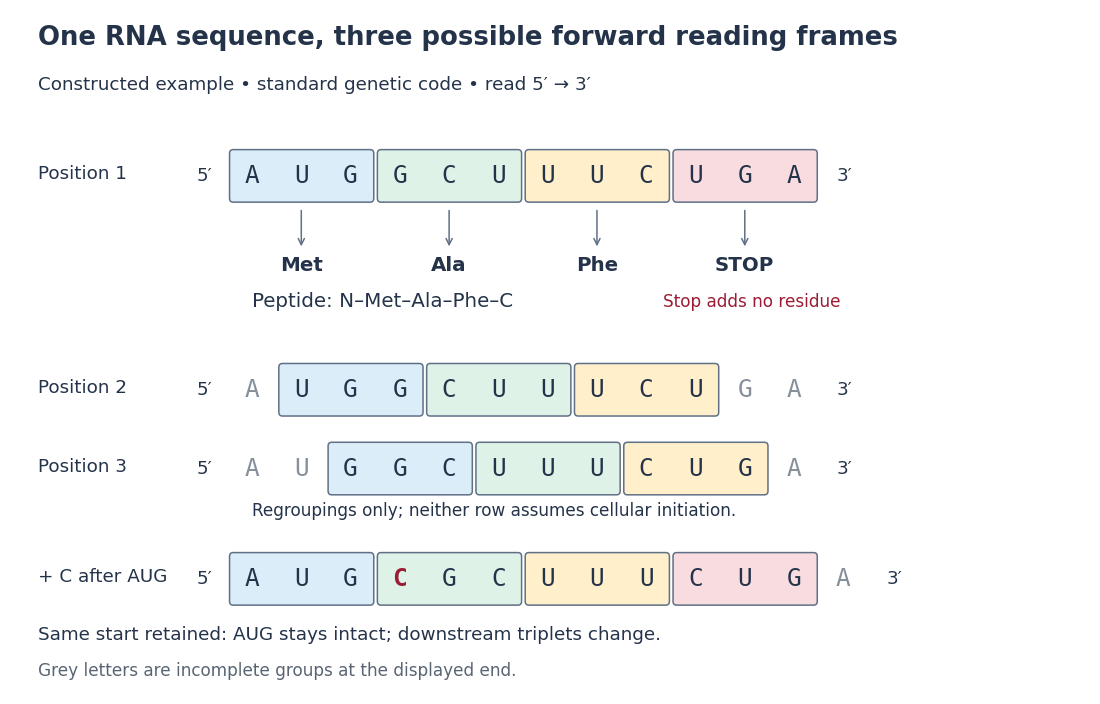
A reading frame specifies how consecutive nucleotides are grouped into codons. Starting at position 1 of AUGGCUUAA gives AUG / GCU / UAA; starting at position 2 gives UGG / CUU with AA left over. The letters are unchanged but the groups differ. A possible grouping alone does not establish an actual biological translation initiation site.
For the twelve-nucleotide example, number positions from the end. The three possible forward reading frames start at positions 1, 2 and 3:Parentheses enclose incomplete trailing groups. The second and third rows do not assert initiation of biological translation in a biological cell. A chosen start fixes which positions belong together; the ribosome then advances through consecutive codons rather than searching each three-letter window independently.
A codon is a three-nucleotide unit read in a specified reading frame during biological translation. For example, GCU specifies alanine in the standard genetic code. Its letters are read .
For an original example, choose the messenger RNA segment and stipulate initiation at the displayed AUG in a suitable eukaryotic context. Under the standard genetic code, its first three codons specify methionine, alanine and phenylalanine; the fourth is a stop codon. The resulting peptide before processing is N–methionine–alanine–phenylalanine–C. Twelve nucleotides therefore specify three amino acid residues and termination. The displayed segment omits the surrounding initiation signals; its nucleotide sequence alone is not a complete expression system.
A codon belongs to an oriented nucleotide sequence: GCU and UCG are different ordered triplets. Four possible nucleobases, adenine, cytosine, guanine and uracil, allow triplets because each position can be chosen independently when enumerating possible sequences. This is a counting argument, not a claim that nucleobases occur independently in real RNA. Sixty-one triplets are sense codons, meaning amino acid assignments, and UAA, UAG and UGA are stop codons in the standard genetic code.[ref]
Biology 2e by Mary Ann Clark and others. §15.1, The Genetic Code, Figure 15.4 and following paragraph: triplets and standard assignments
The useful unit is the ordered triplet together with its reading frame and genetic code, rather than three letters viewed in isolation. That combination lets DNA sequencing data support predictions about protein sequences after identifying the relevant messenger RNA. The Nirenberg and Matthaei experiment illustrates how the correspondence became experimentally accessible.
A generating set of a group from which no element can be deleted. This is inclusion-minimal, rather than necessarily having least cardinality. For finite p-groups, the Burnside basis theorem makes all such sets have the same size.
For the positive-shape generalized Pareto distribution with shape and scale , the expected Fisher information matrix for one observation isThe orthogonalization equation for two statistical parameters gives at fixed new nuisance coordinate. Thus is a global interest-respecting reparametrization. In coordinates , the information is diagonal with entries and .
Differential shear viscosity measures the incremental shear-stress response around a given positive base shear rate. It differs from the secant shear viscosity mu. A regular locally stable stress-to-rate inversion needs positive differential viscosity. Zero differential viscosity makes a first-order stress perturbation singular, and negative differential viscosity identifies a decreasing constitutive branch.
Binary probit regression sets , where is the standard normal distribution function. Its intercept score is a weighted sum of residuals, so an intercept does not generally force .
An offset is a known term in a generalized linear model's linear predictor, with coefficient fixed to one. With a log link and exposure , choosing gives a mean count . Its role differs from that of a fitted explanatory-variable coefficient.
For a Gamma distribution with fixed shape , choose dispersion , canonical parameter , and cumulant . The canonical link function is the displayed negative reciprocal; reversing its sign is an equivalent regression convention. For independent observations, the score function is and the Fisher information matrix is . The deviance is , with twice the log-likelihood ratio equal to this divided by . The fitted mean is the inverse link applied to , not itself.
Pinned article: Introduction to the OurBigBook Project
Welcome to the OurBigBook Project! Our goal is to create the perfect publishing platform for STEM subjects, and get university-level students to write the best free STEM tutorials ever.
Everyone is welcome to create an account and play with the site: ourbigbook.com/go/register. We belive that students themselves can write amazing tutorials, but teachers are welcome too. You can write about anything you want, it doesn't have to be STEM or even educational. Silly test content is very welcome and you won't be penalized in any way. Just keep it legal!
Intro to OurBigBook
. Source. We have two killer features:
- topics: topics group articles by different users with the same title, e.g. here is the topic for the "Fundamental Theorem of Calculus" ourbigbook.com/go/topic/fundamental-theorem-of-calculusArticles of different users are sorted by upvote within each article page. This feature is a bit like:
- a Wikipedia where each user can have their own version of each article
- a Q&A website like Stack Overflow, where multiple people can give their views on a given topic, and the best ones are sorted by upvote. Except you don't need to wait for someone to ask first, and any topic goes, no matter how narrow or broad
This feature makes it possible for readers to find better explanations of any topic created by other writers. And it allows writers to create an explanation in a place that readers might actually find it.
Figure 1. Screenshot of the "Derivative" topic page. View it live at: ourbigbook.com/go/topic/derivativeVideo 2. OurBigBook Web topics demo. Source. - local editing: you can store all your personal knowledge base content locally in a plaintext markup format that can be edited locally and published either:This way you can be sure that even if OurBigBook.com were to go down one day (which we have no plans to do as it is quite cheap to host!), your content will still be perfectly readable as a static site.
- to OurBigBook.com to get awesome multi-user features like topics and likes
- as HTML files to a static website, which you can host yourself for free on many external providers like GitHub Pages, and remain in full control

Figure 2. You can publish local OurBigBook lightweight markup files to either OurBigBook.com or as a static website.
Figure 3. Visual Studio Code extension installation.
Figure 5. . You can also edit articles on the Web editor without installing anything locally. Video 3. Edit locally and publish demo. Source. This shows editing OurBigBook Markup and publishing it using the Visual Studio Code extension. 
- Infinitely deep tables of contents:



All our software is open source and hosted at: github.com/ourbigbook/ourbigbook
Further documentation can be found at: docs.ourbigbook.com
Feel free to reach our to us for any help or suggestions: docs.ourbigbook.com/#contact