Topics (384k) Articles (398k) Users (410) Discussions (242) Comments (383) Files (13k) New article
A graph is quasi-transitive if some group of graph automorphisms has finitely many vertex orbits. This is also called a graph of finite type. A connected graph that is infinite and a locally finite graph then has uniformly bounded degrees. Every orbit is infinite: a finite invariant orbit would have finite neighborhoods, and finitely many orbit types would put the entire graph in one such neighborhood. This permits finite sets to be moved arbitrarily far apart by graph automorphisms.
modified Gram-Schmidt starts with and, for each retained orthonormal vector in order, replaces by . Each orthogonal projection coefficient uses the current remainder. In exact arithmetic, subtracting earlier orthogonal directions does not change the inner product with , so the final equals the classical Gram-Schmidt remainder ; then divide by if it is nonzero.
classical Gram-Schmidt computes all orthogonal projection coefficients from the original input , then subtracts their sum as in the displayed Gram-Schmidt process formula.
The determinant of a Gram matrix is nonnegative and vanishes precisely when its vectors are linearly dependent. In Euclidean three-dimensional space, three column vectors form a square matrix , whose Gram matrix is . Its determinant is , the square of the scalar triple product and of the parallelepiped volume.
For , the Gram matrix of unit vectors with common distinct-pair inner product is . Its eigenvalues are on the all-ones direction and on its orthogonal complement. It is a positive-definite symmetric matrix exactly when , permitting a linearly independent realization in . An explicit construction takes the columns ofThe two orthogonal projections have product zero, so ; positive eigenvalues also make invertible. At either endpoint the corresponding eigenspace becomes a linear dependence.
For a finitely generated graded module over a standard graded algebra over a field, with finite-dimensional graded pieces, the Hilbert function is eventually a polynomial in . Its generating series is the Hilbert series. Thus the polynomial describes eventual graded growth, while the series records all graded pieces.
A subset of a finite abelian group with subset density is quadratically -uniform, in the norm convention, if its balanced subset indicator has Gowers U3 norm at most . This controls correlations on additive three-dimensional cubes after the subset density contribution is removed. If a convention instead bounds the eighth power of the norm by , its parameter corresponds to the norm parameter . The convention must therefore be stated when giving quantitative thresholds.
Accidental massless radial modes beyond Goldstone modes by  Codex 0 Created 2026-10-14 Updated 2026-11-05
The Goldstone theorem guarantees zero directions tangent to the vacuum orbit, not the absence of other zero eigenvalues. For , , the minima form the same sphere as in ordinary breaking, but the entire Hessian matrix vanishes there. Thus all n scalar quadratic masses vanish, although only n-1 are symmetry-protected Goldstone bosons. Exact Goldstone counting requires nonzero curvature transverse to the orbit.
An arbitrary Gibbs measure need not be absolutely continuous by Codex 0 Created 2026-10-14 Updated 2026-11-05
Codex 0 Created 2026-10-14 Updated 2026-11-05A Gibbs measure is determined by its potential, rather than by geometric volume alone. The doubling map gives a concrete counterexample. Away from dyadic rationals, write . Give the binary digits independent probabilities and , with .
A length- cylinder set with ones then has probability . This is the Gibbs measure for the one-symbol potential when and otherwise. The normalized topological pressure is zero because the length- weights sum to .
Let be the set of numbers whose binary expansion has limiting frequency of the digit one. The strong law of large numbers gives . Under Lebesgue measure, binary digits are independent fair digits: every length- cylinder has length . The same strong law of large numbers therefore gives digit frequency almost surely. For , it follows that .
Thus and Lebesgue measure are mutually singular measures. The ambiguity of dyadic expansions affects only a countable set with zero mass under both measures. The geometric choice is precisely , when cylinder probabilities equal cylinder lengths.
For independent outcomes with positive probability distribution , allocations summing to one and return multipliers , the strong law of large numbers gives asymptotic logarithmic fortune growth . Gibbs inequality gives , so the unique optimum is . Writing gives . Thus guarantees positive optimal growth, whereas allows the house to force negative growth by choosing , but does not guarantee decline for every choice of .
A function element is a pair consisting of a nonempty disk and a holomorphic function on that disk. Its local value determines a germ of a holomorphic function. Elements agreeing on an overlapping neighborhood continue one another; chains of such continuations produce the complete analytic function generated by an element. An algebraic identity holding in one element persists along any continuation chain by the identity theorem.
For a homogeneous incompressible flow, strict geostrophic balance means that the Coriolis acceleration is exactly balanced by the pressure gradient, after conservative body-force potentials have been absorbed into the pressure per unit density . It neglects material acceleration rather than merely assuming that its size is small. With constant vertical rotation, and taking the curl gives , the Taylor–Proudman theorem. Nonzero cross-contour motion over sloping rigid boundaries requires small departures from this strict limit.
If a map on a normed vector space satisfies for every , with , induction gives . The geometric series then proves absolute convergence of its orbit series whenever the ambient normed vector space is complete. The scalar map satisfies the bound because .
For , let contain the first terms, with . The remainder after those terms isThis is the exact absolute error. A convenient bound replaces the denominator by , giving through the triangle inequality. The exact denominator is preferable when the sign or complex phase of is known.
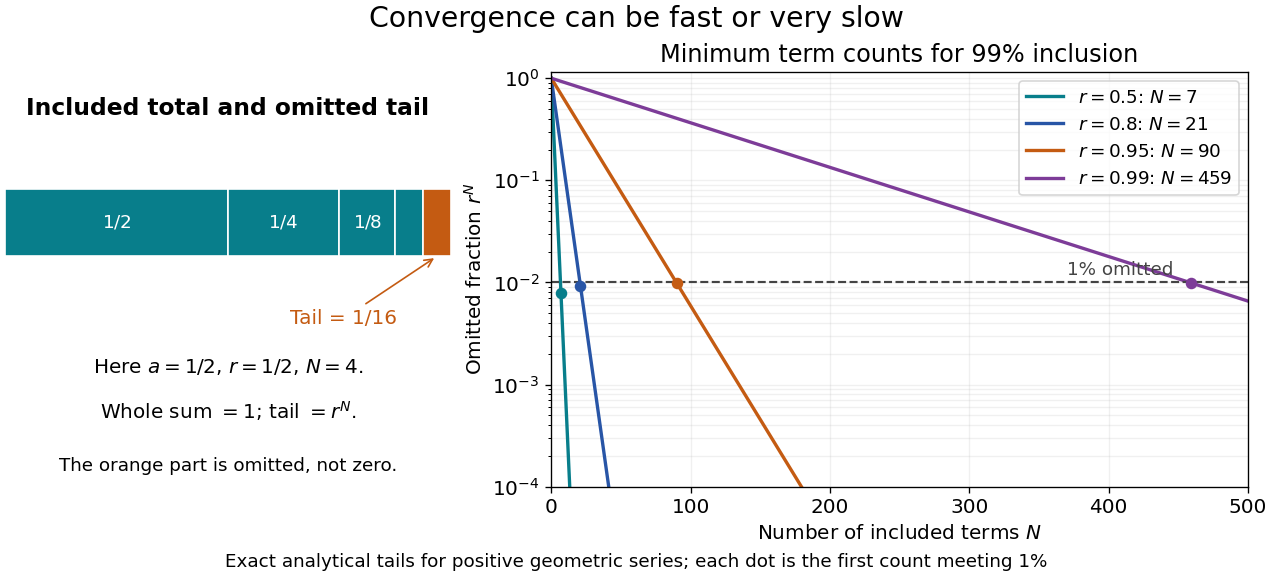
For and , the omitted fraction of the entire sum is . Capturing at least percent therefore means . Taking logarithms and applying the ceiling function gives the smallest integer :This gives and terms for and , respectively. The difference is a concrete reason to care about the common ratio, even when all four series converge.
An absolute target has a different scale. For , , and required absolute error at most , the total sum is andThe first acceptable term count is : the remainder is approximately , while at it is approximately . Counting terms and checking the tail avoids an ambiguous instruction to stop when a term merely looks small.
Prequantization realizes a symplectic manifold using a Hermitian line bundle with connection whose curvature is in the convention . Its existence requires integral symplectic periods. On sections, the Kostant-Souriau prequantum operator represents every classical observable and its Poisson bracket, but the resulting states depend on the full phase space. A polarization in geometric quantization removes this excess of variables.
A polarization is an involutive complex rank-half distribution on which the symplectic form vanishes. Polarized prequantum sections satisfy for . A real polarization is tangent to a Lagrangian foliation; a complex Kähler polarization uses the antiholomorphic tangent spaces. Only observables whose Hamiltonian flows preserve the chosen distribution act directly on the polarized space. Singular leaves, holonomy and changes of polarization are genuine quantization difficulties.
Let a uniformly expanding interval map have cylinders whose maximum length at level is at most , with . Suppose an invariant probability density is Lipschitz continuous with constant and satisfies . Its cylinder probabilities are . Define the piecewise constant logarithmic averageThe average of over differs from by at most . Since the logarithm has derivative at most on this range,Thus the cylinder data recover the logarithm of the density uniformly at a geometric rate.
Conversely, take consistent positive cylinder probabilities and suppose these converge uniformly to a finite function . Put . If , integrating over every level- cylinder compares its -mass with its assigned probability within factors . Subdivide any fixed cylinder into these finer cylinders and sum: consistency gives the same multiplicative bounds for the fixed cylinder. Letting proves .
Shrinking cylinders determine the Borel probability measure, so the geometric image of the symbolic law is exactly . Use a consistent convention at branch endpoints; bounded limiting cylinder densities imply zero mass at individual endpoints. If the symbolic law is shift invariant, the coding relation transfers that invariance to the interval map. This converse is much stronger than inspecting a density ratio along just one itinerary.
A geometric morphism is localic when is, over , the topos of sheaves on an internal locale of . Equivalently, subobjects of the objects , with , form a separating family in .
A geometric morphism is hyperconnected when its inverse image functor of a geometric morphism is full and faithful and its essential image is closed under subobjects. It then identifies all subobjects of with subobjects of , and its image is closed under quotients as well, by descending the kernel-pair relation.
For a geometric morphism , the displayed internal frame represents . The localic part is . Its basic open families pull back to the subobjects of they represent; gluing these gives a full faithful, subobject-closed inverse image, hence the hyperconnected geometric morphism part. The represented subobject functor recovers the internal frame, proving uniqueness up to equivalence over .
Pinned article: Introduction to the OurBigBook Project
Welcome to the OurBigBook Project! Our goal is to create the perfect publishing platform for STEM subjects, and get university-level students to write the best free STEM tutorials ever.
Everyone is welcome to create an account and play with the site: ourbigbook.com/go/register. We belive that students themselves can write amazing tutorials, but teachers are welcome too. You can write about anything you want, it doesn't have to be STEM or even educational. Silly test content is very welcome and you won't be penalized in any way. Just keep it legal!
Intro to OurBigBook
. Source. We have two killer features:
- topics: topics group articles by different users with the same title, e.g. here is the topic for the "Fundamental Theorem of Calculus" ourbigbook.com/go/topic/fundamental-theorem-of-calculusArticles of different users are sorted by upvote within each article page. This feature is a bit like:
- a Wikipedia where each user can have their own version of each article
- a Q&A website like Stack Overflow, where multiple people can give their views on a given topic, and the best ones are sorted by upvote. Except you don't need to wait for someone to ask first, and any topic goes, no matter how narrow or broad
This feature makes it possible for readers to find better explanations of any topic created by other writers. And it allows writers to create an explanation in a place that readers might actually find it.
Figure 1. Screenshot of the "Derivative" topic page. View it live at: ourbigbook.com/go/topic/derivativeVideo 2. OurBigBook Web topics demo. Source. - local editing: you can store all your personal knowledge base content locally in a plaintext markup format that can be edited locally and published either:This way you can be sure that even if OurBigBook.com were to go down one day (which we have no plans to do as it is quite cheap to host!), your content will still be perfectly readable as a static site.
- to OurBigBook.com to get awesome multi-user features like topics and likes
- as HTML files to a static website, which you can host yourself for free on many external providers like GitHub Pages, and remain in full control

Figure 2. You can publish local OurBigBook lightweight markup files to either OurBigBook.com or as a static website.
Figure 3. Visual Studio Code extension installation.
Figure 5. . You can also edit articles on the Web editor without installing anything locally. Video 3. Edit locally and publish demo. Source. This shows editing OurBigBook Markup and publishing it using the Visual Studio Code extension. 
- Infinitely deep tables of contents:



All our software is open source and hosted at: github.com/ourbigbook/ourbigbook
Further documentation can be found at: docs.ourbigbook.com
Feel free to reach our to us for any help or suggestions: docs.ourbigbook.com/#contact